October 26, 2026
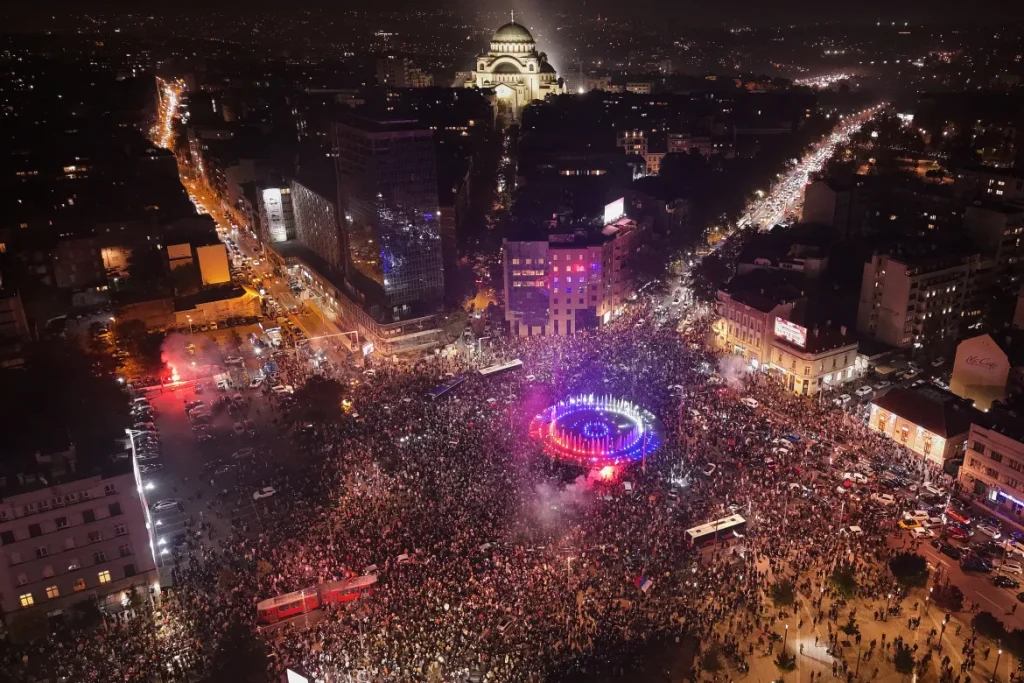
We’re writing to you from Belgrade the morning after. Not many of us slept, and judging by the streets, neither did the rest of the city.
On Sunday, 25 October, Serbia voted and the Student List won. Late that evening Aleksandar Vučić went on television and admitted he had lost. The final count isn’t in yet, but the result is not in doubt. The students’ list has more than half the vote and a majority in the 250-seat parliament.
For more than twenty years, our team at CANVAS has worked with activists from dozens of countries on one question: how do ordinary people defeat a government that looks unbeatable? This time the answer came from our own streets, again. We want to explain what happened, because movements elsewhere will try to learn from it, and we’d like them to learn the right lessons.
What fear did to us
You can’t understand Sunday without understanding the fourteen years before it.
Most people in Serbia learned to live with a low, constant fear. You assumed your phone wasn’t really yours. Amnesty International later confirmed what many suspected: spyware was being installed on the phones of activists and journalists, sometimes while they sat in a police station. If you spoke up, a tabloid might put your face on the front page the next morning, with a story about who was paying you. People lost jobs and contracts for being on the wrong side. Plenty stopped saying what they thought, even at the kitchen table.
We see this pattern in almost every country we work in. That kind of power doesn’t have to arrest everyone. It only needs everyone to believe they could be next.
How it started
On 1 November 2024, the concrete canopy at the Novi Sad railway station fell and killed sixteen people. The station had just been renovated. Everyone understood immediately what that meant.
Students refused to go back to classes; they blocked their universities, and the academic year was put on hold. Many observers abroad missed how important this was. A march lasts an afternoon. A blockade of the universities lasted for months and took a whole part of society out of normal life. In our field we call that noncooperation, and it is far more powerful than protest alone. Every regime depends on people showing up and doing what is expected of them. The students stopped.
They never hit back
For two years the students were arrested, followed, slandered and called foreign agents. Cars drove into crowds. People were beaten. The government gave them every excuse to fight back, and they didn’t.
At the huge gathering in Belgrade in March 2025, student marshals in yellow vests kept the crowd calm, and blue flares showed people the way out if things went wrong. None of that was improvised. We teach this in every training we run: nonviolent discipline doesn’t happen by itself. It is planned, practiced and repeated until it’s second nature. The students did exactly that.
Here is why it mattered so much. Violence was the one thing the regime wanted from them. A single burning car would have given the government its “terrorists” and sent the cautious middle class back indoors. Because the students stayed nonviolent, everyone could join. Grandmothers did. Farmers did. People who had never been to a protest in their lives did.
What it cost
People sometimes talk about nonviolent action as if it were the soft option. Anyone who watched these students over the past two years knows better.
They walked across Serbia, town to town, for days at a time, in freezing rain and in summer heat. They arrived with bloody socks and taped-up blisters, slept wherever someone offered a floor, and set off again in the morning. In village after village people stood by the road with bread, hot tea and blankets, and a lot of them were crying. Those marches reached places that no rally in Belgrade ever could, places the government thought it owned.
Their professors paid too. When faculties sided with their students, the government cut university salaries to a small fraction of what they had been. Some received nothing at all for months. The president went on television and said that instead of salaries, they would get potatoes. School teachers who backed the protests were punished the same way. These are people with children, mortgages and parents to look after, and they stayed with their students anyway.
A list with no politicians on it
Then the students did something we had not seen done quite like this anywhere.
They didn’t hand their momentum over to the opposition parties, and they didn’t run themselves. They wrote their own rules. No students on the list. Nobody from the ruling coalition. No officials from the opposition parties. No extremists.
For more than a year, over eighty student assemblies in six university cities proposed names, argued about them, interviewed people and vetoed the ones they didn’t trust. It was slow, messy and deeply democratic. We think that is exactly why it worked. Nobody could say it was cooked up in a back room.
What came out was a list of 250 people who were respected long before politics: professors and teachers, doctors, actors, artists, athletes. A cardiologist from Novi Sad was at the top. A former governor of the National Bank shared the list with one of the best basketball players this country has ever produced. Several opposition parties pulled their own lists and backed the students instead, which can’t have been easy for them.
Why disagreeing helped
The people on that list don’t agree about much. Some are on the left, some on the right, and some have never thought of themselves as political at all. The government’s media called that chaos.
We see it the other way round. Movements win by bringing huge numbers of people on board, and huge numbers of people never share one ideology. If the list had looked like one camp, it would have attracted one camp. Because it looked like Serbia, almost anyone could find someone on it they trusted.
What held it together was simple. Nobody wants another leader the whole country has to obey and adore. Nobody wants to live again in a place where a handful of people get rich off everyone else. The students put it on their posters in three words: “Serbia or Mafia.”
Healing from a cancer
The best way we can describe where Serbia is today is this: we’ve had the diagnosis, and treatment has just started.
For years the country lived with a cancer. Captured courts, captured media, public money flowing into private pockets, and fear as the normal background of life. It spread slowly into nearly every institution.
Sunday didn’t cure it. Sunday made treatment possible.
Anyone who has sat next to someone they love during chemotherapy knows what comes next. It takes a long time. It hurts. Some weeks the treatment feels worse than the illness. There will be setbacks and bad results, and people saying things were better before. The old networks won’t leave quietly, and some reforms will fail the first time they are tried.
But this cancer can be beaten. And the whole body has to heal, including the neighbours, relatives and colleagues who voted for the other side on Sunday. They aren’t the disease. They’re part of the country that has to get well.
What we ask of each of us
Serbia has just shown that nonviolent action still works when it’s planned, patient and carried by many hands. Now it has to show that a country can heal. We intend to be part of that work.
With hope, and a lot of work ahead,
The CANVAS team
Center for Applied Nonviolent Action and Strategies, Belgrade