Weekly Report: April 6 2018

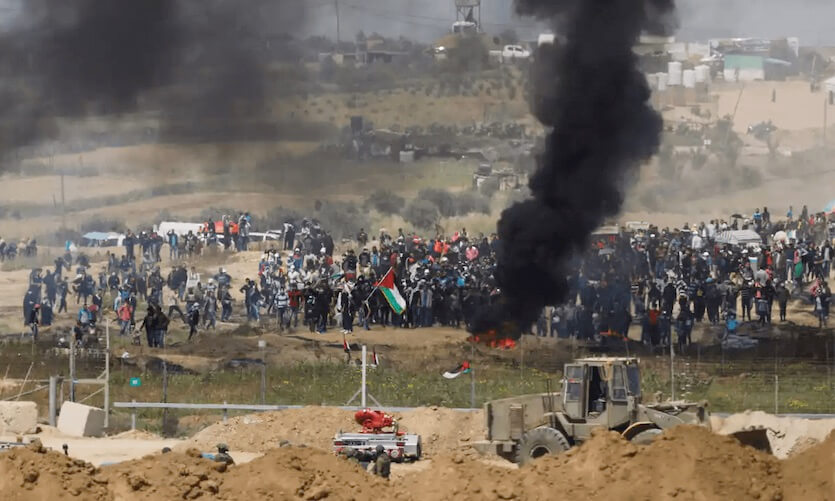
Photo: Smoke rises while Palestinians protest on the Gaza side of the border with Israel. Reuters.
Israel

This week has seen a surge in direct conflict between Israelis and Palestinians, who have come out to protest for rights to their homeland in “the Great March of Return”. Already, the week has brought at least 21 deaths, including at least one Palestinian killed by an Israeli air attack at the border. The protests will continue until ‘Nabka Day’ on May 15. The date will mark 70 years since the ethnic cleansing of 750,000 Palestinians by Zionist militias. Despite the violence being so actively committed against the Palestinians during these demonstrations, many have vowed to stay. Said one demonstrator, “We are here to deliver a message that we are resistant and we want to return to our land no matter what.” Last Friday, an estimated 1500 Palestinians were injured by Israeli snipers over the border. In advance of this Friday’s protest, protesters built large towers of tires to burn, hoping that the smoke will obscure the snipers’ view. Other Palestinians threw Molotov cocktails and stones over the border fence at Israeli soldiers. Israeli forces responded with tear gas and live fire, witnesses said, fearing the protesters would use the tire smoke as cover to try to breach the fence. Israel has accused Hamas of orchestrating the protest and border attacks, but both the March For Return organizers and a Hamas spokesperson deny that the march is for any escalation between Hamas and Israel, but rather for the people of Palestine. Hamas did urge its supporters to keep the protests peaceful, however, and to cover their faces, and maintains a strong presence in the camps and near the border. The United Nations has urged Israel to desist in their use of live ammunition against civilian protesters. Today 40 Palestinians are reported in critical condition, wounded by live fire and tear gas, and one man died this morning from gunshot wounds he sustained earlier in the week.

United States

Across the country this week, teachers went on strike to protest low wages, out-of-date classroom resources, and an overwhelming lack of government support for public education in the US. The states of West Virginia, Oklahoma, and Kentucky have seen some of the largest crowds come out to demand better, more reasonable conditions for themselves and their students. The demands go much further than wage increases. In Oklahoma, for example, the government has already agreed to raise annual salaries. Rather than settle for this partial consolation, however, the teachers will continue to demonstrate until higher education funding is promised. Although their numbers are now more than 300,000 strong, the governor of Oklahoma has belittled and expressed annoyance at the protests, comparing the distraught teachers to “teenagers who want a better car.” Nevertheless, the tremendous power teachers hold as a pillar of society gives their movement serious credence. Many also expect the momentum to spread to further states.

President Donald Trump began a push this week to further tighten immigration laws. His goals include the toughening of applications and approvals for asylum seekers, stripping protections for children who arrive alone illegally, and allowing families to be detained for longer periods while they await decisions about their status and possible deportation from immigration authorities. Earlier in the week, Trump had taken to twitter to declare that “DACA is dead” and “Republicans must go to Nuclear Option to pass tough laws NOW. NO MORE DACA DEAL!” His tirades, while not always followed by actualized legislation, appear to this time signal a worsening of conditions for those concerned.

Philippines

The Supreme Court ordered police forces to turn over reports on their actions during the war on drugs, against the government’s wishes to keep the bloody affair secret. Human rights groups have applauded this action, hopeful this will help expose abuses and accompanying cover-ups committed in the name of Duterete’s war on drugs. Over 4,000 people have been killed by police, often described as “vigilantes or rival gang members” by police who deny involvement with the murders.

The son of the former dictator Ferdinand Marcos lost an election for the vice presidency, and has demanded a recount, which has begun.

Duterte has called Myanmar’s treatment of Rohingya muslims “genocide” and has offered to accept the Muslim refugees. He also ordered that officials begin a ceasefire deal with communist rebels to resume peace talks.
South Africa

According to a new report published by the World Bank, South Africa is the most unequal country in the world. A total of 149 countries were analysed using the Gini Index. Inequality within the country has increased since the end of the apartheid, with high unemployment and poverty hitting exclusively black and coloured South Africans. More than half of the South African population is currently living below the national poverty line.

Thousands of supporters are expected to march to the Durban High Court on Thursday evening and Friday morning in support of former president Jacob Zuma, who is facing charges of corruption. Groups and religious organisations supporting former president Zuma argue that he has been targeted with political intentions. Zuma is planning to challenge the 16 charges involving fraud and money laundering during a 1990s arms deal. Such legal prosecutions rarely occur in South Africa, and protesters are expecting that outside attempts have been made to stage chaos during the protest with the objective of discrediting supporters of Zuma.
DRC

It has been revealed that opposition leader Moïse Katumbi held Italian citizenship for over 16 years, meaning he might not be eligible to run for presidency in the upcoming elections in December. According to Congo’s constitution, nationals are unable to hold dual citizenship, although this is also believed to be the case for several politicians in DRC.

The DRC’s foreign minister, Léonard She Okitundu, has announced that the country will not participate in the donor conference organised by the UN and the EU taking place in Geneva on April 13. Okitundu argues that the humanitarian community had exaggerated the crisis in some parts of the country, and said that the UN mission should leave the country in 2020. Okitundu also expressed that the DRC wants the UN mission MONUSCO to leave the country in 2020, a peacekeeping mission that the UN security council voted to extend the mandate to one year during last week. MONUSCO is the UN’s biggest peacekeeping force. The resolution, presented by France, emphasizes the mandate to protect civilians during the elections in December.

At has also been reported that journalist Eliezer Ntambwe, presenting on the privately owned news outlet and YouTube channel Tokomi Wapi , was arrested by Congolese police on April 2. Ntambwe was accused of defamation and extortion following an interview that accused governor of seizing a diamond from a miner with violence. Congolese journalists have since gathered in protest outside the prosecutor’s office.  
Zimbabwe

President Emmerson Mnangagwa met with Chinese President Xi Jinping in Beijing on April 3rd. The goal of the state visit was to deepen ties with China and is part of President Mnangagwa’s efforts in the search for foreign investment before the upcoming elections later this year. China has been an ally to Zimbabwe since the 1960s; their relationship has involved diamond exports and various infrastructure initiatives such as railways, roads and mines. The country has also provided arms and military training to Zimbabwe, and lately invested the Kariba South Power Station Extension Project. However, China has recently received critique for creating dependency relationship with African countries, and trade agreements involving the exchange of loans for natural resources. The official meeting is thus also a symbolic gesture responding to the critique expressed by the Trump administration.

The former Vice-President and opposition People’s Rainbow Coalition (PRC) presidential candidate, Joice Mujuru, pledged in their coalition’s election manifesto in that if if she wins the upcoming general elections, she will continue the search for Itai Dzamara, the human rights activist abducted in 2015. Mujuru also made promises that she will launch a war against corruption, establish a productive, gender and age sensitive cabinet, free access to primary education, and establish long term student loans. Mujuru served as deputy to former President Robert Mugabe for 10 years before she was expelled in 2015 due to corruption allegations.

Last week, Zimbabwe also celebrated their newly gained freedom of expression, when a mock play to publicly process the memory of the oppressive former president Robert Mugabe was performed in Harare. The theatre is replacing fear with laughter by ridiculing him and the former first lady Grace Mugabe, with scenes that would have led to arrests during his rule just a few months ago.
Mexico

Mexican politicians have united against Trump’s plan to deploy National Guard troops to the border until a wall is constructed. Sitting president Pena Nieto, the Mexican Senate, and presidential candidates Lopez Obrador and Anaya have set aside any political differences or ill-will to condemn Trump’s tactic. While the deployment is not expected to have much practical effect, since the guards are not to have weapons or immigration duties, politicians have called the move a populist intimidation tactic, and an insult to Mexicans. Lopez Obrador has declared the country will not accept the militarization of the border, while Anaya called for Mexico to limit its cooperation with the US on anti-terrorism until the Guard members are withdrawn. These statements come as a caravan of over 1000 migrants travel through Mexico, fleeing Central American violence. Hundreds of the members of the caravan have requested documents to stay in Mexico, while some others planned to make their way north to the United States.

In other news, Lopez Obrador holds an 18 point lead with 38% of the vote, according to Business Insider.
Myanmar

Social Welfare Minister Win Myat Aye hopes to visit Rohingya refugees in their camps when he visits Bangladesh this month. He will be the first to visit the Rohingya camps since hundreds of thousands began to flee the country in August. Win Myat Aye is in charge of overseeing the repatriation process, and says he wants to speak with the refugees to tell them that “we are ready to accept them back.” Rights groups still fear for the safety of any Rohingya repatriated to Myanmar, where many Rohingya villages have been razed and where they are still treated as stateless persons.

The Myanmar government has agreed to allow United Nations inspectors to monitor repatriation preparations in the country, a dramatic change from the government’s stance in past, which included repeatedly refusing to allow fact-finding missions. Officials plan to invite a delegation from the UN Security Council in approximately one month.

In other news, the Kachin Independence Army (KIA), an ethnic separatist militia, has advised civilians to leave Kachin State as KIA plans to launch an offensive on April 10. Unrelated, civil society organizations chastised Facebook for failing to properly limit hate speech in Myanmar, saying it often incites violence.
Venezuela

Members of the campaign team for the opposition candidate, Henri Falcon, were attacked. One member is under permanent observation in the hospital, having suffered a severe head wound. The attackers have been presented by media as supporters of Maduro, but the president has denounced them, saying any who attack in this way are not “chavistas”. Maduro announced that the government will not tolerate any violence in relation to the campaigns, and ordered an investigation into the attack. 17 people have been arrested so far.

Claudio Fermin, head of Henri Falcon’s campaign, has said the main opposition coalition, MUD, has agreed to support Henri Falcon in his bid for the presidency after weeks of insisting that it would abstain. He emphasizes that participation is the only way to ensure a peaceful transition.

Venezuelans abroad are angered after Maduro denies the tide of Venezuelans fleeing the country, saying the numbers are over-reported in an attempt to paint him in a bad light. He mocks those who have left, saying they must be cleaning toilets in the countries they have taken refuge in.

Venezuela’s exiled top prosecutor, Luisa Ortega, accused Maduro of “massive acts of corruption,” and presented her case to a symbolic court composed of exiled justices who presided over the case. Ortega presented the judges with her evidence, such as bank documents, immigration records and audio recordings. Maduro was assigned a public defender when he did not appear for this mock pre-trial hearing in Colombia. The court will decide if the case will continue to trial by April 9.

Other news:

Brazil – The Supreme Court of Brazil has ruled that former president Luiz Inácio Lula da Silva is to be imprisoned while he appeals a corruption investigation. Lula claims that this move is a politically motivated means to stop him for running for the presidency again in October. – BBC

Indonesia – Indonesia has declared a state of emergency when an oil spill caught fire and killed 5 fishermen. – Al Jazeera

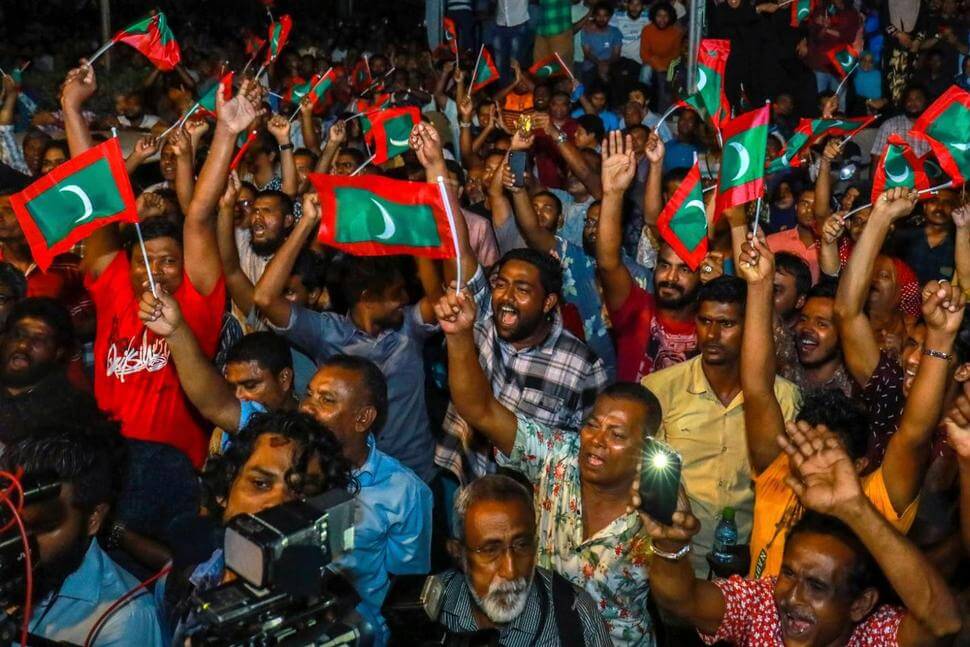
Maldives – Although the state of emergency has ended, the Maldives remains this week in an oppressive political crisis. 31 of the nation’s 45 opposition lawmakers are under arrest, two supreme court justices and a former president are in indefinite detention, another former president is in exile, and “many citizens remain in jail for exercising their fundamental rights.” – World Politics Review

Syria – One year after a deadly gas attack on Khan Sheikhoun, and even though the Syrian government publicly denies it, chemical weapons are still in use in the country. Over the course of the civil war, hundreds have been killed and many thousands affected by chemical weapons, although the international community generally continues to turn a blind eye. – Al Jazeera

Slovakia – Protests continue in the wake of the assassination of a journalist last month. Having already succeeded in calling for the resignation of the nation’s prime minister, this week’s 45,000 demonstrators are now after the chief of police, another elite individual at the center of their corruption concerns. – Reuters

South Korea – Former president Park Geun-hye has been found guilty of abuse of power, corruption, and coercion. She has been sentenced to 24 years in prison. Park had become the first South Korean president to be ousted when she was forced from power in March 2017. – BBC

Cambodia – Foreign election observers have been invited to oversee the elections this July, after the main opposition party was dissolved, positioning sitting Prime Minister Hun Sen to win again. – Reuters

Vietnam – Six human rights activists were sentenced to between seven and fifteen years in jail in the midst of a harsh crackdown on activists in the country. They were charged with affiliating with the Brotherhood for Democracy, a group of peaceful advocates accused by the state of trying to overthrow the government. – Washington Post | CNN

India’s Dalit Protest Dilution of Act Protecting Them Against Class Crimes

The Supreme Court in India ruled to dilute the protections laid out in the Scheduled Castes and Scheduled Tribes Act, sparking protest across the country. The deaths of 10 protesters followed, and political leaders called for peace. The government filed a petition to have the court review their ruling, and the fight for human rights continues.
Weekly Report: 30 March 2018

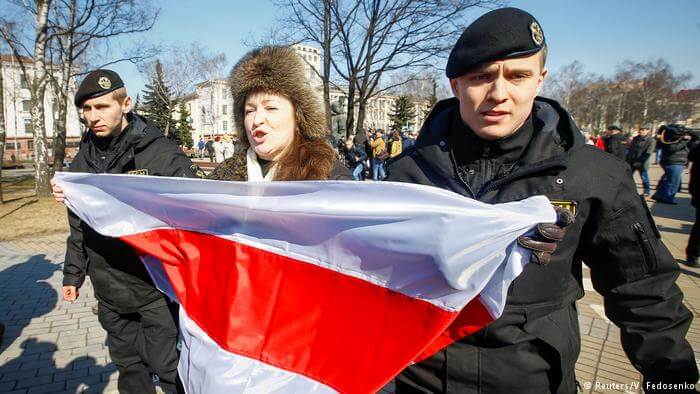
Photo: More than 70 pro-democracy protesters were arrested at a demonstration in Minsk, Belarus this week. V Fedosenko. Reuters.

Zimbabwe

President Mnangagwa was slammed by opposition groups this week after ruling out possible election reforms. The decision was announced after negotiations with the US this week, where Zimbabwe was given a set of conditions that, if met, would lead to the restoration of good trade relations between the countries. The move not to reform was one of these given conditions. Critics are furious over this development, citing the dire state of civic freedom in Zimbabwe at present. “Villagers are being commandeered and coerced to attend Zanu PF political rallies and other functions. No less than 5 000 soldiers in civilian attire have since been deployed into rural Zimbabwe to clandestinely campaign for the ruling party,” said Obert Gutu, spokesperson of the MDC.

Also this week, Mnangagwa is launching five anti-corruption courts around Zimbabwe. This is to combat the pervasive corruption in the country, which Transparency International’s Corruption Perceptions Index ranks extremely poorly, at 157 of 180 countries in the world. It’s also no coincidence that these courts are being launched right as Grace Mugabe faces game poaching and smuggling charges.

In other recent news from Zimbabwe, some activists in the village of Kadoma came up with a clever way to address the problem of potholes in their roads. They planted banana trees in the holes, an action that the government was definitely not pleased by. Like many creative and especially strategic protests, however, this had the exact intended effect, and the government moved quickly to fix the roads.

Venezuela

A fire was set in a police station in the city of Valencia, leading to the deaths of 68 people. Two of those killed were women who were visiting the station; the other 66 were inmates. The deaths were mostly a result of smoke asphyxiation, while others were of burns. The fire is believed to have been started by inmates attempting a prison break by setting their mattresses alight. According to a local opposition lawmaker, Juan Matheus, the detention center was holding three times its maximum capacity of 60 inmates. Venezuela’s head prosecutor assured the nation that a full investigation will be launched. Families of the inmates gathered outside the station, demanding answers about their loved ones. The crowd grew angry as officials refused to provide answers, even hours after the fire was extinguished, kicking riot shields, throwing stones, and leading the police to use tear gas to disperse the crowd.

This tragedy highlights the state of Venezuela’s atrocious prison system, one plagued with overcrowding and lawlessness. Over 230 current inmates are classified as political prisoners, and Human Rights Watch has reported that more than 6,600 people died in the country’s prisons between 1999 and 2015.

United States

Controversy erupted in the US this week over President Trump’s decision to add a question about citizenship to the national census. Opponents to this change immediately called it politically motivated, and at least twelve states have threatened to sue the Trump administration to block the change. The United States Constitution calls for an accurate census to be conducted every ten years that counts every individual living in the country, not just citizens, so that the results can be used to allot a wide range of government functions, including redistributing national representation and setting voting districts. The addition of a question about citizenship will discourage participation in the count, skewing these results. For the Trump administration, with its distinct war on aliens and immigrants raging, this could be the exact intended effect.

In this week’s update on chaos in the president’s cabinet, there has been one new replacement and innumerable bad decisions. President Trump moved to replace Veterans Affairs Secretary David J. Shulkin with his own personal physician. Dr. Ronny L. Jackson is now to be faced with the serious challenges of the department, including its completely insufficient personnel and infrastructure. Dr. Johnson will still need to be approved by the US legislature before officially taking on the position, and this process could be problematic due to his sheer lack of relevant experience. Meanwhile, Secretary of Housing and Urban Development Ben Carson worked this week to scale back protections for fair housing, and the EPA is planning to roll back pollution requirements for cars in the US.

International news from the US this week saw a tensing of relations between the US and Russia. In response to the Russian attack on former spy Sergei Skripal and his daughter in the UK earlier this month, Trump decided to expel 60 Russian officials from the US and to close the country’s consulate in Seattle. In retaliation, Russia expelled 60 US diplomats and closed the US consulate in St. Petersburg. Relations between the countries appear to be at their worst since the Cold War, presenting a serious concern to the international community.

Philippines

Vicky Tauli-Corpuz, a defender of indigenous rights and a special advisor to the UN on the subject, has been branded a terrorist by the government of the Philippines. This was officially over alleged connections to Maoist rebels in the country, with about 600 others also facing this terrorism charge. Tauli-Corpuz and many activists attest, however, that the label is merely a means for the government to target perceived political threats. In this case, the threat is the international attention that she has worked to draw to human rights violations by the government against indigenous peoples. An op-ed by Tauli-Corpuz for the Financial times warns that “You can keep shooting the messenger, but you will run out of bullets before we run out of messengers and, at the end of the day, the message will be heard.”  

Separately in the Philippines this week, the first public hearings by the Commission on Human Rights of the Philippines have begun into whether citizens’ human rights have been violated by fossil fuel companies. Testimonies at this trial so far have consisted of accounts of the tragic effects of climate disasters on livelihoods and ecosystems in the country. Many climate action groups see this trial as a huge and critical step for the environmental movement around the world. These hearings are expected to last a year.

Mexico

The landscape of candidates for the presidency has been relatively settled, but today the official campaigning begins. Concerns over fake news in the country are growing, and rumors of meddling by Russian agents are leading the National Electoral Institute (INE) to take steps to protect the country and its elections from foreign influence. The INE has signed deals with both Facebook and Twitter, and is expected to sign a third with Google. These deals are to limit the impact of bots and trolls, which digital experts warn are being used by political parties at higher rates than have been seen before in the country.  

Myanmar

Myanmar’s parliament officially elected Win Myint to the presidency, succeeding Htin Kyaw who retired last week. Myint has been a longtime Suu Kyi loyalist, and that is not expected to change. Some analysts fear that he will be unwilling to put the country’s interests first, before Suu Kyi’s or the military’s wishes, and that this will be a nominal change at best.

In other news, the defense lawyers for the two jailed Reuters journalists have filed a motion to dismiss their case. They say that there is not any legally sufficient evidence that could be presented against the reporters. One of the reporters, Wa Lone, petitioned the new president, asking for freedom of the press in Myanmar and saying that he and other imprisoned journalists were there to report the injustices happening in the country. The police and prosecution maintain that they were arrested for violating the Officials Secrets Act by possessing confidential state documents illegally.

Other News:

Syria – Russia has announced that the massive military offensive in Eastern Ghouta is almost over. Rebels have been cornered to just one town in the region, and tens of thousands of civilians have now been given safe passage out of the area. – Reuters

Egypt – President Abdel-Fattah al-Sisi is poised to stay on for a second term after the elections this week, with polls showing a victory of 92% from the 25 million votes counted so far. Many lament the backsliding, finding this election reminiscent of those that were taking place before the Arab Spring in 2011. – CNBC

Belarus – At least 70 people, but possibly many more, were arrested in Minsk for attempting to hold an opposition protest while attempting to hold a march. They had come out on the 100th anniversary of Belarus’ 1918 proclamation of independence from Russia to oppose Lukashenko’s authoritarian government. – ABC News

Honduras – Protests in the country continue against the re-election of President Hernandez and the continued detention of 26 political prisoners. Since these protests began in late January, hundreds of people have been arrested and at least 38 people have died. – teleSUR

Hungary – Recent numbers from Hungary have shown that a majority of voters want far-right Prime Minister Orban out of office. Their failure to unify the nation’s many opposition parties, however, effectively ensure that he and his party will maintain their huge majority of seats and power in the upcoming elections. – NYTimes

Guatemala – A judge in Boston has ordered that a Guatemalan man accused of war crimes and human rights violations be returned to his home country. He served as a paramilitary commander during Guatemala’s civil war, and the government claims he was involved in murders and other crimes against indigenous Mayans. – ABC News

Cambodia – Opposition members gathered in Phnom Penh this week, in a rare public demonstration since last year’s government crackdown. They came out on the 21st anniversary of a deadly grenade attack on an opposition rally that killed at least 16 people and left hundreds injured. – Reuters

New Malaysian Bill Against Fake News Isn’t Solving Any Problems

It’s no secret that in this modern age of fast and easy communication, fake news has become a serious threat to justice and democracy. Malaysia caught the world’s attention this week, however, after introducing a controversial bill that effectively worsens the very crisis it’s trying to solve.

Vietnam’s Own Lady Gaga Detained Post Album Promo

Singer and activist Mai Khoi Do Nguyen was detained upon returning from Europe, where she was promoting her most recent album titled “Dissent.” Her fame has so far kept her relatively safe from the harassment many Vietnamese activists experience. But, as the regime grows more comfortable exerting its power and the international community turns a blind eye to human rights violations, even those above the fray are subject to the whims of the government.

Weekly Report: 23 March 2018

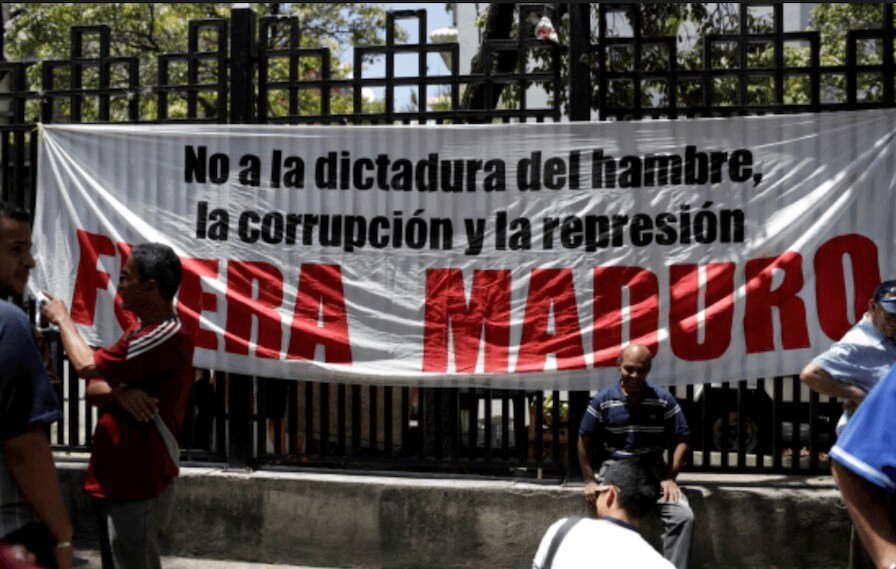
Photo: Venezuela opposition banner reading “No to the dictatorship of hunger, corruption, and repression. OUT MADURO”

Venezuela

Four Venezuelan officials have been blacklisted by the United States, part of a new set of targeted sanctions against the South American country’s government. The four were all players in Maduro’s political network, and each was connected to allegations of graft and corruption. Any assets within US jurisdiction will be frozen, and any Americans are forbidden from engaging in any financial transactions with the individuals. Also included in this expansion of sanctions was a ban on Venezuela’s cryptocurrency introduced last month by Maduro. US Treasury secretary Steven Mnuchin lambasted the currency as Maduro’s attempt to maneuver around previous sanctions. The sanctions did not include any restrictions on Venezuela’s oil sector, as the US worries targeting oil would only deeping the suffering of Venezuelan citizens. The Venezuelan government however, has no such reservations. This week an ex-oil refinery boss of the state-owned company PDVSA was arrested and accused of corruption. This arrest joins dozens of others as the government cracks down on the oil sector. The opposition has called the arrests nothing more than a power struggle within the government.

In other news, several protests across the country were held over the weekend against the May presidential elections. They were organized by the Broad Front for a Free Venezuela, made up of the opposition coalition MUD, leftist dissidents, and some civil society groups. Parliamentarian Delsa Solorzano says “The assemblies are a show of resistance against a regime that wants to deny us our rights. We have to salvage the right to vote freely.” Another protest, not coordinated by the Broad Front, took place on Thursday when frustrated citizens vandalized a statue of Chavez. They gathered in a town square in the early morning, burning tires over power cuts and unpredictable food supplies in the region.

Mexico

Mexican citizens can, for the first time, register to vote absentee while in the US for a presidential election. This has led to a flood of people trying to make registration appointments, and the Dallas consulate is overwhelmed by immigrants from Mexico trying to register before March 31 deadline. Originally, the consulate said it had reached its maximum number of appointment slots two full weeks before the deadline and was forced to book applicants into April, past the deadline. After an incensed response by the Mexican community in the area, the consulate has expanded its appointments by extending its hours and setting up temporary locations, nearly doubling the amount of appointments it can offer. Some Mexican citizens worry that the government failed to prepare itself for the increase registrations because many Mexicans in the US are expected to vote for Lo?pez Obrador, competition for the ruling party’s candidate Meade.

On that note, voter opinion polls show conflicting leads for Lo?pez Obrador, ranging from 5 percentage points to 18 points, with Anaya in second place in most polls and ruling party candidate Meade trailing in third. Following a discovery by the National Electoral Institute of falsified signatures from two independent candidates, only one independent remains in the race: right-wing politician Margarita Zavala. This, together with Anaya’s corruption scandal, could pull Anaya from second place and set Meade against Lo?pez Obrador.

Separately, Nieto’s presidency has reached the highest recording of violence against journalists— often committed by state officials, according to the human rights group Articulo 19. The numbers have reached 2,000 attacks and 41 murders during his six year term, representing a more than 200% increase from 2012.

Myanmar

Myanmar’s government is considering legislation that would allow greater oversight of work done by international bodies such as INGOs and UN missions. This has sparked concern that the country would crackdown more harshly on their activities, and is part of a trend by governments in Southeast Asia to limit civil society.

Myanmar’s civilian president Htin Kyaw has announced his resignation due to deteriorating health. He was a close friend of Aung San Suu Kyi and his role was more ceremonial, since Suu Kyi continues to function as the country’s de facto leader. He will be replaced by Win Myint, a longtime member of the ruling party and Aung San Suu Kyi loyalist, who was just elected to be the third Vice President. The new president will have little impact on the overall governance of the country and continue to act as nothing more than a figurehead. In the interim the more senior of the VP’s, the military’s appointment Myint Swe, will rule until parliament officially elects a new leader. Myint Swe is a retired general, and previously headed the military intelligence agency under the junta rule, and many in the civilian government’s ruling party are wary of what actions he may take during his brief time in office.

This Wednesday marked the 100th day since two Reuters reporters were arrested and accused of violating the Official Secrets Act, and the 11th time they appeared in court.

DRC

Government forces killed at least 47 people during protests in the DRC against Kabila last year. A UN report released this week called this an attempt by the government at “quashing dissent at all costs.” This crackdown on peaceful protesters threatens the prospect of peaceful elections, which are set to be held in April 2019. The date is already a much-delayed reschedule, coming after Kabila refused to step down from power in December. Meanwhile, Kabila denies that his security forces have used excessive force on the protesters. The UN report, on the other hand, details numerous accounts of the lethal force used and the force’s attempts to cover up the consequent human rights violations, including removal of victims’ bodies and preventing access to domestic or international observers.

Also this week, the UN Security Council humanitarian needs resulting from conflict in the DRC have doubled in the past year. They estimate that approximately 13 million people are affected, requiring humanitarian assistance, including 4.6 million acutely malnourished children. “We’re seeing mushrooming epidemics including the worst outbreak of cholera in 15 years. There’s also an epidemic of sexual violence — most of it unreported and unaddressed — and much of it against children.” The UNSC cited underfunding as the single biggest impediment to humanitarian response in the country.

USA

Trump has replaced his national security advisor Lt. Gen. H.R. McMaster with John Bolton, his third national security chief in 14 months. Bolton has been in Republican circles for decades, serving under Reagan and both Bush administrations. His track record is one of hawkish opinions and a willingness to intervene, and a diplomatic style described as abrasive. Bolton and Trump are on similar pages regarding Iran, and the country appears to be “heading toward a much more confrontational relationship with the Islamic Republic.” Their opinions diverge more on North Korea, with Bolton fully supportive of a pre-emptive strike against the Asian country. He has nonetheless stated that Trump’s scheduled diplomatic meeting with Kim Jong Un will not be within the “norms of traditional diplomacy” for which Bolton has expressed disdain.

Trump’s lawyer John Dowd resigned on Thursday, after Trump signaled his willingness to sit down with investigators, against Dowd’s advice. The team of lawyers handling this investigation is now populated more by TV personalities than by cautionary forces like Dowd, which will allow Trump to act how he wishes and “embrace a more aggressive posture” toward the inquiry.

Trump this week also announced plans to introduce tariffs up to US$60 billion on imports from China. China has retaliated with its own tariff proposal of 15% import tariffs on over 100 types of US products, like fruit, wine and steel pipes, worth US$977 million.

Other news:

Maldives – President Abdulla Yameen has finally lifted the 45-day state of emergency in the country. Earlier this week, security forces arrested former president Gayoom, two supreme court judges, and a top judicial administrator. They were all charged with terrorism. – Al Jazeera

South Africa –  Jacob Zuma is now to face 16 counts of corruption from the 1990s, after being forced by his party to resign from the presidency last month. –  BBC

Russia –  Vladimir Putin secured a fourth presidential term this week, winning the election by more than 75%. He received congratulations on his reelection from leaders of China, Saudi Arabia, Iran, Venezuela, Bolivia, Cuba, and later the US. –  CNBC

Nigeria –  Boko Haram has freed almost all of the 110 schoolgirls kidnapped last month. The information minister of Nigeria reported that no ransoms were paid, but rather that the release was achieved “through back-channel efforts and with the help of some friends of the country.” – Al Jazeera

Cambodia – Cambodia’s UN representative has rejected a statement by 45 countries calling for free and fair elections and criticizing the Cambodian government’s treatment of the main opposition party. “These backward steps include signs of escalating repression of the political opposition, civil society and media,” said the statement, but the Cambodian ambassador dismissed the concerns as being politically motivated. – Washington Post

Colombia – Activist Juan Mena was shot and killed while walking in public in Quibdo, Choco. He had recently returned to the area after fleeing death threats made against him. – TeleSUR

Bolivia – The police and coca growers clashed violently on Tuesday when the police barred the growers from a legal coca market. The growers responded with force, lighting sticks of dynamite and throwing stones at police cars. Officers used tear gas to disperse the rioters and took at least five people into custody. – LA Herald Tribune

Peru – President Kuczynski offered his resignation after videos allegedly showing his allies trying to buy off an opposition lawmaker were released. However, he has taken issue the wording of a congressional resolution to accept his resignation, and is threatening to remain, forcing congress to continue with a slow impeachment process. – ABCNew

Philippines – President Duterte has called for a mass withdrawal from the Rome Statute and the ICC. This is not expected to interfere with preliminary examinations of Duterte’s violent drug crackdown. Also, Chief Justice Maria Lourdes Sereno is in danger of being impeached by Congress, ostensibly for over 25 different reasons. Some, however, believe she is being removed for her outspoken criticism against the government’s war on drugs. – Reuters  | Economist

Syria – A remaining group of rebels in Eastern Ghouta have announced a ceasefire to begin talks with the Russian military to allow for the safety of civilians – BBC

Murder of Brazilian Activist Brings People Power out in Force

The recent murder of Brazilian human rights activist and Councilwoman Marielle Franco has deeply shaken the communities she advocated for. More than a thousand people have taken to the streets of Rio de Janeiro in protest of not only her killing, but also its suspicious and abhorrent context. By mourning her loss, their voices prove something important: She was not alone.

Farmers in India March For Six Days For Change In Agrarian System

Farmers in India are tired of a failing system and an unresponsive government. Over 45,000 people marched for six days until they reached Mumbai, where they were greeted by supportive community members, and presented their demands to state ministers. The government listened to their demands, and when the protestors returned home, they had promises of change on 100% of their demands.

Weekly Report: 16 March 2018

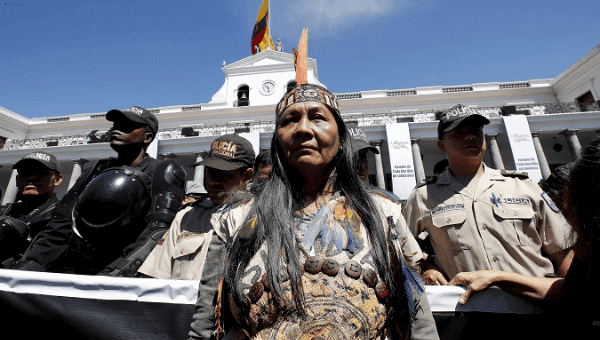
Photo: An indigenous woman protests Amazon land rights in front of the presidential palace of Ecuador. EFE.

Myanmar

Earlier this week, a UN official investigating the Rohingya crisis said that her observations are leading her to believe that this may amount to genocide. “I am becoming more convinced that the crimes committed following 9 October 2016 and 25 August 2017 bear the hallmarks of genocide and call in the strongest terms for accountability.” In her report, she further calls for a thorough, unbiased, and serious investigation into the crimes being committed against the Rohingya. Myanmar later issued a rejection of this UN statement. Top officials in the country denied that Myanmar or its military had committed any crimes against the Rohingya. This comes even after the army has, on rare occasions, admitted to killing some Rohingya people. Nevertheless, the government’s crimes against the minority are egregiously brutal and targeted, far beyond what they have acknowledged at all.

In another part of the country, approximately 2000 people were displaced by military forces this week. The Karen (alternately ‘Kayin’) State in southern Myanmar is home to another of the nation’s ethnic minorities. In 2012, the people here negotiated peace with the central government, in talks led by Aung San Suu Kyi. This invasion and displacement of the people endangers that ceasefire, risking a plunge back into one of the longest-running civil conflicts in the world.

Venezuela

Miguel Rodrigues Torres, ex-interior minister and former Chavez spy chief, was arrested March 12 for “involvement in actions against peace” according to a government statement and for “conspiring to destabilize the government.” The statement accused him of plotting a coup with discontented military officers and of working for US intelligence, supporting Maduro’s suspicions of US meddling, although no evidence has been offered.

Torres was close with Chavez, aiding his short-lived coup attempt in ‘92. Since then, Torres served for a time as Maduro’s interior minister, but after leaving the post has distanced himself from the unpopular president, expressing support for the opposition protests and even looking to run as a presidential candidate (though he was barred due to “administrative irregularities”). He was also accused of collaborating with Oscar Pe?rez, the bomb-dropping helicopter pilot who was shot and killed earlier this year by government forces. Torres denies this connection.

On another note, the Venezuelan opposition group Broad Front is calling for mass street protests against the “fraudulent” presidential elections scheduled for May. Broad Front spokesperson and parliament member Negal Morales claims the group is insisting upon nonviolent demonstrations, saying “We are not fostering … the possibility of a confrontation between civilian people and armed people” and that they are pushing only for civic dissent. The group is asking Venezuelans outside the country to set up protests in solidarity, wherever they may be. Broad Front additionally asked for “citizen assemblies” to be set up in each of the Venezuelan states. These assemblies would help coordinate the mass protests country-wide on Saturday, as well as form chapters for the coalition and record membership.

Venezuela is expected to ask the UN to send international observers for the upcoming election. Henri Falcon, an opposition candidate, will join the UN ambassador in his request, despite the main opposition’s fears that observers will only lend legitimacy to the elections.

Philippines

President Rodrigo Duterte announced that he is pulling the Philippines out of the International Criminal Court (ICC). He notified the UN Secretary General of this decision on Friday, along with a supposed assurance of the Philippines’ commitment to the rule of law. In the official letter submitting the decision, the Philippines called this move a “principled stand against those who politicize and weaponize human rights.” Duterte has notoriously been accused by the ICC of crimes against humanity, including the killings of thousands in his crusade against drugs. According to ICC protocol, the withdrawal will officially take effect in one year.

Earlier in the week, the Chief Justice of the Philippines has said that she will not resign, despite the impeachment complaints facing her. Lourdes Sereno has said that to quit would be easy, but that the people of the country deserve someone to fight for justice. Sereno is one of the few, and perhaps the most important, of those in government resisting Duterte’s war on drugs. She also famously opposed the president by voting against the martial law implemented on the island of Mindanao and against the decision to posthumously bestow full military honors on former dictator Ferdinand Marcos. Sereno maintains that she will fight for innocence of these current politically-motivated charges until the end.

USA

Turmoil hit the US government again this week with the firing of Secretary of State Rex Tillerson by President Donald Trump. Tillerson and Trump have long been known to disagree on foreign policy in critical areas, including the Iran nuclear deal, the Paris Climate accord, North Korea, and the “overall tone of U.S. diplomacy,” according to Trump in a recent statement. With such a wide range of policy disagreements in critical area, this firing does not come as a huge surprise. It is, however, seriously concerning to those both in the US and abroad. The timing comes right before the summit between Trump and North Korean leader Kim Jong Un, plunging the event into an even deeper level of uncertainty. In the tweet Tuesday that fired Tillerson, Trump also announced that current director of the CIA, Mike Pompeo, is to become the new US Secretary of State.

Tens of thousands of students nationwide walked out of their schools Wednesday to protest inadequate gun control in the US. This was the latest in a series of demonstrations by the ‘Mass Shooting Generation’ that was raised in a society where school shootings are treated just as an unfortunate fact of life. During this protest, many students marched outside their schools, holding powerful signs and demanding stricter gun control. Others held moments of silence, organized shows of solidarity, or used the opportunity to spread compassion among the student body, to let others know that they’re not alone.

Syria

Thursday saw the largest single day exodus of the war that has now plagued Syria for more than seven years. Between 10,000 and 15,000 people fled the Eastern Ghouta region that is currently heavily under siege. The battle over this area has already left more than 1,500 dead and more than 6,000 injured – numbers expected to rise until an effective ceasefire can finally be reached. Russia, although aware of the humanitarian tragedies playing out on the ground, has yet to propose or enact a plan that would effectively help the civilians affected. A report by Al Jazeera this week condemned the lack of food being allowed to enter the region. Approximately 25 trucks of food were permitted entry to the region, containing less than two days’ worth of food per family there.

Meanwhile in Afrin, another deadly offensive rages on. Here too, hundreds of families are fleeing for their safety. The Turkish attack has killed at least 20 people so far. Like in Eastern Ghouta, however, there does not seem to be a clear end to the violence in sight for this Kurdish city. Turkey has today dropped leaflets inviting surrender and “warning residents not to act as human shields for terrorists.” It remains yet unclear how the city will respond.

Other news:

Maldives – The EU Parliament put through a resolution this week to impose sanctions that target the Maldivian government, in response to its worsening political crisis. This is yet another sign of the mounting and increasingly widespread international pressure on the small island nation. – AVAS

Zimbabwe – In the first televised interview with Robert Mugabe since his ousting in November, the former leader declared that the rise of Mnangagwa was an unjust coup d’etat. “We must undo this disgrace which we have imposed on ourselves, we don’t deserve it… Zimbabwe doesn’t deserve it.” – The Guardian

Brazil – Councilwoman and prominent human rights advocate Marielle Franco was assassinated in Rio de Janeiro this week. She had been one of the most important and well-known defenders of civil and human rights in Brazil. – teleSUR

Cuba – Cubans took to the polls last weekend to elect a new government, ushering in the end of the Castro era. The planning for this transition is now underway. – Jamaica Observer

Ecuador – Dozens of Amazonian women have taken to protest a law that permits extraction and development of the rainforest by camping out in front of the presidential palace. They are demanding a meeting with President Lenin Moreno, to challenge him on this decision, which they call unlawful and short of international regulations. – teleSUR

Peru – The nation’s congress has begun impeachment proceedings against President Pedro Pablo Kuczynski. His charges involve a massive corruption scandal with the Brazilian construction company Odebrecht. The overwhelming number of lawmakers behind this measure give serious credence to the prospect that the impeachment will go through. – Washington Post

Mexico – A report released by the UN this week reveals human rights violations and cover-ups by the Mexican authorities in their investigation into the disappearance of 43 students in 2014. – Amnesty International

CANVAS News
Journalist’s Murder Sparks Protests and Progress in Slovakia

Two weeks ago, an investigative journalist was murdered. In the time since, tens of thousands of people have taken to streets across Slovakia, demanding justice, change, and a better, more democratic future.

“O, Canada, You’re on Native Land”

Kinder Morgan, North American energy infrastructure giant, wants to build a new pipeline through indigenous land, endangering the waterways and all those who live there. The people of First Nations are standing up and fighting back. Their resistance movement includes building Tiny Houses as an assertion of indigenous sovereignty and taking the struggle to the courts.

Weekly Report: 9 March 2018

Photo: Activists protest against government-backed amendments to Myanmar’s protest law in Yangon. (Reuters)

Myanmar

Between 200 and 500 demonstrators gathered in Yangon in protest on Monday while the parliament deliberated an amendment to the Peaceful Assembly and Peaceful Procession Law of 2010. This change  threatens three years in prison for those who support any demonstration that damages the “security, rule of law and stability of the state, and the moral interests of the people.” In particular, the amendment requires protest organizers to divulge the details of their budget, including their funding sources. Political analyst Maung Maung Soe says the amendment may be intended to target nationalist opposition members who “pay money to people to protest,” in order to destabilize the young government, but that it will nevertheless impact activists not influenced by these nationalist lobbyists. “It’s not possible to only restrict one side,” he warns. The protesters say the amendment would limit free speech; if the government hinders protest, it “cannot hear the true opinions of the people,” said farmers’ rights activist Zaw Yan. A reactionary petition to the amendment has been introduced, signed by around 190 Myanmar civil society organizations and individuals such as Maung Maung Soe. On the other hand, once champion of human rights and democracy Aung San Suu Kyi has supported the amendment. It passed in the Upper House on Wednesday, despite the protests of some MP’s who disapproved of the increased punitive measures, the speed with which the amendment was pushed through parliament, and the vague wording that could allow authorities to arrest peaceful protesters.

The US Holocaust Museum has rescinded Aung San Suu Kyi’s Elie Wiesel Award for human rights due to her continued silence over the human rights abuses committed by the Myanmar military regime against the Rohingya Muslim minority. The mounting abuses have been described as an ethnic cleansing by the UN and have driven around 700,000 people to flee Myanmar. Suu Kyi and her government have refused to work with UN investigators and blocked international media from areas where violence was reported.

An international coalition and the Watchlist on Children and Armed Conflict called on UN Secretary General Guterres to blacklist Myanmar for grievous violations of children’s rights. Watchlist’s report cites “numerous reports of the killing, burning and beating to death of Rohingya Muslim children by government forces.”

Venezuela

The opposition is once again calling for supporters to take to the streets in protest, asking for a March 17 demonstration against the presidential elections that it considers fraudulent and plans to boycott. Previously, the opposition had stopped calling for protests after a violent crackdown by the government resulted in more than 120 deaths. This protest will be the first major demonstration since last year.

The National Electoral Council announced the five candidates registered for the presidential race. Henri Falco?n and incumbent president Maduro are the two main contenders. The CNE also announced that citizens  had until mid March to register to vote.

Henri Falco?n  entered the presidential race after a break from the main opposition party. While they are of the opinion that his participation will add a “veneer of legitimacy” to the elections, Falco?n states that “Choosing to fight despite unfair rules does not legitimize the rules: It confirms our willingness to defend our rights,” and says the only way to topple a government is through popular uprisings. Voter opinion polls are conflicting. Falco?n references some that show him leading by 14 points against Maduro, who is struggling with hyperinflation, food shortages, and political turmoil. Another poll showed that only 17 percent of the population plans to vote, causing analysts to warn that this would nearly guarantee a win for Maduro. Falco?n maintains that participation is the only way to rid Venezuela of Maduro.

This Monday marked both the fifth year anniversary of Chavez’s death and the beginning of a summit featuring Latin American and Caribbean leaders. The leaders hailed Chavez’s legacy and denounced foreign intervention in Venezuela’s affairs, accusing the US and other states of violating Venezuela’s sovereignty.

USA

Donald Trump is set to be the first US President to hold a diplomatic meeting with the leadership of North Korea. He and Kim Jong-un have announced a meeting in May, with the news coming after successful talks between North and South Korean diplomatic delegations. Kim has further said that he is “committed to denuclearization,” generating both international skepticism and also a glimpse of hope for stabilization in the world order.

Steel and aluminum tariffs have been announced by President Trump despite bipartisan advice against them. Lawmakers domestically and internationally have warned the president against these measures, which they fear could incite a trade war with the country’s important allies. The EU has already announced the retaliatory tariffs that it plans to institute in response to the US decision, but EU Trade Commissioner Cecilia Malmström added to the news that she was “eager to avoid an escalation in the war of words between Washington and Brussels over tariffs.”

Syria

The ceasefire conceded by Russia recently continues to prove insufficient for the humanitarian aid urgently needed in Eastern Ghouta. Recent conflicting reports allege a chemical attack against in the territory, but in any case, violence unquestionably continues.

The UN this week reported that more than 1000 children have been killed or injured in Syria since just the beginning of this year. Another report from Reuters exposed a rise in the number and frequency of attacks on health facilities in the country. In the first two months of 2018, the number had already climbed to half of the total amount of attacks that took place last year.

Zimbabwe

Former president Mugabe has startled many this week by posing for a picture with the retired general who will head the opposition Zanu-PF party in the country’s approaching election. This seemed to be an endorsement of the modern party that he formerly led for almost 40 years. At a rally two days after the photo was published, normally-disciplined youth at a Zanu-PF rally shouted “down with Mugabe” in apparent opposition to the development and its implications. Beyond this outburst, many across the country have recently begun to fear a resurgence of the politician. They fear destabilization and the threat he could pose to President Mnangagwa, although most are unsure exactly how the risks would play out.

In a speech later this week, Mnangagwa attempted to reassure the people of both his power and also his visions of progress and good governance in the country. “My government will continue to ensure that there is policy clarity, certainty, cohesion consistency and will guard against policy overlap, information asymmetry, and policy reversals.” Many are nevertheless continuing to express their uncertainty for the future of Zimbabwe’s leadership.

Maldives

The ex-police chief of the Maldives has been arrested due to allegations of plotting to overthrow the ruling government. This development follows his firing in February, which occurred after he ordered the release of all the country’s political prisoners. That moved sparked the current bout of intense turmoil in the country, including the implementation of a state of emergency that is still in effect and the crackdown on protests in capital Malé. Many have been suppressed and taken as political prisoners. The UN Human Rights Council this week reprimanded the country over its unacceptable human rights situation under the state of emergency.

In other recent news regarding the Maldives, former president Mohamed Nasheed disclosed in an interview with Deutsche Welle that the nation’s current government is selling oil to North Korea. A ship was recently caught violating US sanctions against the rogue state. That ship was not only flying Maldivian flags, but was registered in the country and financed by the Bank of Maldives. This creates an incredibly complex situation for both the international community and the people of the Maldives, whose lives could be directly affected by the consequences of this action.  

Cuba

The Cuban people will vote on Sunday in elections that will decide 612 new members of the National Assembly of People’s Power and fill more than 12,000 local positions. Although the people do not directly elect their president, a new leader will also be decided in this process by the National Assembly. Raul Castro has announced that he will not seek another term in office, making this the first time in decades that Cuba will have a president outside the Castro family.  For many, this fact is a sign of hope, for others it is anxiety.

Not involved in the elections this time are any members of the country’s opposition alliance. Opposition leaders announced in November that they had failed to get any candidates through the first round of selection for the municipal positions up for election this weekend. Several hundred dissidents had sought nomination, and their failure across the board is blamed on repression by government authorities.

Honduras

The Honduran anti-corruption commission Maccih, backed by the Organization of American States (OAS), has expressed concern over proposed legislation that would alter the Seizure of Assets Law to protect those charged with corruption. In a tweet, Maccih said that the reform could give “privilege to public officials who are being charged with embezzling state funds.”

Two years ago, indigenous activist Berta Caceres was murdered after a decade-long fight against a dam project. This week, Roberto David Castillo, executive president of a hydroelectric company behind the development of the controversial dam, was arrested in connection with her death. He was accused of “providing logistics and other resources to one of the perpetrators already prosecuted for the crime,” according to Public Ministry spokesman Juri Mora. He is a former military intelligence officer of Honduras and the ninth arrest in this case so far. Last week, members of Caceres’s activist group gathered in front of prosecutors’ offices in the capital, demanding the arrests of the other officials they consider responsible.

Other news:

Italy – The results of national election Sunday divided the country between the north and south, but both regions brought victory to populist, anti-establishment, Eurosceptic parties that much now vie for government leadership. – BBC

Czech Republic – Thousands of people came out in protest Monday after the national parliament endorsed a new head of oversight of the Czech police. The chosen lawmaker is Zdenek Ondracek of the Communist party, a former member of a communist-era special police unit. – Reuters

Sri Lanka – A nationwide state of emergency has been imposed following the outbreak of violence between Muslim and Buddhist groups early this week. – AlJazeera

Ukraine – Ukrainian police have been accused of attacking and injuring multiple journalists covering protests in Kiev last week.  – KyivPost

Sierra Leone – A fair and free election was held in the country on Wednesday this week. While voting was conducted peacefully, vote counting and the results remain yet unclear. – AfricaNews

Poland – President Andrzej Duda apologized this week to Jews expelled from the country by the ruling communist authorities in 1968. This came as a surprise to many, in light of the nation’s recent controversial actions regarding its history and involvement in Jewish history. – BBC

Chile – In her final days in office, outgoing Chilean President Michelle Bachelet has announced that she will work with lawmakers to replace the “dictator-era constitution” with a modern rewrite including equal pay for men and women and the right to strike for workers in Chile. The move is largely symbolic, as it is almost impossible that such a change could go into effect by the end of her term Sunday. – Reuters

Mexico – Leftist presidential candidate Lopez Obrador pulls ahead of his competition by another point, at 35% of the popular vote and a 14 point lead, according to a poll completed last week. His competition, Anaya and Meade, is mired in accusations of corruption and both squabble for second place, dragging each other down. – Reuters

CANVAS’s News
World’s Longest-Jailed Journalist Freed in Uzbekistan, but Media Struggle Continues

The longest-jailed journalist in the world is finally free. After 19 years, Uzbekistan has released Yusuf Ruzimuradov. While many are celebrating this victory as a sign of progress, however, human rights organizations are focused on the long battle still ahead for achieving press freedom in the country.

A Look at the Failure of Aung San Suu Kyi

In 2012, Daw Aung San Suu Kyi was awarded the Elie Wiesel Award for human rights. Earlier this week, the honor was rescinded. How could it be that this leader, once among the most respected champions of human rights in history, has now so egregiously abandoned her virtues?

Take a look at the Guardian’s live feed of actions on International Women’s Day here.

Weekly Report: March 2 2018

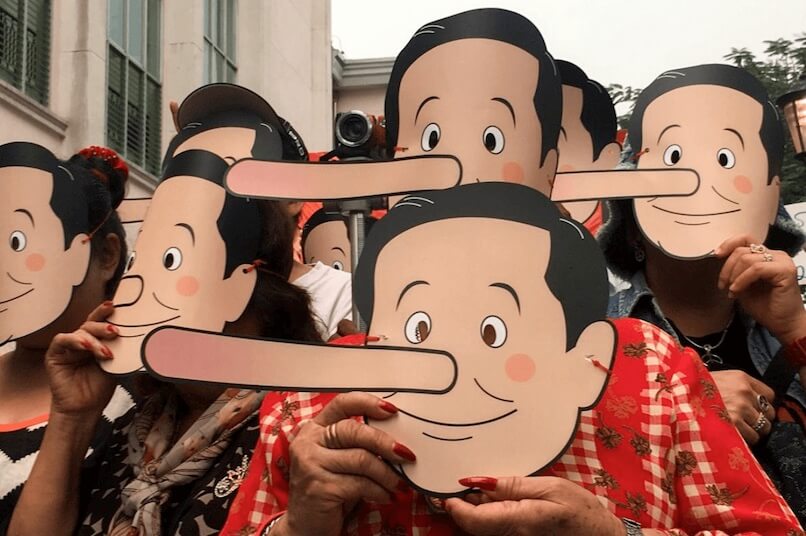
Photo: Protesters in Thailand hold up Pinocchio masks and call their former-military Prime Minister of a liar after he pushed back elections yet again (Reuters)

Venezuela

On Thursday, the presidential elections originally slated for April 22nd were pushed back a month to May 20. The deadline to register a candidate was extended to the afternoon of Friday, March 2. Despite the revised date, the main opposition coalition uphold to its decision to boycott the election, and have not submitted any candidates to the race, declaring the delay a “farce to legitimise a dictatorship.” Other minor opposition parties have decided to nevertheless participate, and several have put forward candidates. Henri Falcon on Tuesday announced his decision to run for president in defiance of the opposition, saying that he “operates independently of the opposition coalition,” who accuse him of trying to claim the spotlight.

The Venezuelan government has also said that it will allow international observers to oversee the election, however experts have said that “four to six months [are] needed to allow for international observers to do their work.” The United States and many of Venezuela’s neighbors have rejected the vote, and Peru has withdrawn Maduro’s invitation to the Lima group’s summit in mid April. A one-month delay in the elections does little to balance the heavy repression, hundreds of political prisoners, media censorship, and death. Instead, some suspect the move is a ploy to deceive observers into thinking that Maduro is complying with international pressures, with the actual goals of lightening sanctions and fracturing the opposition.

The May election will include only the presidential slate. The National Electoral Council (CNE) has rejected Maduro’s call for a “mega-election,” which would have held legislative, state, and municipal elections at the same time as the presidential election. The CNE President Tibisay Lucena stated that the country would be unable to prepare a range of elections in such a short time frame, but signaled that the parliamentary elections could be moved up and that the CNE will evaluate the dates. The parliamentary elections are planned for 2020.

Maldives

The Maldives is still under a State of Emergency. The country has stated that it will lift the emergency only when “threats posed to national security are nullified.” This comment was made in response to the European Union request that it be lifted at once. The nation is currently detaining not only protestors, but also international lawyers that have been sent to study the emergency on the ground. Amnesty International released a statement this week regarding the conditions in the country. “The Maldivian authorities must immediately and unconditionally release all people who have been arbitrarily detained under the state of emergency solely for exercising their human rights and halt attacks on peaceful protesters.” Opposition officials are seeking UN mediation in an attempt to bring about the end of this crisis, however at this time, the future remains fairly uncertain.

Honduras

During a visit by US Ambassador to the UN Nikki Haley, civil rights groups in Honduras decried the consolidation of power by President Hernandez and violence against protesters. Hernandez was reelected in November 2017, which was only made possible by a controversial 2015 Supreme Court ruling that modified a constitutional provision from the early 80’s, at the end of military rule. The Coalition Against Impunity in Honduras and the Center for Justice and International Law (CEJIL) explain the ruling as a result of Hernandez’s, and the ruling National Party’s, rising control over key institutions like national courts. This election was also shrouded in accusations of fraud, slow and biased counting of votes, and general opacity of the Supreme Electoral Tribunal, which “manipulated the system,” according to former Opposition Alliance candidate Nasralla. His supporters took to the streets and the situation rapidly deteriorated as protestors took up arms, stones, and homemade mortars, and the government met them with police, riot shields, tear gar, and some reported instances of firing live bullets.

Not easily quelled, the protests have run throughout the country over the last two months. This weekend, a “caravan of insurrection” took place in the east of capital Tegucigalpa; a procession of hundreds of vehicles assembled to oppose electoral fraud and demand that Hernandez step down. “This is a protest against the murders, the abuses and the electoral fraud,” said former Honduran President Manuel Zelaya, coordinator for the Opposition Alliance.

Civic groups and the UN have condemned the treatment of the protestors, citing CEJIL in its claims that over 190 demonstrations were repressed and 1,257 people detained. They report 38 deaths, 76 victims of torture, 393 wounded in protests, 105 displaced due to violence, 15 journalists attacked, and 73 people victims of threats because of the militarized response, and on Monday the Opposition Alliance accused the US and the Organization of American States of “becoming ‘a real present threat to the Honduran people’ for enabling the government to ‘kill’ and ‘persecute’.”

Rights advocates within Honduras have expressed dismay at the international community’s response to the country’s behaviour, calling the UN’s reaction tepid and criticizing the US decision to support Hernandez. Opposition supporters returned to the streets on Tuesday, protesting the US decision during Haley’s visit to the county. At least six people were wounded in clashes with the police. The demonstrations included the burning of tires and the carrying of coffins and crosses to represent the 38 people who died in the December and January protests. The police used tear gas to scatter the protestors.

In other news, Former First Lady Rosa Elena Bonilla de Lobo has been arrested on charges of graft, allegedly siphoning public funds for programs for the poor for her family’s personal use.

Mexico

A visit by President Enrique Peña Nieto to the White House has been cancelled after a “heated phone exchange with US President Donald Trump.” This is the second time a meeting between the two has been cancelled. Both cancellations resulted from comments by Trump about the border wall he hopes to construct between the countries.

The United States ambassador to Mexico, Roberta Jacobson, has said she will resign from her post in May, stating further that it was a very difficult decision and “all the more difficult because of [her] profound belief in the importance of the US-Mexico relationship.”

Presidential candidate Ricardo Anaya has been accused by opposition parties of corruption and money laundering. After his own party called for an investigation into the accusations, they also demanded he be barred from the race.

USA

The battle over gun control in the United States raged on this week. Teachers and students continue to protest across the country for tougher regulations against obtaining firearms, while proponents of gun ownership and the NRA continue to defend the easy access to ownership for Americans. There has been progress, with some states moving toward higher age limits, tougher background checks, and the introduction of a national bill to ban bump stocks. The private sector has also taken action, with US companies raising age limits and setting additional regulations on purchasers.

Jared Kushner, the President’s son in law, has had his personal security clearance downgraded this week. Until this development, he had been working with an interim security clearance while the FBI conducted a full background check. Now that this is completed, the portfolio and range of tasks taken on by Kushner is expected to shrink drastically; he will now be privileged to much less information. Serious concerns have also arisen over Kushner’s leveraging of his position. Reports this week came out detailing how Kushner’s private business received almost $200 million in loans after meeting with financial executives at the White house.

In other notable news, a top intelligence official revealed this week that the US Government has not ordered the National Security Agency to counter Russian influence in US elections. This is of serious concern in an international system where Russian meddling seems a pervasive and credible threat. Additionally, US Communications Director Hope Hicks has resigned after admitting that she has told lies in official capacities for President Trump. This resignation came the day after a nine-hour interrogation by the Special Counsel investigating Russian interference in the 2016 election.

Myanmar

Three Nobel Peace Prize laureates have demanded that Aung San Suu Kyi condemn the violence against Rohingya, or else face prosecution for genocide. Suu Kyi is “directly responsible for the crimes perpetrated against the Rohingya Muslims,” according to Ebadi, one of these three lauriates. The trio had visited Rohingya refugee camps in Southern Bangladesh as part of the Nobel Women’s Initiative, a mission to “witness the plight of Rohingya women in the squalid refugee camps.”

Myanmar has deployed troops to the border with Bangladesh in an “anti-terrorist operation.” Both the UN and Bangladesh have responded negatively, the UN concerned about the “military build-up” and Bangladesh summoning the Myanmar ambassador and insisting the military pull back their forces immediately.

Indonesia

The House of Representatives passed a new piece of legislation this week, allowing MPs to press charges against those who “undermine its honour or that of its members.” Media members and civil rights advocates worry this law will limit freedom of the press and expose journalists to litigation for simply doing their job, moreover reducing the accountability of politicians in Indonesia. This legislation was passed with little fanfare while the country was distracted by relatively controversial changes to the penal code. These changes will outlaw “extramarital and homosexual sex,” alarming the local LGBT population. Arsul Sani, a politician with the conservative Islamic United Development Party, said that these updates will bring the code “in line with the rest of the country’s “religious values’.”

Philippines

The Philippines’ top diplomat urged the United Nations not to “weaponize” human rights, encouraging it to send an impartial investigator to the country: just not Agnes Callamard, the special UN rapporteur on extrajudicial, summary or summary executions. The administration feels that Callamard has prejudged both the country as a whole and also its war on drugs, which is thought to have killed thousands in its first year, as she has in the past condemned the drug crackdown.

President Duterte has announced plans to step down from the presidency two years before the deadline at which his term would have otherwise expired.

Last weekend, the Philippines commemorated the 32nd anniversary of the People Power revolution that ousted dictator Marcos.

Cambodia

The ruling party has claimed all 58 seats in the country’s senate, which is of little surprise since the opposition party was dissolved last fall. The sweeping win illuminates the “faltering political health” of Cambodia and fortifies the power of the Cambodian People’s Party. The senate is elected not by the body politic directly, but rather by local level councilors. The senate will become a “rubber-stamp chamber” with very little of its own power, predicts Southeast Asia researcher Jonathan Sutton.

This concerns the international community; the US has announced cutbacks on aid programs and the EU is considering the withdrawal of trade preference from the country.

Syria

After intense and overwhelming pressure from innumerable foreign sources, Russia has finally agreed to a ceasefire in Ghouta, where fighting has killed more than 600 people in the past two weeks. This was intended to bring about an opportunity for humanitarian intervention, but by all accounts, it is completely inadequate. The violence has not sufficiently de-escalated and officials believe that the daily five-hour pauses in violence are not adequate time to administer much-needed aid and to allow civilians to escape the besieged area.

CANVAS’ News

EDSA Commemoration Reminds the Country and President of the Strength of the People – The Philippines commemorated the anniversary of the People Power Revolution of 1986. But it was not just celebration: many activists used the weekend to raise their voices against the actions of President Duterte. They called for the end of drug-war killings, martial law, and proposed changes to the constitution.

Other News

Colombia – Colombia’s ELN rebels will hold a four-day ceasefire during the elections this month, the group announced on Monday. This is out of respect for the voters, not a concession to the “corrupted electoral process,” the group clarified. The presidential candidate of Colombia’s demobilised FARC has been taken to hospital with chest pain. – teleSur | BBC

China – President Xi Jinping has moved to abolish Presidential term limits, in a move that has shocked and concerned many in China and across the globe. The country also made a curious move to suppress information by banning the letter ‘N’ online, in an attempt to quash dissent in the wake of the term limit announcement. – The Economist

Cuba – Protests this week by Cuban nationals around the world demanded the return of Guantánamo to Cuba. A Cuban diplomat tweeted: “#Guantánamo Is Ours: According to the Cuban Constitution, the Republic of #Cuba repudiates and considers illegal and null treaties, pacts or concessions concluded in conditions of inequality that ignore or diminish its sovereignty and territorial integrity … #USOutofGuantanamo.” – Mundo Obrero

Russia – In an annual address to his nation ahead of the approaching March 18 election, President Vladimir Putin promised to stoke the economy, vowed to halve the poverty rate, and boasted of new ICBMs that were impervious to US defenses. His reelection is, in any case, practically guaranteed. – Radio Free Europe

Italy – National elections are to be held Sunday, and many are deeply concerned about the widespread misinformation that has spread over social media in the runup. Most possible election outcomes give victory to a government that is more pro-Russian than many of its other, especially Western European, contemporaries. – NYTimes

Thailand – Although currently under military rule, the country is on track to hold elections next year. This was announced by the Prime Minister, who has although moved the predicted elections from November 2018 to Spring 2019. There is presently a ban on political campaigning, which had been instated after a former army chief seized power in 2014. This is expected to be lifted by August 2018 so that political parties can form and candidates can step forward. Lifting the ban, however, and holding the elections, have been pushed back multiple times. This delay has inspired around 300 activists to protest at Thammasat University, wearing Pinocchio masks and calling the military leader a liar. – Bloomberg | Reuters

Weekly Report: 23 February 2018

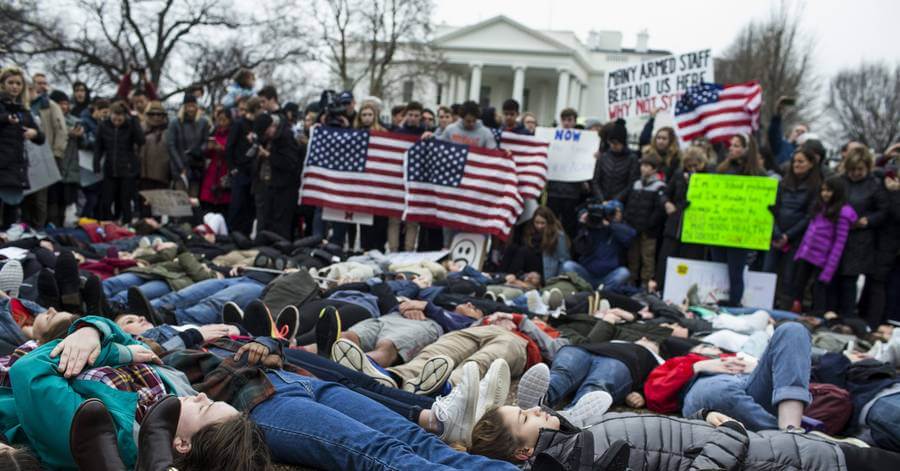
Photo: Students demonstrate in the US capital, using a lie-in to protest for stricter gun laws and honor the victims of school shootings.

Honduras

Juan Jiménez Mayor, leader of an anti-corruption panel in Honduras, has resigned as a result of “rising hostility from the Honduran government” toward him and his group of prosecutors. His resignation was accompanied by the resignations of the panel’s top prosecutor, Julio Arbizu, and of Chilean judge Daniel Urrutia.

The efforts to block the panel, which included threats, freezing proposed legislation to protect witnesses,  and stalling the enforcement of new campaign finance laws, are the “beginning of a political offensive against the fundamental pillars that are against corruption in Honduras,” says director of the National Anti-Corruption Council Gabriela Castellanos.

CANVAS’ News

Transparency international has released its annual Corruption Perceptions Index. This year’s report shows that the majority of countries are making little or no progress in ending corruption. The index found that New Zealand and Denmark rank highest, in other words least corrupt, while Syria, South Sudan and Somalia rank lowest.

The ‘Mass Shooting Generation’: Children, born after the Columbine attack in 1999, that have grown up in a world that treats gun violence at schools like an unfortunate fact of life. But now they’re growing up, finding their voices, and in light of recent incidents, they’re making themselves heard.

Mexico

The three main presidential candidates have formally accepted their nominations. For the first time in modern Mexican political history, three independent candidates from outside the traditional parties are ready to enter the competition too, pending ratification by electoral authorities.

Each party candidate held a rally in Mexico City this week, addressing key issues  including corruption and violence, the economy, and relations with the United States under President Trump. The LA Times covered their addresses. See a summary below.

Lopez Obrador, of the leftist MORENA party, proposed creating a federal public security department that would incorporate military and police forces, to address security issues in the country. This is Lo?pez Obrador’s third bid for the presidency, and he currently leads the polls. In a speech, Lo?pez Obrador, vowed to maintain a friendly realtionship with Washington, but calls the idea of a wall along the border unnecessary and in violation of human rights.

Ricardo Anaya of the Partido Acción Nacional (PAN) was sworn in as the candidate for a coalition between the conservative PAN and the left-leaning Partido Revolución Democrática (PRD). His main speaking points were violence and corruption, inequality, and poverty. Anaya proposed to grow the economy by boosting investment and progressively increasing the minimum wage, saying, “the best social policy is economic policy, and well-paid jobs.” Regarding the wall, he declared, “Mexico will not pay a single cent,” and insisted that, while relations with the US will remain friendly, he would not let Mexico be taken advantage of.

José Antonio Meade accepted the nomination by the Partido Revolucionario Institucional, the ruling party that dominated Mexican politics for most of the 20th century. He too spoke on corruption and violence. His more unique message was to promise to create a “national registry of the needs of every person,” which would include things like scholarships, medicines, and transportation.

USA

This week saw the US consumed by debate over gun control. This comes directly in the wake of the shooting at a Florida high school that left 17 dead and many more injured. Although many agree that something should be done to prevent further attacks of this nature, disputes over the exact course of action highlight a fissure in the country. Students and many democratic lawmakers are calling again for a ban on highly dangerous weapons. They want also more thorough background checks and stricter regulations about who can legally purchase guns. Gun proponents, as per usual, have accused these people of “hating freedom.” Republican lawmakers, including Florida State Senator Marco Rubio and US President Donald Trump, see the shooting as evidence that there are too few guns in use. Trump has suggested arming teachers in classrooms to dissuade attackers and rejected the idea of active shooter drills. Regardless of the president’s intentions, a poll this week found that two out of three Americans, a significant majority, support stricter gun legislation. The disparity between this popular opinion and the national legislation brings again into focus the non-democratic implications of the powerful gun lobby in the US.

In other news, Special Counsel Robert Mueller continues to move forward with his investigation into Russian interference in the US presidential election. Last Friday, he released an indictment against 13 Russians. It says these agents created false American identities on social media to “deepen racial and partisan divides and to stoke distrust in democracy.” More recently, Paul Manafort, President Trump’s former campaign chairman, has been charged with financial crimes that include money laundering. Campaign Deputy Rick Gates has also been charged, caught up in a complicated plot to leverage money from Manafort’s real estate. He is expected to plead guilty in cooperation with the counsel. CNN also reports that Mueller is investigating Jared Kushner’s efforts to secure foreign funding for his interests during the presidential transition.

Syria

More than 400 people have been killed by a government aerial offensive, backed by Russia, in Eastern Ghouta this week. The attack was launched on the rebel-held enclave on Sunday and has continued since. Human rights groups and the UN Special Envoy to Syria are pressing for an urgent ceasefire and immediate humanitarian access. They estimate that well over 2,000 people in the territory are injured, and the death toll is steadily climbing. Russia has so far rejected all agreements, stating the need for a ceasefire that would apply also to the Islamic State, Al Nusra, and additional rebel groups in the Ghouta region.

A ceasefire must be reached soon – each day of its delay worsens the humanitarian crisis in the region. Said Doctor Abu Yahia, “Our medical center was hit in four air raids yesterday, which caused significant damage to the facility and the services it offers…Hospitals across the entire city have been bombed.” Hospitals and support cannot continue at their present rate for much longer, especially not while being targeted. This has been one of the bloodiest weeks in the country’s long civil war.

In the north of Syria, militias loyal to Assad reclaimed Afrin. For about a month, Turkey has been conducting an assault on this Kurdish-held area, and although this is seen as a victory for Syria, the assaults have not ceased. Turkey had previously been promising to rebuild the city to be reinhabited, however this recent development serves as a harsh setback. It also complicated Turkey’s mission, which had been heavily influenced by the presence of the Kurds in Afrin as a perceived security threat to the Turkish border.

Myanmar

Rights groups in Myanmar report that the site of a mass grave in Rakhine state is being bulldozed, purportedly on government orders, flattened to “hide evidence.” This follows the report by the Associated Press that exposed other sites of massacres backed by witness reports and video documentation. Aerial photography showed other villages razed, suggesting that the government cleared not just the destroyed areas, but tracts that had until then stayed unaffected and intact as well.

Rohingya refugees continue to refuse to repatriate,  demanding that their civil rights be upheld and their homes be rebuilt before they return. As the government knocks down yet more houses, these demands seem far from being met. A government spokesperson stated the land being bulldozed was only “plain land” that the government was preparing for efforts to rebuild. Construction crews have erected new housing structures on some of the cleared areas, intending to provide housing for  Rohingya, according to a government administrator in Maungdaw. That does not appear to be the case for the majority of those built or planned so far, however, and many Rohingya fear authorities are seizing land they’ve lived on for generations. The UNHCR maintains its concerns that conditions in Rakhine state are not safe for voluntary return.

Rights groups have also urged authorities to release information about two ethnic Kachin civilians who were reportedly captured by soldiers in northern Myanmar.

Maldives

The ruling government has announced its readiness for a dialogue with the opposition, just one day after extending the national state of emergency. This controversial move is not likely to inspire progressive talks, as the emergency was extended in order to subdue the opposition protests in Male. The original emergency, imposed by President Yameen after the release of opponent political prisoners, was set to expire after 15 days. On day 14, the protests had yet to be quelled, so the emergency will now continue for another 30. The opposition has called this move illegal.

This island nation has lately become cause for international concern. The Ministry of Foreign Affairs of India has condemned the extension of the emergency in a public statement. “It is important to ensure that all democratic institutions are allowed to function in a fair and transparent manner in accordance with the Constitution,” stressing also a return to normalcy as soon as possible. The Maldives has nevertheless stressed its desire for India to stay out of the nation’s domestic affairs. “There is no doubt that the Maldives is experiencing one of the most difficult periods in its history. It is therefore important that friends and partners in the international community, including India, refrain from any actions that could hinder resolving the situation facing the country,” stated the foreign ministry.

International concern has also been raised over Chinese influence. Shortly after the state of emergency was imposed, eleven Chinese warships were deployed to the East Indian Ocean. China never confirmed that the ships were sent in response to the emergency, however they failed to indicate any other reason they might be there. Amid China’s other efforts to expand its influence in the region, however, this latest move concerns other countries in the region, giving them cause to keep vigilant.

Venezuela

President Maduro announced the presale of Venezuela’s new oil-backed cryptocurrency on Tuesday. As Venezuelans continue to struggle with runaway inflation, the government hopes this digital currency will provide an alternative for the collapsing bolivar. The price of the so-called ‘petro’ will be pegged to the price of a single barrel of Venezuelan crude oil. The government hopes that petro sales will help with the repayment of debts and allow investors to circumvent the sanctions imposed by the Trump administration. However, many potential investors harbor doubts and do not “trust the government to faithfully maintain the link” between the price of the petro and the price of oil. Furthermore, as the US considers imposing sanctions on Venezuelan oil, the petro’s backing looks less and less stable. Read the government reports on the petro proposal here.

On Wednesday, Maduro announced his intention to hold a “mega-election,” by adding legislative elections to the scheduled presidential elections in April. Originally, the legislative elections had been scheduled for 2020. The Washington Post has said could that this change could “obliterate the opposition-dominated legislature” by shortening their term by two years. This announcement also followed the opposition coalition’s refusal to nominate a candidate for the presidential election. In any case, the National Assembly, populated largely by opposition members, has been ineffectual since Maduro instated a Constituent Assembly. This extra body, with wide-ranging powers and filled with his supporters, has overpowered the national legislature. The April elections hold little hope for any opposition members to retain their positions, especially as major leaders of the coalition are barred from public office for the next decade, have fled the country, or are under house arrest. Maduro also plans to include municipal and state legislative councils in the April elections. An analyst who also served as a Venezuelan cabinet minister in the early 90’s, Moisés Naím, said Maduro was imitating Putin and Hussein in staging “virtually meaningless elections.” If the opposition boycotts the congressional elections as well, he could replace the only institution not under his control and command nearly every elected office in the state. The Lima Group has stated they will not recognize the results of the April presidential election.

Other News

Vietnam – A court in central Vietnam has sentenced an environmentalist blogger to 14 years in prison for “abusing his democratic freedom and opposing officials on duty.” Activist Hoang Binh led several protests against authorities over the handling of a major environmental disaster caused by a steel plant development in 2016. His sentence is one of the harshest to have been delivered to a peaceful activist in this country. – Reuters

Colombia – President Juan Manuel Santos is asking for international aid to handle the large number of immigrants fleeing Maduro’s regime in neighboring Venezuela. – NPR

Nigeria – Dozens of girls remain missing after Boko Haram militants attacked a school this week. A problematic combination of silence and conflicting reports from the government, regarding the status of the search and the girls’ recovery, are causing parents intense stress and grief. – NYTimes

Romania – Justice Minister Tudorel Toader has said publicly that he’s looking to replace the country’s top anti-corruption prosecutor. This seems to be a direct consequence of the large number of politicians from the ruling party convicted by the prosecutor and an attempt to ease future abuses of power. – Bloomberg

Israel – An investigation is underway, looking into whether Prime Minister Benjamin Netanyahu provided “official favors” to the largest telecom company in Israel in exchange for positive online news coverage. This comes on top of the separate bribery allegations already facing Netanyahu. – Economist

Poland – A drastic increase in logging activity in the Bialowieza Forest, one of the world’s last primeval forests, violates international law. The European Court of Justice is expected to take appropriate action, further increasing tension between European Union and this defiant member state. – NYTimes

Zimbabwe – The funeral for opposition leader Morgan Tsvangirai was held this week with more than 5,000 people in attendance. Those supporters, however, now find themselves in rival factions as the party attempts to move forward with different ideas about leadership and direction. Skirmishes broke out between the various groups at the funeral. – BBC | DW

Weekly Report: 16 February 2018

Photo: President Cyril Ramaphosa delivers his State of the Nation address at Parliament in Cape Town (Reuters)

Syria

It has been reiterated numerous times over the course of the week that the Syrian people alone are the only ones to determine the future of their country, reinforcing Syria’s sovereignty and reaffirming Syria’s commitment to the final statement of the Syrian National Dialogue Congress in Sochi.

Continuing aggressions by Turkey and Israel bombard Syria, causing countless injuries and claiming several civilian lives. The UN Secretary-General “has called for an immediate de-escalation in Syria after Israeli recent aggression on Syrian territories.”

In commemoration of the 36th anniversary of the open strike announced in 1982 against the Israeli occupation, authorities and their decision to annex Golan and impose the Israeli laws and “identity” on its Syrian citizens, locals of the occupied Syrian Golan gathered on Wednesday. “The Syrian people in the occupied Golan have always renewed their deep attachment to homeland and commitment to the Syrian identity, undaunted by repressive Israeli measures”.

Syrian Arab News Agency [SANA] (Continued Aggressions) | SANA (Call For Immediate De-Escalation) | SANA (Terrorism) | SANA (Syrian Golan)

USA

The United States was shaken this week by a devastating shooting at a Florida high school. A 19-year-old gunman killed 17 and injured an unknown number of people. This is the 239th school shooting since the attack on Sandy Hook Elementary School that killed 26 in 2012, but also the deadliest in this time frame. President Trump has called the shooter “mentally disturbed,” evoking the sentiment that the shooting is a result of poor mental health infrastructure in the United States. Many across the country see it rather as yet another consequence of insufficient gun regulations. The Florida shooter, despite a long history of dangerous and erratic behavioral issues, did pass his background check and purchase the gun he used legally.

In other US news this week, senators have rejected an immigration deal proposal that would have funded the wall and instituted strict limits on incoming migrants, but helped the ‘Dreamers’ whose fate has been recently under threat by the Trump administration. This leaves those hundreds of thousands of people, who have known no life other than that they’ve lead in the US, with uncertain futures. In other immigration-related news, on Thursday the 4th U.S. Circuit Court of Appeals ruled that President Trump’s ban on people traveling into the U.S. from six Muslim-majority countries is unconstitutional.

CNN | NYTimes

Venezuela

Candidates for the presidency will have to register online by February 26th for their position on the ballot to be confirmed March 5th. The opposition party has 9 days to make its final decision to whether or not their will abstain from the race.

The Lima Group, plus Canada, have criticized the government’s decision to hold elections without coming to an agreement with the opposition. The countries said the election “would not be free and fair as long as Venezuela has political prisoners, the opposition was not fully participating and Venezuelans abroad were not allowed to vote” and advised the government to reconsider their election calendar. Colombia stated they would not recognize the outcome of the elections.

The President of Venezuela has ordered the country’s consulate in Miami to be reopened before the elections in April. It had been closed in 2012 by Chavez. US Senator from Florida Marco Rubio, echoing Secretary of State Rex Tillerson’s earlier comments, tweeted about supporting a military coup in Venezuela. When the Associated Press contacted him, he emailed back “The Maduro regime is an illegitimate government which has brought suffering and misery to the people of Venezuela.” Thousands of people in Florida are from Venezuela, having fled crime, economic deprivation, and unrest under Maduro’s regime.

Brazil will declare a “state of social emergency” in Roraima, a northern border state. To control the flow of refugees from Venezuela, the government will boost funding and troops in the area, said Defense Minister Raul Jungmann on the 14th. Ten percent of the population of the Roraima’s capital are arrivals from Venezuela – about 40,000 people who are now straining public resources. Colombia is also struggling with Venezuelan immigration as thousands of people cross its borders.

Reuters | Business Insider | Washington Post | Brazil Government News

Cambodia

As Cambodia nears its July national elections, the ruling CPP continues to consolidate its power, moving the state  closer to single-party dominant rule. In addition to the le?se majeste?? law proposed last week that makes defamatory speech about the Cambodian monarchy illegal, five other amendments were passed, each impacting the freedom of citizens or limitating the potentional power of any opposition groups. These amendments to the Cambodian constitution included new restrictions on voting rights, authority by the government “to take action against political parties if they do not ‘place the country and nation’s interest first’,” and an instruction that Cambodia is not to interfere in “internal affairs of other countries since it opposes foreign interference in its own affairs.” This last amendment seems to target the CNRP, the largely dismantled opposition party, which has consistently appealed to the international community to pressure the government toward free and fair elections. Prime Minister Hun Sen pivots, from picking away at his opposition, now fragmented and mostly in exile, to entrenching his position through legislation.

At the same time, Cambodia’s economy is flourishing. Tourism, largely from China, fuels the economy along with low-cost manufacturing for the rest of the world. Cambodia is edging towards China’s position of key manufacturer in the global market as China’s wages rise and firms look for new locations from which to source their products. Some firms may however be attempting to pressure the Cambodian government as Walmart did, to respect its civil society.

The Cambodian National Council for Women signed its annual report this week. The report congratulates the government on its efforts to elevate gender equality in society, highlighting examples like the issuance of land titles to “poor women and widows” and an increase in female civil servants. Women’s rights activists, however, doubt the validity of the achievements. They point out that the increase in female civil servants was barely significant, with just one percent growth, and more than half were at lower level and municipal positions: never at any decision-making level. Nominations for the seats claimed from the recently-dissolved opposition party being almost exclusively men, “female representation at the national level has actually dropped.” Thida Khus, executive director of women’s rights NGO Silaka, declared that efforts towards gender equality have “come to a standstill” due to the political tension in the country. She hopes attention will return to the issue after the July elections.

Human Rights Watch | CNBC | Phnom Penh Post

Bolivia

The Carnival of Oruro: Cultural Heritage of Humanity in Bolivia commenced on February 9th. Traditionally, it is a 10-day celebration that honors Bolivia’s indigenous history and Christian symbols in a display of cultural syncretism. It is considered one of the world’s most important celebrations and one of the largest in South America.

The first day of the Carnival saw a gas explosion and a traffic accident. A series of further explosions, in this case deliberate, took place over the course of the Carnival. This has led President Morales to call for exhaustive investigations of the explosions that have claimed over 40 lives and injured over 120 civilians. One of the attacks was labeled a “fatal homemade Carnival Bomb.” ‘A Criminal Attack’,” as the deadly device consisted of ammonium nitrate, dynamite, and explosive oils. This is not the first year that Carnival has claimed innocent lives, leaving concern and sadness lingering amongst the Bolivian people as tragedy strikes once more.

Bolivia Without Violence launched a campaign called “Carnival without excess, without violence,” which aims to reduce “crime during the annual celebrations and [encourage] men to treat women and girls with respect.” Bolivia is also raising awareness of the Law to Guarantee Women a Life Free From Violence, which, according to the UN, has yet to reduce femicide. Statistics have shown that over 100 women arehave been murdered yearly in Bolivia. The campaign consists of private, public, and international organizations, including UN Women and local municipal governments that, who distribute thousands of leaflets, install billboards, establish emergency hotlines, and broadcast educational videos.

History recalls several decades of Bolivia “fighting to reclaim its coastal territory from Chile, which it lost in the 1897 War of the Pacific,” leaving the country landlocked. March 23rd marks the yearly celebrations Bolivia holds to celebrate the Day of the Sea, a national holiday marking the loss of its territories to Chilean forces. President Morales has announced a mass mobilization to commemorate the centennial of the maritime claim against Chile, in which nationwide ceremonies will be held as a “show of unity of the Bolivian people around the maritime demand.”

teleSUR (Anti-Violence Carnival Campaigns) | teleSUR (Explosion Investigations) | teleSUR (Fatal Homemade Carnival Bomb) | teleSUR (Social Movements)

Mexico

In light of intensifying criminal activity throughout the country, Mexican federal intelligence agents have been assigned to tail presidential candidates: notably PAN candidate Anaya, an opponent to ruling PRI’s candidate Meade. Interior Secretary Alfonso Navarrete said that Anaya was supposed to have been informed of the security detail and insisted that the tail was for security reasons only– not, as Anaya wrote, in order to spy on the opposition. The agents had been assigned to tail Anaya through his tour of the Veracruz state, where cartel-related violence is common. The detail was to simply “report any mishap” that may occur on the campaign trail as part of a “protocol in which [they] analyze security issues in the states.” Critics have claimed this use of agents and resources is “wasteful,” particularly as the country struggles to conduct successful and effective intelligence operations against its main security threat: drug cartels.

An indigenous woman named Maria de Jesus Patricio, or “Marichuy,” is running as an independent candidate in the presidential race. This week, she was injured and one member of her team was killed in a car accident. The candidate previously served as the spokesperson for the political arm of the Zapatista National Liberation Army, the National Indigenous Congress. Patricio has not collected enough signatures to enroll officially as an independent candidate, let alone win the presidency. However, her presence in the political field helps to draw attention to the poor, the indigenous, the most marginalized in the country, and their struggles in civil participation.

Polls continue to show left-wing presidential candidate Lo?pez Obrador in the lead with 33 percent of support, although Anaya, candidate for the left-right coalition called “For Mexico in Front,” has been catching up, now only 8 points behind with 25 percent. Jose Antonio Meade of the ruling PRI trails behind still, with one poll showing a decrease from 17 percent to 14 percent.

Associated Press | US News | Reuters

Other News

South Africa – Jacob Zuma, former President of South Africa, “announced on Wednesday evening that, although he does not agree with his decision, he will resign as president of the republic effective immediately”. – news24 | DW

Zimbabwe – Morgan Tsvangirai, former prime minister and leader of Zimbabwe’s largest opposition party, has died. The future of his party and its leadership remains uncertain. – NYTimes

Ethiopia – Prime Minister Hailemariam Desalegn resigned after deadly unrest pushed his government to release several high-profile political prisoners. – NYTimes

Maldives – The alliance of Opposition parties in the Maldives has appealed to UN Secretary-General Antonio Guterres to mediate all-party talks to resolve political turmoil in the country. – First Post

Myanmar – This week, Bangladesh authorities passed a list of 8,032 names of Rohingya refugees to be repatriated to Myanmar. This is despite the fact that the U.N. announced the conditions in Myanmar are unacceptable for voluntary return, given that Myanmar hasn’t addressed the Rohingya’s exclusion and denial of rights in Myanmar, and the outflow of refugees from Myanmar continues. – NYTimes | Washington Post

Weekly Report: 09 February 2018

Photo: “Thousands of citizens took to the streets of Afrin [Syria] to denounce the Turkish aggression on their city.” (Syrian Arab News Agency)

Democratic Republic of Congo

This week, the Congolese government has ordered former colonizer Belgium to close its consulate and cut off flights from Brussels. This came as a result of worsening relations between the two nations since the Belgian government terminated all cooperation on projects in the former Central African colony over human rights and security concerns. However, “the Belgian government has redirected €25m allocated for such projects to non-government organizations working on humanitarian aid in the country.”

Ethnic violence between the Hema and Lendu has erupted in northeastern DRC, taking the lives of more than 24 people and leaving hundreds of homes burned to the ground. Meanwhile, the US has slapped sanctions on Congolese General Muhindo Akili Mundos and rebel leaders Gedeon Kyungu Mutanga, Guidon Shimiray Mwissa, and Lucien Nzabamwita for “contributing to widespread poverty, chronic food insecurity, and population displacement”. These are the same four men that the UN Security Council sanctioned last week for human rights violations.

As conflicts persist in the DRC, rampant militia groups “have recruited at least 585 children for use as fighters or human shields in the war afflicting in Kasai regions.” In addition to the recruitment, humanitarian organizations disclosed that at least 120 children have been abducted and abused and another 350 have lost track of their families, classifying them as unaccompanied.

Consequently, over 8,000 Congolese have fled to neighboring countries Burundi and Tanzania over the past week, following military operations to rid eastern DRC of the various militia groups. Moreover, many refugees are displaced, and many NGOs report that the number of refugees fleeing is an understatement of the crisis.

As President Joseph Kabila still refuses to step down after his mandate ended in December 2016, elections meant to replace him continue to be repeatedly delayed. Since the DRC’s constitution does not allow the president to seek a third consecutive term in office, this has led to speculation of his unwillingness to give up power. Thus it has been stated that President Kabila “intends to respect the constitution and relinquish power after elections scheduled for December” of this year.

Independent
Voice of America (Ethnic Violence)
CAJ News Africa (Child Soldiers)
CAJ News Africa (Refugees)
Voice of America (President Kabila)

Zimbabwe

Power struggles have broken out within Zimbabwe’s main opposition party. This follows the news that opposition leader Tsvangirai will leave the country to seek medical treatment for colon cancer in South Africa. The details and severity of his illness are unclear, with a huge disparity between reassurance from him that he is recovering and reports from major media outlets that call him “critically ill.” In any case, Tsvangirai’s departure from the country is itself a huge destabilizing force for his party. To make it worse, the election is mere months away, and the negative prospects for the opposition are seriously exacerbated by the disarray of the leadership structure in his absence. Tsvangirai has three deputies, of which one, Nelson Chamisa, was appointed to serve as the interim leader until his return. Others in the party are disputing this decision. Many feel that deputy Elias Mudzuri, who was the acting leader before this recent announcement, should continue to hold the position. Still others believe that the temporary leader should be the third deputy, Thokozani Khupe. The infighting bodes very poorly for the upcoming election. An opposition alliance had already endorsed Tsvangirai in the upcoming election against Mnangagwa, but further endorsement of any of the replacements seems rather unlikely while the party is in disarray. All of this helps Mnangagwa, whose ultimate goal is to stay in power.

In other election-related developments, many have begun to speculate that Mugabe is forming a new political party, “The New Patriotic Front”, with other members of his ousted regime. The party declares that the November coup was illegal and calls on the military to reinstate Mugabe as leader of Zimbabwe. This development is still in its early stages, but could eventually come to have very serious consequences for the country and its upcoming elections.

On Wednesday, Zimbabwean leaders and civil society organizations called on Mnangagwa to end the political violence that has been rampant in the country over the past few weeks. The speakers referenced a legislator who was pelted with stones last week and underscored the importance of defending democracy. Nelson Chamisa addressed the country: “I am saying this because we are seeing an escalation of attacks on MPs and citizens, particularly as we approach general elections, yet we do not want elections to be tainted by violence and instability, and this issue must be taken to the President so that his call for peaceful elections is taken seriously.”

ABC
IOL

Cambodia

Cambodia announced a new law banning anyone from insulting the king: offenders risk up to five years in jail. Hun Sen, a leader planning to extend his tenure in the July elections, led the cabinet meeting in which the law was adopted. He has already made progress dissolving the opposition and “[has driven] many of his critics into self exile”.

The current king, Sihamoni, keeps a relatively low profile, particularly compared to his father, and his status is mostly symbolic. He is regarded kindly by Cambodians and is largely seen as “above the political fray.”

Rights groups are still nervous that this new law will allow dissenters to be targeted, particularly because Hun Sen has often been accused of having the courts in his pocket.

Opposition MP Sam An was jailed in 2016 for “incitement” when he accused the government of using “incorrect border maps during negotiations with Vietnam” in a Facebook post. Sam An appealed the conviction, taking it to the Appellate Court and eventually the Supreme Court. Today, the Supreme Court upheld the previous decision and Sam An returned to jail to finish serving his sentence of two and a half years.

A letter from September of 2017 has recently been made public, wherein the Ministry of Posts and Telecommunications within the Cambodian government ordered internet providers to block access to the Cambodia Daily website. Executive director of the Cambodian Center for Independent Media, Nop Vy, states the “government’s actions were damaging to media freedom and open access to information.” The government also suspended 20 radio stations that carried US content, and banned the National Democratic Institute. The Institute is US-funded and supports transparent government and civic participation.

Ten tourists were arrested in Siem Reap for taking pornographic photos and publishing them online. Seven of the foreigners have been released on bail. Locals describe the group, and other tourists in general, as acting in a manner very disrespectful toward Cambodian culture. The locals and police there are frustrated with and tired of the inappropriate and party-oriented behaviors of the vacationers.

Channel NewsAsia
Phnom Penh Post
VOA
The Guardian

Mexico

US Secretary of State Rex Tillerson warned Mexico to keep an eye out for Russian influence or interference in their elections, saying that “European counterparts had noticed that Russia had its fingerprints on a number of elections.” An aide for ruling PRI candidate Meade warned in January that Russia may try to support López Obrador.

López Obrador of MORENA has an 11 point lead ahead of his competition for the presidency, with 34% of the vote according to polls from Parametria. The runner-up, Anaya, is 5 points ahead of the ruling party’s candidate, Meade, and has gained some ground on López Obrador. This year’s election could be the first year independent candidates are on the ballot in this country with a history of de facto single-party rule. These candidates, although it is doubtful they will win, could take votes from the other candidates and affect the outcome. This is particularly true as many Mexicans are still undecided between the top three.

Deaths at the border between the US and Mexico rose in 2017, from 398 in 2016 to 412, even though the number of people attempting to cross the border dropped significantly. Accompanying this statistic is the 44% drop in border patrol apprehensions. Altogether, it appears “the deterrent is Donald trump” according to bluntly stated article by The Economist.

A US brewery is setting up shop in a Mexican state and will neighbor with local farmers. Already suffering from water shortage, the farmers worry the new brewery will suck up all the water, strangling their livelihoods. Last summer, local farmers protested the project with other residents, forming a movement called Mexicali Resists. Thousands of people gathered in protest before government buildings, blocking deliveries going to the construction site. Now unrest has flared again as protesters camp out in front of the site, clashing with police and private security as dozens block the construction of a water pipe to the factory. In the 1940s, large tracts of land previously owned by a cotton-producing company were split into community-owned ejidos, and with the land came water rights. Now, the farmers guard the water rights carefully and are “seething at the idea that precious water rights are being handed over to gringos.” Since its formation in 2016, Mexicali Resists has employed several tactics to stymie the progress towards completing both the brewery and its water supply, ranging from blockades to climbing a crane coupled with a hunger strike, to physically confronting police officers.

Alejandra León, a lawyer for some of the farmers, reports that an environmental impact study on the brewery revealed which current wells would be tapped (as the area has banned drilling of new wells as the water table recedes). The owners were unaware the company had looked into using their wells.

Reuters (Russia)
Reuters (Voter Polls)
The Guardian
The Economist
The Guardian (Brewery)
Mexico News Daily

Venezuela

The International Criminal Court has taken initial steps towards investigating Venezuela over “allegations of excessive force and other abuses,” including “serious abuse and ill-treatment” of detained opposition members by government security forces in response to opposition protests. In the past, Maduro has dismissed criticism of his regime as US-prompted attempts to undermine his government. Prosecutor Fatou Bensouda of the ICC began the preliminary examinations after “a careful, independent and impartial review of a number of a number of communications and reports”. While Bensouda has not released the names of the leaders to be investigated, the ICC mandate is to prosecute individuals for serious crimes, such as crimes against humanity: heads of state and government officials are generally the subjects. The examination will continue if the court finds enough evidence to commit to a full investigation and if the national courts are found unable or unwilling to conduct proper trials on their own. Protesters, quelled by the reaction from the Venezuelan government, may need to step forward to assist in this case. There is no timeline for this examination, or the possible investigation to follow.

Sitting President Maduro has officially been chosen as the Socialist Party candidate and the election date has been set for April 22nd. Both decisions immediately follow the end of talks between opposition and government, without agreement. The quick elections have drawn criticism from other Latin American countries, wanting the government and opposition to conclude negotiations addressing the conflict first, and the US said it will reject the “snap” election. The opposition is still undecided on a candidate, or if it will even participate in the election, despite its role in pushing for elections originally. Maduro has announced plans to “wean Venezuela’s economy off” of oil production.

This comes at the same time the US is considering sanctioning Venezuelan oil in an attempt to pressure the country into holding free and fair elections. Venezuelan oil production has been decreasing since 2014, but still the country pumped more than one million barrels a day in December by industry estimates.

The fall in production has only intensified the suffering of Venezuelans, already experiencing food and medicine shortages. Other Latin American countries stated they are disinclined to take measures that may worsen the humanitarian crisis.

CNN
Wall Street Journal
ICC
Al Jazeera
CNN
Reuters

The United States of America

The government has shut down and reopened again, the second time in 2018. The spending agreement that ended the last shutdown expired this week, and national lawmakers have been unable to reach another agreement for national funding moving forward. Many expect this shutdown to be very brief, with a deal seeming well within sight. Earlier in the week, Trump had said that he would “love to see a shutdown” if the legislators couldn’t come to a deal that satisfied him on immigration.

President Trump is garnering criticism for his plans to hold a military parade through the US capital this summer. Although he was reportedly inspired by one such parade he saw in France on Bastille Day, many Americans associate these displays primarily with authoritarian regimes. While this decision is not nearly enough to label Trump as an authoritarian-esque leader, it falls along a string of similar events that, when taken together, are cause for concern for many fearful Americans. Earlier in the week, the president accused Democrats of treason for not standing and applauding him during the State of the Union.

In the financial world, US stock markets made global headlines as they fell and shook over the course of the week. The market swings “can be traced to the positive U.S. jobs report on Friday, a sign of a strengthening economy in which workers are finally earning higher wages”. Concerns over inflation have also been raised, however, and it seems likely that the Federal Reserve will consequently raise interest rates.

CNBC
The Guardian
Financial Times

The Maldives

Last Thursday, the Supreme Court, in a surprise move, ordered the immediate release and re-trial of nine key political prisoners, along with the reinstatement of 12 opposition parliamentarians who would in session create an oppositional majority. Among the prominent opposition prisoners was former President Mohamed Nasheed, living in self-exile, who had been sentenced to 13 years in prison on terrorism charges that were largely criticized as having been politically motivated.

Celebrations that had turned to protests demanding President Yameen to comply with the decision occurred over the weekend. While the administration and police had originally announced that they would comply with the ruling, the Maldivian government has since refused and, should the Supreme Court move for the impeachment or arrest of President Yameen, has ordered its security forces not to comply.

On Saturday, when parliamentary sessions had been set to resume, the government suspended the parliament. Security forces blocked the members that tried to enter the parliament anyway. Monday, parliamentary sessions had been postponed indefinitely, and the political prisoners remained in jail. The Legal Affairs Minister commented that  there were ‘numerous challenges’ to implementing the order, contradicting a Supreme Court statement from the preceding day that had stated the opposite.

Later on Monday, President Yameen declared a 15-day state of emergency, stating that the Supreme Court decision had “resulted in the disruption of the functions of the executive power, and the infringement of national security and public interest.” With this announcement and two later amendments, numerous constitutional rights have been suspended and Yameen “has effectively quashed any moves by the opposition to impeach him while also stripping the Supreme Court of any authority,” while giving “security forces sweeping powers to make arrests.”. After the state of emergency had been declared, security forces stormed the constitutional court, eventually arresting two Supreme Court judges, whom President Yameen accused of plotting to overthrow him. The chief judicial administrator and former-President Maumoon Abdul Gayoom were further arrested, as well as three family members of one Supreme Court judge.

Late on Tuesday, the three remaining Supreme Court judges announced that the decision to release the nine opposition politicians from prison would be reversed, although the ruling to reinstate 12 opposition legislators would remain valid. Opposition politician Eva Abdulla accused Yameen of coercing and intimidating the judges to get the ruling he wanted.

Last Friday, Mohamed Nasheed had announced his plans to run in the elections, still optimistic the opposition “would succeed in ending the autocratic government within the next […] days and urged the people […] to stand against the injustice of the government.” He has since described “the government’s refusal to obey the court order as tantamount to a coup”. In reaction to the emergency decree, the united opposition urged the security forces “not to support a dictatorship” and Nasheed “accused Yameen of declaring ‘martial law’”, asserting that he should be removed from power. Later in the week, reports appeared about death threats against the arrested Chief Justice and opposition legislators.

India and the United States, along with other international actors including the UN and EU, have expressed concern about the emergency decree, calling on the government to “lift it and restore civil liberties”. Nasheed has urged the US to introduce targeted sanctions and appealed to India to intervene with “a physical presence”. China subsequently asserted that India “has no justification for intervening in the Maldives crisis” and President Yameen “sent envoys to friendly nations such as China, Pakistan and Saudi Arabia to brief them on a political crisis”. A high UN official has warned the Security Council of a further deterioration in the Maldives, while an EU delegation has arrived on-site, though unable to meet the President or other senior government officials.

Al Jazeera
The Guardian
Stratfor
The Guardian
CNN

Syria

Syria welcomes the outcomes of the Syrian National Dialogue Congress that was held on January 29th and 30th in Sochi, Russia. Unanimous consensus was reached regarding Syria’s sovereignty, independence, safety and territorial unity, and the right of the Syrian people to choose their political and economic systems. This affirmed that “the political progress in Syria cannot begin or continue but under the leadership of Syria without any foreign interference.”

Though several officials and groups consistently condemn Turkey’s aggression on the Afrin area in Syria, the hostility has yet to cease. This is heavily influencing the further destabilization of the region. Consequently, after 19 days of Turkish aggression, thousands of citizens took to the streets of Afrin to denounce and oppose Turkey’s assaults.

The Foreign and Expatriates Ministry of Syria has “condemned the false allegations made by the United States in which it accused the Syrian government of using chemical weapons in the Eastern Ghouta in Damascus Countryside.” Syria upholds the belief that the use of chemical weapons or any other weapons of mass destruction is a crime against humanity, that is conceived as unacceptable, immoral, and unjustified act under any condition. It is claimed that the accusations are merely fabrications of US partners on the ground and that there is no evidence of such attacks. Furthermore, it is believed that US allegations coincide with efforts to end the crisis in Syria via a peaceful solution and are made after the US and its allies fail to pass anti-Syria resolutions at the UN Security Council and Organization for the Prohibition of Chemical Weapons (OPCW). Syria believes the US’s motivations for maintaining presence in the country are no longer to fight ISIS.

The Foreign and Expatriates Ministry of Syria has also expressed that Israel’s repeated attacks on Syria reflect Israel’s continuous “aggressive approach represented by supporting terrorist groups to prolong the crisis in Syria and to raise the morale of the terrorists”. On Wednesday, Israeli aircraft fired missiles from Lebanese airspace, which coincided with armed terrorist organizations’ attacks. Over 1,000 rockets and mortar rounds were launched on several cities in Syria, killing and wounding hundreds of civilians. This is deemed proof of coordination, partnerships, and alliances between Israel and terrorist organizations. Thus, the peace and security of the region and, on a larger scale, the world are threatened. The Syrian government reiterated its warnings to Israel, stressing the serious repercussions that would be taken if Israel persists with its attacks on Syria, continued terrorist support, and occupation of Arab territories.

It was officially announced by the Kazakh Foreign Minister that the 9th round of Astana meetings on Syria will hopefully be held at the end of February. Also, it has been agreed by Russian President Putin and Turkish President Erdogan that a new Russian-Iranian-Turkish summit on Syria will be held in Istanbul – date pending.

Syrian Arab News Agency [SANA] (Syrian National Dialogue Congress)
SANA (Continued Turkish Aggression)
SANA (Thousands Take to the Streets)
SANA (Chemical Weapons Allegations)
SANA (Crime Against Humanity)
SANA (Israeli Attacks)
SANA (9th Round of Astana)
SANA (Russian-Iranian-Turkish Summit on Syria)

CANVAS’ News

What really scares populists? Grassroots campaigning and humour: How can ideas that toppled a dictator be used today to defend democracy? In this latest article for The Guardian, Srdja Popovic speaks from his experiences with OTPOR! to explain how people can use laughter, unity, and nonviolence to defend their democratic institutions from destruction.

RiceBunny – The Resilient #MeToo Movement in China: #MeToo has been one of the most profound developments in the modern feminist movement. In China, however, the government and censorship have created additional obstacles for students and activists seeking justice. The resulting hashtag #RiceBunny is a message from Chinese women to the world that they will not be silenced.

Other News

Myanmar – Myanmar’s government has denied the claims in the AP’s report on mass killings and graves. Instead, they argue that only “terrorists” were killed and then “carefully buried.” A man named Islam saw the horrors committed by the soldiers firsthand. He was a Buddhist in the military forces, but converted to marry a Rohingya woman. When the soldiers came to his village, he was conscripted with other Buddhists to help massacre his fellow villagers: those who refused were jailed or killed. Islam escaped one night past drunk guards and fled to Bangladesh, where he was reunited with his wife. – NY Times | The Guardian

Bangladesh – Khaleda Zia, former Prime Minister and leader of the country’s main opposition party, has been sentenced to five years rigorous imprisonment on corruption charges. – Al Jazeera

Ecuador – A referendum this week has resulted in the decision to set a two-term limit on the presidency, the most straightforward consequence likely being the prevention of leftist ex-leader Rafael Correa from ever returning to power. – TeleSUR

Germany – A deal has finally been reached for a new German government, more than four months after negotiations began. The conservative alliance and the left-leaning Social Democrats have again joined in coalition, leaving the controversial, far-right AfD party as the leading opposition. Members of the Social Democratic Party will now vote on the new configuration. – NYTimes

North Korea/South Korea – Kim Jong Un’s sister has arrived at the Olympics and shaken the hand of South Korean President Moon Jae-in. The diplomatic challenge of getting North Korea to attend the international event was a strategic operation that lasted months. – Bloomberg

South Africa – Over the weekend, senior leaders of the ruling ANC party met with President Zuma to ask him to step down amidst mounting pressure over corruption allegations. By Wednesday, reports stated that Cyril Ramaphosa, who had taken Zuma’s position as the ANC’s leader last month, was “holding direct talks with Jacob Zuma over a transition of power”, possibly implying a sooner-than-expected change of leadership. – The Guardian | Reuters

Hong Kong – Late last week, three leading Hong Kong activists and the 2014 Umbrella Movement were nominated for the Nobel Peace Prize by US Congress members. Beijing has condemned the nomination “as a form of ‘meddling’ in its internal affairs.” – Al Jazeera

Kenya – Following last week’s media shutdown, two TV stations resumed broadcasting on Monday, the final station getting back on-air Thursday, after a court ordered their immediate restoration late last week. The government had not yet commented on the delay. This came in the context of an opposition ‘mock inauguration’ last week Tuesday, which led to the arrest of three opposition figures who had participated, of which two were released the same day and another was deported to Canada. – Reuters | NY Times

Bolivia – As heavy rains and flooding continue to drench Bolivia, over 3,100 families have been displaced. Also, the Bicentennial Library Project of the Martí Studies Center in La Paz gave a “a more complete version of Ernesto ‘Che’ Guevara’s diary” to Cuba. Bolivia’s Ambassador to Cuba said the delivery of the newfound documents  “represents a vital step in understanding the past and present” for the country, according to Presna Latina. – teleSUR | teleSUR

Weekly Report: 02 February 2018

Photo: Maldivian opposition protesters demand the release of political prisoners in Male, Maldives

(AP Photo/Mohamed Sharuhaan, via US News)

Venezuela

United States officials claim that their economic sanctions are “absolutely working” and plan to continue them in a push on the South American country towards democratic change.

One official explained that the sanctions have begun to force Venezuela to default on its debts. He goes on to blame Venezuela’s total economic collapse on “the bad choices of the Maduro regime.”

“Our strategy on Venezuela is extremely effective,” said the same official. Amid these international sanctions and the country’s economic collapse, Maduro has continued to consolidate his power. Venezuela has “long accused Washington of trying to topple the government” and places responsibility for hyperinflation, and for food and medicine shortages, squarely on foreign interference.

Inside Venezuela, Venezuelans have been looting food delivery trucks in desperate attempts to find food, as well as organizing food riots and protests. While Venezuela is no stranger to unrest, the looting is less a resistance to the political regime than it is a near necessity for the lower classes, whose livelihoods have been wrecked by the economic collapse and rampant inflation. David Smilde, a senior fellow at the Washington Office on Latin America who has spent decades researching Venezuela, commented, “They want relief, not necessarily to force Maduro from power.”

US Secretary of State Rex Tillerson has embarked on a tour around Latin American countries. Along the way, he has mused aloud that Venezuela may soon be subject to a military coup. He states that he has no intelligence to support the claim, but is basing this off the trend of military takeover in times of serious crises in Latin America. He also states that he is not advocating for a military coup in the unstable country. Venezuelan Foreign Minister Arreaza criticised these comments and encouraged Latin American countries to ‘unite against a common enemy’: US imperialism.  

Miami Herald
ABC News
BBC

Myanmar

The Associated Press has released a report (containing graphic descriptions) on a late August attack by Myanmar soldiers, who killed hundreds of villagers and dumped their bodies in mass graves. Cell phone evidence with time stamps backs up the claims in the report made by refugees who survived the attack. Those who could, ran to hide in trees outside the village. The soldiers arrived armed not just with rifles, but with shovels and acid as well, prepared to hide their crimes. Myanmar’s military communications office has refused to speak to the press about the recent report. A local security officer stationed near the village denied knowledge of any mass graves.

Last week we learned about a petition started by Rohingya refugees, setting out demands that must be met before they will willingly return to Myanmar. Chief on this list are the need for security, legislation ensuring them citizenship and corresponding rights, and that their homes be rebuilt before they return. High levels of distrust in the Myanmar government and its promises stem from over 40 years of mistreatment. Rohingya have fled in mass numbers from Myanmar before, in the 1970’s and then again in the 1990’s.

This week, it has appeared increasingly likely that the attempts to return the refugees are already foundering, and Bangladesh continues to refuse to consider local integration options. Meanwhile Myanmar is not making any moves towards increasing the security or upholding human rights for returning Rohingya. The refugees in Bangladeshi camps have expressed that they would rather starve in the camps than face almost certain death in Myanmar.

The Associated Press
The Guardian

The Maldives

Maldivian opposition leaders have filed a petition to the nation’s Supreme Court on Sunday to temporarily remove incumbent President Abdulla Yameen. The petition stated that Yameen should be suspended for misrule, rights abuses, and “unprecedented corruption, including unjust enrichment through appropriation of state properties and funds for personal benefit, for the benefit of his family and political associates,” reported Al Jazeera. Signatories included former presidents Mohamed Nasheed and Maumoon Abdul Gayoom, Yameen’s half-brother. The President has dismissed the petition and denied accusations. The Supreme Court has not commented yet on whether they would hear the petition.

On Monday, the Criminal Court also issued a 15-day remand period for MP Faris Maumoon (Maumoon Abdul Gayoom’s son), following his arrest on Saturday, only shortly after he had been released from six months in police custody. Earlier, on Saturday, reports about a resignation of Police Commissioner Ahmed Areef and unrest within the police department had spread, but have since been refuted by police officials.

The most prominent news from the Maldives released on Thursday, when the Supreme Court surprisingly ordered the immediate release of nine key political prisoners. Among them was Mohamed Nasheed, currently still in self-exile, who now might be able to run for presidency again in this year’s election, though new trials were ordered. Nasheed had been sentenced to 13 years in prison on terrorism charges, largely criticized as politically motivated. The court acted further, overturning another ruling on Thursday that will allow 12 opposition parliament members to return to the legislative body, now with an oppositional majority. In their reaction, the opposition stated this verdict to “effectively end President Yameen’s authoritarian rule”, wrote Agence France Press on the Guardian. The administration and police announced that they will comply with the ruling, while President Yameen has ordered the dismissal of the police chief. Hundreds of opposition supporters celebrated in the streets of the capital Male, but were quickly pushed back by police, who also fired teargas. Nasheed meanwhile urged his supporters “to avoid confrontation with the police.” By early Friday, the Associated Press had reported of violent clashes between protesters and the police.

Al Jazeera
The Guardian

The United States of America

This past week began in the US with the first State of the Union address by President Trump. This annual speech is the head of state’s chance to directly address the American people, to share with them what he has accomplished, to remind them of his continuing goals, and to announce new plans, policies, and initiatives that he has for the nation. While this year’s address took plenty of time to revel in its “extraordinary success” and to reiterate many of the policies that Trump outlined in his campaign, it introduced very little new policy. Much of the speech was dedicated to taxation and immigration policy. Trump spoke at great length about the dangers that immigrants pose to the US, the toll that such high immigration takes on the American people, and of course the urgent need for a wall along the border with Mexico. This part of the speech was seriously unsettling to a huge portion of the American public. Additional points included increasing investment in fossil fuels, funding infrastructure improvements, fighting the national drug epidemic, increasing military funding, and the announcement that he would continue to keep open the detention facilities at Guantánamo Bay.

In other news from Washington, a controversial memo is prepared for release, against the wishes of many national lawmakers and top law enforcement officials. It regards FBI’s Russia inquiry, supposedly accusing the Justice Department and FBI of abusing their authority. FBI director Christopher Wray has stated that he may quit his position if the memo is released, further complicating the whole situation. Lawmakers in favor of its release, notably including Speaker of the House Paul Ryan, have said that it does not undermine the Mueller investigation. President Trump, on the other hand, has said that the contents of the memo will discredit the Russia investigation. This is especially problematic for the democrats and law enforcement officials who oppose the memo’s release. They have raised questions about the memo’s accuracy and about its omission of key information that they say is needed to put the issue into proper context. After all, this memo reflects simply the thoughts and opinions of its author, Rep. Devin Nunes, chairman of the House Intelligence Committee. It is not a formal, government-sanctioned release. In any case, Washington is bracing for impact.

NYTimes
CNN
Washington Post

Zimbabwe

On Wednesday, Reuters revealed that the government is going to match the lease contracts of white farmers to the same 99-year lease period black Zimbabweans had been able to opt for. This measure concerning land ownership addresses one of Zimbabwe’s most sensitive issues. At the same time, efforts were launched to find and repatriate millions of dollars which had been smuggled oversees during the last years of Robert Mugabe’s rule. According to the Guardian, observers have noted that the current  anti-corruption drive could be covering Zanu-PF intra-party factional fights. President Emmerson Mnangagwa has meanwhile made the headlines by saying that Robert Mugabe did not make mistakes during his time in power, when asked by Russia’s Sputnik News.

Reuters had further seen an appointment letter, revealing that President Emmerson Mnangagwa named High Court Judge Priscilla Chigumba as new head of the Zimbabwe Electoral Commission. Chigumba is set to take the post which has been vacant since former chair Rita Makarau resigned in December. Different opposition figures have stated in reaction that they would be alertly watching Chigumba in her new position. Some pointed out Chigumba now had to rise to the occasion, while People’s Democratic Party (PDP) spokesperson, Jacob Mafume, voiced his concern that “a key participant in the elections gets to choose a chairperson on his own,” wrote New Zimbabwe. With regard to the election, VOA Zimbabwe had reported early this week that the EU had signaled its willingness to send election monitors to Zimbabwe. Simultaneously, Reuters reported that a “company helping to produce a new voter roll for Zimbabwe has accused the election commission of ‘impropriety’ in its handling of
tenders, potentially tarnishing the credibility of [the upcoming] poll.”

Facing “severe turbulences” ahead of the election, Zimbabwean main opposition political parties have called for unity in the MDC Alliance. One of the bigger challenges is alliance candidate Morgan Tsvangirai’s ailing health. At the same time, the MDC Alliance’s President said that US President Trump had “pledged to bail out the MDC Alliance government with $15 billion for reconstruction and economic recovery programmes if they are voted into office in the forthcoming polls”, reported New Zimbabwe. National People’s Party (NPP) leader and presidential candidate Joice Mujuru who is currently touring Zimbabwe, has been assaulted with rocks, but not seriously injured, alongside others at a political rally. The NPP blames Zanu-PF supporters for the assault.

Reuters
The Guardian
New Zimbabwe / AllAfrica (Opposition on Chigumba)
New Zimbabwe / AllAfrica (Trump pledge)

Cambodia

Imprisoned opposition leader Kem Sokha was denied bail by Cambodia’s Appeal Court in his first court appearance since his arrest in September. Kem Sokha was charged with treason, accused of trying to topple the government with American support. Thursday’s ruling upheld an earlier decision after lawyers had filed an appeal on January 18. According to one of Sokha’s lawyers, the judge stated that Sokha should be kept in prison “due to ongoing court procedures and his own safety,” wrote Channel NewsAsia. This lawyer expressed disappointment and will discuss a possible appeal at the Supreme Court with Sokha and other lawyers.

Meanwhile, self-exiled opposition leader Sam Rainsy officially launched the Cambodia National Rescue Movement, which he and other opposition members abroad had announced earlier this month. Rainsy spoke to approximately 400 supporters in California at the launching event. He called this movement ‘symbolic’ and seeks to keep the now-dissolved CNRP ‘alive’, release Kem Sokha and other prisoners for political charges, and ensure free, fair and ‘inclusive’ elections with a participation of the CNRP. In the meantime, Prime Minister Hun Sen has warned him not to bring his movement to Asia, saying the government would take action against it, calling it ‘terrorism’. In another reaction, two Khmer Kampuchea Krom advocacy organizations have appealed to all Khmer Krom not join the new CNRM, while another organization said “individuals should decide their political alliances themselves, after careful consideration.”

After the sentencing of two environmental activists last week, Cambodian soldiers allegedly killed a three-person team, which had been on patrol in the Keo Seima Wildlife Sanctuary in North-Eastern Cambodia on Tuesday. The team was said to include a forest protection ranger, a military police officer, and a Cambodian employee of the New York-based Wildlife Conservation Society. They had confiscated Vietnamese logging equipment illegally, said a senior environmental official in the province. He asserted that “the three were killed […] by government armed forces who backed the illegal timber cutting”. The Guardian further wrote that they “are the latest victims of an alarming trend in recent years, the murder of environmental defenders by parties seeking the financial exploitation of natural resources.”

In the international realm, US senators have urged the UN in a letter to address the situation in Cambodia and introduce sanctions, prompting discussions within Cambodia and beyond, among politicians and analysts.

Channel NewsAsia
Radio Free Asia
The Guardian

Syria

Turkish forces continue to inflict aggression on certain regions in Syria. This has caused serious controversy as civilians are being killed and houses, places of worship, and archaeological sites are being destroyed. It was voiced by the General Directorate for Antiquities and Museums at the Ministry of Culture that Syrian identity and “the past of the Syrian people and their present and future” are being threatened.

In opposition to US intervention in Syria, a solidarity stand was organized at Aleppo University. They stood “in support of the national decision and in rejection of the US intervention in Syria and the US illegal military presence which violates the international law and makes an aggression on the Syrian sovereignty.” There is skepticism that this intervention hinders any efforts to realize a political solution to the Syrian crisis, and instead supplies and supports terrorist existence. This show of solidarity also symbolized the unity of the Syrian citizens and “their support to the Syrian Arab army in its war against terrorism and the evil powers.”

Additionally, the Damascus University and International Committee of the Red Cross (ICRC) mission in Syria aims to cooperate in the organization of “workshops, lectures, and programs related to spreading the concepts of international humanitarian law.”

Meanwhile, more promising prospects for Syria emerged as the Syrian National Dialogue Congress took place this week in Sochi, Russia. The conference hosted around 1500 participants and observers representing different parts of Syrian society and figures from foreign opposition groups. A popular perspective highlights the importance of holding the Congress as a “step on the road to resolving the crisis in Syria”, even though some groups were absent. Though the reality is that the Congress will not achieve political reconciliation, its purpose is to lay the groundwork for future settlement of the crisis, shedding light on the different common positions and views regarding the conflict’s resolution.

Staffan De Mistura, the UN’s Special Envoy for Syria, strengthened the necessity of a constructive dialogue and political solution as the only solution to the crisis in Syria. The results of the Congress were transmitted to Geneva as a contribution to the settlement process among the Syrians according to the UN Security Council Resolution No.2254.

The Congress concluded with a final statement that was composed and approved by the different perspectives present. It stated, “We, the delegates of the Conference of the Syrian National Dialogue, representing all segments of Syrian society, its political and civil powers, ethics, confessional and social groups, … with the intention to put an end to seven years of the suffering of our people, through the achievement of a common understanding of the necessity for the salvation of our homeland … the restoration of its dignity on the regional and world stage, the provision of fundamental rights and liberties for all its citizens, and most importantly the right to peaceful and free life without violence and terror.” The statement went on to say that “respect of and full commitment to the sovereignty, independence, territorial integrity and unity of the Syrian Arab Republic as a land and a people, in this regard no part of the national territory shall be ceded. The people of Syria remain committed to the recovery of the occupied Syrian Golan by all lawful means in accordance with the UN Charter and international law.” (To read the entire statement click here)

Syrian Arab News Agency [SANA] (Turkish Aggression on Archaeological Sites)
SANA (Solidarity Stand)
SANA (International Humanitarian Law)
SANA (Sochi Congress)
SANA (De Mistura – Syrian National Dialogue Congress)
SANA (Final Statement)

Democratic Republic of Congo

Waves of violence continue to engulf the DRC. UN peacekeepers are currently stationed in the country, having been deployed with the UN Stabilization Mission in the DRC (MONUSCO). DRC President Joseph Kabila claims, however, that “MONUSCO has not ‘eradicated’ any armed group in nearly 20 years.” Furthermore, many armed groups have been ambushing the peacekeepers, even killing one on Saturday.

UN Secretary-General António Guterres, who condemns the killing, has called on all armed groups in the DRC “to lay down their arms and seek to resolve their grievances peacefully”. To the dismay of Guterres, however, President Kabila has warned MONUSCO not to consider the DRC under the UN’s care, adding that he would clarify DRC-UN relations in the coming days.

To escape the violence, surges of refugees are fleeing to neighboring countries like Burundi, Tanzania, and Uganda. Military operations have intensified against the various armed groups. This has alarmed the UNHCR, as they witness thousands of children, women and men abandoning their homes.

Escaping forced recruitment, direct violence, and other abuses by armed groups, scores of refugees had no option other than to flee their homes to neighboring countries, already hosting many other refugees, and to existing overcrowded transit centers and camps. Since the beginning of 2018, over 5 million Congolese have been displaced, both internally and externally. “This places DRC among the world’s biggest displacement crises.”

Voice of America
Relief Web
UN News Centre

Other News

North/South Korea – After what has been seen as a rapprochement between the nations over the upcoming Winter Olympics in the South, the North has abruptly cancelled a joint cultural performance. The reason was ‘biased’ and ‘insulting’ media coverage in the South, according to a North Korean telegram. South Korea reportedly called this move ‘regrettable’. Meanwhile, the North Korean flag is displayed alongside others at the Olympic village.  – BBC

Kenya – On Tuesday, thousands attended the mock-inauguration of Raila Odinga in Nairobi, after it had been unclear whether police would permit supporters to gather. The gathering was mostly peaceful, though there were unconfirmed reports of scattered clashes and teargas used nearby. However, authorities appear to have ordered a media blackout to hamper coverage in Kenya. Intending to play the role of ‘deputy-president’ in the mock inauguration, Kalonzo Musyoka was reportedly blocked from participation in the event, and said on Wednesday that gunshots were fired at his home and a grenade detonated in what was “an assassination attempt.”  – The Guardian

Spain – Tuesday, Catalonia postponed the election of its new regional president until further notice, following Spain’s Supreme Court decision that Carles Puigdemont, separatist leader  the only candidate, could not be elected without physical presence. Remaining in Belgium, Puigdemont stated that he could lead the region from abroad, fearing to be arrested for charges including sedition and rebellion upon return to Spain. The candidate was the only nominee for the post after separatists won by a small margin in December regional elections. Pro-independence parties said they would not nominate a new candidate, suggesting a continued push for secession, amidst a sustained direct control by the national government. – Reuters

Bolivia – Bolivian President Evo Morales is revising the Patriotic Agenda for 2020-2025, the country’s long-term national goals, to address the needs of the country’s growing middle-class sectors. “The current agenda is composed of 13 proposals to eradicate poverty, stabilize the economy, and provide basic social, health, education services.” – teleSUR

Cuba – Fidel Castro’s son popularly known as “Fidelito” to the Cuban people, has committed suicide at 68 years old. He had been a USSR-trained nuclear physicist, and headed the nuclear program from 1980 to 1992. – BBC

Poland – On Thursday, Polish lawmakers approved a draft of legislation that would make it illegal to charge Poles for any type of complicity in the tragedies of the Holocaust. Because the Polish state did not yet exist, lawmakers in the country have long refuted terms like “Polish death camps”, that were of course operated by the occupying Nazi forces. This new proposed law is nevertheless drawing sharp criticism, especially from the US and Israel, who point out that even under occupation, the Polish people themselves were often complicit, and that this law seems to be an attempt by Poland to undermine open speech and to potentially rewrite history in a more favorable way. – NYTimes

Uzbekistan – Rustam Inoyatov, security chief of Uzbekistan, was ousted yesterday by President Shavkat Mirziyoyev in a bloodless coup. Inoyatov had been the biggest brake on Mirziyoyev’s transformative politicking. Although a popular world perspective portrays this development as encouraging, it gives no indication of how Mirziyoyev plans to use his now-unchecked power. – The Diplomat

Mexico – A student disappeared for days after being arrested and beaten by police officers. He was eventually found, disoriented and unsure of his own identity, with “visible signs of torture.” His peers, joined by students from many other schools, have organized a massive protest; they shut down their schools and are demanding that the government investigate the officers. Two officers have already been arrested. In other news, recent polls show candidate López Obrador from the political party MORENA leading the race with 32 percent. – BBC teleSUR Reuters

CANVAS’ News

CANVAS would also like to bid farewell to Gene Sharp – dear friend and powerful inspiration. His passing is an obligation to carry on the torch of democracy, human rights, people power, and nonviolent struggle with even stronger commitment. “Sharp had an extraordinary talent for finding movers in every corner of the world, and he offered them a guiding light as they fought for democratic change.” In a piece for the Washington Post, Srdja Popovic and Slobodan Djinovic, co-founders of CANVAS, reflect on the passing of visionary Gene Sharp. They remark on his legacy, as it affected their own movement in the past, and as it continues to shape nonviolent movements into the future. Read more here: Gene Sharp has passed away — but his ideas will go on inspiring activists around the world

Women’s Rights are Human Rights – Iranian Women Protesting the Veil Law: In the struggle for women’s rights in Iran, enduring since the 1979 Revolution, a resurgent act of protest this week demonstrated the exasperation many have with the implemented Sharia Law. This policy sidelines women and bestows on them the “harsh reality of subjection to a patriarchal interpretation of Islamic law when applied by the legal machinery of a modern state.”

Protesting Putin – Thousands Demonstrate Across Russia: Across Russia on January 28th, demonstrators took to the streets in opposition to Vladimir Putin and in support of boycotting the upcoming presidential elections in March. The rallies were called by Alexei Navalny, the politician widely regarded as Putin’s only significant political opponent. From Moscow to Vladivostok, thousands of Russian citizens, especially young people, braved police threats and frigid temperatures to make their voices heard.