This piece of “movement writing” is written by the coheads of the Center for Applied Nonviolent Action and Strategies and the cofounders of the Otpor! movement that ousted Yugoslavian President Slobodan Milošević in 2000. The article discusses the most promising tactics in contemporary prodemocracy activism, drawing on the authors’ considerable experience working with activists across the globe. Popović and Djinovic argue that the efficacy of traditional nonviolent strategies has waned with respect to contemporary prodemocracy struggles—which often seek to defend institutions rather than dismantle them—and advocate for more creative, humorous approach to contention.
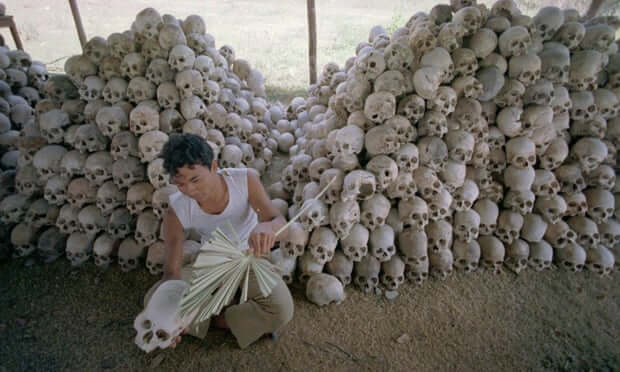
An estimated 1.7 million people died during the Khmer Rouge Regime in Cambodia. This week, deputy PM announced there will be no more persecutions. (The Guardian)
Syria
On Saturday, at least 40 people were killed in a US-led airstrike in an area along the border of Iraq. While the strike was against the Islamic State, civilians were killed by the coalition. The coalition spokesperson denied allegations of civilian killing, although Syrian medics and media outlets have said otherwise.
Between November 28-29th, Russia, Turkey, and Iran are going to hold a meeting to discuss talks about Syria. The meeting will take place in Kazakhstan and members from the Syrian government along with delegates from the Syrian rebels are supposed to attend.
On Tuesday, the Trump administration developed new sanctions which will harm both Syria and Iran. The Trump administration is under the impression that an Iranian company posing as a pharmaceutical and medical business is having money funneled out of Iran’s central bank, and into a state-owned Russian bank account. Furthermore, it is believed that the money is being used to aid Syria in paying for Russian oil. Another accusation is that President Assad facilitated “hundreds of millions of U.S. dollars” towards Hezbollah and Hamas. Now, new sanctions will be imposed on both Syria and Iran due to Iran’s continuous support of the Assad regime and funding towards “terrorist organizations.”
Bolivia
As stated in the memorandum of understanding between Bolivia and Paraguay, Bolivia is working on creating a technical team to form the gas pipeline project. The Bolivian proposal will be presented before the established 90-day deadline. Bolivian natural gas is accordingly the most competitive in the region, given imports from other countries is far more expensive.
Throughout the government of Carlos Mesa, Eduardo Rodríguez Veltzé, and Evo Morales, many laws and decrees were issued in financing and constructing the two highways which are under investigation in the Lava Jato case. While many of the laws were established prior to Morales’ presidency, all of the construction and payments were made during his time in office. Although, the most recent report to investigate several officials is claimed to be biased. There are four individuals on the list of people who participated in the construction of the highways, who are not being investigated.
It has been reported that in the past six months alone, $1,500 million worth of products illegally entered into the Bolivian border from Peru and Chile. The government of Bolivia declared that they plan to build 25 new border posts until 2019. Since November 15th, the government has sent 8,000 militants to the border and so far have destroyed 12 smuggling routes. In October of this year, 118 illegal routes were discovered and had previously been used to smuggle contraband across the border. The first installation of a border post will be on the 28th of November along the border of Chile.
This week, a scandal broke out about people being registered as militants for specific political organizations when they never registered at all. This is believed to be at the hands of the TSE, who are now being accused of electoral crimes of falsified document use, computer manipulation, and alteration of the Electoral Roll. The TSE is in charge of keeping data about citizens accurate, and by having individuals falsely registered, they are breaking the penal code in Articles 198, 199, and 203.
Nicaragua
In a statement on Friday, the president of the Inter-American Commission of Human Rights (IACHR) expressed great concern about human rights abuses of political prisoners in Nicaragua. Margarette May Macaulay, the president, refers to the unsanitary conditions of the prisons, along with the negligent medical care. Further, Macaulay believes that prison officers are imposing “maximum security regimes without objective criteria.”
In an effort to protest against the government of Nicaragua, Nicaraguan diaspora who are in the United States is calling for a strike between December 1st-15th. The rules of the strike are to avoid sending money to Nicaragua between those days. The diaspora is doing this through peaceful means of resistance.
At the Ibero-American summit which took place last Friday, the crisis occurring in Nicaragua failed to make it to the table for discussions. Only the president of Costa Rica, Carlos Alvarado made an explicit report about it. Ortega was originally supposed to attend the summit held in Guatemala but decided to cancel last minute.
The ex-political secretary of the FSLN at the Central Bank, Ligia Gómez, confessed about the realities of working for the government. Gómez testified that the government of Daniel Ortega had planned out the repressions of civic protesters since April 18th. While the past seven months of repression and human rights violations are incredibly evident, the confirmation through confessions from an ex-official is incredibly validating for the public. This recent admittance was seen as “tremendous,” according to the legal advisor from the Nicaraguan Center for Human Rights (Cenidh).
Since November 2nd, the political symbol Alex Vanegas has been locked up in jail. According to 100 Noticias, he is being illegally detained and psychologically tortured by the Sandinista police. Accordingly, today an appeal was made to release him. Although, this is Alex’s 6th time being illegally detained.
North Korea
Although there are talks on the way for North Korea to end its nuclear program, the newly tested “ultramodern tactical weapon” which is unidentified, shows a desire to both upgrade weapons and reassure its military. The observation of the weapon last week is further complicating the already stalled talks with the United States concerning nuclear weapons. Officials believe that the new, unidentified “steel wall” of a weapon is Kim’s idea of transitioning from the traditional military; nearly 1.3 million people strong, to high-tech weapons.
A report came out this week that in early November, a retired North Korean Official was arrested for speaking out against Kim Jong Un. The arrest took place once the official was made aware that he was under investigation, and attempted to flee the country. The official had accordingly disapproved of a new construction plan and felt that Kim did not care about “the lives of the people.” He spoke of this to a close friend, who then reported it to authorities.
On Tuesday, North Korea blew up ten DMZ guard posts at its southern border. Officials believe that North Korea did this to meet their November 30th deadline. Meanwhile, South Korea is also in the process of taking down ten of its own concrete guard posts. After meeting in September, the leaders of both nations agreed upon demilitarizing their joint security area.
Myanmar
On Sunday, four people were injured in a Rohingya Camp after a police raid and shooting. This came after the Myanmar police were informed of two men in the camp attempting to smuggle individuals out by boat just a few days prior. Nearly 20 officers entered the camp and detained the two men. According to Reuters, some civilians began to throw rocks and get violent with the police, and the officers began shooting at civilians in return. While nobody was killed, two people are in critical conditions.
In September, two Reuters reporters in Myanmar were found guilty of breaking the country’s “Official Secrets Act.” Their arrest and charge for being jailed for seven years have raised questions about Myanmar’s ability progress towards democracy. While Myanmar leader Aung San Suu Kyi stated that their jailing had nothing to do with being reporters, but rather for their lack of ability to handle “official secrets,” there is evidence of this case being a police set up and further lacks proof of the crime. Given the lack of evidence of their crime, Myanmar’s court has now allowed an appeal to proceed.
USA
While President Trump is attempting to restrict asylum seekers from crossing into the United States along the Southern Border, there are two legal challenges. It is believed that the Trump administration’s proclamation is violating federal law because it bypasses the law which states that it is necessary to have at least 30 days notice of a change in government regulation. Furthermore, the language limits asylum seekers to official ports of entry. Under the current law, asylum seekers may already be in the United States if they wish to apply for Asylum, even if they entered the country illegally. Further, as of Monday, a federal judge blocked Trump’s asylum ban temporarily.
The Environmental Protection Agency (EPA) is aiming to reset its decade-old proposal on biofuel by November of 2019. The reset in policy is likely to cause friction between two large industries in the United States: corn growing and oil companies. While corn growers want the highest possible targets in order to activate investment, oil companies want the opposite because of high costs. Current policy requires refineries to blend in increasing amounts of corn-based biofuels into U.S. gasoline, which costs oil companies “a fortune.” Further, partly due to high costs, production has fallen. Given slow production, the new policies will aim to create goals which are more realistic and manageable.
Cambodia
Last week, the UN tribunal convicted the last two living leaders of the Khmer Rouge genocide for crimes against humanity and war crimes. Although, Cambodia continues to reiterate its end to continuing the tribunal. The 1970s genocide killed nearly 1.7 million people. While two leading men were convicted, there are still four other people who are being prosecuted. Their prosecutions have continued to be stalled. The tribunal is a mix of Cambodian officials, and international prosecutors and judges. Without the aid of the Cambodian members of the tribunal, the convictions cannot take place.
Mexico
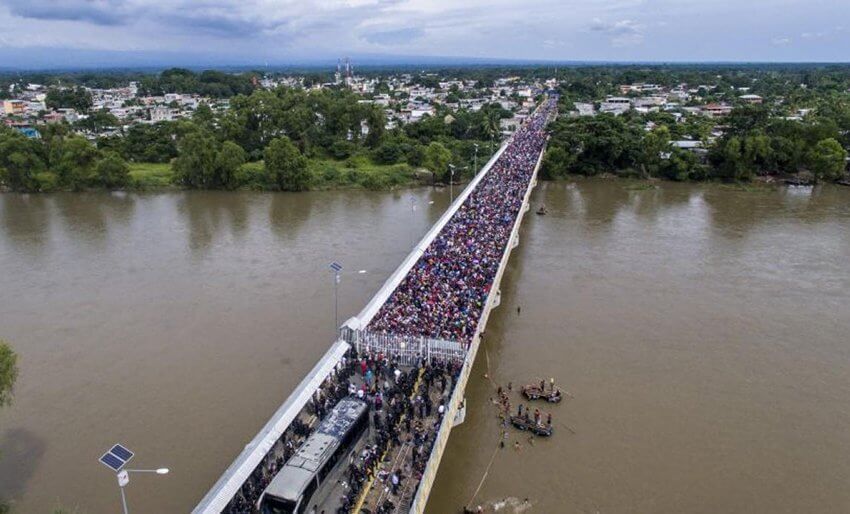
On Sunday, civilians in the Tijuana district of Mexico began to protest against the thousands of Central American migrants who appear to be lingering around their border city. The group of protesters began to chant the Mexican national anthem and waved flags, urging the Central American migrants to go back home. The migrants may have to stay in the Tijuana area for months as they wait to claim asylum into the United States. The Tijuana mayor labeled the mass amount of people an “avalanche” which could end up staying for at least six months.
The incoming president, Andrés Manuel López Obrador, who will officially take office on December 1st of this year, has come up with a new plan to eradicate the increasing crime rate in Mexico. This week, lawmakers from Obrador’s party proposed a new bill which would combine forces of both civilian and military police to create a national guard, under one military command in order to prevent crime within Mexico. The incoming president faces criticism of his plan, given he is coming into office as the murder rate in Mexico is at an all-time high, and as the police forces continue to be plagued with corruption. Critics are afraid that Obrador will have similar short-term thinking to his predecessors.
The Maldives
On Saturday, Ibrahim Mohamed Solih was sworn in and officially declared as the seventh president of the Maldives. In his inaugural speech, Solih reiterated that he intends to bring peace again to the country by implementing judicial reform, seeking the truth behind unsolved murder cases, and rehabilitating fundamental rights and freedoms. Furthermore, Solih seeks to maintain good relations with international actors, specifically India, and reshape foreign policy to focus more on human right, climate change, and democracy. Thousands of civilians attended his ceremony at the national stadium in Malé.
While Solih generally maintains support in the public spotlight, there are a few criticisms of his newly appointed coalition cabinet. Among the new cabinet are a variety of members from the four coalitions. On social media, some disapproved out of fear of under qualifications, allegations of corruption, and potential conflicts of interest. The administration is also the largest seen in Maldivian history.
Just days after Solih became president, there are plans for the Maldives to pull out of the Maldives-China free trade agreement. In a commentary, ex-president Mohamed Nasheed believes that the pact is incredibly one-sided and that the Maldivian parliament will not approve the necessary law for the trade deal to come into action. China has yet to respond to this commentary.
Zimbabwe
Reported by the Zimbabwe Association of Doctors for Human Rights (ZADHR), doctors in Zimbabwe allegedly were forced to describe bullet wounds as stab wounds. Doctors say that state agents forced them to false diagnose in order to cover up the violence carried out by authorities and security services during the violence which took place after elections this year. There were several cases of injuries and death due to gunshot wounds but went reported as stabbings. Military personnel has denied allegations of killings on August 1st after the elections.
Laos
This week marks the 50 year anniversary of the United States dropping its biggest bombing campaign on Laos in history. 50 years ago, more than 20 million tonnes of bombs were dropped on the small country. To this day, citizens in the country are still facing struggles given the leftover explosives that have not been deactivated yet. Nearly 80 million unexploded bombs are still hurting and killing innocent men, women, and children. Now, Laos is hoping for as many resources necessary to deactivate the remaining explosives.
Vietnam
This week, Vietnam and India have agreed to increase trade and relations between the two countries. In a press conference, expansions in trade, defense, and security are among the areas which India and Vietnam discussed further cooperation. The plan is to reach $15 billion by the end of 2020 in their bilateral trade volume; surpassing their $12.8 billion from last year.
Furthermore, Russia and Vietnam also plan to step up bilateral trade ties by 2020. By 2020, they wish to triple trade from their previous $3.55 billion to $10 billion. Mainly, cooperation will be emphasized on the oil and gas industries. Effect trade is made possible since the 2016 singing of the Eurasian Economic Union trade deal.
On Thursday, Vietnamese officials began to protest a move of China to build a new platform, likely to be used for military purposes, in the South China Sea. Accordingly, the new platform is in violation of Vietnam’s sovereignty. This is just the most recent of numerous actions taken by China regarding the South China Sea to infringe on national sovereignty. In a meeting, China’s foreign ministry spokesperson denied the building of the infrastructure is a violation of International law or Vietnam’s sovereignty.
The Democratic Republic of the Congo
Over the weekend, there was a deadly attack in Beni, the epicenter of the Ebola outbreak. Clashes broke out just meters away from the local emergency center. In total, seven Malawian and one Tanzanian peacekeeper were killed. Both the United Nations and the World Health Organization resumed work. Further, in the latest Ebola report, there are 166 confirmed deaths, and 47 probably deaths due to the disease.
Colombia
President Duque claims that the top ELN leader, Gabino, is in Cuba. Duque believes that the supreme leader traveled from Venezuela to Cuba, even though he has an international arrest warrant, issued by Interpol. Accordingly, many ELN members are in Cuba with permission from the government in order to negotiate peace talks with Duque, although the president continues to fail in negotiating with the group. Anonymous sources stated that Gabino traveled to Cuba for medical treatment, but this is neither confirmed or denied. Duque is certain that Gabino is on the island, and wants to know why.
On Monday, violence unfolded in the Bogota refugee camp, home to Venezuelans. The tent camp, El Camino, set up directly for Venezuelan refugees who have fled their home country due to the economic and political crisis, is facing food shortages. Because of the lack of food, people in the camp began to violently react and riot against one another. Authorities in the camp denied the accusations of inhuman conditions and humanitarian shortfalls and insisted that the city of Bogota maintains open doors for those affected by Venezuela’s crisis.
A new decree to stop the number of assassinations of political leaders in Colombia has been put in place by president Duque. Since the president took office, killings of social leaders have increased severely. Since the peace signing with FARC, 416 leaders have been assassinated. The imposed decree states that the government will provide protection for all human rights defenders with a Plan of Timely Action (PTA) designed to find warning signs before a killing. The specific groups who are being targeted include anti-corruption campaigners, representatives of coca-growing communities, rights defenders, among others.
Venezuela
In a surprising move, the Trump administration is considering pushing Venezuela on their list of state sponsors of terrorism. This list is intended for governments who repeatedly are questioned on their provision for supporting acts of international terrorism. The U.S. list so far only includes Iran, North Korea, Sudan, and Syria. Lawmaker Marco Rubio has specifically pushed for this action, citing Venezuela’s ties with Hezbollah in Lebanon and FARC in Colombia. Venezuela has long been accused of state-sponsored terrorism, but the threats have been downplayed because there is a lack of concrete evidence. While this action is up in the air, the United States has yet to make a final decision on the matter.
Malaysia
Investigations recently opened up about a submarine deal which took place 16 years, when the former prime minister, Najib Razak was in a position of power. Since losing elections in May of this year, Najib has continued to face many allegations of corruption. While he pleads not guilty to all of them, investigators with the Malaysian Anti-Corruption Commission (MACC) are currently inspecting the possibilities of scandal during a 2002 sale of Scorpene-class submarines by a company based in France. While there is not enough evidence at this point in the investigation to convict Najib of any crimes, it is certainly on the radar of MACC.
In its newest attempt to get to the bottom of degree fraud, Malaysia has developed a blockchain certificate verification system. Fake degrees have become an ever-present dilemma facing Malaysia, for obtaining a false degree not only damaged the reputation of Malaysian universities but also poses a threat to students who rightfully obtained a university degree. The NEM blockchain possesses unique qualities regarding the ability to accurately trace falsehoods.
Other News
The Philippines — As the government continues to tighten their grip on media freedoms, artists are fighting back through their work. (Al Jazeera)
Saudi Arabia — After their neighboring country, Germany decided to halt arms sales to Saudi, Finland, and Denmark decided to do the same. (Washington Post)
Palestine — Martin Griffiths, the UN special envoy for Yemen, is expected to arrive in the country in order to push towards peace between the Houthis and the Yemeni government. (Al Jazeera)
China —Civil rights activist, Huang Wenxun, has been re-detained after being released from a three-year prison sentence. Accordingly, he was arrested for celebrating the October 10th, the founding of the 1911 Republic of China. (RFA)
Yemen — Due to international requests for a ceasefire between the Saudi-UAE alliance and the Houthis in Hodeidah, the coalition is finally coming to a halt. This is after weeks of fighting between the two groups. (Al Jazeera)
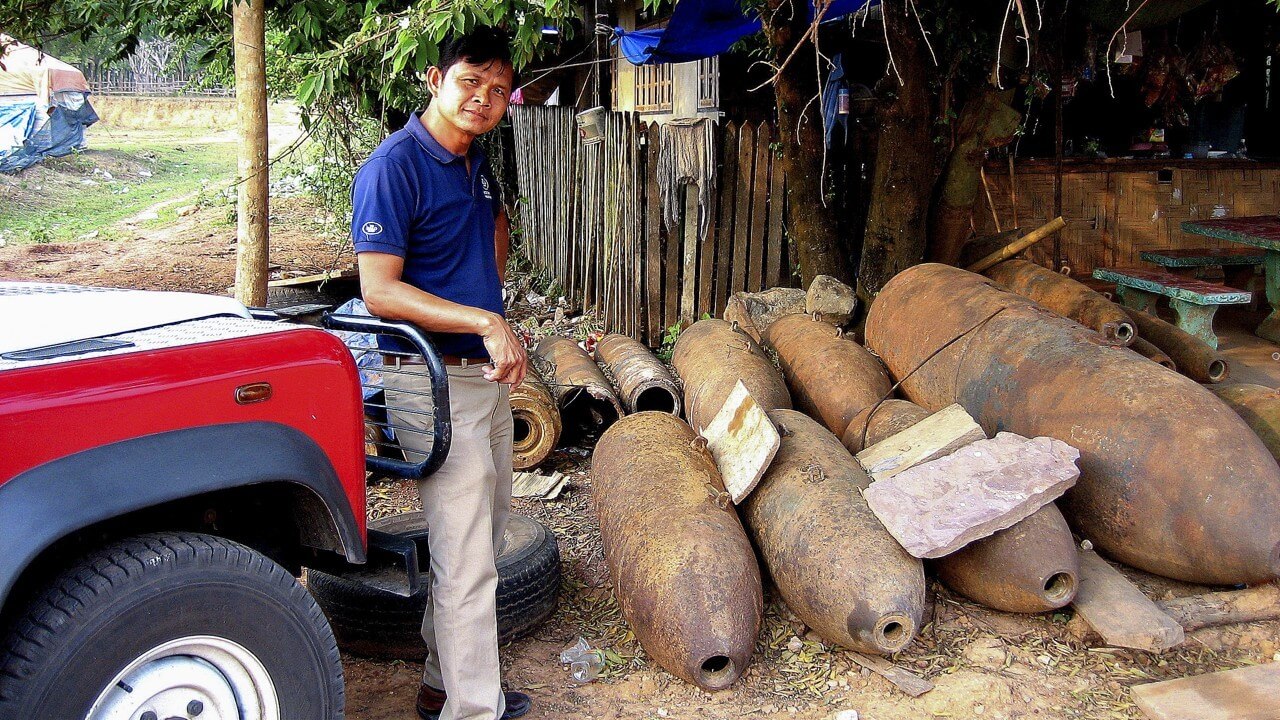
Disarmed bombs left from American activities in Laos during the Vietnam War. (Halo Trust)
Syria
In the area of Deir al-Zor, the US-backed Syrian Democratic Forces resumed fighting against the Islamic State. This comes after a suspension in warfare. Presumably, Deir al-Zor is the last “foothold” of IS near the Iraqi border.
A report which came out this week claims that beginning in February, the global chemical weapons watchdog group will begin to hold accountable those responsible for chemical weapons used during the Syrian war. The task was given to the watchdog group, given the number of attacks in the most recent years by both the Syrian forces and rebel groups. Attacks have previously used both chlorine and sarin. The team will begin analyzing attacks which began as early as 2014.
Bolivia
Last Friday, a bricklayer shouted “Bolivia said no! Respect the referendum!” at president Morales. For this, the man was imprisoned and put on trial. After hearing of this case, presidential candidate Mesa took to Twitter to declare his solidarity and support for the man. Mesa sees his imprisonment as a direct abuse of the government. While the Bolivian government is claiming that the man also tried to throw an unknown object at president Morales, there is no evidence of the event. There was no reported aggression.
This week, the Social Democratic Movement, led by Ruben Costas and the National Unity party, led by Samuel Medina, agreed upon an alliance in the upcoming presidential elections. The new alliance is also open to agreements with other parties, for they believe that uniting citizen platforms will create a strong movement in opposing Evo Morales. This alliance was official just one day before the deadline to create political alliances expired.
In the Lava Jato case, the MAS has decided to have the Office of the Prosecutor to investigate Mesa, along with seven other former officials who may have been involved with the case during Mesa’s presidency. The Lava Jato case is specific to the construction of the Roboré-Arroyo Concepción highway while Mesa was the president of Bolivia. The investigation will seek to find evidence of Mesa’s involvement in the Lava Jato case; the largest foreign bribery case in history.
On December 5th, the Inter-American Commission on Human Rights (IACHR) has set a hearing to discuss whether or not re-election is a human right. This comes after the Human Rights and Observatory Foundation (FODHJ) requested further investigation of the matter.
Nicaragua
Over the weekend, the Minister of Foreign Affairs of Spain, Josep Borrell, called the events occurring in Nicaragua a “bloody repression.” The Minister spoke of using sanctions against the Nicaraguan government and claimed that the international community has not done enough to put pressure on Daniel Ortega. Borrell would like to put sanctions “on the table.”
The latest reports indicate that since the repressions of Ortega’s government, the death toll has risen to 535 people. Furthermore, according to ANPDH, an estimated 4,354 people have been injured and are unable to access medical care. 1,302 citizens have been kidnapped by paramilitary groups, and 472 of them freed. Conflict between the government, pro-government citizens and opposition groups still continues.
On Wednesday, the Secretary-General of the Organization of American States (OAS) met with representatives from the National Blue and White Unity (UNAB) and Nicaraguan diaspora in the United States. Almagro discussed the crisis occurring in Nicaragua and the many violations of human rights. Furthermore, Almagro spoke of the urgency to release the nearly 400 political prisoners.
North Korea
The Editorial Board of the Washington Post has written a scathing op-ed regarding the Trump Administration’s handling of the North Korea situation, particularly as not much has changed in the volatile situation many residing in the DPRK face – the regime’s crushing prison camps and weapons programs have remained intact, with the only major difference being a lack of military tests. Since the summit, Trump has “swooned” over letters written by Kim Jong-Un, North Korea’s infamous despot, and claimed that the United States is in ‘no rush’ to deal with the North Korean nuclear program. Most concerningly, the human rights situation in North Korea has remained alarmingly stagnant, and many international actors have not paid any attention to it at all.
On Monday, new satellite images have identified over a dozen undeclared missile operating bases, something that indicates that Pyongyang has indeed decided to continue moving forward with its ballistic missile and weaponry programs amid stalls during its talks with the United States. These images were first reported on by the New York Times and later were analyzed by Beyond Parallel, the Korean Peninsula program at the Center for Strategic and International Studies. The images have been identified as belonging to thirteen out of a projected twenty hidden test sites. On Tuesday, United States Vice President Mike Pence met with Japanese Prime Minister Shinzo Abe; both leaders reaffirmed the need to maintain sanctions on the DPRK in order to achieve denuclearization.
According to Washington-based cybersecurity firm CrowdStrike, North Korea’s hacking program constitutes “the most innovative threat-actors in cyberspace,” despite the fact that the DPRK’s program lacks much of the “technical sophistication” of actors such as Russia or China. On Friday, according to North Korea’s official news media, the state has tested a new “ultramodern tactical weapon.” The state media has yet to identify the weapon and it is uncertain exactly what it is, although South Korean sources claim that the North Koreans have tested multiple rocket weapons this month. Also on Friday, the North Korean government announced that it would deport an American citizen detained one month ago for illegal entering the country to the United States.
Myanmar
Despite consistent condemnations from the United Nations and dozens of human rights groups, Myanmar and Bangladesh are moving forward with the beginnings of their repatriation plan to return Rohingya Muslims to the very place that they initially fled this Thursday. Michelle Bachelet, the United Nations High Commissioner for Human Rights, announced on Tuesday that forcing the first batch of approximately 2,200 Rohingya living in Bangladesh to return to the “ground zero” of ethnic cleansing against them would be a “clear violation” of core international legal principles. United Nations officials have also claimed that they were not involved adequately throughout the process. Rohingya refugees themselves have also spoken out about their lack of involvement in the processes, many of whom have shared that they are afraid to return to Myanmar. On Thursday, people protested when they were told that buses had been organized, and it is unclear if any have been forced to leave so far.
As a result of this ongoing Rohingya crisis, Amnesty International has withdrawn its most prestigious human rights award (the Ambassador of Conscience Award) from Myanmar leader Aung San Suu Kyi, only the latest of a number of international honors and recognitions to be stripped from the leader in response to the genocide against Rohingya
USA
What began as a small campfire on last Thursday in Paradise, California, ended as the worst wildfire that California has ever seen. The fire was officially put out on Tuesday evening. Latest reports indicate that 63 people have been confirmed dead, and the toll is expected to increase. Furthermore, the fire started in a town home to 27,000 people, and 7,000 structures have been wiped out. Now, most citizens are without homes and businesses. 95% of the town is gone. This is the deadliest wildfire that California has endured.
According to a think tank group, the Brookings Institute, the Trump Administration has the highest number of turn-over in their staff. As of Tuesday, it is possible that president Trump may fire three more officials including the cabinet Chief of Staff John Kelly, Homeland Security Secretary Kirstjen Nielsen, and Interior Secretary Ryan Zinke.
Cambodia
According to the anti-trafficking authority of Cambodia, fifteen people have been arrested for alleged illegal surrogacy in Cambodia – a violation that can result in charges of human trafficking and lead to approximately 20 years in prison. In Cambodia, commercial surrogacy is seen as “buying or selling children” according to the National Committee of Combating Trafficking; the status of the children born as a result of this practice is unknown, as it is uncertain whether the intended parents will be permitted to claim and raise the children.
On Friday morning, over four decades after a fifth of Cambodia’s population perished under the rule of the Khmer Rouge, an international tribunal ruled for the first time that the Khmer Rouge committed genocide against the Muslim Cham minority and ethnic Vietnamese. Additionally, two of the oldest surviving members of the regime – Nuon Chea and Khieu Samphan – were found guilty of genocide and various crimes against humanity.
Mexico
During the New York trial of drug lord “El Chapo” Guzmán, the current and former president of Mexico were accused by El Chapo of taking bribes from the Sinaloa Cartel. President Nieto denies any claims to being involved with the largest drug cartel in Mexico. Further, El Chapo believes he is being made a scapegoat, stating that the true leader of the cartel, Ismael “El Mayo” Zambada is walking freely in Mexico.
The Maldives
This week, the United Nations reported on a number of family planning youth advocates in the Maldives who are responding to a troubling lack of family planning education and reproductive health. In the Maldives, sex out of wedlock is criminalized, and citizens cannot access family planning services until after they have been married. Only one organization provides sexual and reproductive health education to young people the Society for Health Education, supported by the United Nations Population Fund.
On Wednesday, a controversial anti-defamation law was repealed by the Maldives’ Parliament; the 2016 law had served to re-criminalize defamation and had been used to fine and jail journalists and individuals found guilty of slander alike. This is the first of many campaign promises by president-elect Ibrahim Mohamed Solih, despite the fact that he has yet to formally take office. On the same day, an outspoken whistleblower who had formerly worked with the judicial watchdog agency returned to the Maldives after living abroad for several years and was promptly arrested for “mocking Islam and leaving the principles of Islam,” and also for her own safety, according to the police. This arrest was legal under the 1994 religious unity law, which criminalizes “attempting to disrupt the religious unity of Maldivians or talking in a manner that creates religious conflict among people,” in addition to “criticism of Islam in a public medium” under various sections of the penal code, citing posts that she made on social media perceived to be critical of Islam.
Zimbabwe
Inflation is the highest that it has been in Zimbabwe since its period of rapid hyperinflation ten years ago, leading economic experts to say that Zimbabwe’s economy is currently “teetering on the edge.” This month, inflation rates have soared to 21%, as opposed to the previously cited regional threshold of 7% – and compared to last month’s inflation rate of 5.4%. It is thought that this soaring rate of inflation has been exacerbated at least in part by the implementation of a tax imposed by Finance Minister Ncube on October 1st.
This week, two Zimbabwean generals testified that government troops were not responsible for the killings of six civilians during post-election violence on August 1st, claiming that the shooters instead must have been related to Zimbabwe’s opposition activists, which a military official described as “militant.” These interviews took place as a part of the government-led commission to determine the source of the shootings.
Laos
According to a piece by Radio Free Asia, it is highly likely that more disasters akin to the Lao dam disaster in July will occur if the region does not do more to hold project-funders and international development partners accountable and ensure that the environment is capable of supporting such large-scale projects. There are plans for 11 more large-scale dams, either proposed or already under construction, on the Mekong River in Laos and Cambodia – and about 140 dams on Mekong tributaries in Laos.
Amid the escalation of the trade war between the United States and China, China has pledged to set up a free-trade zone on its border between Thailand and Laos, offering special privileges to traders from the Mekong countries in what is likely an attempt to build regional supremacy amid its global economic uncertainty. It is also highly likely that this is only the first of a series of measures that will seek to bring Chinese economic ties closer to ASEAN. A report released on Friday revealed that it will be 200 years before Laos is cleared of unexploded American bombs from the time of the Vietnam War, with a remaining 80 million bombs to be dug up and defused.
Vietnam
On Monday, Vietnam became the seventh country to ratify the new Trans-Pacific trade pact (the Comprehensive and Progressive Agreement for Trans-Pacific Partnership, or CPTPP). It is believed that this will help Vietnam to modernize its labor laws and industrial relations system, and also help to grow its garment-focused export industry. The CPTPP has been signed formerly by Australia, Canada, Japan, Mexico, New Zealand, and Singapore. The four remaining states that are expected to ratify the pact are Brunei, Chile, Malaysia, and Peru.
Vietnamese activists fear that the government’s continued support of an anti-dissent law that could regulate anti-government speech on the internet could be used to completely curb activist activity even further than it is already being stifled. This law will come into effect on January 1st and will give relevant companies such as Google and Facebook, one year to bring their company policies into compliance with the draconian new law.
The Democratic Republic of the Congo
According to the World Health Organization (WHO), the Ebola outbreak is expected to last another six months in the DRC. Thus far, Ebola has claimed at least 200 lives in the latest outbreak, and while predicting a timeframe of ending the epidemic is a difficult matter, officials believe there cannot be a final declaration of its end until mid-2019.
After leaders from a variety of opposition groups met in Geneva to discuss and choose one leader to oppose Joseph Kabila in the December 23rd elections, Martin Fayulu was chosen as the candidate. An agreement was signed upon on Sunday, marking a rare moment in the Congo, given the political distress which has been occurring in the country due to president Kabila’s unwanted ruling since 2001. Although, a mass of citizen protests began because of the choice. Further, two of the opposition leaders who met in Geneva pulled out of the contract because the reaction from the public was angry and unsupportive of the decision. There are doubts that the December 23rd election will show a peaceful transition of power.
Colombia
During a student-led protest across Colombia after talks with president Duque stalled, violence unfolded after groups of masked people began to attack the police. Due to this, the police began to violently attack students. While students intended to march peacefully, the feared riot police, ESMAD deployed tear gas and stun grenades. It appears as though the masked people who uninvitedly joined the march and escalated the chaos with the police. Students are now fearful that president Duque will see the acts of violence, he will pull out of talks completely.
On early Saturday morning, a group of ELN soldiers attacked buses and trucks in the César area of Colombia. In the event, the ELN forced passengers off of the buses and the vehicles were set on fire. This recent violent event came just one week after an ELN guerrilla group killed four Venezuelan soldiers. Five people were wounded in the most recent attack.
After walking 300 miles from the Choco area of Colombia to the capital of Bogota, 500 internally displaced civilians were turned away from entering the capital. The indigenous communities had walked to Bogota in order to flee the violence undergone between FARC members, ELN guerrillas, and the AGC paramilitaries. Authorities have continued at failing to maintain control of Choco. Once the band of 500 people arrived in the capital, they did not receive food, water or shelter. Instead, they were stopped by authorities.
Venezuela
The oil-rich Venezuela continues to have shortages in food, medicine and other basic goods for people across the country. In the latest report, it seems that Venezuela’s inflation rate is approaching 150,000%. It is expected to continue to spiral out of control. The new “Sovereign Bolivar” instituted by President Maduro just a few months ago persistently fails.
According to a Reuters report, Chinese telecom giant ZTE helped Venezuela develop a social credit system, similar to the one in China. The new development, called the “fatherland card” is intended to hold information about the user, and the data is then put into a government database. This way, the government can keep track of medical records, presence on social media, membership of a political party, and more. Venezuelans are concerned that this system can be used to further tighten social control. The card was implemented last year, and president Maduro offered cash prizes and cheaper fuel as an attempt to get people to sign up for the service. Accordingly, nearly half of the population has the card.
Malaysia
On Monday, Malaysia has decided to abolish the death penalty for 32 offenses according to a Minister in the Prime Minister’s Department, who claims that a cabinet memorandum is already being circulated to the relevant ministries. On Wednesday, Malaysian Prime Minister Mahathir expressed appreciation and thanks towards Singapore for its role in aiding Malaysia to recover some of the funds lost as a result of the 1MDB scandal. Malaysian prosecutors have also announced that they will bring additional charges against the wife of the former premier Najib Razak in relation to this scandal. She has already pleaded not guilty to earlier charges.
This week, Malaysia claimed that amendments to curb child marriages will be reviewed in the middle of 2019 after widespread international backlash at a series of child marriages through the Islamic court system in rural Malaysia. On Thursday, the wife of former prime minister Najib Razak was officially charged with corruption accused of soliciting and receiving an approximate $45.12 million USD in bribes.
Other News
Russia — The Russian Duma has approved a bill which will soften punishment for first-time hate crime offenders this week. (Radio Free Europe)
Hungary — The former prime minister of Macedonia, now a fugitive after being sentenced to jail time for corruption, has reportedly sought asylum in Budapest claiming “persecution” by a “leftwing government” . (The Guardian)
Poland — On Sunday, Poland held a nationwide march to mark their anniversary of independence. While it was a peaceful march, far-right groups were among the 200,000 participants amidst a controversial decision to allow them in. (BBC)
The Philippines — Prominent Philippine journalist and government critic Maria Ressa, founding member of news site Rappler, has been charged with tax evasion in a move that Ressa and other advocates claim are acts of intimidation by the government. (TIME)
Saudi Arabia — The Attorney General of Saudi Arabia is pursuing giving the death penalty to at least five people who were involved in the Jamal Khashoggi murder. (Al Jazeera)
Palestine — In a targeted rade to kill a Hamas leader, Israeli soldiers killed seven Palestinians in the Gaza Strip this week. Further, one Israeli soldier died. (Al Jazeera)
China — An American congressional panel focusing on Chinese policy has released a report urging policymakers to take a harder approach to an increasingly authoritarian China. (Radio Free Asia)
Yemen — Due to international requests for a ceasefire between the Saudi-UAE alliance and the Houthis in Hodeidah, the coalition is finally coming to a halt. This is after weeks of fighting between the two groups. (Al Jazeera)
A UN convoy which was supposed to reach the Rukban desert camp last week has finally arrived. There are near 50,000 stranded Syrian refugees in the camp, 80% being women and children. The area is controlled by Syria’s army and is nearby a U.S backed rebel-base. After joined efforts between the UN and the Syrian Arab Red Crescent on Saturday, 78 trucks containing food, medical supplies, and hygiene kits arrived.
On Thursday, 19 people who have been held hostage by IS since a July 25th attack, have finally been freed. On July 25th of this year, 30 people were kidnapped by IS when they raided the Sweida province. That same day, the militant group killed 216 people in the region. Of the 30 people kidnapped, 19 were released. Syrian troops liberated the 19 women and children, and in exchange, IS received a monetary payment and women related to IS militants who were being held hostage by the Syrian army.
On December 6th of this year, eight departments of the country will hold a strike in solidarity against Evo Morales. Although, the president of the Association of Municipalities of Santa Cruz (Amdecruz) admitted that the mayors of his municipality will not be taking part in the strike. Jorge Tuto Quiroga, the former president between 2001-2002 strongly warned the TSE that if they try to illegally enable Evo Morales and vice president Linera in the 2019 elections, they will face trials and jail time. Quiroga stated that the members of the TSE cannot simply ignore the Political Constitution of the State.
On Wednesday, officials from Bolivia and Paraguay met to discuss building a bi-national pipeline, the installation of gas networks, selling LPG to Paraguay, and exploration into hydrocarbons. At the meeting, they signed a memorandum which established an open negotiation between the two countries for further developments.
On Friday, November 2nd, seventeen people were arrested by the Sandinista police. The reason for the arrest is considered “ridiculous” given, those arrested were imprisoned for using the colors of blue and white during a visit to a gravesite in order to honor their loved ones. The Nicaraguan Center for Human Rights (Cenidh) reported more than 100 officers inside and around the gravesite.
While civic resistance continues to remain strong against Ortega and the Sandinista government, the United States is helping to make economic and diplomatic means difficult for the Nicaraguan government. This month, the United States imposed a law called “Global Magnitsky” which would punish Ortega by removing visas and financial restrictions of members of Ortega’s government who have helped to commit crimes and violate human rights. This will likely put pressure on Ortega to hold an early election or force him to negotiate for an internationally supervised election.
While Daniel Ortega has only registered 273 political prisoners, the Blue and White National Unity claims that there are a total of 552 people imprisoned. Ortega’s government continues to deny allegations of the number of prisoners and their poor treatment. The government is treating the prisoners as “terrorist and coup prisoners”.
Between November 9-11th, a meeting will be held in Washington to discuss the ongoing crisis in Nicaragua. Members from civil society organizations, the Nicaraguan Association for Human Rights, the Nicaraguan Foundation for Economic and Social Development, among others, will attend. The meeting will be led by the Nicaraguan Freedom Coalition and will pose as a platform to unite different groups in the country to discuss the crisis. The goal is to not only bring international awareness to Ortega’s government but also to return democracy to Nicaragua by adopting a resolution.
Beginning Thursday, any Nicaraguan with a refugee application card who is currently residing in Costa Rica may apply for a work permit. According to the Inter-American Commission on Human Rights (IACHR), between January and September of this year, more than 52,000 Nicaraguans who have entered Costa Rica have remained in their territory and at least 40,000 of them have articulated a need for protection from Costa Rica.
A report released by Human Rights Watch this week revealed that sexual abuse against women is widespread, especially abuse enacted by officials. According to this report, which was compiled from individual testimonies from over sixty North Korean defectors, sexual abuse and assault are so common that many women believe it is a part of everyday life.
During a visit by Cuba’s president, North Korean leader Kim Jong-Un’s official portrait was unveiled next to a portrait of Cuba’s president. The unveiling of this portrait is significant – it signifies that Kim is being seen as a leader in his own right instead of simply a successor to his father. Kim’s reputation as such has improved domestically throughout 2018, thanks in part due to a large number of high-profile diplomatic meetings, including the Singapore Summit with US president Donald Trump.
The long-awaited talks between the DPRK and the United States have been called off by the North Korean side this week. According to the United States State Department and South Korean foreign ministry, the meetings were called off due to scheduling issues and nothing more. However, the calling off of these talks has come at a time when the DPRK and the United States are coming to a head over the future of sanctions against the DPRK and nuclear weapons on the Korean peninsula.
The European Union threatened over the weekend to impose trade sanctions on Myanmar that could have a devastating effect on the country’s domestic clothing industry as well as various others over a lack of accountability on the part of Myanmar’s government with respect to the genocide against the Rohingya. Meanwhile, the United Nations has urged Bangladesh and Myanmar to drop their “rushed” plans to repatriate the Rohingya to Myanmar. stating that Rohingya refugees still face a “high risk of persecution” if they return.
This Monday, the lawyers of the two Reuters journalists jailed for reporting on the military violence against the Rohingya filed an appeal, claiming that the original ruling of the court was incorrect. The two reporters were sentenced to seven years in prison for breaching Myanmar’s official secrets act, accused of possessing secret documents. In their appeal, the lawyers stated that the court “ignored compelling evidence of a police set-up” in addition to violations of due process and an inadequate job on the part of the prosecution.
On Wednesday, a report commissioned by Facebook found that Facebook platforms were definitively used to incite violence in Myanmar, specifically in aiding organized groups to conduct attacks on the country’s Muslim population. Facebook has stated: “We agree that we can and should do more.” In Myanmar, Facebook is so ubiquitous that it is considered to be essentially the internet.
On Sunday, Mike Pompeo, the U.S Secretary of State, agreed to hold accountable all people involved in the killing of Jamal Khashoggi. At the same time, Pompeo would like to maintain strategic relations between the United States and Saudi Arabia. Thus far, 16 visas from individuals involved have been revoked.
Tuesday concluded the United States most expensive and consequential midterm election. While Democrats claimed the House of Representatives, the Republicans claimed the Senate vote. These results show to confirm the divided country. There were highly contested votings in Indiana, Missouri, North Dakota, and Texas, all of which won with a Republican majority. Furthermore, this election showed a record number of women representatives in the House.
On Wednesday, Attorney General Jeff Sessions resigned from working for the White House after president Trump’s request. Sessions had been in charge of the Russian interference investigation during the 2016 presidential campaign. While Session’s removal has been foreseen for some time now, some officials were shocked at his forced resignation. The Attorney General will be replaced by Matthew G. Whitaker, Session’s chief of staff.
This week, a report released by Freedom House claimed that internet freedom in Cambodia is slipping after Cambodia has continued a series of crackdowns on online dissidents. In addition, media freedom has declined in that independent media institutions have been stifled and shut down, including Radio Free Asia Cambodia and the Cambodia Daily newspaper, and the relationship between the government and journalists has worsened. Cambodia’s score for media freedom has been slipping continuously for the past few years.
Thanks to threats from the European Union, Cambodian Prime Minister Hun Sen has begun to relax pressure on local labor union leaders. The European Union is continuing to review Cambodia’s duty-free export access, which is only available to developing countries. As a result, business leaders that benefit from Cambodian labor, including representatives from countries such as Adidas, New Balance, and others, have come to meet with Cambodian government ministers in an attempt to defuse the situation.
This week, a United Nations expert released a report claiming that in order to improve human rights in Cambodia, the government must allow for inclusive institutions, transparency, and access to justice – all principles directly in accordance with Sustainable Development Goal 16. Particularly concerning to the United Nations is the lack of speedy trials in Cambodia, in addition to issues such as transparency regarding land rights for Cambodian citizens.
Two busloads of Central Americans fleeing towards the United States border, totaling nearly 80 people, have gone missing this week. The National Human Rights Commision states that the missing people were kidnapped and turned over to criminal groups in Mexico. This occurred while the migrants traveled through Puebla on last Saturday. Neither federal or state authorities have responded to the reported incident. Accordingly, criminal groups have long kidnapped Central American migrants in order to force men into labor work and women into prostitution.
Indian Prime Minister Narendra Modi is set to visit the Maldives, the only country in South Asia which he has yet to visit, next week. Although the visit has yet to be officially announced, Modi’s staff has already arrived in the Maldives to help plan for the occasion. It is expected that Modi will use this occasion to revive a closer relationship between India and the Maldives, particularly as the previous administration stopped many large infrastructure projects that were jointly underway with Indian contractors. Thanks to Indian support, the Maldives also became the latest member of the Indian Ocean Rim Association, something that would not have been possible under the previous administration.
Dr. Mohamed Asim, the foreign minister of the Maldives, has been accused of sexual harassment in the workplace by at least four junior staffers. According to sources from within the minister’s bureau, at least one of the accusations would qualify as sexual assault. However, the ministry’s permanent secretary has claimed to not have any official complaints submitted until this Thursday. Impunity for perpetrators is currently a huge problem in the Maldives in the case of sexual assault investigations.
According to several news sources, petrol supplies have returned to normal at most service stations in major Zimbabwean cities, signaling that the worst of the previous financial crisis is over. The price has also begun to recede for fuel in both Harare and Bulawayo. Despite this, officials are still concerned that the economic crisis will return. It appears to have been spurred on by major economic reforms announced last month, which incentivized Zimbabweans to attempt to spend as much of their money as they possibly could before cash or goods could disappear – not helped by the memory of the 2008 economic crisis. It remains to be seen whether the situation will be ameliorated for good by the end of the month when Financial Minister Ncube announces the national budget.
This week, two former ministers under Robert Mugabe’s reign appeared in court to face corruption charges: former information, communication, and technology minister Supa Mandiwanzira, and former local government, youth, and environment minister. Both were formerly fairly significant in the ruling ZANU-PF party. On Wednesday, 47 people died in a major traffic accident along the Harare-Mutare highway, which Zimbabwean police have characterized as a collision between two buses caused by “speed or reckless driving.”
Analysts are predicting that Laos’s dependence on Chinese loans to build their extensive dam projects will lead to Laos falling “even deeper” into China’s infamous debt trap. It is estimated that Laos has received about $11 billion in development financing from China so far, second only to Pakistan in Asia. Laos, currently one of the poorest countries in Southeast Asia, has already been warned last year by the International Monetary Fund that it runs a huge risk of “external debt distress.”
Vietnam has claimed that due to “toxic information” on platforms such as Facebook and Google, it wants at least half of its domestic social media users to use domestic social networks by 2020. Vietnam’s information ministry has been drafting a code of conduct for the internet. As the Vietnamese government normally exercises strict controls over domestic media and what is allowed in the country, it is thought by many that this is actually a way of silencing dissidents – who are generally only able to openly critique the government through their online activities.
According to a recent human rights report, brutal torture and sexual assault have been used by authorities in the DRC against political dissidents as a way to silence them. Members of political opposition groups or social justice campaigns have fallen victim to rape and torture for simply taking part in protests or by wearing political shirts. This report comes after interviewing 74 people, both women, and men. According to the report, all of them women and two-thirds of the men had been raped, while others were subject to electric shocks and beatings.
Different leaders from opposition groups for the upcoming elections have agreed to go to Geneva in order to select a joint candidate. The leaders left on Thursday for the three-day summit. There are high expectations, therefore all of the leaders believe it is best to act together to choose one leader. The DRC elections are to take place on December 23rd, and the outcome is crucial for the future of the Congo.
According to the United Nations, an estimated 350 people have fled the northeast region of Colombia, while another 400 people are caught in the “crossfire” of warfare between militant groups ELN and EPL. Last week, president Duque declared that he sent 5,000 troops to the region in order to protect civilians and create peace, even though civilians from the region fiercely opposed the president’s decision. Militarizing the region, Catatumbo has only proven to develop more harm than good in the past. Locals from Catatumbo believe that the military is corrupt and unorganized, and they have yet to help in the most recent situation concerning people being caught in the crossfire of militant groups.
Last week, Venezuelan soldiers entered through the Colombian border. This is the latest in a series of border crossings. On Wednesday, Colombia sent a letter of protest to Venezuela. Duque sees the repeated crossings as a violation of sovereignty. Venezuela did not immediately respond to the letter.
Due to the imposed US financial sanctions on Venezuela’s gold, Venezuela’s hard currency has dwindled. Because of this, Maduro is pursuing bringing back nearly $550 million of gold from the Bank of England, held in Britain. Venezuela is fearful of being caught up in international sanctions. Given the country is in its fifth year of recession, losing this gold could cause even further damage to the country’s economy.
The European Union has extended sanctions on Venezuela until November of 2019. In 2017, the EU imposed an arms embargo and further added a variety of Venezuelan officials to the sanctions list. The most recent decree is because of Maduro’s human rights violations and undermining of democracy. The EU’s sanctions came less than one week after the United States imposed sanctions on the oil-rich country. The goal is to add more pressure on Maduro and his government.
This week, the Malaysian delegation at the third Universal Periodic Review by the United Nations Human Rights Council in Geneva reaffirmed the new Malaysian government’s commitment to working towards ratifying all UN human rights treaties that have yet to be ratified by the Malaysian government. The Malaysian government also indicated that it would be placing a moratorium on all executions until the death penalty is abolished, attempting to signify its new commitment to human rights. Activists and civil rights groups also used the stage provided by the Universal Periodic Review to express disappointment and outrage to the government’s response to accusations of female genital mutilation in the country. The Malaysian government claims that people practice “female circumcision,” and insists that the practice is independent of what is characterized as FGM.
Dozens of Rohingya Muslims and Bangladeshis boarded a boat attempting to reach the southern coast of Malaysia and were apprehended by Malaysian authorities. This has occurred mere weeks after Myanmar and Bangladeshi officials announced a repatriation plan set to begin in mid-November, despite protests from groups such as the United Nations that such repatriation efforts are premature. The Malaysian Prime Minister, Mahathir Mohamad, warned Malaysians to not “abuse” the freedom of speech, expression, and media given by the government. Specifically, he condemned uses of these basic freedoms to cause trouble on matters relating to race and religion.
Russia — This week, the United States blocked a Russian attempt to ease sanctions against the DPRK under the premise of affording humanitarian aid to the impoverished nation. (Radio Free Europe)
Hungary — Although the Hungarian investigation of an alleged corruption scheme involving the Prime Minister’s son-in-law has been dropped, the European Union announced that it would continue pursuing the case. (Politico EU)
Poland— After elections were concluded on Sunday, Poland showed a deeply divided nation between its more liberal cities and conservative countryside. (New York Times)
The Philippines — Former Philippine first lady Imelda Marcos has been found guilty of graft this Friday, a rare conviction among a variety of corruption cases that have been brought up in recent Philippine politics. (TIME)
Pakistan — Asia Bibi, the women who was held on death row for the past eight years, was freed of her sentence. Her freedom sparked riots in Pakistan. (BBC)
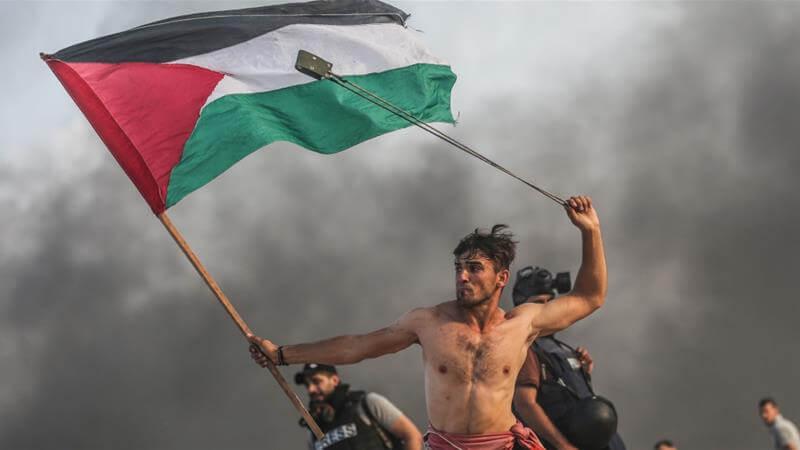
Palestine — During a protest, a young Palestinian man famous for his symbolism of Palestinian resistance through a picture of him which greatly compares to the French Revolution painting, Liberty Leading the People, was injured by Israeli Soldiers. (Al Jazeera)
China — As many as 500 children of detained Uighur Muslims have been placed in what is being called a “closed school” in Kashi Prefecture, where they are not allowed to have any kind of contact with the outside. It is thought that these are the children of those who have been placed in “re-education camps.” (Radio Free Asia)
Yemen — The Yemeni port city of Hodeidah is facing the worst violence that it has seen in months. This is due to the US-backed Saudi coalition of fighters in a war with the Iranian-backed Houthis. It is estimated that nearly 100 civilians died this week. (CNN)
A protest against Israel’s blockade of Gaza. (Mustafa Hassona/Anadolu)
Syria
A clash between US-backed Syrian fighters and Islamic State Militants left at least 40 Syrian fighters dead. Further, Islamic State recaptured land which was taken from them earlier this month along the border of Iraq. The Syrian Democratic Force (SDF) has been working to capture the last pocket of land being controlled by IS since September. This area is also home to thousands of civilians who are being held in the crossfire.
On Saturday, leaders from Russia, Turkey, Germany, and France met in Istanbul to discuss various issues facing Syria. While there was not a major breakthrough in talks, the four-way summit addressed the necessity of an eventual peace plan. With Russia backing Assad’s Regime, and Turkey backing rebel groups in opposition of Assad, the meeting made for an interesting dialogue. The leaders also discussed the refugee crisis, the Idlib demilitarization zone, and constitutional reform.
The Rukban Camp on the border of Syria and Jordan, home to more than 50,000 stranded civilians, has yet to receive aid since last January. This week, a convoy carrying aid was supposed to make its way to the camp but has been suspended due to security reasons. The camp is home to 80% women and children, all of whom are in desperate need of food, water, and medical attention. While people living in the Rukbar Camp need help, aid workers on their way were in danger.
Bolivia
This week, Maria Eugenia Choque was elected as the new president of the Supreme Electoral Tribunal (TSE). Further, Antonio Costas Sitic will become the new vice president. These new positions came after the previous president and vice president resigned. Their management will continue for the next two years and obtain duties in both the primary and general elections in 2019.
On December 6th, civic leaders from eight separate departments in Bolivia are calling on a strike against Evo Morales. They are calling on a national strike against the referendum results from February 21st, 2016 when President Morales was put into office, even though he lost the majority of votes. The strike is intended to prevent the TSE from granting Evo Morales access to candidacy for the 2019 election cycle.
Nicaragua
This week, Ortega’s government is trying to completely censor the media outlet, 100% Noticias. The Nicaraguan Institute of Telecommunications and Postal Services (Telcor) was ordered to replace the news agency with a separate one. Telcor announced that 100% Noticias is an illegal company. Accordingly, the government does not have any legal basis for their claim.
At the end of Mass at a cathedral in Managua this weekend, members of the church held a peaceful protest in which they carried crosses with the names of victims of the socio-political crackdown since April 16th. There were a total of 528 names written, given this is the number of people who have died because of the Sandinista government.
Last Friday, 70 hooded men entered the prison where political prisoners were being held. The prison called La Esperanza is a women’s prison where political prisoners were being held. The men who entered physically beat the prisoners. This week, members of the Inter-American Commission on Human Rights (CIDH) tried to gain access into La Esperanza in order to verify the physical and mental health of those beaten, but they were denied entry. Prison authorities did not let them in.
North Korea
The United States chief envoy for North Korea said on Monday that he was “certain” that the cooperation of Washington and Seoul could help to secure full nuclear disarmament on the Korean peninsula. However, he did not claim to be on a specific timeline and has yet to set a concrete meeting with his North Korean counterpart.
Skeptics have been watching South Korean President Moon Jae-in’s relationship with North Korean premier Kim Jong-Un, especially as Moon attempts to shift Kim Jong-un’s public image from one of a war-mongering dictator to someone who is a “young and candid strategist.” This has exacerbated a clear tension between American and South Korean foreign policy – it has been a foregone conclusion among American policymakers for quite some time that the DPRK cannot be trusted to keep promises, even if the proper concessions are made. On Wednesday, the DPRK and South Korea agreed to hold sports talks this week to strengthen exchange; these talks will even include discussions of joint participation in the upcoming 2020 Olympics and a potential 2032 joint Olympic bid.
A Human Rights Watch report released this week has revealed that rape and sexual assault perpetrated by North Korean officials is so widespread that it is considered to be part of ordinary life. According to those interviewed, sexual assault has been so normalized that many defectors did not think it was unusual, and that women have little choice but to comply once an official decides to set his sights on her.
This Thursday, Kim Jong-un publicly latched out at the sanctions regime against the sanctions continued to be enforced against the DPRK by the United States under Trump, claiming that the sanctions place the DPRK in a very difficult situation as it attempts to transform itself into a “tourist destination.”
Myanmar
Workers have been striking from a Chinese-owned garment factory as part of an effort to reinstate colleagues who had previously been fired for their connections with a trade union. In the city of Yangon, about 100 protesters demanded an audience with Chief Minster Phyo Min Thein, seeking to discuss their grievances with the minister. Earlier this month, dozens of workers from the same factory were injured after assailants attacked a crowd that had been gathered outside of the factory – an incident that the government claimed was started by the workers themselves.
Less than a week after United Nations investigators warned that the genocide against the Rohingya is still ongoing, Myanmar and Bangladesh have come to an agreement to start returning Rohingya refugees to Myanmar in mid-November. However, many Rohingya fear to return to Myanmar – especially since they are still not guaranteed rights such as citizenship, access to healthcare, and the freedom of movement. United Nations officials have condemned this deal and attempt at repatriation.
Additionally, there is evidence that Myanmar officials are in fact seeking to eliminate evidence that the Rohingya population even lived in certain areas of the Rakhine state: the government has been enacting large-scale construction projects in depopulated areas, with local government administrators claiming that these new comes would soon be occupied by “Rakhine, Chin, Bamar, and Hindu people from other parts of the country.” Meanwhile, some of the five ethnic armed groups that have yet to sign Myanmar’s nationwide ceasefire will attend talks with the Union Peace Dialogue Joint Committee, according to a report released on Tuesday.
USA
Over the weekend, a man named Robert Bowers entered a Synagogue in Pittsburgh, Pennsylvania and carried out a mass shooting. Bowers killed a total of eleven people, while others were injured. After authorities arrested the man, he claimed he just wanted “to kill Jews.” This shooting is the deadliest attack against Jewish people in the United States to date. There will be a court hearing this week to determine Robert Bowers jail time.
Due to the large mobilization of Central American migrants making their way to the United States border, Homeland Security and the Pentagon have decided to send 5,200 troops, military helicopters, and razor wire to the Mexican border. While some officials see the mass of people as a security threat, others, like the policy counsel for the ACLU’s Border Rights Center in El Paso state that, “Sending active military forces to our southern border is not only a huge waste of taxpayer money but an unnecessary course of action that will further terrorize and militarize our border communities.” Furthermore, the caravan of people is nearly 900 miles away, so it does not appear to be an immediate threat.
Cambodia
Although Kem Sokha, the leader of the banned opposition party (the Cambodian National Rescue Party), was released from prison to house arrest on September 10th, he is being barred from speaking to United Nations officials. Specifically, Rhona Smith – the UN Special Rapporteur on Human Rights in Cambodia – has been refused permission to speak with him about his detainment and various other issues, although she will be allowed to speak with various government officials and representatives from human rights groups during her visit this week. Meanwhile, Cambodia’s king has moved around 60 court officials, judges, and prosecutors to various posts around the country in a move welcomed by NGOs as a potential method to reduce judicial corruption.
Australia’s refugee resettlement deal with Cambodia has expired and is no longer considered to be an option according to Australian officials this week. According to rights advocates, the deal (which involved the Australian government paying Cambodia to resettle its refugees, who are usually confined to an offshore processing center on the small island of Nauru. Meanwhile, Cambodia-based rights group Licadho released a report on Thursday detailing the overcrowding issue in Cambodian prisons, with a focus on what they are calling “needless mass detention.”
Mexico
As migrants coming from Guatemala crossed the border into Mexico through the Suchiate River, one man died in clashing. Mexican authorities were deployed to the border. Accordingly, the police were not armed, yet one man was killed with a rubber bullet to the head. The deployment of authorities to the border is to stop the flow of migrants coming from Central America, given they are coming through Mexico in an illegal way.
The Maldives
Amnesty International released a briefing on October 30th that detailed the ordeal of Lahiru Madhushanka, a Sri Lankan driver who was accused of planning to assassinate then-President Abdulla Yameen in 2015. Madhushanka was reportedly denied a fair trial and repeatedly beaten by police in what may amount to torture. He was also denied access to legal representation and forced into prolonged solitary confinement. Amnesty International has urged that as the Maldives transitions into a new presidency, it must pay more attention to strengthening its human rights record.
Another area that Solih may wish to focus as he assumes the presidency next month is the potential for the Maldives to escape what is known as China’s debt-trap, in which Beijing repeatedly finances a variety of “questionable” infrastructure projects across countries and makes repeated purchases of land. It is hoped by some analysts that the Maldives will shake Chinese influence and return to the sphere of India, despite the fact that China holds over 80% of the Maldives’ sovereign debt. The relative cost of Beijing’s infrastructure project to any other agent of infrastructure development in the region means that it is, however, going to be incredibly difficult for the Maldives to completely depart from Chinese influence as it seeks to maintain investing in regional infrastructure.
Former Maldives president Mohamed Nasheed returned from a two-year-long exile on Thursday, only two days after the Supreme Court withdrew a warrant for his arrest. Nasheed was welcomed at the Male airport by president-elect Ibrahim Mohamed Solih and hundreds of reporters. It is unknown what role, if any, Nasheed will play in Solih’s new government.
Zimbabwe
A man detained for insulting the president while testifying before the commission probing the fatal shooting of six civilians during post-election protests this summer has been freed on bail this Monday. The man, Wisdom Mkwananzi, was detained after he accused Mnangagwa of leading a 1980s government crackdown during which human rights groups claim approximately 20,000 suspected government opponents are killed. According to a spokesperson from Zimbabwe Lawyers for Human Rights, he was charged with “undermining the authority of the president, assaulting police officers during his arrest, and lying under oath.”
Over the weekend, the opposition Movement for Democratic Change held a rally at which it installed candidate Nelson Chamisa as the “president of Zimbabwe.” Chamisa lit a ‘democracy flame’ that was meant to resemble Zimbabwe’s Independence Flame in an attempt to draw attention to what MDC believes were the rightful results of the election. ZANU PF, the ruling party, has claimed that these actions “border on treason.” Chamisa and the MDC have continually refused to recognize the results of August’s elections as legitimate.
On Monday, President Emmerson Mnangagwa met with Zimbabwe’s business community and attempted to reassure them that he is working to stabilize the economy, despite signs that the country may be returning to a massive economic crisis, the likes of which haven’t been seen since the massive crisis ten years earlier. Mnangagwa also said that Zimbabwe would continue operating under its multi-currency system, although the bills have been increasingly difficult to come by as of late. By the end of the week, Mnangagwa announced the discovery of potential oil and gas deposits in the north of the country.
Laos
A report uncovered by Radio Free Asia has revealed that the government was ill-equipped to handle July’s dam break, which killed over forty people and has left countless others missing; this report reveals a high level of redundancy between local and higher-up levels of the government, as well as general confusion over when to start evacuations. This account reveals that the government may have even known about the need for evacuation up to a day before the breaking of the dam, even though evacuations were not begun until two and a half hours before the dam actually burst.
Vietnam
Though the recent appointment of Communist Party chief Nguyen Phu Trong has been seen by some as his rise to the top as a dictatorial strongman (as he is the first person to be both Party chief and president), some analysts believe that instead of showing his strength, this development is reflecting the Vietnamese government’s overall weakness. Although there has not yet been any substantial actions taken by the government to show otherwise, it is speculated that Trong was only nominated to be president because there were no other viable candidates that fit the requirements.
Vietnam has this week rolled out a series of measures aimed at controlling “false information” in its latest effort to combat ‘fake news,’ although many critics believe that these measures are in actuality meant to punish and control those who dissent against government policy. Vietnam has also been attempting to enact tougher measures on companies such as Google and Facebook to ensure that they hand over information on people who post what the government deems to be “false information,” and also remove such information when it is discovered.
The Democratic Republic of the Congo
As of Monday, there are 120 confirmed cases of Ebola in Beni, the epicenter of the outbreak. Of those cases, 30 of the people are children under the age of 10 years old, and 27 of them have died. According to Reuters, the children may have contracted Ebola after being treated for unrelated cases of Malaria in a clinic run by traditional healers. Furthermore, in the provinces of North Kivu and Ituri, 168 individuals are confirmed dead and another 98 have been affected. The high numbers are in part due to the heightened conflict causing complications in administering help from health officials.
Colombia
This week, President Duque plans to send 5,000 troops to a northeastern region of Colombia. This came after citizens of the area begged the president to do the opposite. Duque’s deployment came after visiting the area of Ocaña because it is overrun by guerrilla groups and is home to Colombia’s second largest Coca growing region. According to locals, sending troops into the area only inflicts more violence and does not resolve any issues.
After Brazil elected the far-right president-elect, Bolsonaro, president Duque both congratulated Brazil and went as far as to suggest an alliance against Venezuelan president Maduro. Reports came out that Duque would willingly use military intervention against Socialist president Maduro if Jair Bolsonaro joined in.
Venezuela
On Tuesday, an official from the Treasury Department of the United States warned that Venezuela could pose a huge threat to its regions stability. The official stated that neighboring countries like Brazil, Colombia, and Argentina due to Venezuela’s migrant and economic crisis’. Further, the Venezuelan president has been accused of contaminating water supplied at gold mining sites. The top official believes that Venezuela’s neighbors and their allies (including the United States) are under threat.
Malaysia
A luxury ocean-liner that had been previously been at the heart of the longstanding 1MDB scandal has gone on sale on Monday in an effort by Malaysian government officials to recover some of the billions of dollars that have gone missing from the state fund under the previous presidency. Reportedly, Malaysian financier Jho Low bought the yacht with money diverted from the 1MDB fund. So far, he has not been apprehended by investigators.
Malaysia has suspended seven police officers after discovering that about US$1.9 million has gone missing following a police search of a condo in Kuala Lumpur. This investigation was conducted by the police narcotics unit. About 20 other people have been detained in relation to the case. A little over half of the money has been recovered so far, and the police are attempting to locate the rest. On Thursday, the United States Department of Justice has announced charges against a fugitive Malaysian financier and two former Goldman Sachs bankers for money laundering in connection to the 1MDB fund.
Palestine
On Monday, three young Palestinian boys were killed by bombings coming from the Israeli Defence Force. The boys were aged 13-14 and the killing took place in the southeastern Gaza Strip.
This week, the Palestine Liberation Organization (PLO) was given permission to suspend recognition of Israel until Israeli recognizes Palestine. Further, they were given permission to stop security coordination with Israel. Economic agreements have been suspended, and the validity of the Oslo Accords have been revoked.
Other News
Russia — Despite American threats to withdraw from the Intermediate-Range Forces treaty, NATO has urged Russia to hold true to the arrangement despite the renewed tensions between Russia and the United States. (Radio Free Europe)
Hungary — A Hungarian journalist who has filmed tripping and kicking migrants at the border in 2015 has been cleared by courts, despite their acknowledgment that her actions were “morally incorrect and illicit.” (BBC)
Poland— The recent rule created to forcibly replace a majority of Polish judges into retirement is now being contested. (Radio Poland)
The Philippines — Philippine President Rodrigo Duterte has sacked most top officials in the customs bureau after they failed to intercept over a ton of methamphetamines, replacing them with individuals from other agencies. (Al Jazeera)
Pakistan — On Wednesday, Asia Bibi, the women who were originally put on death row eight years ago after defiling the name of the Prophet Mohammed, overturned her conviction. (CNN)
China — A researcher based in Canada has claimed that China must now justify the existence of its many re-education camps for Uighur Muslims after compiling a list of these 59 camps, and has claimed that the Chinese government has been deleting information about these camps since he began his investigations. (Radio Free Asia)
Iran — This week, Denmark accused Iran of planning an assassination of an Iranian activist on Danish soil. (BBC)
Yemen — As a part of a new Saudi-EAU-led coalition, more than 10,000 troops will be sent to Hodeidah in order to fight the Houthis. (Al Jazeera)
A caravan of migrants at the bridge at the Guatemala border, with hopes of reaching the US. (Mexico News Daily)
Syria
A mosque being used as a base for Islamic State was targeted and struck this weekend. Behind the strike was the United States-led coalition. In the air strike, 22 jihadists were killed near the Iraqi border, one of the last Islamic State territories. Furthermore, according to The Syrian Observatory for Human Rights, a separate airstrike carried out by the U.S. led coalition on last Thursday and Friday killed 41 people. This includes 10 children who may have been related to Islamic State fighters. On Saturday, Syria’s foreign ministry declared that the killings are considered a crime. They claim that the United States was relentless in their actions and has called on the United Nations to punish them.
After being held captive for three years, Japanese journalist Jumpei Yasuda is released. Yasuda was being held hostage by the Nusra Front, an Al-Qaeda affiliated group located in Syria. The Japanese government was notified this past Tuesday about Yasuda’s reappearance and had been sent to an immigration facility in Turkey, directly next to the border of Syria.
Bolivia
This Sunday, results of the voting intentions for the upcoming 2019 elections came out. In the results, Carlos Mesa headed the MAS by two points. Given, the opposition wishes to band together for the second round of votes in order to unite together against the MAS and claim victory. While news agency pagina siete reported the voting results, officials from the MAS are in disbelief of the outcome.
According to a survey published by pagina siete, 25% of people in Bolivia blame Evo Morales for the failure at the Hague. Further, Víctor Borda, MAS deputy stated that he believed the ruling influenced the mood of people in Bolivia against President Morales. While Morales took most of the blame according to the survey, 17% blamed it on the Bolivian legal team, 3% on Carlos Mesa, 2% on Héctor Arce and 1% on Eduardo Rodríguez Velzté.
On Monday, the president of the Supreme Electoral Tribunal (TSE), Katia Uriona, resigned after being head since 2015. Opposition leaders running for the 2019 elections are afraid that her resignation puts the MAS in control of the TSE. According to a leader from Democratic Unity, Uriona’s resignation risks “the full room…left with five members of majority masista.” While members of the ruling party, such as David Ramos believe that the members of the TSE will remain impartial.
After Morales’ government proposed a “law against lying” the Inter-American Press Association (IAPA) is demanding its withdrawal from implementation. The SIP believes that the law takes away the right for freedom of speech, and is further incompatible with international standards of Human Rights. The Inter-American Commission for Human Rights (CIDH) declares that any form of censorship, direct or indirect, cannot be a law. The IAPA indicates that in this year alone, 30 journalists have been killed within Bolivia. Journalists are not only facing severe censorship but also a violent backlash from the government.
The Plurinational Electoral Body (EPO) officially stated that political parties planning to run in the 2019 elections had until midnight on Wednesday of this week to present their participation. This means that militants of their respected organization must present “militant books” with corresponding legal personality admitting their abilities to run for elections. In total there are nine political parties which obtained legal personality, and twelve others which are still in the process of gaining legality. After midnight, it was calculated that the MAS has the highest number of militants registered with a total of 1,080,000. Meanwhile, the Left Revolutionary Front (FRI) which backs Carlos Mesa had 90,000 registrations.
Nicaragua
This week, the director of 100% Noticias received an award called the Freedom of the Press award, presented by the SIP. The director, Miguel Mora, gave a speech stating, “I thank God for granting me the honor of presenting the brave men and women of the independent press of my beloved blue and white homeland.” Further, he highlighted the past six months of Nicaragua, calling the situation a “state massacre.”
At a meeting in Washington this week, the Organization of American States (OAS) Secretary General, Luis Almagro spoke of the violation of human rights occurring in Nicaragua. He further states that the violations carried out by Ortega’s government are “totally incompatible with democracy.” Almagro cautioned that if the Nicaraguan Government continues with its repression, the recourse of Article 20 of the Inter-American Democratic Charter will unfold. This article is specific to allowing the general secretary, or any member state to request the assembly of the permanent council to implement “diplomatic efforts” to alter a constitution which affects the democratic order within a country.
This week, the Nicaraguan Center for Human Rights (Cenidh) declared that there are at least 40 political prisoners in need of medical treatment, but are not receiving it. Some prisoners suffer from chronic illness and authorities are refusing to give them medical attention. A representative of political prisoners has urged the judiciary to take prisoners to medical facilities in order to receive treatment, but they have yet to get a response.
A marathon runner by the name of Alex Vanegas continues to be a peaceful activist, protesting against the imprisonment of political activists and standing up against the Sandinista police. Vanegas used to show his support by running through the streets wearing blue and white, but due to a recent violent attack against him by Sandinista authorities, he can only walk. Recently, the marathon runner shared a video explaining what he previously faced as a political prisoner. Vanegas had spent four hours under interrogation and questioning, and further threatening of being jailed if he continues to protest against the government. This is the most recent detainments of four which he has faced.
As of early October, heavy rains have been severely affecting Nicaragua. This week reports estimate 21 deaths due to the rain. Between October 15th-22nd, 17 people died. On Tuesday the government established a “red alert” in a total of 15 regions of Nicaragua. The rest of the 7 departments which make up Nicaragua are in yellow alert, which warns civilians to act in case of a serious disaster.
This week, Donald Trump’s secretary advisor, John Bolton is to travel to Moscow to discuss Russia’s involvement in Nicaragua. Bolton does not believe that progress between the United States and Russia can continue if Russia works with Nicaragua’s regime. Bolton included Nicaragua, Venezuela, and Cuba as three countries which Russia supports, and are antagonists to the United States.
North Korea
The respective governments of North and South Korea have agreed to remove both guns and guard posts from Panmunjom, the only town that exists within the Demilitarized Zone between the North and South – where meetings between the two Koreas are usually held. This zone, governed by the UN, will have firearms and military posts withdrawn from it by October 25th, and the United Nations will help facilitate the process and aid both Northern and Southern troops in these changes.
The DPRK’s state media has begun to step up its criticism of US involvement in inter-Korean affairs, particularly criticizing the fact that the United States continues to use economic sanctions against the North Korean government. In addition, the contents of this media make it clear that the DPRK is attempting to project a strong message towards Washington, and may even be threatening to stop some of its progress (such as an end-of-war declaration) if sanctions do not let up.
Despite the trend of warming ties between the DPRK and South Korea, the United Nations independent investigator on North Korean human rights has warned that the human rights situation in the DPRK has not changed at all, claiming that more must be done on the topic of human rights. Although the South Korean foreign minister, Kang Kyung-wha, has stated that now is not the time to raise “these issues,” the rapporteur has called such an approach “worrying,” especially as there has been no reference to human rights during any of the diplomatic meetings that the North has been involved in thus far.
This week, the FBI claimed that Singaporean man Tan Wee Beng has been laundering money for North Korea through two companies with which he has ties – Wee Tiong (S) Pte Ltd. and WT Marine Pte Ltd. Although the US issued a federal arrest warrant at the end of August, the Department of Justice only issued an arrest warrant this week. Tan, 41, told BBC reporters that he only found out about the claims through the internet, and was reportedly shocked at his alleged involvement.
Myanmar
On Tuesday, Australia’s government revealed that it would impose sanctions against five Myanmar military officers who have been accused of overseeing widespread violence against Myanmar’s Rohingya Muslim population. It is believed that the five who have been targeted by these sanctions, Aung Kyaw Zaw, Maung Maung Soe, Aung Aung, Than Oo, and Khin Maung Soe, are thought to have stepped down from their posts once it was indicated that they played pivotal roles in the mass killings. In addition, Australia has stepped down from its previous role in the training of Myanmar’s military, sending a loud and clear message of disapproval of the government’s actions.
In recent interviews with CNN reporters, Rohingya refugees within the Rakhine state for internally-displaced people have called their conditions akin to those of an “open-air prison.” Many of these people were told that they would be displaced for only a few weeks when violence broke out in 2012, but have been there for upward of six years. There is no opportunity for jobs or homes for these people in camps, and a widespread lack of trust in the government.
According to Marzuki Darusman, the chair of the United Nations fact-finding mission on Myanmar, has released a statement stating that the genocide against the Rohingya is still ongoing. Analysts with Al Jazeera believe that in spite of this conclusion and the current pressure on the UN Security Council to somehow intervene, it is incredibly unlikely that it would make it that far – especially as China and Russia would likely use their veto power to protect Myanmar from any Security Council action. Furthermore, the UN special investigator on human rights in Myanmar has described the situations as an “apartheid situation.”
Three journalists arrested for reporting on government corruption have been released on bail this Friday, although the reporters claim that they have done nothing wrong. The maximum sentence for incitement, which is what they have been arrested under, is two years. They are facing charges under the government’s colonial-era penal code. The Myanmar Press Council has been pushing for the dismissal of this case and claims that they cannot settle any kind of dispute with negotiations until they will talk to the government.
USA
After claiming that Russia has defied the terms of the arms treaty between Russia and the United States, President Trump has withdrawn from the Intermediate-Range Nuclear Forces Treaty. After stating the official plans for withdrawal, Trump declared that “we’re not going to let them [Russia] violate a nuclear agreement and go out and do weapons and we’re not allowed to.”
On Monday, LGBT activists took to the streets in order to defy the recent push to take away rights for transgender people. The Trump Administration is proposing allowing Health and Human Services define gender as biological and an immutable condition determined by genitalia at birth. The new definition could be submitted by the end of the year. Furthermore, it would abolish federal protection and recognition for transgender people.
This week, a series of pipe bombs were sent out through mail to a variety of prominent Democrats, the CNN headquarters, former President Obama and the Clintons. A total of five pipe bombs have been discovered. Officials are unclear as to who has sent them and some reports say that a few of the bombs were hand delivered. None of the packages reached their intended targets, thanks to security forces. The CIA sees this situation as a large threat and is continuing to investigate the matter.
Cambodia
A Cambodian-American political activist formerly jailed in Cambodia from 2015 until this past August has stated that he wishes to continue fighting for democracy and fair elections in Cambodia and may even return to his home country in the future. This man, Meach Sovannara, brought his family to America in 2003 after receiving death threats due to his work as a journalist with Radio Free Asia, where he covered government corruption and rule-of-law violations. Meach was held in the notorious Prey Sar prison, although he claims that he was treated rather well and visited often by members of NGOs, likely due to his American citizenship.
This week marked the anniversary of the Paris Peace Accord, which ended the war between Cambodia and Vietnam 27 years ago and was lauded as a development pushing Cambodia on a course towards democracy. Unfortunately, due to the state of the Cambodian government currently, the anniversary was met with very little celebration and fanfare among the previously involved parties as Cambodia has been suffering from a long democratic backslide over the past few years.
Despite the perceived closeness between Chinese and Cambodian officials, anti-Chinese sentiment has been rising among Cambodian citizens due to the increase of Chinese nationals living and working in Cambodia on Chinese construction projects. Hun Sen claimed that the influx of Chinese nationals was necessary due to the level of work needed by Chinese projects. However, those in affected provinces have claimed that the Chinese nationals living in Cambodia have caused land prices to rise, something that is negatively impacting the livelihoods of locals.
Mexico
Demanding entrance into Mexico, a caravan of nearly 4,000 Central American migrants are camped outside the border between Guatemala and Mexico. The large crowd of people is a mix of men, women, and children. There has been a standoff between Mexican authorities and those trying to cross the border. The caravan eventually plans to cross into the United States. Cries from the migrant crowd said, “we’re not criminals, we’re international workers!” While metal barriers and police with pepper spray continue to hold off the rush of people crossing the border, some have managed to use rubber rafts or get past police in small, manageable groups in order to continue on their journey north.
The Maldives
The top court of the Maldives has unanimously rejected outgoing President Abdulla Yameen’s bid to annul the results of the presidential election this September, claiming that no claims of fraud were substantiated and that there was “no constitutional basis…to order a new poll.” Yameen, who lost the vote by a margin of 16 percent to his opposition, filed a complaint against the results after initially appearing to accept them. Thankfully, it appears Yameen’s desperate attempt to cling to power ends here.
The High Court also freed an opposition leader on Monday, setting aside his lower court conviction for bribery – which he conveniently was sentenced to after he joined forces with the opposition. This man, Qasim Ibrahim, is only one of many who have been jailed by Yameen’s administration after a series of politically motivated trials, and it is hoped that this will be a sign of good things to come as Mohamed Nasheed prepares to take the presidency this November. After a long hiatus, the Maldivian parliament will reconvene this Sunday to decide the start date of the next presidential term.
Zimbabwe
The ongoing economic crisis in Zimbabwe has led to what has been described as an “acute shortage” of medical drugs, and an increasing amount of Zimbabweans have turned to the black market in order to fulfill their healthcare needs. For some with chronic medical needs, the prices of necessary drugs soared. Furthermore, the government has neglected to import enough antibiotics in recent months – as, according to the government, these drugs are not a priority. However, this neglects the fact that many Zimbabweans with chronic respiratory illnesses disproportionately rely on cough medicines to control their symptoms – and that many of those affected by conditions that require short-term antibiotics are vulnerable, such as children.
Opposition leader Nelson Chamisa says that in order to resolve the current economic crisis, it is necessary that Zimbabwe create a transitional authority, claiming that his party is “ready to discuss” the issues with current President Emmerson Mnangagwa – though Chamisa stressed that he would still refuse to recognize Mnangagwa’s presidency as legitimate.
Laos
Repercussions from the collapse of the Xe-Pian Xe-Namnoy saddle dam in Southern Laos this July are still being felt by Lao citizens; many of the other dam projects within the Southeast Asian country have come under scrutiny by both Lao citizens and international actors. Many of these dams – funded and supported by important agents of development such as the World Bank – have displaced a huge number of people and even destroyed livelihoods due to the creation of reservoirs, which has flooded wide swaths of farmland, forests, and otherwise crippling important industries to Lao citizens. The consequences are mainly felt by the masses, as the dams do not generate income for them while forcing them to uproot and destroying their industries. The affected civilians are also the most disadvantaged due to the repressive nature of the Lao government and little infrastructure for civil society that would allow them to advocate against these large construction projects. A panel of water experts that met this week claimed that specifically the World Bank’s promotion of these dams – referred to as a “hydro-power myth” by some – has been a massive failure in terms of obtaining sustainability.
Vietnam
This Tuesday, Communist Party General Secretary Nguyen Phu Trong was confirmed as Vietnam’s new President, giving him unparalleled control and solidifying him as a strongman despite the original structure of the Vietnamese government having been meant to diffuse power among four distinct individuals. Trong is known for his close ties with Chinese leaders, as well as his large anti-corruption campaigns – although it is thought that he has little actual governing experience. It is thought that his double role as president and party head will allow him to take an unprecedented amount of power, especially when it comes to trade and foreign relations with an eye towards China and the United States.
The Democratic Republic of the Congo
The harassment and arresting of journalists continue to be an issue in the DRC with the most recent abduction of five journalists. After publishing articles about “misappropriation of rations” for the police in AfricaNews, Octave Mukendi, Bruce Landu, Roddy Bosakwa, Dan Luyila, and Laurent Omba were taken. Reporters Without Borders, a media watchdog, called for the release of the five journalists. Reportedly, they were soon released after 12 hours.
In the midst of the most recent Ebola outbreak, Congolese rebels have kidnapped 12 children and killed 15 civilians. The attack appeared to be in the epicenter of the Ebola outbreak, making it extremely difficult for aid workers to continue with their job in stopping the spread of the disease.
Over the weekend, reports came out about eleven political prisoners who were released. The prisoners backed opposition presidential candidate Jean-Marie Michel Mokoko during elections, two years ago. According to local civil rights groups, dozens of political prisoners have been jailed. While advocacy groups for human rights continue to defend political prisoners, the current president of the Congo, Denis Sassou Nguesso faces criticism and pressure to improve human rights within the DRC.
Colombia
Up until 2016, most landmines and explosives were placed throughout Colombia by ELN and FARC groups. After the peace treaty was signed between the Colombian Government and FARC, Colombian authorities and international organizations have been working together in order to remove them. Although, Red Cross reports that this year, 106 people, mostly civilians have fallen victim to landmines. There is a target to rid the country of the explosives by 2021, but some regions are still plagued. The 106 people affected by the devices is a large spike in comparison to last years, 56 victims.
On Monday, Pope Francis and President Duque met to discuss the issues facing Colombia today. While Duque did not speak much about the conversation between the two, the Vatican stated that the Pope underlined the importance of collaboration and dialogue between the church and the state. Further, the Pope gave input in the peace process between the government and FARC, given Pope Francis is a large supporter of proceeding with peaceful means.
Venezuela
Amidst Venezuela’s plunging economy, Coca-Cola Femsa is getting ready to lay off about 2,000 employees. There are a total of 4,800 current employees at the site in Venezuela. Given the country’s recession since 2015, consumer demands have increasingly gone down. Furthermore, because Venezuela is inconsistent with meeting demands of import basic goods such as sugar, large plants like Coca-Cola have needed to halt production.
President Maduro has been “looting” Venezuela of its gold, according to the U.S. Treasury’s assistant secretary for terrorist financing. Reports came out this week that Maduro is illegally exporting Venezuelan gold to Turkey in the attempt to save his country amidst its economic collapse. In recent months, the Venezuelan government has shipped more than 21 metric tons of gold without legal approval. This comes after the United States sanctioning on gold exports.
Malaysia
According to Malaysia’s opposition leader, Ahmad Zahid Hamidi, the recent earthquake and subsequent tsunami that struck neighboring state Indonesia was “punishment from Allah” for the activities of LGBT people. Ahmad Zahid is only the latest in a series of Malaysian politicians making increasingly homophobic statements, including the current Prime Minister Mahathir Mohamad. Currently, Ahmad Zahid has been arrested for corruption and is facing jail time. On Friday, Malaysia’s Prime Minister rejected the very concept of LGBT marriage during a state visit to Thailand on Thursday, claiming that the “institution of the family has…been disregarded in the West.”
Palestine
In a statement on Wednesday, China’s commerce ministry confirmed the signing of a free trade agreement with Palestine. The memorandum of understanding (MOU) is an agreement between Palestine and China stating that both sides will “step up” negotiations.
This week, Human Rights Watch (HRW) condemned the government of Palestine for carrying out human rights abuses. HRW reports that Palestinian authorities in the West Bank and Hamas in Gaza have systematically tortured and imprisoned people. In response to these accusations, Palestinian Authorities said: “The state of Palestine has signed all international laws and conventions that ban human rights abuses and torture and is committed to enforc[ing] them.” They further claim that Human Rights Watch is biased.
Other News
Russia — After Trump announced his decision to pull out of the 1987 Intermediate-Range Nuclear Forces Treaty, Russian President Putin warned that this action could lead to a new “arms race” between the two countries. (Radio Free Europe)
Hungary — A planned Holocaust museum set to open in Budapest has continued to come under fire for erasing the role of Hungarian perpetrators in violence against Hungarian Jews, portraying Hungarians only as “rescuers” in what scholars from the World Holocaust Remembrance Center call a “grave falsification of history.” (Channel News Asia)
Poland— On Thursday, the outcome of last weekend’s local elections came out. Accordingly, Poland’s ruling Law and Justice party (PiS) has taken the lead within regional parliament but did not win mayoral contests in Poland’s largest cities. (Politico)
The Philippines — Despite widespread international criticism, Philippine President Rodrigo Duterte has finally faced his first serious drop in popularity ratings as a result of the worsening Philippine economy. (The Guardian)
Pakistan — For the first time in history, Pakistan plans to send their first human into space. This will take place in 2022 with the help of China. (Times of India)
China — China has claimed that it will defend its ‘territory’ in the South China Sea and Taiwan ‘at any price’ – despite Taiwan’s self-governance and the territories in the South China Sea being widely disputed. (Al Jazeera)
Iran — Iran has been called on by Human Rights Watch to immediately discharge eight environmental activists. Accordingly, the activists have been detained since January. Reports say that at least four of them could face the death penalty. (Radio Free Europe)
Yemen — After a Saudi-led attack on Yemen at a vegetable market, 21 people have been confirmed dead. (Al Jazeera)
Nicaraguan police beat demonstrators in Managua. (Oscar Navarrete, La Prensa)
Syria
With just one day to spare, the previously known militant group ‘Nasra Front’ (now known as Tahrir al-Sham), has agreed to abide by the deal of the Turkey-Russia buffer zone. The deal was to fully demilitarize any militant groups in the zone by Monday, October 15th. In a statement, the group said: “We value the efforts of all those striving – at home and abroad – to protect the liberated area and prevent its invasion and the perpetration of massacres in it.” While the group does not intend to give up their arms, nor end their jihad, they intend to remain peaceful, yet weary with Turkey and Russia.
As of Sunday, after three years of being closed, the Naseeb crossing between Jordan and Syria has reopened on Monday, October 15th. The crossing will not be open to ‘normal’ traffic yet, reports say. This is an important step for neighboring counties of Lebanon, the Gulf, and Turkey, seeing as this route provides multi-billion dollar trades. Also on Sunday, foreign ministers from Iraq and Syria discussed the possibility of reopening the border between their countries. Currently, their border is only open for government or military use. The dialogue between Assad and his neighbors is a step forward for Assad, given his government has been isolated since the Syrian war broke out in 2011.
With the United States increased focus on Iran, officials are concerned that this could draw the U.S. military closer to open conflict within Syria. While the Trump Administration has previously made drawing Iranian forces out of Syria one aspect of its four-point plan in Syria, it is becoming more evident that the Trump Administration plan is changing. The new plan would put an emphasis on squeezing Iran financially by withholding construction aid from where both Iranian and Russian forces are held. Further, the United States would impose sanctions on Iranian and Russian companies present in Syria. The administration will soon submit a new strategy to, which will more accurately reflect President Trump’s priorities.
Bolivia
Both The Social Democratic Movement (MDS) and SOL.bo plan to hold an alliance with the former president, Carlos Mesa. This comes just months before the 2019 elections. Their goal in unity is to end corruption in Bolivia and bring an end to the authoritarian government.
In the tropics of Cochabamba, the MAS has banned other political parties from registering militants. Further, the MAS has threatened to expel organizations which do not support Evo Morales. This prohibits political parties from opening registration tables, who are not the MAS. The leader of the political group, Leftist Revolutionary Front (FRI) strongly opposed this ban in a statement, claiming that this is “intolerance, the result of 12 years of absolute and hegemonic control of the MAS.”
Despite a 2009 approved constitution allowing indigenous groups of Bolivia to gain autonomous territory, only three of the twenty Autonomous Territorial Entities (ETAs) have obtained self-governance. Accordingly, there are a series of obstacles in the way of indigenous groups having access to their rights. Most of the said obstacles are due to national regulations imposed by the Supreme Electoral Tribunal, along with other platforms through the central state. Groups that wish to become autonomous must pass 11 requirements.
This week, the National Committee for the Defense of Democracy (CONADE) announced that they will soon call to action their five resolutions of the council which took place on October 10th, just last week. Among the issues they intend to demand, one of them is a call for the resignation of candidacy for president Morales and his vice president, Álvaro García Linera in the upcoming 2019 elections. An official document stating CONADE’s demands will be sent to the Supreme Electoral Tribunal (TSE).
Nicaragua
On Sunday, the news agency, 100% Noticias, was attacked by Sandinista supporters. Accordingly, the attackers were together on a bus and threw stones at the news agency’s building. Since the protests against Ortega’s government began, 100% Noticias has repeatedly been the victim of an attack, given they are a news agency which reports the truth of what is happening in Nicaragua.
This weekend, demonstrators against Ortega’s government held a peaceful march in Managua, led by the National Blue and White Unit. At the demonstration, Sandinista police used stun bombs and beat several people. Further, they illegally arrested 38 individuals. On Saturday, Sandinista police announced that they would not allow marches if they did not have proper authorization. This is the latest example of police brutality and repression seen in Nicaragua. After finding out about the illegal arrests and police brutality, the executive secretary of the Inter-American Commission of Human Rights described the event as, “unacceptable repressive and authoritarian attitudes at this moment.”
On Sunday, human right defender, Haydee Castillo was arrested in the airport on her way out of Nicaragua. Castillo was traveling with the president of the Center for Justice and Human Rights of the Atlantic Coast of Nicaragua when immigration authorities detained her and brought her in for questioning. She was soon handed over to the Sandinista police. Castillo was then released on Monday, October 15th.
A number of individuals exiled to neighboring Costa Rica gathered to give a press conference, admitting to what they had previously experienced in Nicaragua. The group included President Ortega’s stepdaughter, the retired major of the Nicaraguan army, a defender of human rights in the LGBT community, and more. Upon speaking, Ortega’s stepdaughter denounced the president, claiming he intends “to eliminate any different or critical thinking that takes away the legitimacy that this government has already lost.” Further, others reiterated that the international community needs to step in and help to seek a peaceful solution for Nicaragua.
Nils Melzer, head of the United Nations Special Rapporteur on torture, has submitted a request to visit Nicaragua. Melzer would like to visit Nicaragua to discuss the reported allegations of torture of political prisoners by the Sandinista authorities. He has yet to hear a response, and further, admits that it is a likely difficult response to obtain. There are currently at least 300 political prisoners, some of which have been tortured in order to obtain confessions.
This Thursday marked six months of nonviolent struggle for the Blue and White Party of Nicaragua. The Blue and White party has now launched a series of forms of protest, which they invite all Nicaraguans to join in on. The strategies are as followed: wear white on every 18th of the month, wear black on every 19th of the month, every Monday wear red lipstick, a “blackout” (stop using power) every day between 8-9 pm, stopping the usage of DNP oil, stopping consumption when convened, and to “activate” the streets in demand for freedom.
North Korea
On Tuesday, South Korea, the DPRK, and the United Nations Command jointly consulted regarding the disarming of the Joint Security Area (JSA) in the inter-Korean border area. This is following up on an earlier decision made at the Pyongyang summit between the two leaders in September. The first step in disarming the JSA, de-mining, began on the first of October and is estimated to last around 20 days. Meanwhile, South Korea and the DPRK have agreed to break ground in late November or early December to eventually connect railways across the border between the two Koreas as part of a modernization effort.
North Korean Vice Premier Ri Ryong Nam has been invited to attend a forum on inter-Korean cooperation in Seoul, alongside business leaders from important South Korean companies such as Samsung and Hyundai. Although Ri’s attendance has yet to be confirmed, it is highly likely that he will be in attendance according to an anonymous source from the South Korean Ministry of Economics. In another move by North Korea to broaden its diplomatic horizons, Kim Jong Un has invited Pope Francis to visit North Korea, in a move supported by South Korean President Moon Jae-in. However, North Korea is incredibly repressive when it comes to religious practices, and there are precious few venues in the country where citizens can freely practice religion without fear of persecution.
Myanmar
After revelations last month that Myanmar’s military utilized social media sites such as Facebook to stir anti-Rohingya sentiment prior to the beginning of the Rohingya genocide in the Rakhine state, Facebook reported on Monday that it removed 13 distinct pages and 10 accounts for “engaging in coordinated inauthentic behavior” including the distribution of propaganda. This has continued on from Facebook’s initial investigation, which removed 52 pages and 18 accounts, including some directly linked to military personnel, in August. The Facebook posts used talked about Islam as a “global threat to Buddhism” and shared fake stories about crimes committed by Muslims – and some of them were even linked to celebrity pages. The social media campaign appears to have been active for at least the past 5 years.
The United States, alongside 8 other Security Council members, has requested that the UNSC receive briefings on the United Nations Fact Finding Mission in Myanmar. Myanmar’s ambassador has gone on record saying that his government strongly objects to this request, and it is expected that China will object as well – although it cannot use its veto on the vote, seeing as adding an item to the agenda is a procedural matter. Meanwhile, on Wednesday, three detained journalists appeared in a Yangon regional court fighting allegations that the stories that they had published were false. The story itself detailed alleged fund mismanagement by the Yangon regional government.
United States Senate Majority Leader Mitch McConnell claimed that it would not be helpful to continue “piling on” accusations towards Myanmar civilian leader Aung San Suu Kyi, claiming that such accusations are undermining the “best hope” that is to be had for democracy in the southeast Asian country.
USA
This weekend, both coasts of the United States saw clashes between far-left group Antifa and far-right group Proud Boys. Both of these activist groups condone political violence. In both New York and Portland, Oregon. Videos went viral of both groups beating each other. Among the weapons used, police stated they saw hard-knuckle gloves, batons, knives, and clubs.
Officials this week have estimated that more than 200 undocumented children separated from their families, are still in US custody. Nearly 175 of those children had parents removed from the United States. Of these, only 18 of them are in the process of being reunited with their families.
On Thursday, President Trump threatened to order the military to fully close the US-Mexico border if the flow of migrants does not stop soon. President Trump tweeted, “Hopefully Mexico will stop this onslaught at their Northern Border. All Democrats fault for weak laws!” This lash of a tweet came after hearing word of 4,000 people from Honduras making their way to the border with the intentions of crossing into the United States.
Cambodia
A recent report by Al Jazeera revealed that Cambodia’s brick-making agency, which is being used to support the rapid growth of many of its urban centers, relies upon the debt slavery of Cambodian families in order to exist – despite the fact that slavery is illegal under both domestic and international law. According to the International Labor Organization, debt bondage often goes hand in hand with climate change, as many poor farmers often have no other option to take once their crops fail. Cambodia also lacks a social security system and farmers receive no support from the government.
According to a leaked phone call, a ruling party official stated that Cambodian workers who take part in protests against Hun Sen from abroad should be identified and beaten – or made to suffer “traffic accidents.” This official, identified as the spokesperson for the Labor Ministry, made these remarks after recent protests from Cambodian migrant workers living in Tokyo. Civil society organizations have already begun to report that these remarks have frightened migrant workers abroad, who believe that they may be targeted by the government.
Cambodian civil society groups have banded together to create a joint petition, sent to the European Union, to advocate that the European Union not sign an agreement with Vietnam regarding the international trade in timber. Cambodian groups are against this due to Vietnamese support of the illegal mining industry in Cambodian territory. A report by the UK-based Environmental Investigation Agency claimed that around 300,000 cubic meters of timber – including species of lumber that are endangered – were smuggled out of protected areas in Cambodia to Vietnam. However, Cambodia is also facing trade issues of its own – Cambodian Prime Minister Hun Sen arrived in Brussels on Wednesday to attempt to persuade top European Union officials to forgo previously threatened sanctions against Cambodia due to actions by Hun Sen’s regime, which rendered the summer’s general elections unfair according to most of the Western world.
On Thursday, the Inter-Parliamentary Union’s Committee on the Human Rights of Parliamentarians universally condemned the treatment of Cambodian lawmakers, particularly opposition lawmakers as part of the CNRP. The IPU, However, Cambodia’s ruling party summarily dismissed what the IPU described as “brutality” on the part of the Cambodian authorities.
Mexico
The extradition of César Duarte, former Chihuahua governor, is being delayed. Duarte faces criminal charges in corruption and illicit enrichment. He fled to the United States in March of last year and is now believed to be residing in Texas. The delay in extraditing the former governor is being labeled as an act of corruption, according to former chief of the Special Prosecutor for Electoral Crimes, Santiago Nieto.
A report came out this week that Duarte, former Chihuahua governor is not the only official guilt of a crime. Accordingly, state and municipal governments in Veracruz are accused of embezzling upwards of 33 billion pesos over the course of 10 years from 2007-2017. Of the 212 municipalities, mayors of 153 of them are being accused of illegally diverting resources in 2017.
This past Saturday, the border between the United States and Mexico was opened up for the sixth time to allow families to reunite for some time. Nearly 3,000 people gathered at the border in the “Hugs, Not Walls” event. More than 200 families were able to see each other for a short period of time, all thanks to the Border Network for Human Rights cooperation with U.S. border control.
The incoming president has adopted a new security strategy of dividing Mexico into 265 regions. Accordingly, the plan is to deploy between 300-600 members of the army, navy, and federal police to each region, all depending on their crime rate and the number of people in the region. Soon to be president López Obrador says this plan will be implemented as soon as he takes office. Furthermore, 70% of the goal of the security plan is to bring peace to the country through preventative action, meaning combating root causes of violence through stimulating economic growth, creating jobs and providing more education. The other 30% of the strategy is considered coercive, referring to the deployment of federal security forces. After hearing the proposed plan, a top security analyst both questioned and critiqued the plan, pointing out that the number of deployments per region does not add up.
The Maldives
Over the weekend, the currently ruling Progressive Party of the Maldives has denied offering bribes in exchange for false testimony to back President Abdulla Yameen’s challenge of his defeat in the election. Furthermore, on Tuesday, the Maldivian Supreme Court refused to call secret witnesses in President Abdulla Yameen’s petition to annul the results of the September 23 election, despite the president’s lawyers attempting to do so. The bench ruled that these witnesses were inadmissible; Chief Justice Dr Ahmed Abdulla Didi announced that a judgment would be heard at the next hearing, although a date has yet to be confirmed. Yameen has been seeking a Supreme Court order for new polls, although he initially conceded mere hours after the election had finished.
On Thursday, the High Court overturned former president Maumoon Abdul Gayoom’s conviction of “obstruction of justice,” which would have resulted in a sentence of 19 months in prison. In part, the High Court judge made this decision, as Gayoom was denied proper representation during crucial parts of the trial. He was released on bail a week after the September elections.
Zimbabwe
Despite claims that the economic situation in Zimbabwe is worsening as black market fuel sales increase and goods continue to be incredibly difficult to find, Zimbabwe’s government claimed that things are improving, and the worst of the country’s economic struggles are now over. However, prices are continuing to rise, and there continue to be mass shortages of goods on the ground – with some economists claiming that the current crisis is only exacerbated by a widespread lack of trust in the government among Zimbabwean citizens.
Because of this widespread economic crisis, the Zimbabwean black market has risen in importance to become a vital part of Zimbabwe’s economic structure. According to black market sellers interviewed by Al Jazeera, there is very little that the government can actually do to enforce legal transactions in the case of fuel, as there is simply no other way to obtain fuel for average Zimbabweans. Much of the blame for the crisis has fallen upon the Zimbabwean president, Emmerson Mnangagwa, who is urging the populace to be patient – as these things cannot be fixed in such a short period of time. However, anger against Mnangagwa appears to be widespread, even as he attempts to tackle other issues. Recently, he posted a picture of himself getting vaccinated against cholera on Twitter, urging people in high-density areas of Zimbabwe to do the same to protect against the current cholera crisis in Zimbabwe’s capital; however, citizens responded angrily on Twitter, claiming that Mnangagwa should instead be focusing on the economy.
Laos
Although the Laotian government has been promoting Chinese tourism and will continue to do so over the coming year in a bid to improve the economy, Radio Free Asia’s Lao Service has spoken to many that believe that instead of improving the economy of Laos, it is highly likely that much of the money to be brought in by the joint 2019 Visit Year campaign will serve to benefit Chinese hotels and tour groups, without any benefit actually coming to Lao citizens.
Despite taking part in a profit-sharing arrangement with a Vietnamese rubber company, Lao villagers are now receiving no financial compensation for the land that they had leased, with the company claiming that the land actually belongs to the state. The seizure of land for development or agricultural use by foreign companies has been an increasingly large problem in many authoritarian Southeast Asian states, and this is only the latest example in this trend.
Vietnam
United States Defense Chief James Mattis headed to Vietnam starting on Tuesday in what is suspected to be an attempt to counteract the effects of Chinese influence on Vietnamese policy. Over the past year, the United States has pushed harder to cultivate a strong military relationship with Vietnam, with a United States Navy aircraft carrier making a port call at Da Nang. Mattis will be visiting Ho Chi Minh City, which is rarely on the itinerary for Americans visiting Vietnam. Furthermore, the trip initially included a visit to Beijing, which was canceled due to rising tensions between the United States and China.
Following a surprise release from prison on Wednesday, prominent Vietnamese activist and blogger Nguyen Ngoc Nhu Quynh (who uses the pen name “Mother Mushroom”) arrived in the United States, where she requested to leave to in the event of her release for the sake of her family. However, she also says that she will not stop raising awareness and protesting until there are human rights in Vietnam, and she has advocated that the American government do the same. Although her release is a positive step forward, Vietnam does not appear to have let up in its punishment of critics in any way, and it continues to oppress and imprison other activists, journalists, and members of civil society.
The Democratic Republic of the Congo
After three years of being held in prison, opposition leader Paulin Makaya has been denied leaving Brazzaville. Makaya has tried to travel twice since released and has been stopped both times. Accordingly, Makaya had been jailed after organizing a demonstration against the constitutional referendum which allowed the president to pursue another term in May of 2016. Makaya was released from prison as of September 17th of this year.
According to Reuters, Congolese migrants residing in neighboring Angola and who have been involved in diamond mining, have been subject to a brutal crackdown carried out by police. In the past few weeks, Angola has launched an operation to crackdown on the thousands of people searching for diamonds and other stones in the northeast of the country. In a report with 20 Congolese migrants, Reuters was told that the migrants had been subject to violence, looting and forced displacement by security forces in Angola.
In the latest UNICEF report on malnourished children in the DRC, it was estimated that at least two million children are in fact acutely malnourished and are facing the risk of death. This continues to be an issue looming over the DRC, and humanitarian budget cuts to the region have made it even more difficult for aid workers to help.
On Monday, a US official reported that people from the United States Center for Disease Control and Prevention, who are in the DRC in order to help control the Ebola outbreak, have been taken out of the more high-risk areas. Due to the recent spike in violence, it was felt that the safety of this personnel was at risk and they were unable to properly do their job.
Colombia
After half a million students and teachers took the streets to demand more funding for Colombia’s education system, President Duque has offered concessions. Accordingly, the countries education system needs $1 billion to cover basic operations costs. Further, students and professors say that universities are in need of an extra $4.9 billion for maintenance of infrastructure. The marches help were the first since the newly elected Duque. After the demands, President Duque admitted that Colombia’s education system is in fact suffering, and has vowed to give $164 million. Although, opposition reject the concession, as they are demanding $325 million.
This week, Colombia’s former army commander agreed to tell the truth about the war crimes which took place under his command. General Montoya had previously resisted the accusations but has now decided to come forward. During the US-funded “Plan Colombia” implemented in 2000, Montoya was held responsible for the execution of thousands of civilians. The general may face 40 years in prison for his crimes against humanity.
With surprise, Colombia’s House of Representatives has voted to hold off 2019 elections and instead push it to 2022 when national elections are held. The amendment seeks to end the separation of elections. While the amendment was approved by 24 of the 32 members of the senatorial first commision, other officials believe that the proposed amendment is purposely trying to reduce regional autonomy by holding regional and national elections at the same time.
Venezuela
After spending four years in prison, a Venezuelan activist named Lorent Saleh was released from prison and immediately sent to Spain. In a statement, Saleh said, “What I ask is that we all think about the fact that in Venezuela there are innocent people behind bars, people that have been kidnapped and who deserve to cross the same bridge that I have.” Back in 2014, Saleh was arrested after a video surfaced of him speaking out against Venezuela. The arrest was highly condemned by human rights groups. Saleh’s sudden release came just days after a political prisoner suspiciously died and further, is seen as a way to ease political tensions.
According to the International Monetary Fund (IMF), Venezuela’s annual inflation rate could reach an all-time high at the end of 2018. The suspected inflation is suspected to hit 1.37 million percent. This has increased dramatically since January’s inflation rate of 13,000 percent, to July’s rate at 1,000,000 percent, to now.
Malaysia
After six hours of questioning over the alleged abuse of power that took place while he was in office, former Prime Minister Najib Razak was seen leaving the headquarters of the Malaysian Anti-Corruption Commission on Tuesday. It is suspected that this new round of questioning might be a result of a new investigation taking place, linked to the heavily-scrutinized state fund 1Malaysia Development Berhad (1MDB). Najib was last summoned to the MACC on September 19th, when he was held overnight and forced to appear in court in the morning. So far, it is unknown exactly what new allegations may have emerged to cause this new round of questioning.
Ahmad Zahid Hamidi, the former deputy prime minister, appeared in court this Friday to face charges of 45 separate counts of corruption. He is only the most recent in a string of senior Malaysian politicians to be charged with suspected corruption since May’s general elections. Some of Zahid’s charges relate to the misuse of charitable funds and questionable payments, although he has so far denied all wrongdoing. Following his arrest, Zahid spent the night in custody, had to pay a bail of 2 million ringgit (approximately $481,000 USD), and was forced to surrender his passport.
Palestine
This week, Israeli prime minister Benjamin Netanyahu has threatened to cut off all fuel deliveries to the Gaza strip. This threat came after a move by Hamas on Friday to employ tactics, including sending balloons attached to explosive devices over the border to Israel. Further, on Friday, Israeli forces killed seven protesters along the fence during the ongoing Great March of Return protest. If Netanyahu cuts off fuel shipments, the Gaza Strip will lack electricity completely, seeing as Israel is the only supplier of the resources. Accordingly, fuel deliveries will only continue if there is a complete ceasefire to violence.
Reports came out this week that the unemployment rate for college graduates in occupied Palestine is 55% for men, and 72% for women. Accordingly, college graduates are finding it harder to obtain a job than their peers who do not have any degree in higher education. the Palestinian minister of education is worried about young Palestinians’ future opportunities.
In response to a rocket launched from Gaza into the Israeli territory of Beersheba, Israel fired back with jets, striking 20 targets in the Gaza strip. One Palestinian was killed, and eight others were injured. Among the injured were six children.
Other News
Russia — 21 died at a shooting taking place at a technical school in Crimea, a region which was illegally annexed from Ukraine. (Radio Free Europe)
Hungary — In another move condemned by the United Nations as “cruel and incompatible with international human rights law,” Hungarian officials have passed a constitutional amendment that bans people from sleeping on the streets, which came into effect this Monday. (Washington Post)
Poland— At Poland’s Equality March, promoting the rights of the LGBT community, counter-protesters pelted marchers with firecrackers, rocks, and bottles. Several dozen counter-protesters were then arrested. (Radio Poland)
The Philippines — Shortly after formalizing his bid for Camarines Sur Governor, House Majority leader Rolando Andaya Jr. survived what is suspected to be an assassination attempt. (CNN Philippines)
Pakistan — Militants within Pakistan abducted 11 Iranian guards, sparking a coordination of search efforts. (Washington Post)
Tibet — Chinese workers in Qinghai province, on the border of Tibet’s autonomous region, attacked a group of Tibetans who were protesting their intrusion into local grazing areas – even dragging one man a short distance with a truck. (Radio Free Asia)
China — A regional official in west Xinjiang defended the mass internment of Chinese Muslims in the province, claiming that authorities were preventing “terrorism” through these centers, which supposedly are providing “vocational education.” (Al Jazeera)
Iran — On Tuesday, the United States imposed sanctions on a band of businesses which provide financial support for military forces in Iran, which supposedly train and deploy child soldiers. (Al Jazeera)
Yemen — This week, President Hadi fired his prime minister, Ahmed Bin Dagher. The prime minister was blamed for Yemen’s poor economic crisis. (Al Jazeera)
Bhutan — Two opposition parties received the most votes during last months national elections, and this Thursday, voters cast their ballot for the National Assembly. (NHK World)
Supports of the 21F referendum gathered in Santa Cruz, Bolivia (paginasiete)
Syria
In 2015, there was a closure of a vital trade route named the Nassib crossing. The route is along the border between Jordan and Syria and previously played a crucial role in transporting goods between Turkey, the Gulf and Lebanon. As of this week, Assad has claimed that there have been talks between Syria and Jordan to reopen the Nassib, but Jordan states that more talks need to be held between the two countries before any final decision can be made. If it reopens, neighboring countries such as Lebanon would then have access to millions of dollars worth of exports and imports. While this may be a positive step for neighboring countries, some diplomats and officials say that the reopening would help Damascus show that the Syrian war is coming to an end, and thus give President Assad a major win.
This week, there were talks between Russia and Syria about potentially reconstructing gas transportation infrastructure, underground gas storage facilities, oil and gas production, along with oil refineries in Syria. According to the RIA news agency, Syria must first come up with the sufficient funds necessary to undergo these projects.
After Russia and Turkey made a deal last month to create a buffer zone and demilitarize rebels in Idlib, reports say it is complete. This means that heavy weapons such as rockets, mortars and missiles have been removed as of Monday. Further, transit traffic will be restored on the M4 and M5 highways by the end of 2018.
Bolivia
This week, former president, Carlos Mesa, who is running for president in the 2019 elections, wrote a letter to the Financial Investigation Unit (UIF) to lift its banking secrecy. In the letter, he asked to make public any and all information of his personal banking statements including current accounts, savings accounts, credit cards, loans, etc. Mesas’ goal is to make his banking transparent for the public. He posted the letter to his online blog for the public to see.
After last week’s ruling at the ICJ in favor of Chile, President Morales stated that he will not only send a letter to the United Nations, but also to President Piñera of Chile. His intentions are to continue dialogue with Chile.
On October 23rd, Juan Lanchipa will be officially sworn in as the new Attorney General. There was an unanimous vote among the MAS, with 116 votes, to choose Lanchipa who was also former director of the Strategic Directorate of Maritime Demands.
On October 10th, other known as The Day of Democracy, mobilizations of people took to the streets to either proclaim their support for Evo Morales or of the 21F referendum. In the morning, the MAS and its supporters packed the Plaza San Francisco, and in the afternoon, opposition groups and their followers did the exact same thing.
Nicaragua
Even though there is a state of emergency throughout Nicaragua due to heavy rainfall, Sandinista police continued kidnapping people this week. On Sunday, at least six people were kidnapped, including one minor. Most of the people are from the area of Altagracia.
This week, a report came out stating that amongst the 30 articles of the Universal Declaration of Human Rights, the government of Nicaragua has violated at least 18 of them. Most of the violations have to do with political and civil rights of citizens. Specifically, articles about the right to life, private property, security, freedom of thought, freedom of assembly, presumption of innocence, among many others, have been violated by Daniel Ortega. The situation in Nicaragua will soon be under review by the United Nations in an a Universal Periodic Review, which takes place every four years.
A former journalist for the Sandinista media has come forward this week about the realities of working for the government outlet. The journalist, Mikel Espinoza, has been covering the news since April 18th, when the Nicaraguan crisis began. Although he questioned the Sandinista government from the beginning, he stuck with it. He has now finally come forward after reporting on the murder of a 6 member family who died on June 16th. Accordingly, he knew that the Sandinista police were behind the murder, but he could not write about it. Mikel is now residing in Costa Rica for safety measures.
Medardo Mairena and Pedro Mena were arrested on July 12th of this year after being charged by the Sandinista police of terrorism, organized crime, kidnapping, etc. Among these crimes, the two were also accused of killing four police officers. This week, for the second time, the trails against the two leaders of the Antichannel Movement were rescheduled for unknown reasons. Accordingly, the prisoners are being treated unfairly by authorities. In a letter to his parents, one of the prisoners wrote that cells are closed, there is no right to lighting, and there is unhealthy, bad food.
This week, Costa Rica granted political asylum to Álvaro Leiva, a Nicaraguan human rights defender. This is the first request for political asylum since the beginning of the Nicaraguan crisis.
North Korea
United States Secretary of State Mike Pompeo visited Seoul on Sunday and Monday, spending two days there in order to brief the South Korean president on his trip to Pyongyang, which had taken place on October 7th. According to Pompeo, the discussions were “productive.” North Korea is soon expected to continue reaching out as part of its foreign relations program, with South Korean President Moon Jae-in stating that he expects not only a second US-DPRK summit, but also a summit between Kim Jong-Un and Chinese Premier Xi Jinping. Additionally, it is possible that a Russia-DPRK summit may take place for the first time since the previous North Korean administration.
Russian officials have reported that an unprecedented amount of DPRK fishing vessels have been found off of the Russian coast not only to take shelter in the instance of storms, but also to steal fish and fishing supplies. Meanwhile, South Korean Foreign Minister Kang Kyung-hwa stated this Wednesday that her ministry is “reviewing” alongside other political entities the lifting of its standalone sanctions against the DPRK, known as the “May 24th measures.”
On October 9th, US President Donald Trump stated that the second summit held between the United States and DPRK would be held after American midterm elections this November. Although not much is known in the way of details about this summit, Trump claims that several locations to host the summit are being considered.
Myanmar
This Wednesday, Japanese Prime Minister Shinzo Abe held a joint press conference with Myanmar Prime Minister Aung San Suu Kyi that Japan would support efforts by Myanmar to accommodate Rohingya refugees’ potential return, and urged Myanmar to fall in line with an independent investigation. During her appearance in Tokyo, she promised an accurate investigation by the appointed “independent” investigation, commissioned by the government. However, concerns have been raised that said fact-finding committee is biased, with one panelist claiming that “there will be no finger pointing.”
Myanmar’s largest non-state army, the Wa Army, is urging other ethnic armed groups to become signatories to the Myanmar peace accord, asking that they be included in a meeting next week with Aung San Suu Kyi. The event, which will take on October 15th in central Myanmar, will be the first time that many of these armies have met with Aung San Suu Kyi after years of violent conflict, although some non-signatory groups see the meeting as a propaganda tactic as opposed to a genuine attempt to facilitate peace in the country.
Myanmar police detained three journalists this Wednesday on charges related to showing disrespect to the Yangon regional government. The three journalists, Kyaw Zaw Linn, Nayee Min, and Phyo Wai were sent to Insein Prison. This is only the latest in the recent trend of arrests against journalists who are critical of the government in Myanmar.
USA
Over the weekend, Brett Kavanaugh was officially confirmed into the Supreme Court. Over the past few weeks, Kavanaugh was accused of sexual assault by multiple women, including Christine Blasey Ford. The confirmation into the Supreme Court has caused a national uproar.
Nikki Haley, the US Ambassador to the United Nations, admitted her resignation for the end of this year. The move came fairly abruptly, and Haley admits that she is not sure what she will do next. Now questions raise around who will be her replacement. The Trump Administration will pick a new candidate in the coming few weeks.
On Monday, the Trump Administration announced that they will continue ahead with their plan to promote the use of ethanol. This comes just weeks before the midterm elections, and is a move that may gain support from Republicans in the Midwest. At the same time, it is a move holds a lot of opposition from independent oil refineries. According to a Trump administration official, increasing the supply of biofuels gives the consumers a choice. Others argue that the use of ethanol may cause harm to vehicle engines.
As of last week, the Washington Post journalist, Jamal Khashoggi has been missing after visiting a Saudi consulate in Istanbul. Although it is not certain, many officials believe that Khashoggi was killed in the consulate, although Saudi has denied the accusation. This week, the Senate of Foreign Relations Committee claim that Saudi Arabia “have a lot of explaining to do.” On Wednesday, top officials from the committee wrote to President Trump, triggering a law that would require the president to consider sanctioning anyone responsible for Khashoggi’s disappearance or possible death. Rand Paul went a step further and called on the U.S to block arms sales to Saudi Arabia. After Trump heard about this, he stated that he is reluctant to cut off arms deals, as it would be detrimental to the United States economy. Further, President Trump says that he wants to know exactly what happened before coming to a final move.
Cambodia
Despite clear threats of increased trade pressure from the European Union, Cambodian Prime Minister Hun Sen has remained defiant of the European Union’s wishes of Cambodia to respect the human rights of Cambodians. Over the weekend, the European Union announced that it would commence a six-month review of Cambodia’s duty-free access to the European Union, meaning that various Cambodian exports may be able to face tariffs. Hun Sen chose to focus on the need to preserve Cambodian sovereignty in the face of such threats from abroad, despite the fact that such tariffs would impact Cambodia’s exports to the EU – which were worth over 5 billion euros last year.
During an interview with Japanese media, Hun Sen has publically suggested that his eldest son, Hun Manet, could be a “possible future leader” of Cambodia. Hun Manet is currently the Commander of the Royal Cambodian Army, having been appointed last month. The international community has been criticizing the Cambodian government’s actions over the past year as it has suffered a massive democratic backslide.
Mexico
On Tuesday, Pemex announced that they found reserves with up to 180 million barrels of oil in the Gulf of Mexico. Since oil production has been low for years, this is expected to boost production. This is one of the world’s top discoveries within the past 15 years, says the energy secretary.
This week, a tunnel stretching between Mexico and California was found. Officials discovered this official tunnel, which also has a rail system inside. While the tunnel does not appear to have an exit in the United States yet, it was likely built to transport drugs. This tunnel is the first to be discovered in fiscal year 2019. While no arrests have been made yet, the tunnel is still under investigation.
Reports came out this week that because of the Trump administrations “zero tolerance” crackdown, which has created a nation-wide outrage due to its ability to keep minors in detention centers, adoption of said children is allowed. Accordingly, there are a few holes in the system which allow state court judges to give custody of migrant children to American families. Officials are worried that children recently taken from their families may
The Maldives
After a probe, the Housing Commission has been reauthorized to resume a public housing project that was previously halted under suspicion of corruption. However, there still appears to be disconnect between the housing ministry and federal government – as the federal government stated that it is now authorized to announce criteria, while the housing ministry has allowed residents to begin applications. The social housing scheme will randomly select bidders who meet all of the requirements.
After criticizing the Supreme Court via a tweet, prominent lawyer Husnu Suood was suspended and barred from representing any clients in Maldivian court or tribunal for the next four months. Meanwhile, former President Mohamed Nasheed will return to the Maldives as a “free man,” despite the fact that he is currently living abroad as a fugitive after having been sentenced to prison for thirteen years by the former party in control.
Despite previous assertions that it would agree to the change of government based upon September 23rd’s elections, the Progressive Party of the Maldives under current president Abdulla Yameen officially challenged the election results in the Supreme Court of the Maldives on Tuesday afternoon. Currently, it is unknown under what legal grounds this challenge has come.
Zimbabwe
Over the weekend, a Zimbabwe court ordered the government to pay approximately $150,000 USD to a rights activist, Jestina Mukoko, who was abducted and tortured a decade ago over accusations of plotting to overthrow then-president Robert Mugabe. Mukoko is the director of the Zimbabwe Peace Project. The High Court has ordered that the total payment must be made on or before the end of the month, according to the Zimbabwe Lawyers for Human Rights.
Zimbabwe is now dealing with a massive economic crisis as the past two weeks have brought acute shortages of fuel, drugs, and food, as well as a spike in prices. This represents one of the first major challenges of Emmerson Mnangagwa’s presidency. Mnangagwa claims that this is one of the growing “pains” of liberalizing Zimbabwe’s economy. The Zimbabwe Congress of Trade Unions (ZCTU), however, disagrees with many of the decisions that Zimbabwe’s new economic minister has taken and planned a series of demonstrations, which were to take place this Thursday. The police publicly stated that it would halt any demonstrations held in Harare, ostensibly due to the cholera outbreak. Hours before the planned protests, Zimbabwean police arrested dozens of trade union members, including ZCTU President Peter Mutasa. Outside of Harare, activists were also detained in three major towns.
Laos
Laos is expediting its construction of a high-speed railway link with China in hopes that the historic project will be completed and operational over the next two years. The project will connect the Chinese border in Luang Namtha, a northern province, to the Laotian capital Vientiane, and hopefully provide Laos with a method through which to benefit from regional trade.
Vietnam
Vietnam has continued to pursue the prosecution of those who speak out against the government with a new cybersecurity law that would require firms such as Facebook, Google, and others to set up local offices and store data locally – and would require even email and various other social media companies to set up these offices in Vietnam. Furthermore, the companies would also be required to store user data such as financial records, peoples’ ethnicities, and political views.
The Democratic Republic of the Congo
Other known as “miracle doctor,” Denis Mukwege from the Congo has won a Nobel Peace Prize. The 63 year old is a Congolese gynecologist and has spent his career using reconstructive surgery to repair the horrific damage done to women who have been raped or mutilated by men. He opened up the Panzi Hospital, and has since treated hundreds of thousands of patients. The hospital now cares for more than 3,500 women per year. Mukwege sometimes performs as many as 10 surgeries per day.
As of Monday, Ebola has sickened at least 188 people and killed 118 people in the Democratic Republic of Congo, according to the World Health Organization (WHO). Further, 51 people have survived the disease. Director general of the WHO gave a statement last week that the government of the Congo is doing a great job at handling the outbreak. There are 200 people on the ground within four separate hubs and 52 people have since been administered experimental drugs.
Colombia
This week, UNHCR came out with a report stating that they will intensify aid to the Venezuelans who have crossed the border into Colombia. UNHCR’s Filippo Grandi visited Colombia this week to assess the needs of Colombia. After his visit, Grandi stated that the international community needs to do more in protecting the crisis, given the country is facing a deteriorating situation.
This week, extradited paramilitary chief Salvatore Mancuso, the highest ranking AUC commander, says that he supports the ongoing peace process with FARC. This opposes President Duque and further accuses state officials of trying to derail the investigations of war crimes. In a statement, Mancuso asked the United Nations, Organization of American States and Inspector General’s Office to investigate this issue.On Tuesday, the police said they have increased security measures because of the ELN’s alleged plans to attack in the north of Colombia. This is the last standing rebel group in Colombia. Accordingly, intelligence agencies have interrupted a message coming from the top of ELN’s command to its guerillas to carry out a series of attacks against police in the Magdalena region.
Venezuela
On Monday, one of the people accused of being involved in the attempt of assassination of President Maduro, mysteriously died this week. Fernando Albán, the 56 year old man ‘suspiciously’ fell out of a window. Top Bolivian intelligence say that the death was a suicide, but critics have accused Maduro’s regime of killing the man. Seeing as Fernando was under heavy security and surveillance, his lawyer is calling the suspected death by suicide a total falsehood. Apparently, it would have been totally impossible for Fernando to go anywhere unaccompanied. Albán is only one of many people who authorities have arrested in connection with Maduro’s attack.
Malaysia
Malaysia’s cabinet announced two major legal reforms this Wednesday. The first of these was to abolish the death penalty, a move that has been lauded by foreign diplomats and international human rights groups alike. It is believed that the proposed bill on abolishing capital punishment will be discussed this Monday when Parliament convenes, and Law Minister Liew Vui Keong has called for a halt on all executions, as the bill is most likely going to be passed. Furthermore, the Malaysian cabinet has also ordered the suspension of the colonial-era Sedition Act this Thursday. The Sedition Act was a colonial-era law frequently used to crush dissent, and the hope is that the law will be passed by the end of the year. It is hoped that the legislation to repeal the Sedition Act will also be put before Parliament this Monday.
Palestine
The mayor of Jerusalem stated this week that he intends to remove the United Nations agency for Palestinian refugees (UNRWA) from the city. His intentions are to “end the lie of the Palestinian refugee problem.” This would mean that schools, sports centers and clinics, among other programs run by UNRWA would be handed over to Israeli authorities. Accordingly, the United States cut to the agency is what prompted Jerusalem to do this.
Other News
Russia — A top corruption investigator was shot dead in the Moscow region on October 10th as she was leaving her apartment; reportedly, the investigator had previously received threats due to her involvement in investigating economic crimes and corruption cases. (Radio Free Europe)
Hungary — American lawmakers have raised concerns after the US State Department withdrew a planned $700,000 dollar grant to Hungarian independent media. (Politico.eu)
Poland— This week, President Duda appointed 27 new Supreme Court judges. This move came even after the European Union did not want him to do so. (BBC)
The Philippines — Although it was suspected that Philippine President Rodrigo Duterte was suffering from cancer, officials this Tuesday confirmed that this is not the case, claiming that his condition is “not serious.”(Al Jazeera)
Pakistan — The Pakistani government has formally began the process of a $12 billion bailout from the International Monetary Fund. (New York Times)
China — China has officially created legal precedent for its current practices of holding Uighur Muslims in ‘reeducation camps,’ despite allegations that it has locked up around a million people. (BBC)
Iran — Since the Trump administration pulled out of the Iran Nuclear Deal last month, Iran is facing an economic crisis. This week, Iran’s supreme leader, Khamenei, has urged officials to find solutions. (Reuters)
Yemen — On Thursday, Saudi Arabia was called on by a United Nations human rights watchdog to completely stop its airstrikes in Yemen, which have caused numerous civilian deaths, including child casualties. (Reuters)
From the genocide of the Rohingya, to the violent crackdown on peaceful protesters in Nicaragua, to the surprising success of right-wing populism in Brazil, to the increasingly virulent strains of isolationist nationalism that have been taking root in eastern Europe, it’s a grim time for democracy around the world. But an unexpected source of hope has emerged from the Maldives, an island nation known for little more than its idyllic beaches and long history of authoritarian rule.
Since 2013, the reign of President Abdulla Yameen brought mass abuses of human rights to the Maldives: the jailing or exiling of opposition leaders, increased control over state institutions, withdrawal from Commonwealth, and widespread corruption are only the tip of the iceberg for the small, tropical country.
But on Sept. 23, over 90 percent of Maldivians voted in the first general elections since Yameen came to power five years ago—and voted overwhelmingly for the opposition, Ibrahim Mohamed Solih of the Maldivian Democratic Party, who won after receiving 58 percent of the votes.
But while a celebration is in order, it’s worth remembering that the Maldives has been here before. When two of us first came to work with Maldivians in 2006, we were impressed by the brave and committed Maldivian people, who acted time and time again with courage and talent to defend democracy within their country. And though both of us spent more than a decade with brave Serbian activists fighting the Slobodan Milosevic regime, and years after that training and educating democracy defenders from Kiev, Ukraine, and Tbilisi, Georgia, to Caracas, Venezuela, and Harare, Zimbabwe, through our organization, CANVAS. we could see immediately that Maldivian activists are unique in so many ways.
While a celebration is in order, it’s worth remembering that the Maldives has been here before. In 2008, after a 30-year-long period of dictatorship under Maumoon Abdul Gayoom—whose iron-hand rule of the island nation was characterized by a low tolerance for protests and any vocal opposition combined with a high appetite for nepotism and corruption—overwhelming popular support brought “Anni”—the popular nickname for former journalist Mohamed Nasheed—to power as the Maldives’ first democratically elected president. Anni was successful for the first three years of his presidency as he worked to combat radical Islam and mobilize the tiny island nation to become a leading global voice in the fight against climate change. But his term ended prematurely after three years when, after a coup led by parts of the judiciary and the military, Nasheed resigned after reportedly being held at gunpoint.
Key foreign powers quickly signed on to the new regime’s interpretation that this was a voluntary resignation; the governments of Britain, the United States, and India quickly recognized the new government as valid. However, Nasheed and his followers asserted that a coup had taken place and that he had been forced to resign at gunpoint. The Commonwealth met and concluded that an international investigation needed to take place, but no further action was taken to investigate the constitutionality of the regime change from an international perspective.
Just a day after the regime change took place, Nasheed penned an op-ed for the New York Times detailing his attempts to reform the entire governmental system of the Maldives and the struggles that he faced attempting to do so. He writes, “The dictator can be removed in a day, but it can take years to stamp out the lingering remnants of his dictatorship.” His words proved prophetic. At the next general elections in 2013, Abdulla Yameen (the half-brother of former dictator Gayoom) was elected, and the Maldives returned to old habits. Under Yameen, government funds were embezzled, peaceful protests were suppressed, independent media outlets were shut down, and political prisoners were jailed. Now it seems that the collective international community has finally exhaled in relief. The Maldives may, in fact, have a democratic transition of power. Yameen’s regime is finally over.
Recent history has shown that we cannot allow this positive development to cloud our judgment and lull us into a false sense of security. About 90 percent of the Maldives’ population voted in this year’s elections, showing an unprecedented amount of engagement in Maldivian democracy. The international community owes it to Maldivian citizens to keep watch and ensure a democratic transition of power occurs in November, and furthermore aid the new government in ensuring it can implement positive changes to ensure the longevity of the country’s democracy.
It is especially imperative that we pay close attention to the Maldives in the wake of this election, taking into account the lessons that we have learned through the forced resignation of Nasheed. The Maldives is a relatively small nation, and the apathy of the international community toward the continuation of its democracy not only hurts the country but has a negative impact on the entire world. Had it continued along its path as a democracy last time, thrusting itself into the spotlight as the first Muslim-majority country with peaceful transitions of power within its democratic institutions, and had the world not ignored this tiny island nation, the Maldives might have brought its institutions, expertise, and goodwill toward other countries in the region, maybe even setting the example, case study, and inspiration, and thus radically changing the context through which the Arab Spring occurred only three years after Nasheed`s victory in 2008.
Major media outlets have focused most of their attention on the geopolitical impact of this change, especially the fact that Yameen had been turning a country closer to China, while Solih’s MDP has always advocated for closer ties to the most populous democracy, India. But there is another very important arena in which the smallest Asian country can affect not only the region, but the world—the struggle for democracy.
The world should recognize Solih’s presidency as a beacon of light for other Muslim countries that have experienced similar issues in transitioning to power. Instead of ignoring the potential of the Maldives, we need to instead do our best to nurture Maldivian democracy until it is able to fully bloom—and this means that the international community must do its best to push the Maldives toward a few key changes. At least two avenues of reform are clear: fixing the judiciary and building a muscle of the civil society.
Amnesty International has regularly called for the reform of the Maldives’ infamously corrupt judiciary. The courts have been used by the government to crush the opposition—most notably in the trial of Nasheed shortly after he was forced out of the presidency. He was sentenced to 13 years in prison for terrorism charges and denied access to a lawyer by two judges who had already served as witnesses against him during the investigation phase. In this case, the Maldives needs critical outside aid in order to form an educated, experienced, and corruption-free set of judges.
Second, and even more important, is to empower and support another backbone of vivid democracy: Maldivian civil society. The issue in the Maldives is not that people are unwilling to engage with democracy—they have proven their commitment twice in the past decade by voting in numbers unimaginable for Western democracies. But the international community can help, guide, equip, and train already mobilized Maldivian citizens into a solid and lasting civic power that will make any further efforts to hijack democracy in Maldives impossible.
The new hope for world democracy may be rising in Maldives. This time, democracy lovers of this world must not miss the importance of helping it.
Maldives President-elect Ibrahim Mohamed Solih participates in celebrations after winning the presidential elections on Sept. 29. (Ahmed Shurau/AFP/Getty Images)
From the genocide of the Rohingya, to the violent crackdown on peaceful protesters in Nicaragua, to the surprising success of right-wing populism in Brazil, to the increasingly virulent strains of isolationist nationalism that have been taking root in eastern Europe, it’s a grim time for democracy around the world. But an unexpected source of hope has emerged from the Maldives, an island nation known for little more than its idyllic beaches and long history of authoritarian rule.
Since 2013, the reign of President Abdulla Yameen brought mass abuses of human rights to the Maldives: the jailing or exiling of opposition leaders, increased control over state institutions, withdrawal from Commonwealth, and widespread corruption are only the tip of the iceberg for the small, tropical country.
But on Sept. 23, over 90 percent of Maldivians voted in the first general elections since Yameen came to power five years ago—and voted overwhelmingly for the opposition, Ibrahim Mohamed Solih of the Maldivian Democratic Party, who won after receiving 58 percent of the votes.
But while a celebration is in order, it’s worth remembering that the Maldives has been here before. When two of us first came to work with Maldivians in 2006, we were impressed by the brave and committed Maldivian people, who acted time and time again with courage and talent to defend democracy within their country. And though both of us spent more than a decade with brave Serbian activists fighting the Slobodan Milosevic regime, and years after that training and educating democracy defenders from Kiev, Ukraine, and Tbilisi, Georgia, to Caracas, Venezuela, and Harare, Zimbabwe, through our organization, CANVAS. we could see immediately that Maldivian activists are unique in so many ways. While a celebration is in order, it’s worth remembering that the Maldives has been herebefore.
In 2008, after a 30-year-long period of dictatorship under Maumoon Abdul Gayoom—whose iron-hand rule of the island nation was characterized by a low tolerance for protests and any vocal opposition combined with a high appetite for nepotism and corruption—overwhelming popular support brought “Anni”—the popular nickname for former journalist Mohamed Nasheed—to power as the Maldives’ first democratically elected president. Anni was successful for the first three years of his presidency as he worked to combat radical Islam and mobilize the tiny island nation to become a leading global voice in the fight against climate change. But his term ended prematurely after three years when, after a coup led by parts of the judiciary and the military, Nasheed resigned after reportedly being held at gunpoint.
Key foreign powers quickly signed on to the new regime’s interpretation that this was a voluntary resignation; the governments of Britain, the United States, and India quickly recognized the new government as valid. However, Nasheed and his followers asserted that a coup had taken place and that he had been forced to resign at gunpoint. The Commonwealth met and concluded that an international investigation needed to take place, but no further action was taken to investigate the constitutionality of the regime change from an international perspective.
Just a day after the regime change took place, Nasheed penned an op-ed for the New York Times detailing his attempts to reform the entire governmental system of the Maldives and the struggles that he faced attempting to do so. He writes, “The dictator can be removed in a day, but it can take years to stamp out the lingering remnants of his dictatorship.” His words proved prophetic. At the next general elections in 2013, Abdulla Yameen (the half-brother of former dictator Gayoom) was elected, and the Maldives returned to old habits. Under Yameen, government funds were embezzled, peaceful protests were suppressed, independent media outlets were shut down, and political prisoners were jailed. Now it seems that the collective international community has finally exhaled in relief. The Maldives may, in fact, have a democratic transition of power. Yameen’s regime is finally over.
Recent history has shown that we cannot allow this positive development to cloud our judgment and lull us into a false sense of security. About 90 percent of the Maldives’ population voted in this year’s elections, showing an unprecedented amount of engagement in Maldivian democracy. The international community owes it to Maldivian citizens to keep watch and ensure a democratic transition of power occurs in November, and furthermore aid the new government in ensuring it can implement positive changes to ensure the longevity of the country’s democracy.
It is especially imperative that we pay close attention to the Maldives in the wake of this election, taking into account the lessons that we have learned through the forced resignation of Nasheed. The Maldives is a relatively small nation, and the apathy of the international community toward the continuation of its democracy not only hurts the country but has a negative impact on the entire world. Had it continued along its path as a democracy last time, thrusting itself into the spotlight as the first Muslim-majority country with peaceful transitions of power within its democratic institutions, and had the world not ignored this tiny island nation, the Maldives might have brought its institutions, expertise, and goodwill toward other countries in the region, maybe even setting the example, case study, and inspiration, and thus radically changing the context through which the Arab Spring occurred only three years after Nasheed`s victory in 2008.
Major media outlets have focused most of their attention on the geopolitical impact of this change, especially the fact that Yameen had been turning a country closer to China, while Solih’s MDP has always advocated for closer ties to the most populous democracy, India. But there is another very important arena in which the smallest Asian country can affect not only the region, but the world—the struggle for democracy.
The world should recognize Solih’s presidency as a beacon of light for other Muslim countries that have experienced similar issues in transitioning to power. Instead of ignoring the potential of the Maldives, we need to instead do our best to nurture Maldivian democracy until it is able to fully bloom—and this means that the international community must do its best to push the Maldives toward a few key changes. At least two avenues of reform are clear: fixing the judiciary and building a muscle of the civil society.
This website uses cookies to improve your experience. By closing this message, you consent to their use in accordance with our cookie policy, unless you have disabled them. ACCEPTRead More
Manage consent
Privacy Overview
This website uses cookies to improve your experience while you navigate through the website. Out of these, the cookies that are categorized as necessary are stored on your browser as they are essential for the working of basic functionalities of the website. We also use third-party cookies that help us analyze and understand how you use this website. These cookies will be stored in your browser only with your consent. You also have the option to opt-out of these cookies. But opting out of some of these cookies may affect your browsing experience.
Necessary cookies are absolutely essential for the website to function properly. This category only includes cookies that ensures basic functionalities and security features of the website. These cookies do not store any personal information.
Any cookies that may not be particularly necessary for the website to function and is used specifically to collect user personal data via analytics, ads, other embedded contents are termed as non-necessary cookies. It is mandatory to procure user consent prior to running these cookies on your website.