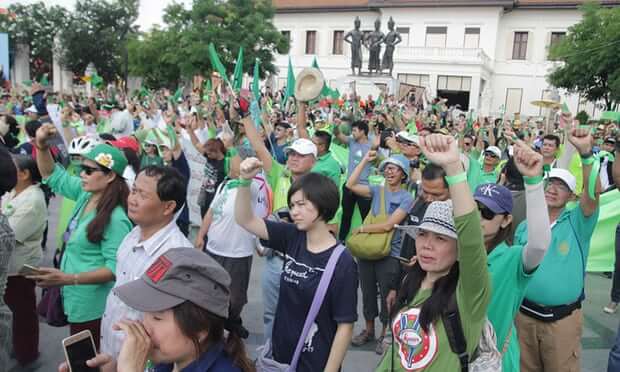
Photo: Protest leader Zaza Saralidze speaks to demonstrators and journalists. Source: RadioFreeEuropeRadioLiberty
Georgia’s Prime Minister Giorgi Kvirikashvili resigned on Wednesday following several weeks of popular protest and political disagreements with Georgia’s ruling party, Georgian Dream. Kvirikashvili has been prime minister since 2015.
Kvirikashvili stepped down in the midst of other resignations by global officials following protests condemning government corruption. On April 23 Armenian Prime Minister Serzh Sargsyan resigned after 11 days of popular protest, as did Jordanian Prime MinisterHani al-Mulki on June 4.
The protests began on May 31st in reaction to the killing of two teenagers in December and the allegedly improper sentencing of their killers. According to protest leader Zaza Saralidze, whose son was one of December’s victims, the two subjects put on trial for his son’s death were not the real culprits, and those truly responsible escaped prosecution because of their relatives who worked in the Prosecutor-General’s Office. Protesters originally called for the resignation of chief prosecutor Irakli Shotadze; however, their demands grew into broader calls against government corruption after Shotadze’s resignation. On June 11, police dismantled protestor tents and detained several members of the political opposition.
Saralidze’s protests follow earlier demonstrations in May against excessive force used by police in anti-drug raids at nightclubs in Tbilisi.
In his resignation speech, Kvirikashvili stated that “we had a number of fundamental disagreements with the party’s leader” Bidzina Ivanishvili, who is the richest man in Georgia.
Kvirikashvili went on to state that “today is the moment when the party’s chairman should have the opportunity to form a team on the basis of his own views.”
According to Georgia’s Constitution, Kvirikashvili’s resignation necessitates the resignation of his entire cabinet. The ruling party now has a week to nominate a new prime minister who will then be officially appointed by Georgia’s President, Giorgi Margvelashvili.
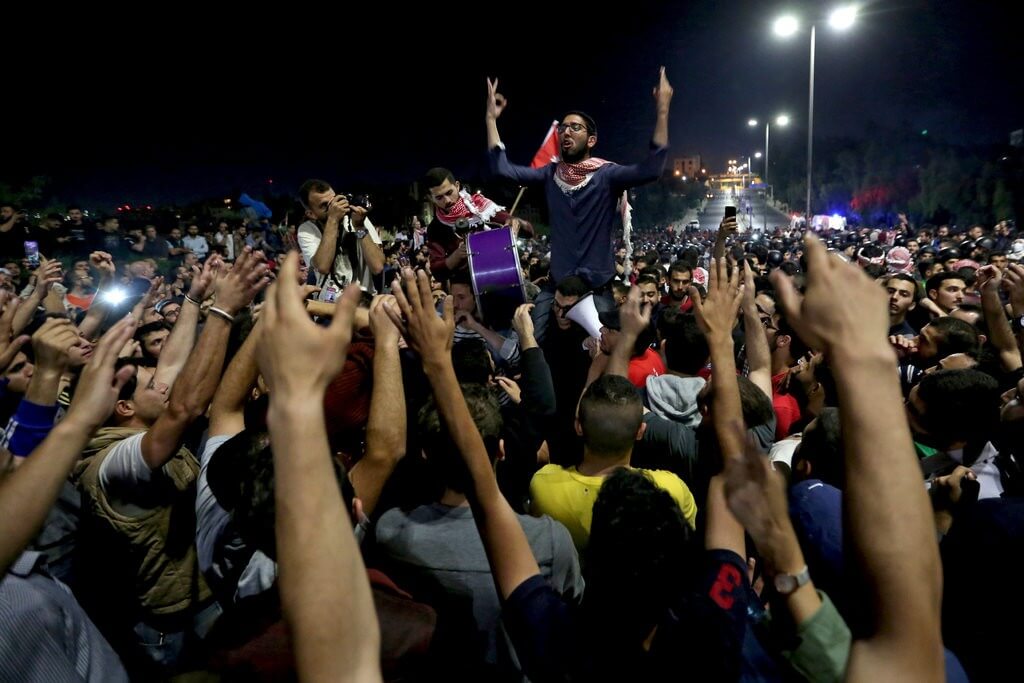
Photo: Protesters outside the prime minister’s office in Amman, Jordan. Raad Adayleh, Associated Press
Malaysia
Malaysian Central Bank Governor Muhammad Ibrahim officially resigned from his position this week after speculations of a multi-million dollar scandal. The scandal involves the 1MDB, a strategic development company, that has been under investigation since 2015. Ibrahim’s resignation was announced by Prime Minister Mahathir Mohamad on June 6. Ibrahim denies any relation to the scandal, however, claiming “…Bank Negara Malaysia will never be party to any such activities that would betray the public trust in us”. The new administration’s Finance Minister, Lim Guan Eng, has suggested that a land sale made by the recent Prime Minister Najib Razak to the Negara Bank is being used to pay off debts to 1MDB. Bank Negara states that the transaction made with Najib Razak was “fair” and in alignment with “relevant laws.”
Attorney General Tommy Thomas highlighted the importance of the case, stating his number one priority is to “nab the culprits responsible for the 1MDB scandal.” Thomas has announced that his department is requesting help from United States, Switzerland, Luxembourg, and Singapore to ensure that the money involved in the scandal is rightfully returned to Malaysia.
Cambodia
Cambodia’s ruling party announced official plans to monitor and control online content intended to “cause instability” leading up to the July election. Cambodia’s Ministries of Information, Interior, and Posts and Telecommunications will work jointly on “controlling all dissemination of information.” Following a recommendation from the National Electoral Council, the regulation also bans journalists from including personal opinion or bias in their reporting. Violations will be punishable with fines of 5 million to 30 million riels ($1,225 to $7,355 USD). Moreover, the articles written in the notice were “loosely termed,” according to a political analyst in Cambodia, and could be interpreted by the government and courts in such a way as to unjustly charge the authors of content that “leads to the destruction of national defense, security and relationships with other countries, public order, discrimination and culture, and national tradition.” Rights and advocacy groups have decried this notice as a violation of freedom of expression. Phil Robertson, Deputy Asia Director at Human Rights Watch, called the notice “a core part of the pre-election censorship,” and said the new measures were sure to result in the arrest and prosecution of opposition activists and NGO campaigners who “still dare to speak truth to the CPP’s power.”
Opposition leader Kem Sokha was denied bail again in an appeals court as he faces trial for charges of treason, which many view as simply a pretense under the recent crackdown on dissent and government opponents to remove him from politics. This is the fourth time he has been denied bail since his arrest in September 2017.
200 Cambodians in the US, supporting dissolved opposition party CNRP, held a protest over the weekend in front of the Japanese consulate in New York City to demand that Tokyo withdraw aid from the upcoming elections until Prime Minister Hun Sen “reinstates democracy” and allows the CNRP to participate in the election. “Without the CNRP, the election will be a joke,” said Meas Chea, a CNRP activist from Philadelphia.
Venezuela
US Secretary of State Mike Pompeo has called for the Organization of American States to suspend Venezuela for causing a humanitarian crisis and for Maduro’s “dismantling of democracy.” The US has already announced that it will not recognize the results of the May 20 elections. Venezuela had announced plans last year to leave the OAS, claiming that the group infringed on its sovereignty. Following Pompeo’s call, Maduro appeared on Venezuelan TV to denounce the OAS and reiterate that the country is leaving it. Venezuelan Foreign Minister Jorge Arreaza vowed not to submit to the international pressure, saying “no imperialist will intervene in our country and hinder our people from voting for their own authorities and having their own democracy.”
Venezuela freed 40 political prisoners and opponents of Maduro on Saturday, bringing the number of those released to 79. The prisoners were each admonished for their alleged violent crimes against the government and then released in a gesture of goodwill. They were barred from speaking to press or on social media, and from travelling abroad. Politicians Wilmer Azuaje and Gilber Caro, plus Raul Baduel, the son of a dissident former general, were among the prisoners released this weekend. Opposition sources say that around 300 activists remain in jail on charges designed to suppress dissent.
Joshua Holt, the US citizen who was held in Venezuelan prison for nearly two years, met with President Trump and described the deplorable conditions in which he and his wife were held.
Colombia
Both of the main presidential candidates, conservative Ivan Duque and leftist Gustavo Petro, have asked the Prosecutor General to show evidence supporting his claims of widespread electoral fraud in March’s legislative elections. Their responses come after Prosecutor General Nestor Humberto Martinez stated that he knew of election irregularities but would not release evidence until after the presidential elections are held. Electoral observers have claimed that almost 3% of first-round ballots have been altered.
A recent wave of killings targeting demobilized FARC rebels is threatening the peace process. Former FARC commander Juan Vicente Carvajal was killed near his home in May, as killings of former militants have increased. Their deaths have incited fear and a distrust of the security forces that have been deployed to ensure their protection as part of the peace treaty.
The latest round of peace talks with another guerilla group, the ELN, has been further complicated by insecurity about the implementation of the FARC agreement. Members of the ELN have emphasized that they will only agree to disarmament if their security can be guaranteed and their vision for a fairer society is implemented.
Three community leaders were killed on Saturday as violence against activists continues. The recent uptick in violence comes as the country prepares for contentious presidential elections, with more than 200 activists killed since January 2017, according to the government.
According to the first poll after the first round of the presidential elections, Duque is ahead by 20 points. The second round will occur in two weeks, when Duque faces Petro for the presidency. Both presidential candidates have chosen women as their vice presidential candidates. Marta Lucia Ramirez, the former Minister of Defense and Foreign Trade, is frontrunner Duque’s running mate. She faces Petro’s candidate Angela Maria Robledo, the Director of the Department of Social Welfare in Bogota.
President Santos has finalized the process to become as a “global partner” of NATO, allowing Colombia to take advantage of NATO resources and protocols. It’s status as a partner would not require engagement in NATO’s military operations.
Mexico
Mexico is responding to the latest round of tariffs from the United States. Their retaliatory tariffs mainly focus on American agricultural products like apples, whiskey, potatoes, and pork. Mexico’s exports to the United States account for more than 80% of total exports, limiting Mexico’s ability to win an all-out trade war. These retaliatory tariffs are mainly targeted to key sectors of President Trump’s support base.
Four years after 43 students went missing in Ayotzinapa, Mexico, a federal court has ruled that a special investigation commission must be created for the case. International organizations and local activists are lauding the move as a step forward in an investigation that has been blocked by the Attorney General’s office.
On Saturday, three female candidates for office were killed across Mexico. Several others including a photographer, a body guard, and a city councilor were found dead along with the candidates. Mexico has seen a surge of political killings, especially of women, as elections on July 1st near.
Mexican businessmen met with presidential frontrunner Andres Manuel Lopez Obrador to discuss development and NAFTA. They agreed to work together to ensure an investment-friendly climate for Mexico after concerns about the left-wing candidate.
On Monday, a peaceful protest in the state of Jalisco turned violent when a group of protestors attacked Navy officers that were surrounding the protest. The violence notably came after recent scrutiny of Mexico’s use of military forces in internal conflicts as a national police force.
Nicaragua
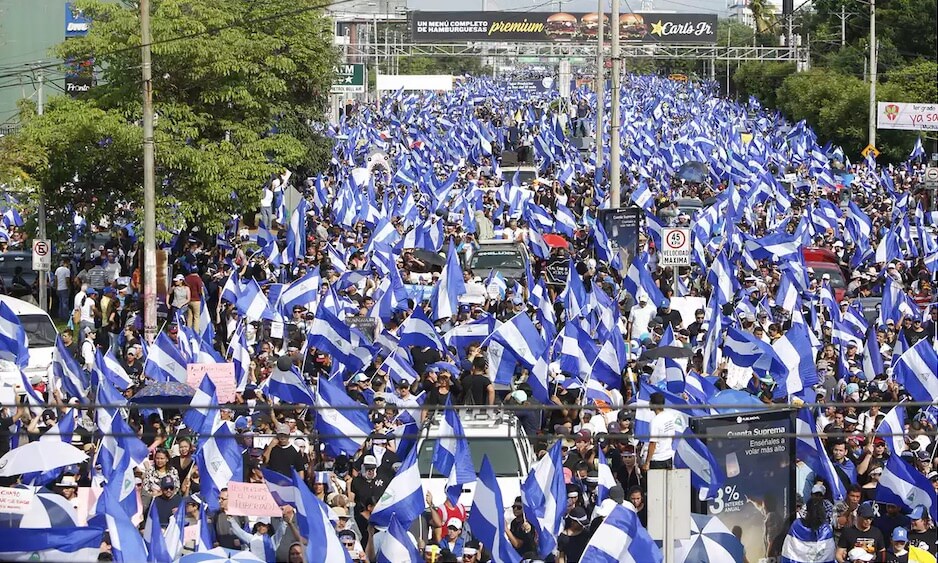
The unrest in Nicaragua, initially triggered by cuts to social funding but now in opposition of President Ortega, has resulted in at least 110 killed and many more wounded as demonstrators are met with police repression. Incidents of snipers in the streets were reported and citizens have been warned not to leave their homes. Between Sunday night and Monday morning, another five were added to the death toll. A preliminary investigation by The Inter-American Commission on Human Rights characterized the protests “by the excessive use of force by the security forces of the State and armed third persons.” Some of these third persons are civilian pro-government forces who opened fire last week on a peaceful march to commemorate the lives lost in this conflict. Amnesty International released a statement calling on the Organization of American States to not abandon the Nicaraguan people as they face harsh repression. As protesters erect makeshift medical clinics to treat victims, civilian government supporters have been “taking potshots” at the clinics and attempting to “create panic,” according to one of the protest organizers.
Pope Francis called for end to the violence in an address to thousands at St. Peter’s Square on Sunday. He said the Church is always a proponent of dialogue and that this situation “requires an active commitment to respect freedom and above all life.” In fact, the Nicaraguan Catholic Church had been facilitating peace talks before last week’s violence resulted in serious setbacks, calling the violence “organized and systematic aggression.”
Business leaders in the country are threatening to withhold taxes from the government until it puts an end to the bloodshed in the country.
Bolivia
Bolivian President Evo Morales denounced alleged coup attempts in Venezuela, citing that they violated “principles of sovereignty and non-interference.” Furthermore, Morales framed the Democratic Charter of the OAS as a means for the United States to garner regional support for its interventions. This comes after American Vice President Mike Pence’s request for the OAS to act against Venezuela.
The Bolivian government announced that it would hold talks with the Public University of El Alto (UPEA) to discuss budgetary demands, which sparked protests that escalated in the death of student Jonathan Quispe. Bolivian Presidency Minister Alfredo Rada denounced the protests as “blocking and obstructing … the city of El Alto” and remarked that the demanded resignation of government authorities is inconsistent with the broader requests of the UPEA. Rada also stated that an investigation into Quipse’s death is being conducted.
Myanmar
Last week, the UNHCR and UNDP signed a Memorandum of Understanding with the Myanmar government to initiate the process for ensuring safe and voluntary repatriation of the some 700,000 Rohingya refugees in Bangladesh. The agreement represents a drastic shift from 6 months ago, when the Myanmar government refused to permit the United Nations to assess human rights violations in Rakhine State. Although this represents an “important and necessary” step towards further cooperation between Myanmar and the UN, many remain pessimistic about the creation of favorable conditions for the return of the Rohingya people. The agreement has not been publicly released, and a statement released on Wednesday had no mention of “Rohingya” or a path to citizenship for them. Kyaw Win, the executive director of Burma Human Rights Network, remarked, “It is very politically convenient for the Burmese government to sign this agreement, and also never commit.”
Refugees and activists also continue to express concerns. They believe the 11 settlements designated for the Rohingya people in Myanmar will become “open air prisons.” Rohingya political activist Ko Ko Linn emphasizes that Myanmar’s dedication to repatriation cannot be genuine when Rohingya people in Myanmar continue to face violent and discriminatory acts. Additionally, the Myanmar government still does not consider the Rohingya people to be citizens. Official documents refer to them rather as “Bengalis,” portraying them as illegal immigrants without acknowledging their generational roots in Myanmar. The National Verification Cards, continuously referred to by the government as proof of active repatriation efforts, only register the Rohingya people, without offering citizenship.
Rohingya refugees in Bangladesh continue to face the imminent threat of the upcoming monsoon season, which would devastate makeshift homes and cause widespread mudslides. Bangladesh is ill-equipped to help the refugees prepare for the monsoons. The International Rescue Committee has been trying to set up healthcare units and distribe “tie-down kits” to stabilize makeshift homes. IRC President David Miliband expressed his frustrations with politics: “humanitarian aid can staunch the dying but it takes politics to stop the killing.”
Chinese conglomerate Citic Group has been leading the construction of a deep water port in Rakhine State. This port is part of China’s Belt and Road Initiative that would give China direct access to the Indian Ocean without having to go through the Malacca Straits. However, the enormous cost of this project at $9 Billion has pressured Aung San Suu Kyi’s government to reevaluate. If the financial costs of this project proves too burdensome and Myanmar defaults on its debt, the port will come under Beijing’s control and threaten Myanmar’s economic sovereignty. Therefore, officials are trying to negotiate the costs down. This situation is uncannily similar to Sri Lanka’s in December of last year. The government was unable to pay its debts to state-backed Chinese firms and formally handing over the port of Hambantota to China. Chinese investments in Malaysia have also induced concerns about the economic power balances in Southeast Asia among Malaysian politicians.
North & South Korea
On June 1st, President Trump hosted North Korean General Kim Yong Chol at the White House. After a 90-minute meeting, it was announced that the June 12th summit in Singapore is reinstated. The meeting, however, did not include US National Security Adviser John Bolton, who had mentioned on a televised interview that the Trump Administration would take a Libya-style approach to North Korean denuclearization. The Libya model refers to the 2003 deal with Muammar Gaddafi to exchange Libya’s weapons of mass destruction for the easing of sanctions. He was eventually killed by US-backed Libyan rebels. Therefore, this reference understandably threatened the June 12 summit. Kim Jong Un’s approach to the Singapore summit represents a notable shift away from the political priorities of Kim Jong Il and Kim Il Sung, who emphasized nuclear development.
Despite the reinstatement of the summit, there remain significant differences between North Korea and the United States’ approach to the possible denuclearization deal. The United States is calling for a “complete, verifiable and irreversible denuclearization” of the peninsula, which may entail prohibiting missile and nuclear testing, limiting North Korea’s supply of fissile material, and closing the Yongbyon nuclear plant.
North Korea’s three neighboring countries have notably high stakes in the Singapore summit. Shinzo Abe of Japan is prioritizing the destruction of long and short-range missiles and reckoning over Japanese abductees. On the other hand, Xi Jinping of China has been supportive of the direct talks between the United States and North Korea, but there is an implicit anxiety that it would negatively affect the diplomatic leverage that China has over North Korea. Furthermore, Xi is interested in managing, as opposed to eliminating, North Korea’s nuclear program. In sharp contrast, South Korea’s Moon Jae-in is the most avid champion of the upcoming talks, since his long-held personal and political priority has been to end the Korean War and ensure peace on the Korean Peninsula.
Thailand
Prime Minister Prayut Chan-o-cha reaffirmed his commitment to enforce his political activities ban, which strictly limits the ability of opposition parties to campaign and recruit candidates. This move effectively ensures that upcoming elections, tentatively scheduled for February, will not be free and fair, since opposition parties will not be able to organize under the same mechanisms as the ruling party. The National Council for Peace and Order has shown a weak commitment to fully repealing the rule, despite statements requesting negotiations over rule modifications before the elections.
A controversial thirty billion baht satellite program is up in the air after Prime Minister Chan-o-cha described it as a work in progress. The program drew outrage this week due to its costs. A Defense Ministry source later described the program as an early-stage proposal that requires multinational support and debate within the cabinet.
Poland
The United Nations report on the criticism of Polish judiciary has been called a “cynical political game” by Deputy Minister of Justice Marcin Warchol. He called the report a “mockery of human rights” as he advocated that the law in Poland ensures a democratically-elected parliament, and that greater parliamentary control of the judiciary makes for a more democratic and accountable system.
There are continued protests by students and employees of the University of Warsaw against Act 2.0 -being deliberated by parliament- calling for more democratic universities. The organizers of the protests have a set of 11 demands regarding university reform.
The motion to censure against Deputy Prime Minister Beata Syzdlo, the minister who instituted judiciary reform and is under scrutiny for her social welfare schemes, has been rejected and Prime Minister Mateusz Morawieki has strongly come out in her support.
Syria
On June 3rd, an Iranian senior military official stated that Iran would not remove its military advisers from Syria. Iran’s presence- unlike that of other military forces, was requested by Damascus. General Massoud Jazayeri, spokesman of the Iranian Armed Forces, stated “Iran and Syria enjoy deep relations that would not be influenced by the propaganda of anyone.” Nevertheless, due to tensions between Israel and Iran, the US and Israel are pursuing efforts to push Iranian forces out of Syria. Israeli Prime Minister Benjamin Netanyahu- threatened to conduct- military strikes on Syria, targeting the posts of Iranian militias and Hezbollah, if Iran does not remove its forces from Syria.
Furthermore, Russia has made an agreement with Israel regarding Iran’s military presence in Syria. Russian Foreign Minister Sergei Lavrov announced “all the forces that are not Syrian should withdraw, and there must be a situation in which only the forces of the Syrian army will be stationed on the Syrian side of the border with Israel.” As Syria’s biggest ally, Russia is eager to use its influence to ensure the stability of Bashar al-Assad’s regime.
USA
The Trump administration has delivered a blow to its closest allies-the EU, Canada, and Mexico– by introducing tariffs on metals, citing national security concerns, and leading to immediate vows of retaliation. With Canadian Prime Minister Trudeau’s failure of a “Maple syrup strategy”, even the closest and the most conciliatory of Trump allies, including French President Macron, are moving further from Trump. Correspondingly, Wall Street has slumped as the Dow Jones Industrial Average closed down more than 250 points on the 31st of May, as investors sold off shares in manufactures and corporations affected by the tariffs. The 44th G7 meeting is underway in Quebec, Canada, and as a consequent of these recent decisions,, Trump is likely to face a chilly response.
In defiance of the United States’ withdrawal from the Iran Nuclear Deal, the European Union is seeking to shield EU companies doing business with Iran and recover damages caused due by US sanctions. Germany, France, and the United Kingdom have sent a letter to Secretary of State Mike Pompeo in a last-ditch effort to negotiate, requesting not to punish EU companies in Iran.
Zimbabwe
Opposition supporters marched through Harare on Tuesday to call for a free and fair presidential election on June 30th. President Mnangagwa, appointed after the removal of Robert Mugabe, has invited international observers for the upcoming elections. Opposition peaceful protests also included delivering petitions to the presidential office and the electoral commission. Protesters were energized by opposition candidate Nelson Chamisa, the head of the MDC-T party.
The following day, a small group of supporters of the ruling ZANU-PF party marched in Harare in response. Both protests were observed by police without interference.
Chamisa promised on Friday to generate a $100 billion economy within a decade, as part of his new election manifesto. He also affirmed his commitment to re-establish ties with Israel, despite a strong existing relationship with Palestine.
Other news:
Maldives – After police interference in the MDP opposition primary that chose Nasheed as its presidential candidate, a group of western nations, including the European Union, have urged the country to hold a “credible, transparent presidential poll.” – Reuters
Armenia – Newly appointed Prime Minister Nikol Pashinyan said that Armenia should hold elections within a year. – Reuters
Jordan – Jordan’s Prime Minister resigned on Tuesday after mounting peaceful protests over a bill that would increase taxes on the working and middle classes. His replacement, Omar Razzaz, has said he will reverse action on the bill after the formation of a government. – Washington Post
Democratic Republic of Congo: Experimental Ebola treatments have been approved by the DRC amidst the growing number of people affected by the Ebola virus in the country. These treatments could bring a major change in the world’s response to Ebola, and responses to this outbreak could help lead a treatment for future generations-Wall Street Journal
CANVAS News Death of Palestinian Medic Sparks Outrage and Investigations
The death of a medic in Gaza has prompted outcry and an investigation by Israeli officials. She was shot by Israeli Security forces as she approached the Gaza border fence. Her death comes as hundreds of Palestinian protesters have been killed by the Israeli military near the border in a recent protests.
Photo: Razan al-Najar’s blood-stained white tunic was carried by mourners. Source: AFP.
The death of 21-year-old Palestinian medic Razan al-Najar in Gaza has prompted international outcry and an investigation by Israeli officials. Al-Najar had been shot by Israeli Security forces as she approached the border fence separating the Gaza Strip from Israel on June 1st. Her death comes as hundreds of Palestinian protesters have been killed by the Israeli military near the border in a recent round of protests.
Al-Najar’s funeral procession on June 2nddrew thousands of Palestinians, including uniformed medical workers, who are in high demand after thousands have been injured or killed since protests began in March.
On Saturday, the United Nations Humanitarian Coordinator released a statement condemning the death of al-Najar. Three days later, Israel’s military issued a statement on Twitter calling her death unintentional and stating that “no shots were deliberately aimed at her”. A follow-up tweet stated that there will be an additional investigation.
Furthermore, Al-Najar’s death comes more than a week after the Palestinian Authority in the West Bank asked the International Criminal Court (ICC) to investigate Israeli responses to protests in Gaza. The power of the ICC investigations are limited, however, because Israel refuses to recognize the Court’s authority.
Despite Israeli and American allegations accusing Hamas of inciting violence, most protesters are unarmed. The rising number of casualties at these Friday protests therefore shows a concerning response from Israeli forces against widely peaceful protests.This excessive use of force at the border is part of a continuing trend against both Gaza and the West Bank. Despite a recent decrease in the total number of protestors due to Ramadan, the number of casualties has continued to rise.
Statements by the Israeli military also continue to equivocate peaceful protestors, small groups of non-peaceful protesters, and extremist groups. These mischaracterizations have been used to justify violent responses towards nonviolent protesters, resulting in unjust casualties. Nonviolent organizers should continue to promote non-violent methods in these protests and continue to condemn any violent response.
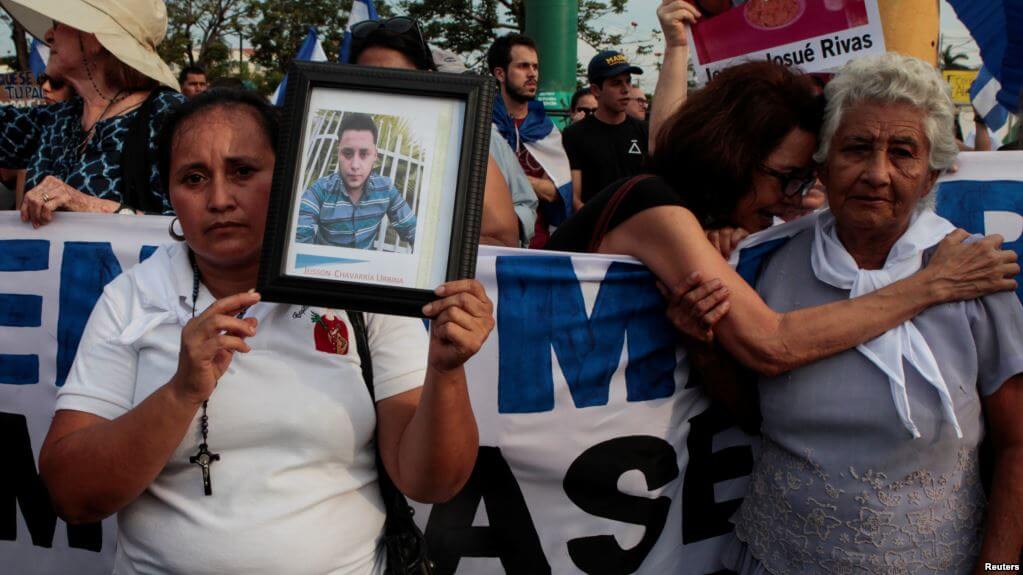
Photo: Nicaraguan mothers protest the killings of their children at demonstrations over past months. The Guardian.
\
Maldives
In a primary election labeled illegal by the ruling government, members of the country’s largest opposition, the Main Democratic Party (MDP), voted resoundingly in favor of Mohamed Nasheed as their candidate for the upcoming presidential elections. Police attempted to halt all “illegal” voting this week, seizing many of the party’s ballot boxes, but their attempts were largely unsuccessful. Creative MDP supporters used an assortment of bins, plastic containers, and cement mixing tubs to make sure people were able to vote. Thanks to these efforts, reports show that Nasheed was able to secure approximately 44,000 votes, or about 85% of the MDP’s support (99.8% among those who voted). Nevertheless, there remain immense obstacles to his candidacy.
The Maldivian government has not only condemned this election as illegal, but has pointed out that Nasheed is an invalid candidate for the presidency. After he was ousted from leadership in 2012, the implemented government followed up his case with a politically-motivated terrorism charge. Nasheed is currently still serving the resulting 13-year sentence, and as a convicted criminal, he is ineligible to be president as per the Maldivian Constitution. The MDP has vowed to fight for the reversal or otherwise elimination of this obstacle, but the future of the election remains to be seen.
Cambodia
Prime Minister Hun Sen has taken up the garment workers’ ongoing dispute with their employer over severance wages and back pay. He has agreed to have the government pay the workers and encouraged the Labour Ministry to amend legislation to ensure that workers are protected from similar situations in the future.
The National Election Committee has randomly assigned numbers for the 20 political parties registered to appear on the ballot. The ruling party, the Cambodian People’s Party, was given number 20 and will appear last. In past elections, the parties have used their number and location while campaigning to help voters recognize them. Hun Sen said on his Facebook page that the CPP’s number 20, at the very bottom of the ballot, would be easy to identify. The election will take place on July 29, 2018, following a three-week campaign period that begins on July 7.
Venezuela
Henri Falcon, who ran against Maduro in the presidential race, is calling for a new election. His entire bid for the presidency went against the main opposition, who thought that his participation would only create a pretense of legitimacy for Maduro’s bid for power. Falcon and his supporters are taking the case to the country’s Supreme Court of Justice, claiming that the electoral process was invalid and that the result must be declared “null and void.” His calls draw attention to the support Maduro’s campaign had received from state media and the alleged bribery that took place when the ruling party set up stands near polling stations to give “bonuses” to poor residents. The Supreme Court is not considered independent, and it is unlikely it will rule in Falcon’s favor.
The EU is preparing sanctions, and has also called for a new election. The bloc clarified that its sanctions will be both targeted and reversible, to limit the impact on the general Venezuelan public, and are expected to be formally adopted at a June 25 meeting in Luxembourg.
The Organization of American States hired a panel of experts to investigate Venezuela’s situation: the group accused the state of crimes against humanity and opened the possibility of a referral to the International Criminal Court. In their report, the panel described a “massive assault on the rule of law” in the country, accompanied by attacks on the judiciary that have resulted in a complete inability of the state to investigate its own crimes. The report outlined many of the crimes allegedly committed by the regime, including multiple murders, at least 12,000 cases of imprisonment and arbitrary detention, torture, rape, political persecution, and enforced disappearances. Following the report, which will be sent to the ICC for follow-up, the OAS secretary-general says he expects tougher sanctions on the country.
On Wednesday May 30, Cuba’s President Miguel Diaz-Canel flew into Caracas for the first time since becoming president in April, to discuss how to strengthen relations. He congratulated Maduro on his re-election and admonished the international community for not supporting the results of the election. Iranian President Hassan Rouhani also congratulated Maduro on his win and Venezuela on its “successful, peaceful and sound” elections.
Joshua Holt, the American who was imprisoned in Venezuela for nearly two years, has returned to the US.
North & South Korea
On May 30th, a top-secret meeting was held between a top aide to Kim Jong Un and a top US official in Singapore. This meeting is one of three between North Korea and the United States to reinstate the summit between Kim and Trump, which was called off last week. Despite the lack of information available to reporters, this meeting is deemed to have been about the logistics for the June 12th summit.
Cho Myoung-gyon, the South Korean Unification Minister, recognizes that there are still significant differences between Pyongyang and Washington but remains hopeful. This comes amidst continued South Korean efforts to reconcile the tension between Pyongyang and Washington while navigating between peace and political alliance. For example, North and South Korea agreed to establish a joint liaison office in Kaesong, North Korea as soon as possible and to hold a meeting later this month to discuss the reunion of separated families. Despite the United States and China’s continued involvement on the issue concerning North and South Korea, the progress made so far is a testament to the divided peninsula’s potential for self-determination and leadership in ensuring global peace.
Colombia
On May 27, Colombia held its first presidential election since the landmark peace deal with FARC that ended a 50-year-long guerilla war. Right-wing candidate Ivan Duque earned 39% of the vote, while leftist, former guerilla Gustavo Petro won 25% and Sergio Fajardo won 24% — none gained the 50% majority needed to win in just one round. Consequently, the country is moving into runoff elections that will pit Duque and Petro against each other. Fajardo supporters will likely be the decisive bloc in this next vote. Fajardo himself has not yet declared which candidate he supports, although his supports seem to be leaning toward Petro. Both Petro and Duque are courting Fajardo, along with the country’s major parties and coalitions.
The Sunday elections had one of the highest turnouts in the country’s recent history, at 53.37 percent, although marred by irregularities. Petro himself decried the pre-marked ballots filled out by his opposition in the political elite. More than 1,239 complaints over electoral offences were registered during the voting day, and all must be addressed by the June 17 runoff election.
Myanmar
On Wednesday, prosecutors submitted a request for the International Criminal Court (ICC) to intervene in the deportation of the Rohingya people from Myanmar to Bangladesh. The document was signed by 400 Rohingya women and girls’ fingerprints. Since Myanmar is not a signatory of the Court, prosecutors are considering using Bangladesh, which is a member of the ICC and a country that has been receiving a huge influx of Rohingya refugees, as the actor through which this request will come to fruition. This has two implications: first, it casts the ICC as one of the few means to hold Myanmar accountable for the atrocities committed; second, this ruling could set the precedent for the Court’s extending its jurisdiction over Syria (which is a not a member ICC) through Jordan.
The United Nations expects 25,000 babies to be born in May and June in Bangladeshi refugee camps housing Rohingya refugees, which is a testament to the large-scale rape and sexual abuse committed against Rohingya women last year in the Rakhine State. Currently, the camps lack the healthcare infrastructure and funding necessary to ensure adequate and sanitary conditions for the refugees and their newborn babies.
The conditions at Bangladeshi refugee camps continue to be threatened by the coming monsoon season. Myanmar’s government claims that it is ready for the refugees to return, but three factors indicate that their return may not be “voluntary, safe, dignified and sustainable.” Firstly, the Rohingya people that remain in Myanmar continue to be internally-displaced in internment camps. Secondly, military acquisition of Rohingya land and property may make the return to original homes impossible. Thirdly, many Rohingya people argue that the National Verification Cards frame them as illegal immigrants from Bangladesh, which relegates them to second-class citizenship and does not recognize their family histories in Myanmar.
Hearings on the charges against Reuters reporters Wa Lone and Kyaw Soe Oo continue. A defense lawyer claims that evidence collected from the two reporters’ mobile phones raises suspicions because some messages were sent from unverifiable sources or were sent after the phones were confiscated. This comes after defense lawyers’ arguing that the documents obtained from their phones were collected without a warrant. Overall, this raises questions regarding the possible involvement of the Myanmar Police in the charges against Wa Lone and Kyaw Soe Oo.
USA
Border control has had a prominent presence in US headlines this week. This was sparked by a push from President Donald Trump to change existing immigration laws. He wants to make it easier for border control agents to jail and quickly deport children crossing the border, and to toughen the process to pursue asylum. The fact that these aspects of immigration are not already in accordance with the president’s wishes is due to what he calls “loopholes” left in the legislation by Congress. “These are not loopholes,” retorted democratic Senator Dianne Feinstein. “They are laws that Congress passed to address the documented injustices facing children in our immigration system.”
In other dangerous developments inspired by the president’s “America First” policy, Trump announced this week that he would be imposing new tariffs on metal imported from the EU, Canada, and Mexico – three among the US’s closest allies. All diplomatic partners have condemned the action and announced retaliatory measures that are targeted to most strongly affect Trump’s bases of support.
Financial irresponsibility did not stop in the international realm this week. The US also announced a softening of the Volcker Rule, which in 2010 had been implemented to prevent another major financial crisis by reining in risky or dangerous trading. Although these reforms are intended to streamline, rather than undermine the legislation, concerns are rampant that this process will not be carried out in the best interests of the general population, but rather in those of the banking elites. “What is critical is that simplification not undermine the core principle at stake — that taxpayer-supported banking groups, of any size, not participate in proprietary trading at odds with the basic public and customers’ interests,” read Paul Volcker himself, the former Fed chairman behind the original legislation.
Zimbabwe
After much anticipation, the date of the Zimbabwean election has been announced for July 30. “I am delighted to proclaim July 30 as the date for the 2018 harmonised elections. These elections will be free, fair and transparent, and the voice of the people will be heard,” read the announcement from President Emmerson Mnangagwa. Mnangagwa, who took over leadership of the country after the ousting of Robert Mugabe six months ago, has thereby finally delivered on his promise that new elections would be held sometime this year. Mugabe meanwhile finds himself absent from the ballot for the first time since the commencement of his 37-year autocratic rule.
In other news concerning the former leader, he failed for the second time this week to show up to a parliamentary hearing concerning the country’s alleged $15 loss in diamond revenue. Mugabe had initially presented this problem in 2016, blaming corruption and foreign involvement for the nation’s losses. Consequently, this parliamentary hearing had been called for lawmakers to hear Mugabe’s evidence. The assembly this week had been organized after Mugabe was absent from first meeting, on May 23. After this second refusal to attend, he has raised a huge red flag about the nature of the scandal. Mugabe is being given one more chance to attend a hearing, now scheduled for June 11, or else he will be charged with contempt and possibly face jail time.
Bolivia
A US judge has absolved the former Bolivian president and his defense minister of any responsibility in the 2003 massacre, in which the military was used on protesters, overturning a previous verdict by a jury in 2017. 67 were killed and at least 400 injured when soldiers fired live rounds into the crowd. Thomas Becker, the U.S. lawyer that filed the lawsuit, said he plans to appeal to the decision.
Last week, a student was killed during a demonstration that called for increased funding for the public university El Alto. The government claims that the death was caused by another demonstrator, but the university denies this and blames the police. Following the death, thousands took to the streets in protest on May 28, where some clashed with police. Economy Minister Mario Guillen has called for talks with the administrations of Bolivia’s 15 public universities, where an estimated 440,000 students study, to resolve the funding issue.
Syria
In an interview with Russia Today, President Bashar al-Assad called on the United States to withdraw from the region given its support of the Syrian Democratic Forces in northern Syria. He reinforced his demand with the threat of using military force if the United States does not withdraw soon. Kino Gabriel, an SDF spokesperson, cautioned Assad when he claimed that Syria’s militaristic response to US intervention would “lead to more losses and destruction and difficulties for the Syrian people.” Furthermore, the US Department of State responded by stating that its intentions are to defend the US and its partners against ISIS and that it does not plan on using force against Syria or Iran. These statements come after inconsistent signals from Washington regarding the US’s plans in Syria.
Commenting on Trump’s calling him an “animal” in April, Assad stated, “what you say is what you are” and declined to offer a nickname for Trump in response. In the same interview, Assad commended Russia’s leadership in its intervention over the proxy battles between Israel and Iran. Moreover, he stated that in response to Israeli air strikes, Syria has been working on strengthening its air defenses with help from Russia.
Russia, on the other hand, has been striking a delicate diplomatic balance between relations with Israel, communication with the United States, and partnership with Iran in supporting the Assad regime. It is not surprising, then, that Israel has been working on developing good relations with Russia in hopes that interest convergence will convince Russia to help Israel contain Iran’s expanding military presence in Syria.
The new Law No. 10 has been established in Syria. Although this law would purportedly allow the government to seize all unclaimed properties and develop them, it functionally prevents those who oppose the regime from regaining their property that was lost during the Civil War and leaves Syrian refugees permanently displaced from their homes. It is also seen as a means of ethnic cleansing, since the regime will dispossess Sunni Muslim opponents while allowing Shia Muslim supporters to live in the newly developed areas.
Nicaragua
A Mother’s Day protest against Ortega and his government took place this Wednesday, led by the mothers of 83 victims killed in previous protests. It had been planned as a peaceful demonstration, but devolved into violence when pro-government forces opened fire. Eleven were killed and 79 wounded. Senior members of Nicaragua’s Catholic church had begun mediating peace talks between Ortega and the student-led opposition in mid-May, but called off negotiations after this latest deadly protest. Calls for Ortega’s resignation continue.
Thailand
On May 23rd, the Constitutional Court declared that the controversial organic bill was constitutional. Following this verdict, Thailand’s Deputy Prime Minister, Wissanu Kreangam, has announced that the next election will happen 11 months from now, perhaps even earlier.
Thailand will be the first country in which China and Japan implement their economic platform to develop the regional economy. Thailand expects this foreign investment to generate $43 billion USD by 2023. China seeks to use Thailand to further its aims under the One Belt One Road Initiative while Japan plans to invest in the ten targeted industries and Eastern Economic Corridor (EEC) infrastructure projects. Thailand’s EEC initiative aims to attract high-technology investment and shift Thailand away from a labor-intensive economy.
After China’s banning imports of electronic waste due to the chronic health problems in the recycling industry, Thailand has faced a huge influx of global e-waste. It is suspected that this waste has been illegally imported by companies. In response to concerns that this could harm the environment and people’s health, the Department of Industrial Works is considering banning certain types of e-waste and strengthening its enforcement of existing laws.
Other news:
Cuba – Parliamentarian Mariela Castro, daughter of former president Raul, has announced the government’s plan to legalize gay marriage in the country by eliminating a stipulation in the constitution that specifies marriage as between a man and a woman. – ABC News
Spain – Prime Minister Mariano Rajoy has been forced out of office by a parliamentary no-confidence vote. He will be replaced by socialist leader Pedro Sánchez. – BBC
Hungary – In the latest of the government’s series of “Stop Soros” bills, Orbán has decided to target those who distribute food, informational leaflets, or legal advice to asylum-seekers. Offenders could face prison sentences and heavy fines. – Al Jazeera
Ukraine – Dissident Russian journalist Arkady Babchenko, who was believed to have been assassinated earlier this week, revealed that his staged killing was actually part of an elaborate operation by the Ukrainian secret services. The hoax concerns many international observers, however, who worry now that future Russian killings may be dismissed as illegitimate as well. – NYTimes
Ireland – The nation has voted overwhelmingly in favor of legalizing abortion. 66% of voters chose ‘yes’ to repealing the constitutional amendment that banned abortion in all but the most extreme circumstances. – The Guardian
Laos – Laos and China have reinforced their partnership in a range of issues, including traffic infrastructure, agriculture, and tourism. Furthermore, Chinese President Xi Jinping cited the importance of the China-Laos partnership in furthering the Belt and Road Initiative, environmental protection, and cooperation in international affairs. – XinhuaNet
CANVAS News What you need to know about Zimbabwe’s upcoming elections
On Wednesday, Zimbabwean President Emmerson Mnangagwa announced that the country is to hold presidential and parliamentary elections on July 30th. In less than two months, Zimbabwean citizens will have the opportunity to vote, in the first elections since the ousting of Robert Mugabe in November last year. What do you need to know about the upcoming elections?
Photo: Opposition MDC supporters wave flags at a rally to launch their election campaign in Harare, Zimbabwe, Jan. 21, 2018. VoA. Associated Press.
On Wednesday, Zimbabwean President Emmerson Mnangagwa announced that the country is to hold presidential and parliamentary elections on July 30th. In less than two months, Zimbabwean citizens will have the opportunity to vote, in the first elections since the ousting of Robert Mugabe in November last year. What do you need to know about the upcoming elections?
Legitimacy
For current President Emmerson Mnangagwa, the 2018 elections are mostly about legitimizing his presidency. Following the November 2018 coup, in which the military leadership installed the former vice-President as the country’s new leader, Mnangagwa needs democratic confirmation through the ballot. Mnangagwa has invited Commonwealth election personnel to monitor voting in Zimbabwe for the first time since 2002, when Harare was suspended from the group over accusations of rigged elections. Experts claim that, if qualified as free and fair, the July-elections could be an important step in bringing foreign investors back to the southern African country after a decade of economic decline.
Nevertheless, there are grave concerns about several aspects of the upcoming elections. Despite Mnangagwa’s narrative of free and fair elections, many still fear rigging. This is not without a reason. A little over a week ago, deputy Minister of Finance Terrence Mukupe made a controversial statement during a ZANU-PF meeting, claiming that those who were behind the military intervention to oust Mugabe will never let MDC-T leader Chamisa take over if he wins the elections.
The electoral Act still does not allow Zimbabweans who live outside the country to vote. Most recently, the refusal of Justice Minister Ziyambi Ziyambi to have an open tender for the procurement of ballot papers and other related material sparked outrage among opposition and civil society, who believe this poses a serious threat to the credibility of the elections.
Main Competitors
The upcoming elections are also to be seen as a clash between old and new. The old political generation is represented by a 75-year-old former ally of Robert Mugabe. Emmerson Mnangagwa still rides the narrative of the independence war like Mugabe did, and is strongly supported by the current upper echelon of the military and by former military leaders who have taken their places in government.
A younger generation of political life is being represented by Nelson Chamisa. The 40-year-old was put forward by the MDC after long time opposition leader Morgan Tsvangirai died of cancer in February this year. Chamisa has prioritized the reform of the country’s social systems as part of his bid to win the Presidency, and has also promised to return land to dispossessed white farmers. Nevertheless, the MDC-party is still fractured, with several party members still not fully supporting Chamisa’s race.
Finally, the G-40 faction, who lost the battle against the Crocodile last November, seem set to mobilize once again. Under the name National Patriotic Front, the Mugabe clan is backing Ambrose Mutinhiri – a man who served nearly four decades under Mugabe and had fought alongside him for liberation.
Election Prospects
Will any of these competitors be able to defeat ZANU-PF in the upcoming elections? In the view of many experts, no opposition party is in a position to challenge the ruling party. ZANU-PF is happy to hold these elections simply because they’re confident of victory, rather than for commitment to a new dawn of democracy. “Though the election looks like it will go to the wire, the greater likelihood, based on cold-blooded analysis, is that experience, depth and state incumbency will triumph over youthfulness,” said Eldred Masunungure, a professor of political science at the University of Zimbabwe.
What role could civil-society and social movements play in the upcoming elections? For an in-depth analysis of the situation in Zimbabwe, check our recently update ZIMBABWE COUNTRY ANALYSIS online.
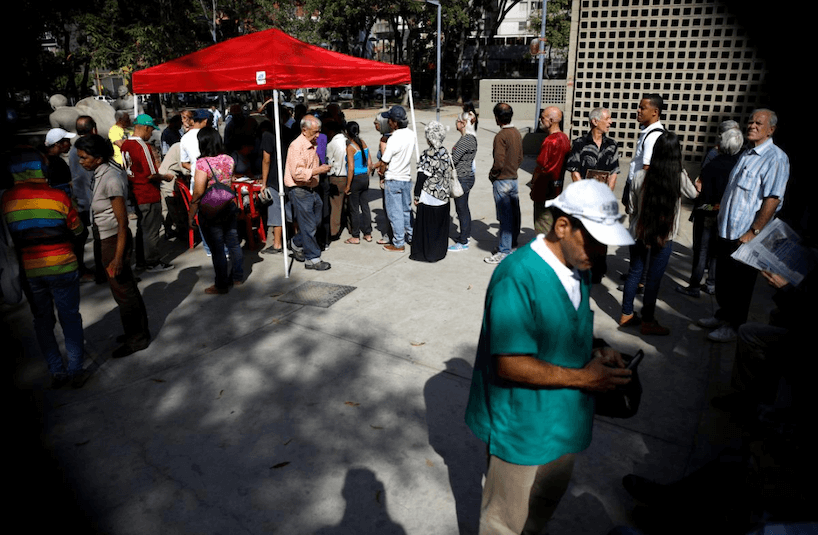
Photo: Venezuelan citizens wait to check in at a “Red Spot” to verify they cast their votes during the presidential election. Reuters.
Cambodia
Cambodia’s National Ministry of Interior has threatened officials of the CNRP, the dissolved opposition party, with seizure of assets if they continue calling for a boycott of the election. This has alarmed observers, who say there is no legal precedent for such a move: the ministry spokesperson has argued that as the CNRP officials are no longer residents of the country, the seizure is permissible. Several CNRP officials and activists have fled the country and are living in self-exile following the dissolution of the party last year. However, Sok Sam Oeun, lead attorney at the Amrin Law and Consultations Group, says he has “no idea” what legal provision the government could use, as calling for a boycott of an election is not illegal in Cambodia. Furthermore, a senior election observer at COMFREL, one of the two observers who declined to send representatives, says the call is an expression of free speech, not an “obstruction” of the election. The former deputy president of the CNRP has compared the threat of seizure to Khmer Rouge tactics, where the regime would evacuate citizens from their homes and towns, only to take all their belongings. A CPP spokesperson has stated that average citizens who may choose to boycott the election will not face any repercussions.
As of Thursday, the National Election Committee has approved all 20 of the political parties that registered for the election. Only two of these currently hold parliamentary seats, the ruling CPP and the Funcinpec party, which only gained seats when the CNRP was dissolved, and not through an election. The remaining parties are all considered to be government allies or too small to gain significant votes.
The country’s second lese majeste case resulted after a barber allegedly shared a post on Facebook that insulted the king.
Venezuela
Maduro won the controversial election this weekend, amid low voter turnout. He has secured himself another six years of rule but his main rivals have claimed the election was fraudulent, and are joined in this assessment by many other countries. Falcon, who had run against him, said “The process undoubtedly lacks legitimacy and as such we do not recognize it.” Maduro won with just under 68 percent of the vote, beating Falcon by nearly 40 percent; Bertucci trailed behind at 11 percent. Many of the voters paused by pro-government stands called “red spots,” set up near polling stations, where they would scan their “fatherland” cards in the hopes of winning a prize promised by Maduro during his campaign.
The US is still deliberating placing sanctions on Venezuela’s oil sector: a move considered to be a “game-changer.” The economy already in crisis and with the price of crude plunging in the country, the oil-dependent state is expected to be devastated by oil sanctions.
Myanmar
A report by Amnesty International details atrocities committed by Arakan Rohingya Salvation Army where the group massacred nearly 100 Hindus. In it, Amnesty warns both sides who have murdered civilians that their actions are unacceptable, prompting other media sites to wonder which side Amnesty is on. It is these attacks, and ones like them, that prompted the brutal retaliation of the Myanmar army leading to the mass exodus of around 700,000 Rohingya.
Canada and Members of Parliament in the UK support referring the Rohingya case to the International Criminal Court for a full independent investigation.
Two antiwar activists were sentenced on Tuesday, May 22, to two months in jail for unlawful assembly. They had failed to gain permission from the proper authorities before demonstrating against the conflict between the Kachin Independence Army and the Myanmar state military. The two insist they were arrested unfairly and that the country’s Peaceful Assembly and Peaceful Procession Law, used as legal basis for their arrests, was unjust. As well, they state the court, and the entire judicial system, is unfree and entirely too influenced by the administration. Their lawyer will file for appeal.
The trial for the two Reuters reporters accused of violating the Official Secrets Acts continues. This week, the prosecution has asked to introduce the reporters’ phones into evidence. This is a shift from previously, when the case rested only on the documents the police claimed the reporters were holding in their hands when they were arrested in a cafe late last year. The prosecution has not explained how the phones will pertain to the case, but the judge nonetheless will allow printed versions of the phone’s contents to be submitted. The defense lawyer says he is concerned about tampering with the evidence, as there is no proof the evidence has been properly extracted and the phones have been in the police’s possession for some time. As well, some documents may have been sent to the reporters without their knowledge in the meantime: the reporters would never have seen those files. The next hearings are scheduled for Monday and Tuesday, May 28 and 29.
Myanmar and Bangladesh tensions continue near the border. Refugees on the Bangladeshi side are erecting makeshift homes for themselves in the no-construction zone. The Myanmar border guard has been using loudspeakers to make announcements demanding the Rohingya leave the are, which Bangladesh authorities say are disrupting life and instilling fear into the people on their side of the border. Myanmar remains resolute that the growing population near No Man’s Land is unacceptable: repatriation efforts remain at a near stand-still.
Planning and Finance Minister U Kyaw Win has resigned from his post as reports reveal that he may be investigated for corruption.
Nicaragua
Peace talks between Nicaragua’s President Daniel Ortega, the opposition, and civil groups, agreed to only one week ago, already came to an impasse on Wednesday and are now suspended indefinitely. The negotiations came to a halt when the opposition demanded the resignation of the president, elections, and constituent assembly to reform the constitution. The government, and some observers, decried these demands as far outside the reaches of peace talks. Foreign Minister Denis Moncada said the opposition was using the dialogues to push “toward a soft coup.”
Since the collapse of these talks, two more have died in clashes. More than 75 people have died, and over 850 have been wounded.
The Organization of American States’ Secretary General Almagro has called for early elections in Nicaragua, and on Monday the Inter-American Commission on Human Rights (IACHR) condemned Nicaragua’s response to weeks of protests against President Daniel Ortega, criticizing a crackdown that resulted in rights abuses including torture and possibly even murder.
North & South Korea
The summit between North Korean Leader Kim Jong-un and US President Donald Trump has been called off. Trump canceled the meeting, which had been scheduled for June 12 in Singapore, citing “tremendous anger and open hostility” as a main factor that drove his decision. Trump followed up this announcement with a broad threat, that the US military would be ready to act if North Korea were to try anything “foolish” in retaliation for the called off talks. So far, however, North Korea has responded rather with the statement that it is ready to talk “at any time in any form” with the US delegation.
Zimbabwe
Deputy Minister of Finance Terence Mukupe made headlines this week when he publicly stated that the army would not allow an opposition leader to take charge of the country, even if democratically elected. This echoes Mugabe-era threats by the military, also warning the opposition of intervention if there were to be an attempted power transition. The government has attempted to distance itself from Mukupe over his comments, but they regardless reflect the lingering fears and feelings of many in Zimbabwe.
The country has now applied to rejoin the Commonwealth. Zimbabwe had been part of this bloc of former British colonies until 2003, when Mugabe withdrew after the nation’s membership was suspended over disputed elections. Many in the UK have expressed great enthusiasm for this move, but with British Foreign Secretary Boris Johnson stipulating that “Zimbabwe must now show commitment to Commonwealth values of democracy and human rights.”
Finally, Former President Robert Mugabe was notably absent from a parliamentary hearing this week regarding the nation’s $15 billion loss in diamond revenue. Mugabe had initially presented this problem in 2016, blaming corruption and foreign involvement for the nation’s losses. Consequently, this session of parliament had been called for lawmakers to hear Mugabe’s evidence, making his absence a red flag for many. The former president himself has in fact walked back on his initial claim since making it, dismissing the losses rather as an “urban legend”. The parliament has summoned him again for a new session on May 28.
Other news:
Syria – State news network SANAA has reported that a military base in Homs has come under fire, but neglected to give further details. Homs was recently taken back into Syrian control, after the last remaining terrorists were evacuated and the Syrian flag was raised. This story is still developing. – Wichita Eagle
Mexico – The second presidential debate, which took place on Sunday, again featured attacks against frontrunner Lopez Obrador and a focus on how the candidates will handle Trump and his agenda. NAFTA negotiations continue with Trump calling Mexico and Canada “spoiled.” – Reuters | Reuters
USA – President Trump is known for his use of Twitter. He has also been known to block those users who criticize him. This week, however, a federal judge ruled this practice to be unconstitutional, calling it a restriction on free speech. This case addressing how social media interacts with the constitution is a novel one, and will likely have impact far beyond just the president’s twitter. – NY Times
Photo: The families of victims of the ongoing protests in Nicaragua demand justice. Reuters.
Venezuela
Presidential elections are only two days away, and the National Electoral Council says that the country is prepared, with all materials having been distributed both domestically and internationally. As of Wednesday, Bertucci still will not step down to clear the way for Falcon.
A poll conducted by International Consulting Services shows 67.5 percent of the surveyed population saying they are “absolutely certain” they will participate in the May 20 elections. Around four percent said they are certain they will not participate, and 1.3 percent remain unsure. As such, nearly 14 million Venezuelans are expected to vote.
The opposition coalition, Broad Front, is calling for abstention from the elections. On Wednesday, it called for supporters to demonstrate on the streets. Protests, however, are feeling ever more futile to the average Venezuelan. While several hundred people turned up this week to protest the “farcical election,” the crowd pales in comparison to the hundreds of thousands seen in past demonstrations. But the violent repression and absolute lack of change has disenfranchised much of the opposition. Furthermore, with the countrying emptying out as citizens flee food shortages and soaring inflation, turnout is expected to be sharply reduced.
Canada has banned Venezuelan expats residing in several of the its provinces from casting their votes in the presidential election. Venezuelan embassies and consulates located in Ottawa, Toronto, and Vancouver will not be permitted to set up polling stations for their constituents. Venezuelan Foreign Minister Jorge Arreaza took to Twitter to criticize the move, saying the Canadian government is violating the voting rights of more than 5,000 Venezuelan immigrants and instructing embassies to ignore Canada’s direction.
Prison inmates have taken over a jail in Caracas and released videos that show prisoners roaming the notorious prison freely, breaking locks and demanding their release. They also make claims of torture and human rights violations. Many of the inmates are jailed opponents of Maduro and have been held without trial. Both those inmates and American political prisoner Joshua Holt have also posted videos saying that they fear for their lives if the government retaliates with a “brutal crackdown from authorities.” The Venezuelan government had tried earlier to claim that it had regained control over the prison, but then changed its statement to having “normalized” the situation after the inmates refuted its claim. In response, an ad hoc committee was set up by Venezuela’s Public Prosecution to investigate the takeover. Attorney General Tarek William Saab has also agreed to relocate over 70 of the prisoners to other facilities.
In March, nine military officers were arrested under suspicion of plotting a coup against Maduro. This week, the families of the officers are demanding their immediate release. They argue that the evidence against the officers is circumstantial, due process was violated, and that the accused are in fact innocent.
Myanmar
A recent UN report warns that violence against ethnic minorities is increasing, perpetrated directly by the government. The report details the dangers being faced not just by the Rohingya, who have been the biggest focus of media attention, but also by the Karen, Kachin, and other peoples who are suffering under the rule of the Myanmar State.
The conflict in Kachin State saw a brutal week. On Monday, Myanmar launched three air attacks on the area around a brigade of the Kachin Independence Army (KIA). That made it the third straight day of attacks on this group and one of many against the people’s independence movement overall. Although the conflict has been ongoing for approximately 60 years, 2018 has seen a massive spike in violence. Just since January, 20,000 people have been displaced due to the conflict.
Activists have taken to protest the violence and atrocities in the capital Yangon this month, calling for an end to the conflict and for aid to be provided to the displaced civilians from Karen. This week, however, the government charged 42 of these activists with violating the country’s peaceful assembly law. The government states that the activists did not obtain official permission for the demonstrations from local authorities. The peaceful protesters, along with many human rights groups and legal aides, see this crackdown on nonviolent demonstration as a threat to the freedom of expression and assembly in Myanmar.
Mexico
Independent candidate Margarita Zavala has dropped out of the race for the presidency, giving a possible boost to Lopez Obrador’s rivals. The peso jumped in response, as investors had been wary of Lopez Obrador’s leftist leanings.
Thieves managed to steal more than 300 million pesos (15.4 milllion USD) in a cyber attack targeting five major companies and banks across the country. They transferred the money to different accounts, many which then promptly withdrew cash from ATMs. The money that was not withdrawn is expected to be recovered. Mexico’s central bank said on Tuesday that it will create a new unit to create and publish guidelines on information security for the country’s banks.
Journalist Juan Carlos Huerta was executed by gunmen this week, making him the fourth journalist to be assassinated in the country this year. The news radio host had been targeted and trapped by his attackers, according to police who were catch the fleeing perpetrators. Many have noted also that this killing came exactly one year after that of acclaimed crime reporter and writer Javier Valdez, an esteemed journalist known well beyond Mexico.
North & South Korea
After a relatively positive and hopeful progression of events between North Korea, South Korea, and the US, tensions have once again begun to emerge. A statement by a North Korean official this week kicked off the shift, telling the world that Kim Jong-un would not be interested in talking part in talks where the only result would be unilateral nuclear disarmament. Rather, there is a hope and expectation for concessions on both sides. US President Trump replied with the promise of ‘protections’ in return for the removal of all nuclear weapons, but as the true negotiations have not yet begun, this is a relatively vague offer.
South Korea has downplayed the North’s threats to pull out of the upcoming talks, after it did cancel a high-level Korean meeting on Wednesday, citing the progress and promise of last months talks between Kim Jong-un and South Korean President Moon Jae-in. In this meeting, they had both stated a commitment to complete denuclearization of the entire Korean peninsula, leading the nation to expect Kim’s concessions to come from other areas of policy. Analysts believe that this recent threat is an attempt to build leverage in advance of that negotiation. An advisor to Moon has suggested, however, that it could be time for an end to the partnership between the US and South Korea, to create a more “natural” political environment.
Despite the flurry of ongoing diplomacy, it was found this week that North Korea is continuing to use cyberattacks against defectors. Through malware on Google Play and phishing attempts through Facebook, North Korean hackers have been seeking to infiltrate the personal devices of defectors, in order to take control of these devices and steal all the data, photos, and information they contain. According to McAfee, the software company that discovered the malware, only about 100 instances of infection have been found, although the hackers have been targeting tens of thousands of defectors.
USA
The Trump administration has announced a rule that will strip government funding from any women’s health organizations that perform abortions in the US. The rule takes specific aim at Planned Parenthood, which serves 41 percent of women who receive federally funded family planning services. Executive Vice President of this organization called the new rule “outrageous” and “dangerous” for women across the country. The restrictiveness of the bill could force many clinics to shut down, resulting in a lack of any healthcare at all for women in need, especially in places where Planned Parenthood offers the only clinics within a reasonable distance to those it serves. It will likely also raise the national rates of unintended pregnancies and lead to an increase in mortality rates.
In other news from Washington, yesterday marked one year since the beginning of Special Counsel Robert Mueller’s investigation into Russian meddling in the 2016 election. Trump called out the probe as a “witch hunt” and again denied all accounts of collusion or obstruction. Many outside the president’s close team, however, feel that the investigation is a serious threat to the Trump presidency and the legitimacy of the election results. In any case, it will no doubt continue to be of paramount focus as its second year moves forward.
Another state has felt the empowerment of teachers who deserve more pay and better funding for their classrooms. North Carolina has become the latest state to see its educators come together and make their voices heard. Here, the central issue is funding, with teachers calling it an afterthought of the budget. Mark Jewell, president of the North Carolina Association of Educators, expressed their grievances. “We have not had a textbook adoption in 15 years. We have school districts deciding whether or not to pay the light bill or buy toilet paper. We have classrooms … that are 35 students and higher in some instances. This is not normal. This is not the North Carolina way.”
Syria
The Organization for the Prohibition of Chemical Weapons has confirmed the use of chlorine gas in an attack on a rebel-held town in early February. This news comes in the middle of the investigation into the presumed use of chemical weapons in Douma last month. The same organization is conducting that investigation as well, and parallels between conditions may now provide additional insight into the examination.
In another kind of study on human conditions, a UN official made a statement this week regarding the effects of international policy on the Syrian people. “Civilians bear brunt of unilateral sanctions, exacerbating unparalleled suffering and destruction,” asserted Idriss Jazairy, UN Special Rapporteur on the negative impact of the unilateral coercive measures on the enjoyment of human rights. Since the outbreak of the conflict, the Syrian GDP has fallen by two-thirds, the cost of food is eight times higher than it had been, humanitarian aid is being denied to civilians because of unintended bureaucratic consequences, and international sanctions have targeted the mechanisms and rights of average people to a critical degree. “The Syrian people should not have to suffer for what has become an international conflict of unbelievable complexity. All those seeking to meet basic human rights require our help, not our red tape.”
Regarding the conflict itself, a major development this week saw government forces take control of the Homs province- the largest province in Syria. Rebel fighters and many civilians are now evacuating the last rebel-held enclave in the region, as Syrian flags are raised throughout the area. This victory is especially significant for the Assad regime, as Homs had been one of the first places to break away from government control at the start of the conflict.
Russian President Vladimir Putin was happy to congratulate Assad on this and other recent military achievements by the Syrian army. The two leaders met this week for joined talks and a bit of self-congratulatory discourse ahead of Putin’s meetings next week with many European leaders pursuing alternate strategies for the Syrian conflict. Observers have called the meeting a way for Putin to grant more significance to Assad and to delegitimize the others’ calls for an ouster to take over in Syria.
Nicaragua
President Daniel Ortega met this week with opposition leaders and protesters in an attempt to end the weeks of unrest that have led to the deaths of at least 60 demonstrators. In these talks, Ortega said that the Nicaraguans killed in these protests were criminals, to which the opposition called him a “murderer” and read out the names of the dead. “We have come to demand you order the immediate halt of the attacks. You’re the boss of the paramilitaries, of the troops, of the mobs backing the government,” said Lester Aleman, a leader of the student coalition present. The opposition is calling for more than the end of the attacks, though. At the core of this riff is the oppression, mismanagement, cut pensions, and dictatorial disposition of Ortega and his government. The calls for democratization are therefore much more than the subject at this particular negotiating table. They are a reflection of the need for genuine concessions, that if not met, could boil over.
Outside the discussion room, the streets are still rife with protest. Thousands of people this week have gone out to call for Ortega to step down from the presidency, felling yet another of the costly Chayo trees installed by the first lady. Additionally, at least two demonstrators have been killed since the start of the week. With the ongoing talks proving less productive than the opposition had hoped, the clashes could continue to be fatal for the foreseeable future.
Zimbabwe
The High Court of Zimbabwe has banned the nation’s traditional leaders from participation in politics. Local chiefs, head persons, and village heads are no longer permitted to make political statements or to formally support any political parties. The court ruled that to do otherwise is a violation of the constitutional right to a free and fair election. One Chief has been further ordered to formally retract his publicly stated support of the Zanu-PF ruling party.
Public workers have rejected an offer from the government for a salary increase, arguing that the proposed 15% raise is not enough. This offer was already an improvement from the 10% suggested last week, but with this more recent increase still leaving recipients below the poverty line, workers are continuing to push for a better livelihood. Although the government of Zimbabwe already spends more than 90% of its national budget on salaries and pensions, the workers are confident that Mnangagwa will be trying hard to please them nevertheless, in light of the upcoming elections.
Other news:
DRC – The Ebola outbreak in the DRC has now reached a city in the northwest of the country, raising serious concerns that its spread will be much more difficult to control. The World Health Organization is treating the outbreak very seriously, deploying personnel and resources to contain the disease as well as possible. So far, 44 cases of the hemorrhagic fever have been reported in the DRC, with 23 cases having resulted in death. – CNN
Israel – Violence at the border with Gaza has left at least 60 dead and injured hundreds of others. Although Isreal has defended this use of lethal force as a necessary defense measure, human rights advocates including Human Rights Watch, Amnesty International, and numerous UN officials, have gravely condemned it. – NYTimes
Cambodia – The garment workers’ protest continues as workers await the severance and back pay they are owed. Separately, two prominent election observers have declined to send representatives to this years elections. – Phnom Penh Post | Fresh News Asia
Thailand – An editor-in-chief at the Bangkok Post was forced to step down over his critical coverage of the military government. He had refused to “tone down” the coverage by the board of directors, many of whom have ties to the government. – South China Morning Post
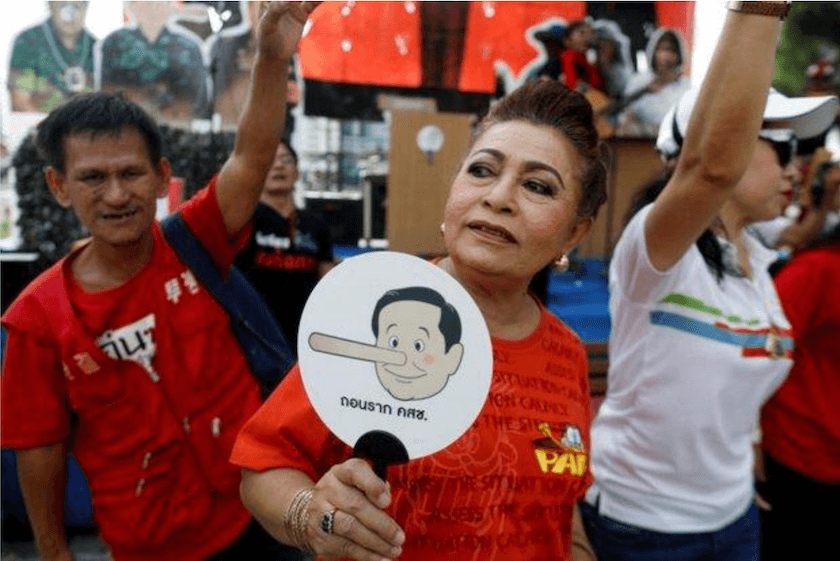
Photo: Protesters in Thailand, demanding the junta stop rescheduling elections. Bangkok Post.
United States
The scandal embroiling the legal team of President Trump heated up further this week. Michael Cohen, a Trump lawyer, was exposed for exploiting his closeness to the president as a way of signing on to lucrative consulting contracts with major American companies. AT&T, an American telecommunications giant, and Novartis, a major pharmaceutical company, both hired Cohen for his promised insight into Trump’s thoughts and policies. Having come to view the contracts as a scam, both of these companies have called the deals a mistake. Regardless, the surfacing of this information presents a grave concern for the fairness of information and policy. If Cohen had delivered on his proposals, he would have given insider information to only those companies that paid him specifically for it. The reveal also raises suspicion and alarm over whether President Trump himself knew about the deals. If so, a corruption or otherwise tremendously serious scandal could ensue. Another member of the legal team, the newly recruited Rudy Giuliani, has also furthered the chaos surrounding the White House this week. In keeping with his media trend of last week, the lawyer has again revealed information about agreements andpayments with a Russian company that could be detrimental to both the president and the ongoing investigation into the 2016 election.
In the international realm, the new US embassy in Jerusalem is sparking turmoil. Saudi Arabia has warned that the move will increase instability in the Middle East, a leader of Al-Qaida hascalled for jihad, and protests in Gaza have turned deadly. Haaretz reports that Israeli gunfire there has killed at least 37 Palestinians and left more than 1600 injured so far. The US had been fully aware that this would be a deeply troubling and divisive move, but its true magnitude is as of yet still unfolding.
Syria
A strike by Israel on Iranian targets in Syria has left at least 42 dead this week. The attack was reported by the Israeli military to have hit nearly all of Iran’s military installations in the country, specifically weapon storage locations, logistics sites, and intelligence centers. The Syrian Observatory for Human Rights, a monitoring group from the UK, has added that many of these sites were posts for Iranian-backed Syrian militias near Damascus. Israeli Prime Minister Benjamin Netanyahu made a statement regarding the strike directly to Syrian President Bashar al-Assad, telling him that this was an attempt to send a clear message. “We are in the midst of a protracted battle and our policy is clear: We will not allow Iran to entrench itself militarily in Syria.”
In other developments on the Syrian War, the ninth round of peace talks have begun. Sponsored by Iran, Russia, and Turkey, the assemblage is this time notably missing the United States. Regarding the absence, Russian presidential envoy Aleksandr Lavrentyev stated, “We are hoping that common sense will prevail and they [the United States] will take part in our session.” Although Russia and Iran support the reinstatement of President Assad, it is likely that Turkey – the other major involved country supporting the control of rebel groups – would also appreciate the return of the US to the talks.
Despite international deliberation for other solutions, the Syrian government has continued this week to reclaim territory and restore a higher degree of order in the country. Military forces madeadvances into an area of southern Damascus, with terrorists there suffering heavy combative losses. In Babila, a city further outside of Damascus, the Syrian flag was raised for the first time after years of persistent terrorist activity.
Nicaragua
Yesterday, the government finally agreed to permit the Inter American Human Rights Commissions and UN to investigate the killings and police violence that has taken place during the last few weeks protests. President Ortega has been under pressure by the Catholic Church and the country’s bishops to agree to an independent enquiry. On Wednesday, May 9th, tens of thousands took part in one of the largest protests so far. Monica Baltodano, who was part of the Sandinista movement that overthrew the US-backed Somoza dictatorship in 1979, commented on the miscalculations of Ortega, saying “He should know that the more people you kill, the more people join the struggle to overthrow a dictator”.
North / South Korea
With the international summit approaching, and the date now set for June 12, preparations and negotiations are well underway. Making international headlines was the recent release of three US citizen prisoners from North Korean prisons. This is a hugely symbolic advance for the nations. Additionally, North Korea has submitted a request to open new international air routeswith the International Civil Aviation Organisation, in an apparent move forward toward global integration.
Zimbabwe
Nelson Chamisa, leader of the opposition Movement for Democratic Change (MDC), will be meeting senior UK government officials including the Labour leader Jeremy Corbyn and Foreign Secretary Boris Johnson during his weeklong visit to the country. During a meeting earlier this week, he expressed concerns and wishes for Britain and the EU to support free and fair elections, ‘Because for a long time, the British government has been emphasising norms, values – let those norms and values of free and fair elections be respected. That is all we want – we’re not asking for money. We’re asking for the solidarity of a global coalition for free and fair elections’. Chamisa also spoke at a campaign rally in Buhera on Saturday, saying he was confident of running over Zanu PF presidential candidate, Emmerson Mnangagwa in elections expected in the next few months, and urging the military to support the people’s choice.
Former UN secretary general Kofi Annan will meet with legislators in Victoria Falls this weekend, a retreat for all political parties represented in Parliament, jointly organized by the Zimbabwe Institute and the Kofi Annan Foundation, with the purpose of debating amendments to the country’s electoral laws.
A splinter faction of the Movement for Democratic Change (MDC-T) officially launched the party’s election campaign and manifesto‚ with the theme “Building an Economy to Support Transformation”. Their key issues are much the same as the once targeted by Zanu-PF, but MDC-T is focusing on workers right to organise, full respect of labour rights and their place in the economy.
In other news, Josphat Mungwariri Ushewokunze, founder and President of the Zimbabwe Democratic Change (ZDC), an aspiring presidential candidate in the forthcoming general election has reportedly died in a car crash on the eve of the launch of his political party.
DRC
The World Health Organization (WHO) has said it is preparing for “the worst case scenario” with regards to the recent outbreak of the deadly Ebola virus in the country. A total of 32 suspected, probable and confirmed cases of Ebola have been registered in Congo since early April. 18 people are suspected to have died as a result of the virus during the past few weeks. The average Ebola fatality rate is about 50 percent, and reportedly, WHO will be start sending vaccines as soon as possible. This is the ninth time Ebola has been recorded in Congo, and the last reported outbreak was in May 2017.
In addition, UNICEF has warned that up to 400,000 children are at risk of starving to death in DRC unless humanitarian aid efforts are ramped up. The agency is calling for $88m to address the crisis. Their report released on Friday says the unstable situation and clashes between regional militia and government forces is severely affecting the most vulnerable children in the region.
South Africa
On Sunday, a suspected explosive device was discovered in Imam Hussain Mosque on the outskirts of Durban, where a deadly knife attack also had occurred on Thursday. Reportedly, three men had stormed the building shorty after afternoon prayers, killing one man and critically injuring two others. The Democratic Alliance, Christians of South Africa (Cosa) and others have condemned the violent act, and the attack on South Africans’ rights to religious practices. A Muslim leader said the mosque had received previous threats and was targeted because it was a Shia place of worship, exposing deep tension between the Shia and Sunni population.
This week, the national government has taken over direct administration of the North West province, where violent protests took place last month, as the population is demanding jobs, housing and an end to corruption. There have also been calls for the regional premier Supra Mahumapelo – a political ally of former president Jacob Zuma – to resign due to accusations of corruption and the misuse of state funds. He has refused, but reportedly he has now gone on leave. It is the first time in South African history that the national government has taken control of an entire provincial administration. The decision to intervene was taken by president Cyril Ramaphosa, as he has made the fight against corruption a priority.
Vietnam
Vietnam requested that China withdraw its military equipment of anti-ship cruise missiles and surface-to-air missile systems from South China Sea outposts, saying its presence seriously violates sovereignty, increases tension and destabilizes the region.
On Thursday, chief accountant of the state-run Vietnam Oil and Gas Group Binh Son Refining and Petrochemical Co. Ltd. was arrested on suspicion of embezzlement and “abusing power to appropriate property”. According to the penal code, if found guilty, he may face life in prison. The arrest is part the government’s crackdown on corruption.
People’s Court of Ho Chi Minh City convicted 56-year-old Bui Hieu Vo on Wednesday to 4-1/2 years for carrying out anti-state propaganda. He was jailed for Facebook posts that “distorted” the political situation in the Southeast Asian country. Police in the northern city of Thanh Hoa also said they had arrested 37-year-old Nguyen Duy Son over Facebook activity attempting “to defame party, state and provincial leaders”.
Thailand
On Saturday May 5, another protest took place at Thammasat University where the group gave the military government until May 22 to meet their three demands: an election by November of this year, the junta to step down, and the soldiers to return to their barracks. 600 police, more than the protesters themselves, were deployed in the interest of “security.” The demonstrators also urged the National Council for Peace and Order (NCPO) to step down from power. General Wanlop said security officers are assessing the situation, but he does not expect it to “spiral out of control.” He did, however, warn the protesters to avoid violence. P-Move, the organizing group, has planned a large pro-democracy gathering from May 19 to May 22. In the meantime, the group will end its demonstrations until then as long as the ruling junta keeps the promises it made.
On Sunday April 30 1,250 people gathered in protest of a proposed luxury housing development in the forested land at the foothills of a sacred mountain. They gave the government seven days to change the development plans or face more mass gatherings. On Sunday May 6, meeting this deadline, the government held talks with the environmental activists, eventually agreeing not to develop on the land and the activists declared this a victory. In the intervening days green ribbons decorated various object in public places to symbolize the environmental movement. One of the movement’s leaders says he hopes this success will empower other groups to take action to remind the government it must consider the opinions of the locals.
Cambodia
The Phnom Penh Post, often seen as the last bastion of free press in the country, has been sold to a PR firm with links to the prime minister. Phil Robertson, deputy Asia director of Human Rights Watch, has called this a “staggering blow to press freedom in Cambodia” and the takeover was followed by several firings of editors and reporters. Still others resigned in protest. Rights advocates and journalists suspect this sale may be related to the upcoming elections, which incumbent prime Minister Hun Sen hopes to win.
Cambodia has made its first arrest under the new lese majeste law, which prohibits speech critical of the monarchy. A teacher was arrested for allegedly insulting the king in a Facebook post.
The registration period for political parties began on Monday and will end on May 14. The ruling Cambodian People’s Party, Hun Sen’s party, was among the first to register as well as the little-known pro-government Cambodian Youth Party and the Cambodian Nationality Party. A spokesperson for the NEC said that over 15 parties have collected forms to fill in and, originally, expected all to send in their applications. The estimate has been revised to around 10 parties. However, as of Monday, the final day to apply, only four parties had been registered. In response, the NEC has extended the deadline for those parties currently in the process. Some parties, like Candlelight Party and Human Rights Party, which both have ties to the dissolved CNRP, have refused to participate in the process.
Separately, a court denied bail to Kem Sokha yet again. His lawyers say his health is failing after months of detention, and still no court date has been set.
Myanmar
Last week, an envoy from the UN Security Council arrived in Myanmar for the first high-level diplomatic mission to the country since last year. On Wednesday May 9 the Security Council released a statement exhorting Myanmar to hold accountable those responsible for the atrocities committed against the Rohingya. The Council has scheduled an open briefing on the trip for May 14, where members will discuss how to work with Bangladesh and Myanmar and the new U.N. special envoy “to resolve the crisis and create the conditions” so the Rohingya can return home. Four human rights groups at an earlier news conference at the UN headquarters in New York recommended the council immediately ask the International Criminal Court (ICC) to open an investigation for crimes against humanity in Myanmar. The Wednesday statement did not address this request.
Foreign ministers and diplomats of the Organisation of Islamic Conference (OIC) set up a campaign committee during two days of talks in the Bangladesh capital. The Muslim nations intend to pressure the international community and Myanmar to take action against those allowed and performing atrocities targeting the Rohingya Muslims in Myanmar.
This week more than 400 Internally Displaced Persons (IDPs) arrived in a small town to take shelter in the churches there from the ongoing conflict between the Myanmar military and the Kachin Independence Army. While the hostilities have not ceased, both sides have agreed to allow the civilians to leave the villages caught in the crossfire. Meanwhile, three antiwar activists were charged on Wednesday May 9 with violating Article 19 of the Peaceful Assembly and Procession Law, which insists demonstrations may only be held with the permission of local authorities.
Venezuela
While the main opposition coalition continues to urge citizens to boycott the “sham” elections, Henri Falcon faces yet another challenge: a rival candidate, Bertucci. Bertucci has been lagging in the polls and has barely been considered a challenger to President Maduro, but recently begun to climb in the polls. This is dividing what little support Falcon may get from opposition supporters who decide to vote.
Maduro announced he will hold another peace talk with “every political and social force in the Latin American country” — once he’s elected. Late last year, peace talks between Maduro and the opposition ended when the opposition declined to sign an agreement, and were still unsatisfied when the electoral board pushed the election back to May 20. He also says, if re-elected, he will win the “economic war” being waged against his country by the “oligarchs” who have plunged the country into economic crisis. He went on to say his critics will “get their comeuppance” and accused businesses of colluding to raise prices in order to sow discontent among voters.
The US has imposed yet more sanctions on Venezuela, now targeting three individuals tied to Maduro and 20 companies owned or controlled by those three. The sanctions are not expected to impact the economic lives of average Venezuelans; none of the sanctions will target the oil sector, although the idea is still under consideration, according to an anonymous administration official. US Vice President Pence has called on the Organization of American States to suspend Venezuela’s membership and the individual states to cut off the nation’s leaders from financial systems and restrict their travel visas. He also demanded Venezuela suspend the May 20 election, expecting voter intimidation and manipulation of data: the country promptly rejected the demand.
Mexico
Three election candidates across Mexico have been murdered in the past two weeks. The most recent was a Morena (leftist party of presidential candidate Andrés Manuel López Obrador) candidate for mayor in the state of Guanajuato. Just three days earlier, a state assembly candidate for the ruling Institutional Revolutionary Party in Mexico’s western Guerrero state was killed. On May 4, another Morena mayoral candidate was killed. Unfortunately, these killings are not out of the ordinary: since campaigning for the July elections began in September 2017 more than a hundred candidates have been killed.
A poll by GEA-ISA showed on Thursday that López Obrador is losing his strong lead in the polls as Anaya narrows the lead. The polls shows López Obrador at 29 percent, up one percentage point, and only five percentage points ahead of Anaya, compared to six points before the first presidential debate. Ruling party PRI candidate Jose Meade is holding steady at 20 percent. The poll did not remove undecided voters from the results, as some polls do.
A journalist was fired from his job at Mexico’s largest media company, Televisa, for a tweet which was seen as inciting violence against the presidential candidate Andrés Manuel López Obrador.
López Obrador recently said he would consider decriminalizing many drugs in in an effort to get a handle on the drug-related violence in Mexico. He is keeping a similar tone as he has in the past: previously, he suggested amnesty deals with the “narcos” leaders, which earned him some harsh criticism.
In other news, the last round of NAFTA talks concluded on Friday, with Mexico clashing with the US on many issues including content rules and dispute-resolution
Other news:
Maldives – Maldives chief justice Abdulla Saeed has been sentenced to nearly five months in prison on charges of obstructing government administration and justice. – South China Morning Post
Guatemala – Guatemalan president Jimmy Morales has asked Sweden and Venezuela to remove their ambassadors, accusing the diplomats of “interfering in domestic politics” and falsely calling the entire country corrupt. – Reuters
Indonesia – Prominent Muslim scholars from Indonesia, Afghanistan and Pakistan met at the Ulema Conference in Jakarta on Friday, where they issued a declaration on the war and peace in Afghanistan, condemning the Taliban’s war against the Afghan government as illegitimate, and saying that all sides agreed to work together with regional and global Islamic scholars to bring about peace and stability in the country. – Tolo News
Hungary – The government has recently announced its plan to further tighten the NGO bill. This will further restrict the rights and operations of organizations receiving foreign funding, plus give the government further authority to intervene or shut down any such NGOs that it deems a “national security risk.” – US News & World Report
Photo: Demonstrators protest against the construction of a government housing project on the forested land around Doi Suthep mountain. Watcharapong Jingkaujai/AFP/Getty Images.
Zimbabwe
Following the primaries held on Sunday and Monday, ruling party ZANU-PF lost several major nominations. The elections faced irregularities and disorganization that resulted in delayed or annulled results in some parts of the country. President Mnangagwa has acknowledged complaints that police had been present in organizing the voting process, and he said that the practice is illegal. In a letter, the president’s special advisor Christopher Mutsvangwa, has claimed the elections had been rigged by senior party officials with the use of the Zimbabwe Republic Police.
In other news, Nelson Chamisa, leader of the opposition Movement for Democratic Change (MDC) has said that Chinese investors are stripping the country of its resources and that, should he win the July elections, any deals will be terminated. China is Zimbabwe’s largest source of investment and its fourth largest trading partner. Chamisa took over as a leader of MDC after deceased Morgan Tsvangirai in February this year.
Zimbabwe is now the second African country after Lesotho to have legalized the production of marijuana for medical and scientific use.
North & South Korea
The nations have together decided to compete as one team at the World Team Table Tennis Championships. Both countries had qualified and planned to play independently in the quarterfinal round, where they were matched against each other. On Thursday, however, they announced that they would both skip the quarterfinals and advance directly to the semifinal round together as one unified team. Earlier this week, there were some other symbolic steps taken toward unity, including the coordination of the countries’ time zones and the dismantling of the propaganda loudspeakers that line the DMZ.
In more pragmatic news, the deliberations over denuclearization have led to varying ideas about conditions. South Korea has recently announced that it plans to continue the presence of the approximately 29,000 US troops stationed there. The announcement is significant especially because North Korea has explicitly stated the troop removal as a condition of its cooperation. US president Trump, despite the South Korean announcement, is reportedly preparing various plans for the troop withdrawal anyway. This comes in advance of his upcoming talks with the leaders over an official end to the Korean War.
Cambodia
Special Rapporteur on human rights in Cambodia, Rhona Smith, stated that the country has onelast chance to reverse its slide into dictatorship with the July elections, saying “no election can be genuine if the main opposition party is barred from taking part.” On Monday, Hun Sen told a group of students that there was absolutely no chance that the Cambodian National Rescue Party, the main opposition party, would return for the elections, as it had been “cremated and buried.” He insists that the other, smaller parties registering will provide acceptable competition to the election. Deputy leader of the CNRP Mu Sochua said “No CNRP, no free and fair election, means that the next government will be illegitimate,” and head of the CNRP Sam Rainsy continues to call for the Cambodian people to boycott the elections. In April the National Election Committee (NEC) warned that those who “interfered” in the polls by encouraging the boycott could face criminal charges. The Candlelight Party has added its support to the election boycott, saying in a statement that it will not take part in the July 29 election.
The registration period for political parties began on Monday and will end on May 14. The ruling Cambodian People’s Party, Hun Sen’s party, was among the first to register as well as the little-known pro-government Cambodian Youth Party and the Cambodian Nationality Party. A spokesperson for the NEC said that over 15 parties have collected forms to fill in and expects all to send in their applications.
Hundreds of protesters gathered in Phnom Penh to demand better working conditions on May 1. This May Day march was forbidden from congregating in front of the National Assembly “to keep security, safety, and public order” per National Assembly instructions, according to Deputy Phnom Penh Governor Mean Chanyada. Chairman of the Cambodian Labor Confederation Ath Thorn has declared this limit a “step too far,” particularly when the march had followed proper legal channels to gain permission for the gathering. Instead, the protesters were restricted to a smaller area near the river, accompanied by a large number of security forces. The Cambodian government has expressed concerns that the march could turn violent, using this to justify what Phil Robertson, deputy director of Human Rights Watch’s Asia Division, has called “arbitrary” denials of the people’s basic rights. He goes on to say that “What this shows is the government is afraid that any sort of public assembly will immediately become anti-government. Even worse, it shows that the government is afraid to hear the real opinions of the Cambodian workers as expressed on the street.” Some workers are worried about the looming threat of sanctions from the US and EU. The sanctions are intended to encourage human rights in the country, but workers would suffer if Cambodian exports lost preferential treatment. Ath Thorn has urged both sides to compromise, so as not to make the workers the real victims of the sanctions.
Venezuela
The presidential campaigns continue on, both sides making promises before the election in less than 3 weeks, despite a subdued response from the country while citizens suffer under the economic crisis. Henri Falcon, the opposition candidate, has promised to raise the monthly minimum wage to $75 and criticised Maduro’s recent pay raise that “doesn’t even pay for a kilo of meat.” He also vows to immediately allow humanitarian aid into the country, and announced that state workers will not be fired or face “persecution” if he wins, referring to the fact that the government regularly coerces state workers into supporting it at rallies and polls. The opposition remains fractured, some insisting they boycott the elections and limiting Falcon’s possible support base. Maduro, for his part, has accused the pro-opposition businesses of leading an “economic war” against his government and blaming them for the economic crisis, instead of his policies. He also promised a “prize” to voters who show a government-issued “Fatherland Card.” He did not specify what this prize may be, but critics say that cash or other bonuses are essentially bribes.
Venezuela’s chief prosecutor Tareck William Saab has ordered the arrest of 11 top executives of Banesco Universal, the nation’s largest private bank. This is part of a wide-ranging probe into the affairs of business leaders who, Saab says, “have done a serious damage to the national economy.” Saab did not provide any evidence or take any questions during his televised announcement of the arrests. The government will take over operations of the bank for 90 days to “clean it” of financial crimes.
The IMF has issued a declaration of censure against Venezuela after an Executive Board meeting found that the country had failed to follow through on its obligation to provide the Fund with macroeconomic data.
Myanmar
An envoy from the UN Security Council arrived in Myanmar on Monday. Tuesday, they traveled to the northern Rakhine state, the center of the mass displacement of Rohingya. Before the visit to Myanmar, the delegation visited Bangladesh, where they spoke to the Prime Minister and listened to the testimony of some Rohingya refugees. They heard accounts of rape, murder, and torture committed by the Myanmar military and iterated that the international community was looking to work with Myanmar to resolve the crisis.
The visit to Myanmar marks the first high-level diplomatic mission to the country since the crackdown last summer that caused over 650,000 Rohingya to flee their homes. De facto leader Aung San Suu Kyi has been making efforts to repair relations with both the Rohingya and the international community, much of which has declared the Burmese government’s actions tantamount to ethnic cleansing, verging on genocide. But human rights advocates warn that although the government says it wants to bring the refugees home, its actions have done little to support its words. Conditions for the return of the refugees remain unconducive, warns the UN, especially considering many of their homes were burned down and have yet to be rebuilt.
The two Reuters journalists who have been on trial for possession of state secrets since December received a significant ruling in their favor. A judge ruled a witness to be credible. Last week, the witness, a police officer, had said in his testimony that the two reporters were entrapped by the police, and the prosecution had asked to have him declared a hostile witness. Now, the judge has ruled he will accept evidence from the officer. Both sides were surprised by this ruling: the judiciary in Myanmar is not known for being independent, and the judge had already showed a preference for the prosecution with his decision to allow the case to go to trial. The witness has already suffered some consequences for his testimony, sentenced in secret to one year in prison for misconduct in a separate case against him. “I am revealing the truth because police of any rank must maintain their own integrity,” said the police officer after the hearing. The defense has not yet presented its case, but will hopefully be bolstered by this success. Hearings are expected to continue for another month.
A report released on Reliefweb conveys the calls of humanitarian NGOS for the protection of civilians in Kachin state and the immediate end of all hostilities in the area.
United States
Schools in Arizona have reopened after lawmakers and teachers reached a deal on education funding this week. The teachers will receive a 20% salary increase by 2020 and the state will restore $400 million worth of funding that had been cut from schools and educational programs during the height of the recession. There is also the promise that the rest of those cuts will be reversed within the next five years. Although these wins are significant, Democratic State Representative Reginald Bolding reminded other lawmakers not to congratulate themselves for easing the very crisis they created. “You can’t set a house on fire, call 911 and claim to be a hero. And that’s what this body has done.”
A report this week details the excessive force and violence used both at the US border with Mexico and elsewhere in the country against immigrants. The findings presented violence and extreme acts by the US Customs and Border Protection Agency that have killed at least 97 people, both citizens and non-citizens, since 2003.
In Iowa, state lawmakers have recently approved a ban on abortion in almost all cases. It prohibits abortion of the fetus from the time a heartbeat is detected, normally 6-7 weeks into a pregnancy. By contrast, the vast majority of US states allow abortion until at least 22 weeks into a pregnancy.
Nicaragua
On April 29th, thousands of protesters demanded justice for the killings of anti-government protesters. This time, the march ‘Pilgrimage for Peace’, had been called for by the catholic church.
International civil rights organizations, protesters and the Nicaraguan population have called for the Inter-American Commision on Human Rights (IACHR / CIDH in Spanish) and the UN to investigate the killings, torture, violence, and repression by the national police as well as the lack of information provided surrounding the health conditions of protesters and journalists in custody and in hospitals. The Nicaraguan State refused to invite the IACHR, and responded in a letter sent on May 1, 2018, asking the IACHR to await progress in internal proceedings. Students from the ‘19th of April Student Movement’ have demanded the ‘total collaboration’ of the government and urged president Ortega to accept the invitation before May 8th, saying they will convene a national strike if he refuses to do so. The national strike has been set for May 9th.
DRC
Around 10,000 women marched peacefully in Beni in eastern DRC on Friday, calling on UN peacekeepers and the army to stop deadly rebel attacks in the region. The women handed over a petition to the mayor and the UN mission, asking them to find and stop the Allied Democratic Forces rebels.
Lieutenant Colonel Maro Ntumwa, know as “The Moroccan”, has been convicted of several crimes committed in the DRC’s restive South Kivu province between 2005 and 2007. The NGO Trial International said he was sentenced to 20 years in prison “of war crimes including sexual slavery, pillaging and attacks against civilians, and crimes against humanity including rape.”
On Tuesday, the International Criminal Court’s chief prosecutor arrived in the capital Kinshasa to investigate deadly violence and crimes against humanity in Kasai. On the same day, a group of opposition activists were released by police. The group of 27 people from the nonviolent Struggle for Change (Lucha), had been detained for attempting to hold a rally and for disturbing public order in Goma, where all kinds of demonstrations are banned. Public rallies have been banned in DRC since September 2016, when dozens of demonstrators were killed. Last year at least 47 were killed. Earlier this year, the Congolese citizen movement Debout (Arise) had asked the ICC to investigate the crackdown on peaceful protests.
Thailand
On Wednesday, hundreds of Thai citizens gathered near the UN headquarters in Bangkok, and two other locations around the city district to demand an end to “the intimidation of community activists by authorities” by the military government and express displeasure over the junta’s repeated delays of the election. The protest was one of the largest since the military coup in 2014, and disregarded the ban on public gatherings imposed by the government. Three hundred police officers were posted to oversee the crowds. Some of the protesters laid out mats, and plan to stay camped outside the government buildings for two weeks. A group called People’s Movement for Just Society, or P-Move, organized the protest despite a history of members being intimidated by Thai military and police officers, some forcibly evicted from their homes.
On Sunday April 30 1,250 people gathered in protest of a proposed luxury housing development in the forested land at the foothills of a sacred mountain. Officials and judges were the intended residents of the development. Again, the protest flouted the ban on public gatherings, but Police Colonel Paisan said they were permitted to assemble as they had correctly requested permission from the bureaucracy. Colonel Paisan, deputy commander of Chiang Mai Police, reported that the protesters were focused more on the environmental impact of the construction than on politics, and even cleaned up the streets after the protest ended. Others have said the debate is just one facet of a longer struggle against the government giving preferential treatment to its officials, often trampling the public in the process. The protesters wore green poncho-like clothing items, or waved green flags or ribbons. They gave the government seven days to change the development plans or face more mass gatherings.
A magazine editor, Somyot Prueksakasemsuk, had been released from prison. He was arrested in 2011 for insulting the monarchy, and after two years held in prison without bail for the trial, was given a sentence of 11 years. He had been organizing a campaign to reform the lese majeste laws, which limit critical speech about the royal family members. In 2017, the Supreme Court reduced his sentence. After his release, this Monday, Somyot promised to keep calling for democracy. He particularly highlights the need for elections, as the Thai military government continues to push back the date, last delaying the election until February of 2019.
Mexico
A poll shows Ricardo Anaya, candidate for the left-right coalition “For Mexico in Front”, still in second place but gaining on leftist candidate Andres Manuel Lopez Obrador even as Lopez Obrador gains another percentage point. Anaya is finally getting out from under the corruption allegations that have been plaguing him for months and rising in the polls. Meade, ruling party candidate, still holds third place but has dropped two points, and the two independent candidates dropped as well. If the trend continues, experts predict a much closer race, although Anaya may still not have enough time to catch up before the July 1 elections.
Lopez Obrador claimed on Tuesday that business leaders have tried to convince the ruling PRI to switch allegiances from its own flagging candidate, Meade, to the pro-business Anaya in a late-campaign alliance. Government spokesperson Eduardo Sanchez has denied this claim, calling it “fake news.” Anaya himself has called on all those put off by Lopez Obrador’s more leftist views to rally behind him.
Concerns over fake news and foreign influence over the Mexican elections were highlighted this week when a message that many Mexican voters would have to re-register within the next few days to be able to participate in the July election circulated social media platforms— but it was false. This was not the first example of fake news spreading across Mexican media: a claim that Pope Francis himself had criticised Lopez Obrador’s political views was also circulated, but again proved to be fabricated. Mexican authorities have reached agreements with social media platforms like Facebook, Twitter, and Google to fight fake news as the election draws nearer, and many fact-checking organizations, some newly established, are on the lookout.
A raid on the headquarters of a police force in central Mexico revealed that 113 of the 185 officers were not registered police officers at all. The fake officers will be facing charges equivalent to impersonation of a police officer, according to the Public Safety Department in Puebla state. The state’s interior secretary cited several cases where bodies had been found in the streets of the town, saying this was proof that the town’s government had “lost control.” Puebla has the largest amount of illegal oil pipeline taps, usually by criminal gangs looking to steal the petrol.
Around half of the individuals who made up the “migrant caravan” that arrived at the US-Mexico border last week have been allowed to apply for asylum in the US. Lawyers and state officials have swarmed the area, some warning the immigrants to not attempt to cross the border illegally, others arguing that applying for asylum was within the immigrants’ human rights. The “caravan” has drawn international attention since Trump took to Twitter to criticize the group.
Syria
Rebels have agreed to surrender their last enclave outside Homs, the third-largest city in the country. This decision came after “intense government bombardment and a debilitating siege,” rendering them unable to go on. The Russian-brokered deal includes the ability for government institutions to re-establish themselves in this enclave at the evacuation of the rebels, and also their subsequent exile to northern Syria. In further developments, rebel groups have been surrendering their heavy weapons, including machine guns and artillery, to the government.
Despite this decline in besieged areas, a UN report this week detailed the persistently critical conditions for Syrian civilians. Beyond the civilians caught directly in the besieged zones, those being evacuated find also completely insufficient and potentially very dangerous conditions. Evacuees have typically been getting shuttled to Idlib, which a UN humanitarian advisor has called “full to the brim” with displaced civilians. The camps are unsuited for decent living, open and congested or with people crammed into collective centers.
South Africa
This week, thousands of South African miners who contracted fatal lung disease reached a $400m settlement with six gold production companies. It’s the country’s largest-ever class action suit and a historic settlement for exploited miners, although it remains to be approved by a high court before being implemented. Only hours after the announcement, 13 miners were reportedly trapped in the Masakhane mine, following an earth tremor. 10 have now been rescued, but 4 died from their injuries. On May 3rd President Cyril Ramaphosa said at the Japan-Africa trade forum in Johannesburg that a mining charter including new rules governing black ownership of South Africa’s mining industry will soon be finalized.
Other news:
Armenia – Protests have reignited in the capital after the national parliament rejected opposition movement leader Nikol Pashinyan’s bid for prime minister. – OC Media
Israel – The national parliament passed a new law giving the prime minister and the defense minister authority to decide when and whether the country will go to war. The move has drawn sharp criticism, both in Israel and abroad, for the potential drastic and hasty decisions that could result. – NYTimes
Iran – Activists have covered thousands of banknotes with drawings and handwritten messages that express and encourage dissent in the country. This inventive protest gained traction recently over social media, with users spreading images of the bills to promote the movement further. – Business Insider The execution of Iranian prisoner Ramin Hossein-Panahi, sentenced to death in January for “taking up arms against the state”, has been delayed. It was due to take place on Thursday but is believed to have been helped by the widespread protests on social media, with his name shared in tweets almost 230,000 times in 48 hours. – BBC
Laos – The minimum wage has been increased from 900,000 kip (some 108 U.S. dollars) to 1.1 million kip (some 133 U.S. dollars) a month, as of May 1. – Xinhuanet
Mali – The U.N. peacekeeping mission in Mali MINUSMA says extremists linked to the Islamic State group in Mali killed at least 47 Tuareg civilians in the Menaka region on April 26 and 27. – Washington Post
Photo: A woman wearing a mask depicting the grim reaper takes part in a protest against the lack of medicine and medical supplies in Venezuela’s hospitals in Caracas, Venezuela. Newsweek.
Cambodia
The upper house of Cambodia’s parliament met for the first time since the election in February, which had been highly controversial. Ruling party CPP won every seat that had been up for election after the Supreme Court dissolved the main opposition party, banning lawmakers from running, and stripping 5,000 opposition councillors of their voting rights. During the session, the King of Cambodia delivered an address in which he urged senators “to protect justice and human rights,” and also made the dubious claim that “liberal multiparty democracy is going smoothly” in the country.
The head of opposition party Khmer National Liberation Front (KNLF), Sam Serey, was arrested in Thailand at an immigration center north of Bangkok. He has now flown to Denmark, thanks to the intervention of the Danish government and a human rights group. It remains unclear why the Thai government acquiesced to this move.
Prime Minister Hun Sen urged union leaders on Sunday to avoid aligning themselves with the remnants of the CNRP and to tell union members to not organize political protests. Hun Sen has been reaching out to garment workers, who make up an 800,000-strong voting bloc, by promising higher wages and health care benefits. Union leaders suggest the prime minister is trying to prevent the workers from taking to the streets in protest, and instead cooperate with the government, perhaps remembering the 2013 and 2014 protests that ended when security forces fired on the crowds, killing five. He directly warned Cambodian Labour Confederation head Ath Thorn and former unionist Rong Chhun against involvement, both of whom are frequent government critics. Former opposition leader of the CNRP Sam Rainsy said in an email that Hun Sen’s orders violate Cambodians’ protected freedoms of opinion, association, and expression.
On April 24, about 100 workers marched from First Gawon Apparel garment factory to Phnom Penh’s Meanchey District Hall. The workers say they have not been paid for four months, and that they have since been camped outside the factory to prevent managers from removing equipment that could be used to pay back wages. Some have been unable to pay rent or tuition for their children’s schooling because of the lapse in pay. District Governor Pich Keo Mony assured workers that representatives from the Ministry of Labour would be sent to speak with the factory owners. He was critical of their march en masse, however, citing the adverse consequences of protest to “affect the public order and impact traffic,” adding that he wishes the workers would have instead sent a few chosen representatives.
The Cambodia Coordination Committee (CCOC), a nongovernmental organisation that has participated in previous national elections, will begin registering its members to act as observers for the July national election. CCOC director Pouv Borey has said nearly 2000 individuals are set to join the process. The National Election Committee (NEC) issued a statement earlier in April to welcome national observers. After the election, participating organizations are expected to submit reports on their observations and conclusions to the NEC. As of April 23, no group had completed the paperwork to register as an observing organization. Some NGOs are waiting until the final registration of political parties in mid-May to decide.
The registration of new political parties begins next week. The Deputy President of the NEC has said that currently 37 parties are registered, but is unsure how many will put forward candidates — some plan to boycott the election entirely.
Russia has agreed to train Cambodia’s National Police in combating terrorism and cybercrime. The partnership raised red flags for political analysts and observers who worry it could lead to more oppressive tactics, considering the Kremlin’s track record for handling social media matters. The decision came the day before Cambodia dove 10 spots on the World Press Freedom Index. A report from Global Information Society Watch was released on the trend of harsher crackdowns on online activities, with Cambodia censoring online expression to the extent that human rights activist Sevan Doraisamy has described it as a “legal euthanization of dissent and political expression.”
Nicaragua
Following the recent violent protests against a social security reform, tens of thousands of protesters marched in the capital Managua on Monday, calling for president Daniel Ortega and his government to step down. Although he had agreed to reverse the changes to the social security system the day before, the protesters are demanding the resignation of Ortega and his wife and vice-president Murillo, as well as the release of political prisoners and an investigation into the killings. Reportedly, streets are tagged with graffiti reading “Get out Ortega” and “Death to Daniel.” In addition, several journalists working for state-run media have resigned.
The anti-government protests in Nicaragua has so far resulted in the death of 63 people, according to Marcus Camona, head of the Permanent Human Rights Commission (CPDH), who went on to call it a ‘massacre by the criminal police’. Camona said 15 people are still unaccounted for and nine known to be in intensive care, with around 160 people injured by bullets.
On Tuesday, the Roman Catholic Church agreed to mediate between members of civil society and President Ortega, and the day after, reports said Nicaraguan police had released dozens of detained lecturers and students, some who say they have been tortured and beaten by police, and came out of prison with their heads shaved, barefoot and bruised. Ortega says he is willing to have a dialogue, and pro-democracy protesters are reported to now be allowed to march. A group of students who took over the Polytechnic University in Managua, as well as business leaders and Catholic clergy, are preparing to negotiate with the president.
Thailand
With the fourth anniversary of the military takeover approaching next week, activists in the country plan to increase their resistance to the junta and hold a demonstration. The Supreme Commander, Thanchaiyan Srisuwan, said security authorities are preparing to deal with demonstrators. He described the military as “part and parcel of national administration” and announced the military’s intention to support the prime minister in his bid for another term.
The Karen Peace Support Network intended to present a new report on its findings on human rights abuses in Karen State by the Myanmar military, but their event at Chiang Mai University was cancelled by Thai police, apparently at the request of the Myanmar military. Initially, the event was moved to another venue, but it was ultimately cancelled when the Thai police showed up at the second location.
A public lecture at Phayao University on the role of student movements in Thailand’s development and politics was also cancelled earlier this week, the university citing orders of the Thai military. Three anti-junta student activists were expected to speak on a panel, and at first the university responded by banning them, but after some negotiating with the event organizers, it eventually cancelled the event altogether.
Myanmar
The Bangladesh government and local aid organizations are working to prepare refugee camps for monsoon season. A voluntary relocation option has been suggested, but it would leave those who remain in perilous accommodations. Médecins Sans Frontières say they are readying for “mass-casualty scenarios.” A government assessment puts 133,000 refugees at critical risk— but only around 300 volunteers have been trained in first aid and search-and-rescue.
The opposition group Union Solidarity and Development Party (USDP) has added its voice in objection of requiring Rohingya to have a National Verification Card (NVC) in order to freely move about the country. USDP spokesman Dr. Nanda Hla Myint announced that that the party will not accept this government plan, and that it will “strongly oppose it along with other party alliances and nationalist groups” and the refugees who have already expressed their indignation.
Over 160 civil society groups have signed an open letter to Myanmar’s president, urging him to immediately release the two Reuters reporters accused of holding sensitive information in a case they call “obviously unreasonable”. Last week, one of the prosecution’s witnesses, a police captain, told the court that a senior officer had ordered a “trap” for the journalists to frame them for possession of secret documents. The prosecution is now trying to claim that the captain is an unreliable witness to get his testimony tossed out. A Myanmar judge will decide next week if the captain can be considered credible. The prosecution is arguing he lied in his testimony because he is holding a personal grudge against the government. Government spokesperson Zaw Htay has not commented on either the letter or the developments in the free press trial.
The UN has urged all parties involved in the conflict in Myanmar’s northeastern Kachin State to honor their international obligations to end the violence under international humanitarian law. The Kachin Independence Army and government forces have clashed repeatedly in the area since the beginning of the year, forcing many locals to flee the violence and trapping still more in the conflict zones, posing “grave protection concerns for these communities.”
Venezuela
The UNHCR criticized the “forced deportation” of 82 Venezuelan asylum seekers from Trinidad and Tobago. The government of Trinidad and Tobago has since denied any “force,” saying the refugees’ return was voluntary. Trinidad and Tobago said the Venezuelans were detained at the immigration detention center (IDC) for various offenses, and then before their return at the airport, were “asked if they had any fear or objection to returning to their homeland” to which all allegedly said they had none, according to a statement from the Ministry of National Security. This procedure is not in line with international standards, which involve individual counseling with the UNHCR and a written statement from each refugee of their free consent to return to their home country.
Patients and doctors joined in protest in public hospitals across Venezuela for an increase in salaries and medicine supply. At another protest outside the the Health Ministry headquarters in Caracas, police charged the demonstrators and kept the doctors and patients from entering the ministry. The protests are part of a larger trend across the country of a rise in demonstrations, according to social conflict NGO “OVCS” which states there has been a 93% increase in protests this year.
Around 3 million children, more than a third of Venezuela’s school-aged children, are missing some or all of their classes as teacher and parents decry the low salaries and lack of school lunches. Free education was once an essential element of Chavez’s socialist plan, but has suffered with other social and welfare programs as the country’s economy plunges into crisis. Officials try to downplay the issue, but many education experts fear the combination of hunger and closed schools will lead to an uneducated and “stunted” generation.
The presidential campaigns have kicked off, starting with rallies held by both candidates where Maduro gave away trash trucks and tractors and spoke on his Plan de la Patria 2025 (Homeland Plan 2025), which includes “improving both education and public healthcare sectors, building five million new homes, as well as revolutionizing the economy.” His competitor, Henri Falcon, described plans to depoliticize state oil company PDVSA and “dollarize an ailing economy.” Rallies for both sides have been poorly attended, unlike in previous campaigns. Falcon, who split from the main opposition, was undermined by other opposition activists who were organizing rallies the same week promoting abstention from the May election.
Diplomatic ties between Panama and Venezuela were improving as of Thursday, when the former agreed to return running flights to and from Venezuela and restore its ambassadors. The relations soured earlier this month when Venezuela cut ties with various Panamanian officials and companies for alleged involvement in money laundering, but look now to be back on track.
According to a piece in the Miami Herald, Colombian President Santos has serious concerns that Maduro and his Constituent Assembly is “secretly drafting a new constitution” that would remove voting power from the people and place it in the hands of “government-controlled ‘mass organizations’” that would elect local officials to elect legislators, who would ultimately pick the country’s most powerful leaders.
Mexico
The first debate between the five presidential candidates took place April 22. The main themes, according to the Washington Post, were violence and public safety, corruption and impunity, and democracy and social inclusion. The candidates were “quick to abandon policy talk to attack the front-runner,” Lopez Obrador, who faced harsh criticism for his proposed amnesty plan for narcos. He responded that the criminals were not, in fact, the main issue, but that it is poverty that drives the “necessity” of crime. Anaya, PAN candidate and holding second place in voter opinion polls, pledged to create an independent attorney general’s office to target political corruption. He has been struggling to get out from under the pall of accusations of corruption and money laundering lowered against him. Meade, PRI candidate, has been dragged down by the ruling party’s affiliation with insecurity and rampant corruption under Pena Nieto’s rule. His points centered on “preventative and investigative policies” to curb corruption and therefore crime. He also mentioned creating a new agency to focus on kidnapping and trafficking.
In other news, the “migrant caravan” that has been making its way from southern Mexico to the US border finally reached Tijuana on Wednesday evening. Many like it have been organized before, but this is the first to gain mainstream US media attention. US government officials have warned that the immigrants would face harsh prosecution if any illegally entered the United States or made “a false immigration claim.”
North & South Korea
The leaders of North and South Korea have formally agreed to sign a peace treaty ending the Korean War by the end of the year, and also to remove all nuclear weapons from the Korean peninsula. “The two leaders solemnly declare … that there will be no more war on the Korean Peninsula and a new era of peace has begun,” announced the meeting’s declaration. Further declarations from the leaders included the promise of quadrilateral meetings between North Korea, South Korea, the US, and China that will work toward closing the war chapter, the cessation of all hostile acts, the conversion of the demilitarization zone (DMZ) into a “peace zone”, a commitment to reunite families separated by the war, economic integration initiatives, closer diplomatic relations at all levels of government, and the participation of joint teams at international events. The event took place at the ‘Peace House’ on the DMZ, a site that could be used for future talks and negotiations, including the upcoming summit planned involving the US.
Earlier, Kim Jong-un had made history as the first North Korean leader since the Korean War to set foot in South Korea. The event was ceremonious, friendly, and full of promise for better relations to come. At the event, Kim Jong-un pledged a “new history” between the countries, and the leaders symbolically crossed the border both ways, holding hands.
Not all South Koreans were in favor of this meeting or of these developments, however, with rallies being held across the country. One such rally in Paju opposed the summit, providing a forum for those who view the North as too fundamentally despicable and volatile to be negotiated will. Overall though, the protests, just as the summit itself, were generally a topic of controversy among the South Korean population. A recent poll showed that only 58% of South Koreans view reunification as necessary. Many opponents cite politics, security, economy, social attitudes, and cultural differences as reasons that reunification might not be a good idea.
In other news, a study by China this week found that a North Korean nuclear testing site has collapsed, likely rendering it unusable and unsafe for further testing. The study also raised caution about possible radiation leaks that could result. This finding is also significant for the light it sheds on the North’s offers to end nuclear testing, adding a dose of reality to what many have tried to frame as purely goodwill.
United States
As many as 50,000 teachers in Arizona and Colorado took to the streets yesterday, in the latest and largest of teacher protests sweeping the US recently. They are demanding higher salaries that should eventually match the national average, new and up-to-date classroom materials, and smaller class sizes. More than 75% of schools in Arizona were affected by the protests, and the numbers in Colorado are expected to rise drastically as demonstrations continue through the end of the week.
Much has happened this week in the world of the cabinet of President Trump. Mike Pompeo, former CIA director and notoriously hawkish hardliner, has been confirmed as the new Secretary of State. Ben Carson, secretary of Housing and Urban Development, proposed changes to national policies this week that will hurt the Americans who need help the most. His proposals will triple rent for the poorest households, make it easier for the government to impose work requirements on beneficiaries, and restrict the overall safety net in place for these people.
Meanwhile, Scott Pruitt of the Environmental Protection Agency faced grilling by two congressional panels on Thursday over recent allegations of ethical transgressions and excessive spending. In the hearings, most questions and accusations were denied or deflected, to the immense dissatisfaction of lawmakers who strive to hold him accountable for his offences.
Finally, an ongoing cabinet appointment process stirred up tremendous controversy in the US, until bipartisan calls for Trump to withdraw his nominee were finally realized. The president had nominated Dr. Ronny L. Jackson, currently working as the White House physician, to head the Department of Veterans Affairs (VA). Recently emerging allegations released by the Democratic staff of the VA detailed serious improper conduct, including numerous drunken incidents and the abuse of prescription medications for himself and other government officials. In this release, staff members are quoted describing Dr. Jackson as “the most unethical person I have ever worked with,” “flat-out unethical,” and “incapable of not losing his temper.” Republicans were also vocal opponent to the appointment, however they were not quite as concerned as the Democrats about his transgressions. “Republican senators say they aren’t eager to spill blood defending a nominee against a barrage of allegations of unprofessional conduct when they already have serious questions about his ability to manage a vast and complicated federal bureaucracy,” explains an article by The Hill.
Syria
The Organisation for the Prohibition of Chemical Weapons (OPCW) was finally able to access Eastern Ghouta this week, to collect samples that will let them test whether chemical weapon attacks were carried out by the Syrian government on April 7. That attack killed at least 40 people and is already widely understood to have involved chemical weapons, including by France, the UK, and the US, who carried out joint airstrikes recently to cripple Syria’s capacity for production and deployment of these weapons. As was reported last week, the Russian and Syrian governments had been blocking the OPCW from access to the site, and even allegedly attempting to sanitize the area before a fair analysis could be conducted. Said an expert regarding the meddling, “It is unlikely that all traces of evidence could be removed, but it could be tampered with.” Now, with the OPCW having finally collected some initial samples, they are transporting them out and will evaluate whether more are needed.
Zimbabwe
On April 23, thousands of nurses finally returned to work, ending the strike, as unions say renewed negotiations with the government are about to begin. Reportedly, no nurses have been turned down or formally dismissed, and they were all able to apply for re engagement or sign new contracts. It was the biggest mass action taken during the presidency of Mnangagwa. The nurses are still waiting for the disbursement of their $17million allowances.
Foreign affairs minister and retired general Sibusiso Moyo visited the Royal Institute of International Affairs, Chatham House in London, where he told Zimbabweans that the results of the election would be respected even if Zanu-PF and president Mnangagwa lost the elections. Zimbabwe’s largest opposition group, known as the MDC Alliance, have expressed the need for the army to and Commander of the Zimbabwe Defence Forces General Valerio Sibanda to make an “unequivocal and unconditional undertaking to the people that the military recognises and accepts the sovereignty of the people of Zimbabwe to freely choose their government” MDC Alliance spokesman said.
Thousands of villagers around east Zimbabwe’s Marange diamond fields took to the streets on Monday protesting the looting of diamond revenue. According to witnesses interviewed by Human Rights Watch, the protesters were met by armed soldiers and police who fired tear gas canisters to disperse the demonstrators. Policed claimed the protest had not been authorized under the repressive Public Order Security Act (POSA). HRW have called for constructive dialogue and for authorities to investigate the violence against the protesters. Only a few days before the protest, former president Robert Mugabe was called by a parliamentary committee to explain his 2016 statement that $15bn worth of gems had been looted from fields in eastern Zimbabwe.
DRC
On Tuesday, the Democratic Republic of Congo’s main opposition party held its first public rally in Kinshasa in two years. The rally was called by new party leader Felix Tshisekedi, who set the intention to unveil the broad outlines of his party’s electoral campaign. Late last year he called for a campaign of civil disobedience but that has been severely hampered with opposition rallies banned since September 2016.
South African Development Community (SADC) Heads of State met on their one-day summit meeting in Luanda on April 24. The main topics of discussion were regional security issues and bringing about stability in Lesotho, the Democratic Republic of Congo and Madagascar. SADC is adding support behind the electoral process and had earlier appointed former Namibian President Hifikepunye Pohamba as the Special Envoy to the DRC ahead of the elections. However, South African President Cyril Ramaphosa, who chaired the summit, stated that “Now that DRC has made so much progress, it is no longer necessary to have a special envoy because they are going to consolidate the progress”.
In other news, the DRC’s Ambassador to Zimbabwe, Mwawampanga Mwanananga, dismissed claims by Botswana that President Joseph Kabila will contest again for elections in December, claiming that he is misinformed.
South Africa
This week, thousands of protesters marched in Johannesburg demanding improved rights and a higher minimum wage. South African unions had called for a national strike in response to the government’s plan to raise the minimum wage to just over one dollar. On Wednesday, protesters called for the proposed hourly wage to be scrapped and replaced with a “living wage” of 12,500 rand ($1,000) a month, a wage three times higher than the current 20 rand an hour minimum wage. Labour ministry spokesman Teboho Thejane said they had received a memorandum from protesters and that officials hoped to finalise amendments to minimum wage legislation with lawmakers by August.
On Tuesday, hundreds of community members, civil society organizations and environmental activists marched and chanted slogans in front of Pretoria High Court, was presiding over a case brought by the Xolobeni community against the government that, if successful, could have far reaching implications for mining communities across the country. The Xolobeni community is asking that the South African Department of Mineral Resources cannot issue a mining license without the community’s consent.
Indonesia
Indonesia is investigating reports from Islamic State supporters that Bahrumsyah, Southeast Asian commander of the militant group was killed by U.S. airstrikes in Hajin, north of the Syrian city of Abu Kamal, last Tuesday. A senior official with Indonesia’s counter-terrorism agency said that if the reports were true, it would become a “motivation to carry out reprisal attacks” in Indonesia. According to data from Indonesia’s counter-terrorism agency, over 600 Indonesians have traveled to Syria to join IS, and 482 have been deported by foreign governments while attempting to join.
Setya Novanto, former speaker of parliament and chairman of the Golkar party, was sentenced to 15 years for corruption and his role in stealing $170m from public funds. He will be fined 500 million rupiah ($36,000) and will be barred from public office for five years after serving his sentence. According to prosecutors, Novanto was among about 80 officials who used the introduction of a $440m electronic identity card system to steal more than a third of the funds in 2011 and 2012.
On Friday last week, five women and three men were caned in public in Banda Aceh, the capital of Aceh province, were Shariah law is implemented. They had been sentenced to caning for ‘showing affection in public’ and for ‘prostitution’. The caning was carried out in public, even though is was recently decided that the province shall no longer allow public canings for violations of Shariah law.
Other news:
Armenia – After days of intense people power on the streets of Armenia, and in a too-rare win for democracy, Prime Minister Serzh Sargsyan has resigned. He left with the words, “You have won, proud citizens of the Republic of Armenia. And no-one can seize this victory from you. I congratulate you, victorious people.” – NYTimes
Cuba – In a surprising development in the movement for equality, as of last week’s elections, three of the six vice presidents of Cuba’s ruling Council of State are black, including the first vice president, and three are also women. – NYTimes
Maldives – Abdulla Sinan, an opposition member of the party South-Machhangolhi, is currently on trial for terrorism charges for “attempting to overthrow the government” in the legislative chaos that took place earlier this year. – AVAS
Hungary – Thousands continue to resist the crackdown on NGOs pushed by recently re-elected prime minister Viktor Orbán. Currently, the government is moving to give the interior minister the right to ban NGOs that pose a “security risk” and to impose a 25% tax on those that support migration. – Euractiv
Vietnam – Following the country’s continuous attempt to crackdown on corruption, police ordered the arrest of several former officials and police officers last week linked to a tax evasion – and abuse of power case. They are suspected of revealing state secrets, violating regulations on the management of state property and land management. – Washington Post
Laos – A minimum wage increase has been announced and will come into effect on May 1, 2018. – Lexology
SOSNicaragua – Is the Ortega Murillo Dynasty Crumbling ?
Across Nicaragua, the protests raged as the people stood against proposed social security reform. The government responded with a media blackout and repression but eventually capitulated to the outrage of the people. Over 25 people died in the process.
Kidnapping and Murder of Ecuadorian Journalists Just One Facet of Declining Free Press
At the end of March, an Ecuadorian media team was kidnapped by a rebel group along the Colombia-Ecuador border. Two weeks later, their deaths were confirmed and journalists in both countries are condemning their governments for the lack of action taken to secure the lives of their colleagues. And across the world, journalists suffer yet more injustices: arbitrary detention, harassment, and threats against their lives. Social movements must not only demand the hard work of journalists but also reciprocate with protection and support.
This website uses cookies to improve your experience. By closing this message, you consent to their use in accordance with our cookie policy, unless you have disabled them. ACCEPTRead More
Manage consent
Privacy Overview
This website uses cookies to improve your experience while you navigate through the website. Out of these, the cookies that are categorized as necessary are stored on your browser as they are essential for the working of basic functionalities of the website. We also use third-party cookies that help us analyze and understand how you use this website. These cookies will be stored in your browser only with your consent. You also have the option to opt-out of these cookies. But opting out of some of these cookies may affect your browsing experience.
Necessary cookies are absolutely essential for the website to function properly. This category only includes cookies that ensures basic functionalities and security features of the website. These cookies do not store any personal information.
Any cookies that may not be particularly necessary for the website to function and is used specifically to collect user personal data via analytics, ads, other embedded contents are termed as non-necessary cookies. It is mandatory to procure user consent prior to running these cookies on your website.