Weekly Report: 02 February 2018

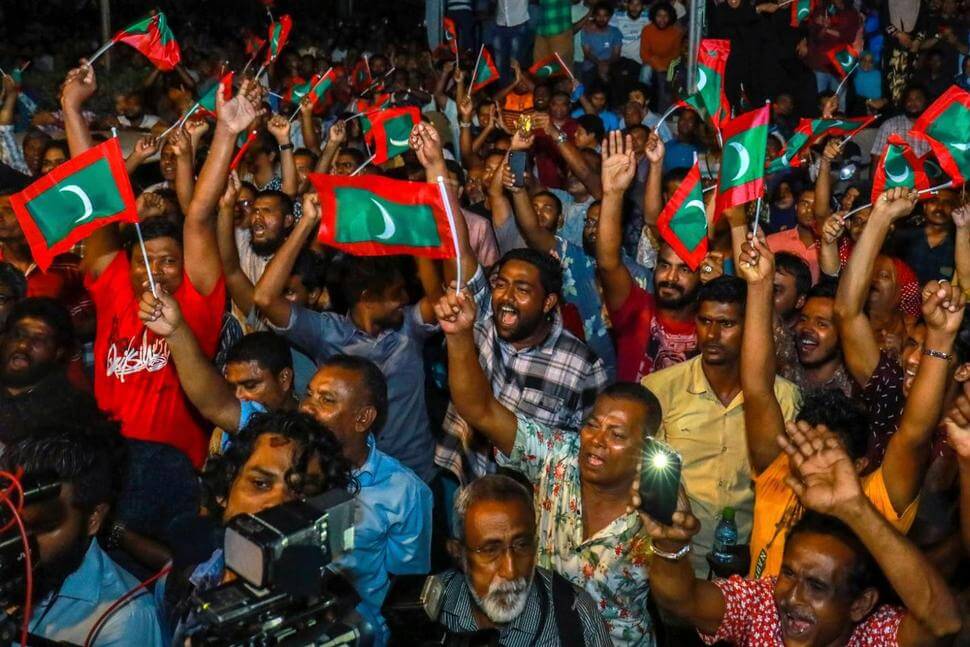
Photo: Maldivian opposition protesters demand the release of political prisoners in Male, Maldives

(AP Photo/Mohamed Sharuhaan, via US News)
Venezuela

United States officials claim that their economic sanctions are “absolutely working” and plan to continue them in a push on the South American country towards democratic change.

One official explained that the sanctions have begun to force Venezuela to default on its debts. He goes on to blame Venezuela’s total economic collapse on “the bad choices of the Maduro regime.”

“Our strategy on Venezuela is extremely effective,” said the same official. Amid these international sanctions and the country’s economic collapse, Maduro has continued to consolidate his power. Venezuela has “long accused Washington of trying to topple the government” and places responsibility for hyperinflation, and for food and medicine shortages, squarely on foreign interference.

Inside Venezuela, Venezuelans have been looting food delivery trucks in desperate attempts to find food, as well as organizing food riots and protests. While Venezuela is no stranger to unrest, the looting is less a resistance to the political regime than it is a near necessity for the lower classes, whose livelihoods have been wrecked by the economic collapse and rampant inflation. David Smilde, a senior fellow at the Washington Office on Latin America who has spent decades researching Venezuela, commented, “They want relief, not necessarily to force Maduro from power.”

US Secretary of State Rex Tillerson has embarked on a tour around Latin American countries. Along the way, he has mused aloud that Venezuela may soon be subject to a military coup. He states that he has no intelligence to support the claim, but is basing this off the trend of military takeover in times of serious crises in Latin America. He also states that he is not advocating for a military coup in the unstable country. Venezuelan Foreign Minister Arreaza criticised these comments and encouraged Latin American countries to ‘unite against a common enemy’: US imperialism.  

Miami Herald
ABC News
BBC
Myanmar

The Associated Press has released a report (containing graphic descriptions) on a late August attack by Myanmar soldiers, who killed hundreds of villagers and dumped their bodies in mass graves. Cell phone evidence with time stamps backs up the claims in the report made by refugees who survived the attack. Those who could, ran to hide in trees outside the village. The soldiers arrived armed not just with rifles, but with shovels and acid as well, prepared to hide their crimes. Myanmar’s military communications office has refused to speak to the press about the recent report. A local security officer stationed near the village denied knowledge of any mass graves.

Last week we learned about a petition started by Rohingya refugees, setting out demands that must be met before they will willingly return to Myanmar. Chief on this list are the need for security, legislation ensuring them citizenship and corresponding rights, and that their homes be rebuilt before they return. High levels of distrust in the Myanmar government and its promises stem from over 40 years of mistreatment. Rohingya have fled in mass numbers from Myanmar before, in the 1970’s and then again in the 1990’s.

This week, it has appeared increasingly likely that the attempts to return the refugees are already foundering, and Bangladesh continues to refuse to consider local integration options. Meanwhile Myanmar is not making any moves towards increasing the security or upholding human rights for returning Rohingya. The refugees in Bangladeshi camps have expressed that they would rather starve in the camps than face almost certain death in Myanmar.

The Associated Press
The Guardian
The Maldives

Maldivian opposition leaders have filed a petition to the nation’s Supreme Court on Sunday to temporarily remove incumbent President Abdulla Yameen. The petition stated that Yameen should be suspended for misrule, rights abuses, and “unprecedented corruption, including unjust enrichment through appropriation of state properties and funds for personal benefit, for the benefit of his family and political associates,” reported Al Jazeera. Signatories included former presidents Mohamed Nasheed and Maumoon Abdul Gayoom, Yameen’s half-brother. The President has dismissed the petition and denied accusations. The Supreme Court has not commented yet on whether they would hear the petition.

On Monday, the Criminal Court also issued a 15-day remand period for MP Faris Maumoon (Maumoon Abdul Gayoom’s son), following his arrest on Saturday, only shortly after he had been released from six months in police custody. Earlier, on Saturday, reports about a resignation of Police Commissioner Ahmed Areef and unrest within the police department had spread, but have since been refuted by police officials.

The most prominent news from the Maldives released on Thursday, when the Supreme Court surprisingly ordered the immediate release of nine key political prisoners. Among them was Mohamed Nasheed, currently still in self-exile, who now might be able to run for presidency again in this year’s election, though new trials were ordered. Nasheed had been sentenced to 13 years in prison on terrorism charges, largely criticized as politically motivated. The court acted further, overturning another ruling on Thursday that will allow 12 opposition parliament members to return to the legislative body, now with an oppositional majority. In their reaction, the opposition stated this verdict to “effectively end President Yameen’s authoritarian rule”, wrote Agence France Press on the Guardian. The administration and police announced that they will comply with the ruling, while President Yameen has ordered the dismissal of the police chief. Hundreds of opposition supporters celebrated in the streets of the capital Male, but were quickly pushed back by police, who also fired teargas. Nasheed meanwhile urged his supporters “to avoid confrontation with the police.” By early Friday, the Associated Press had reported of violent clashes between protesters and the police.

Al Jazeera
The Guardian

The United States of America

This past week began in the US with the first State of the Union address by President Trump. This annual speech is the head of state’s chance to directly address the American people, to share with them what he has accomplished, to remind them of his continuing goals, and to announce new plans, policies, and initiatives that he has for the nation. While this year’s address took plenty of time to revel in its “extraordinary success” and to reiterate many of the policies that Trump outlined in his campaign, it introduced very little new policy. Much of the speech was dedicated to taxation and immigration policy. Trump spoke at great length about the dangers that immigrants pose to the US, the toll that such high immigration takes on the American people, and of course the urgent need for a wall along the border with Mexico. This part of the speech was seriously unsettling to a huge portion of the American public. Additional points included increasing investment in fossil fuels, funding infrastructure improvements, fighting the national drug epidemic, increasing military funding, and the announcement that he would continue to keep open the detention facilities at Guantánamo Bay.

In other news from Washington, a controversial memo is prepared for release, against the wishes of many national lawmakers and top law enforcement officials. It regards FBI’s Russia inquiry, supposedly accusing the Justice Department and FBI of abusing their authority. FBI director Christopher Wray has stated that he may quit his position if the memo is released, further complicating the whole situation. Lawmakers in favor of its release, notably including Speaker of the House Paul Ryan, have said that it does not undermine the Mueller investigation. President Trump, on the other hand, has said that the contents of the memo will discredit the Russia investigation. This is especially problematic for the democrats and law enforcement officials who oppose the memo’s release. They have raised questions about the memo’s accuracy and about its omission of key information that they say is needed to put the issue into proper context. After all, this memo reflects simply the thoughts and opinions of its author, Rep. Devin Nunes, chairman of the House Intelligence Committee. It is not a formal, government-sanctioned release. In any case, Washington is bracing for impact.

NYTimes
CNN
Washington Post
Zimbabwe

On Wednesday, Reuters revealed that the government is going to match the lease contracts of white farmers to the same 99-year lease period black Zimbabweans had been able to opt for. This measure concerning land ownership addresses one of Zimbabwe’s most sensitive issues. At the same time, efforts were launched to find and repatriate millions of dollars which had been smuggled oversees during the last years of Robert Mugabe’s rule. According to the Guardian, observers have noted that the current  anti-corruption drive could be covering Zanu-PF intra-party factional fights. President Emmerson Mnangagwa has meanwhile made the headlines by saying that Robert Mugabe did not make mistakes during his time in power, when asked by Russia’s Sputnik News.

Reuters had further seen an appointment letter, revealing that President Emmerson Mnangagwa named High Court Judge Priscilla Chigumba as new head of the Zimbabwe Electoral Commission. Chigumba is set to take the post which has been vacant since former chair Rita Makarau resigned in December. Different opposition figures have stated in reaction that they would be alertly watching Chigumba in her new position. Some pointed out Chigumba now had to rise to the occasion, while People’s Democratic Party (PDP) spokesperson, Jacob Mafume, voiced his concern that “a key participant in the elections gets to choose a chairperson on his own,” wrote New Zimbabwe. With regard to the election, VOA Zimbabwe had reported early this week that the EU had signaled its willingness to send election monitors to Zimbabwe. Simultaneously, Reuters reported that a “company helping to produce a new voter roll for Zimbabwe has accused the election commission of ‘impropriety’ in its handling of
tenders, potentially tarnishing the credibility of [the upcoming] poll.”

Facing “severe turbulences” ahead of the election, Zimbabwean main opposition political parties have called for unity in the MDC Alliance. One of the bigger challenges is alliance candidate Morgan Tsvangirai’s ailing health. At the same time, the MDC Alliance’s President said that US President Trump had “pledged to bail out the MDC Alliance government with $15 billion for reconstruction and economic recovery programmes if they are voted into office in the forthcoming polls”, reported New Zimbabwe. National People’s Party (NPP) leader and presidential candidate Joice Mujuru who is currently touring Zimbabwe, has been assaulted with rocks, but not seriously injured, alongside others at a political rally. The NPP blames Zanu-PF supporters for the assault.

Reuters
The Guardian
New Zimbabwe / AllAfrica (Opposition on Chigumba)
New Zimbabwe / AllAfrica (Trump pledge)
Cambodia

Imprisoned opposition leader Kem Sokha was denied bail by Cambodia’s Appeal Court in his first court appearance since his arrest in September. Kem Sokha was charged with treason, accused of trying to topple the government with American support. Thursday’s ruling upheld an earlier decision after lawyers had filed an appeal on January 18. According to one of Sokha’s lawyers, the judge stated that Sokha should be kept in prison “due to ongoing court procedures and his own safety,” wrote Channel NewsAsia. This lawyer expressed disappointment and will discuss a possible appeal at the Supreme Court with Sokha and other lawyers.

Meanwhile, self-exiled opposition leader Sam Rainsy officially launched the Cambodia National Rescue Movement, which he and other opposition members abroad had announced earlier this month. Rainsy spoke to approximately 400 supporters in California at the launching event. He called this movement ‘symbolic’ and seeks to keep the now-dissolved CNRP ‘alive’, release Kem Sokha and other prisoners for political charges, and ensure free, fair and ‘inclusive’ elections with a participation of the CNRP. In the meantime, Prime Minister Hun Sen has warned him not to bring his movement to Asia, saying the government would take action against it, calling it ‘terrorism’. In another reaction, two Khmer Kampuchea Krom advocacy organizations have appealed to all Khmer Krom not join the new CNRM, while another organization said “individuals should decide their political alliances themselves, after careful consideration.”

After the sentencing of two environmental activists last week, Cambodian soldiers allegedly killed a three-person team, which had been on patrol in the Keo Seima Wildlife Sanctuary in North-Eastern Cambodia on Tuesday. The team was said to include a forest protection ranger, a military police officer, and a Cambodian employee of the New York-based Wildlife Conservation Society. They had confiscated Vietnamese logging equipment illegally, said a senior environmental official in the province. He asserted that “the three were killed […] by government armed forces who backed the illegal timber cutting”. The Guardian further wrote that they “are the latest victims of an alarming trend in recent years, the murder of environmental defenders by parties seeking the financial exploitation of natural resources.”

In the international realm, US senators have urged the UN in a letter to address the situation in Cambodia and introduce sanctions, prompting discussions within Cambodia and beyond, among politicians and analysts.

Channel NewsAsia
Radio Free Asia
The Guardian
Syria

Turkish forces continue to inflict aggression on certain regions in Syria. This has caused serious controversy as civilians are being killed and houses, places of worship, and archaeological sites are being destroyed. It was voiced by the General Directorate for Antiquities and Museums at the Ministry of Culture that Syrian identity and “the past of the Syrian people and their present and future” are being threatened.

In opposition to US intervention in Syria, a solidarity stand was organized at Aleppo University. They stood “in support of the national decision and in rejection of the US intervention in Syria and the US illegal military presence which violates the international law and makes an aggression on the Syrian sovereignty.” There is skepticism that this intervention hinders any efforts to realize a political solution to the Syrian crisis, and instead supplies and supports terrorist existence. This show of solidarity also symbolized the unity of the Syrian citizens and “their support to the Syrian Arab army in its war against terrorism and the evil powers.”

Additionally, the Damascus University and International Committee of the Red Cross (ICRC) mission in Syria aims to cooperate in the organization of “workshops, lectures, and programs related to spreading the concepts of international humanitarian law.”

Meanwhile, more promising prospects for Syria emerged as the Syrian National Dialogue Congress took place this week in Sochi, Russia. The conference hosted around 1500 participants and observers representing different parts of Syrian society and figures from foreign opposition groups. A popular perspective highlights the importance of holding the Congress as a “step on the road to resolving the crisis in Syria”, even though some groups were absent. Though the reality is that the Congress will not achieve political reconciliation, its purpose is to lay the groundwork for future settlement of the crisis, shedding light on the different common positions and views regarding the conflict’s resolution.

Staffan De Mistura, the UN’s Special Envoy for Syria, strengthened the necessity of a constructive dialogue and political solution as the only solution to the crisis in Syria. The results of the Congress were transmitted to Geneva as a contribution to the settlement process among the Syrians according to the UN Security Council Resolution No.2254.

The Congress concluded with a final statement that was composed and approved by the different perspectives present. It stated, “We, the delegates of the Conference of the Syrian National Dialogue, representing all segments of Syrian society, its political and civil powers, ethics, confessional and social groups, … with the intention to put an end to seven years of the suffering of our people, through the achievement of a common understanding of the necessity for the salvation of our homeland … the restoration of its dignity on the regional and world stage, the provision of fundamental rights and liberties for all its citizens, and most importantly the right to peaceful and free life without violence and terror.” The statement went on to say that “respect of and full commitment to the sovereignty, independence, territorial integrity and unity of the Syrian Arab Republic as a land and a people, in this regard no part of the national territory shall be ceded. The people of Syria remain committed to the recovery of the occupied Syrian Golan by all lawful means in accordance with the UN Charter and international law.” (To read the entire statement click here)

Syrian Arab News Agency [SANA] (Turkish Aggression on Archaeological Sites)
SANA (Solidarity Stand)
SANA (International Humanitarian Law)
SANA (Sochi Congress)
SANA (De Mistura – Syrian National Dialogue Congress)
SANA (Final Statement)
Democratic Republic of Congo

Waves of violence continue to engulf the DRC. UN peacekeepers are currently stationed in the country, having been deployed with the UN Stabilization Mission in the DRC (MONUSCO). DRC President Joseph Kabila claims, however, that “MONUSCO has not ‘eradicated’ any armed group in nearly 20 years.” Furthermore, many armed groups have been ambushing the peacekeepers, even killing one on Saturday.

UN Secretary-General António Guterres, who condemns the killing, has called on all armed groups in the DRC “to lay down their arms and seek to resolve their grievances peacefully”. To the dismay of Guterres, however, President Kabila has warned MONUSCO not to consider the DRC under the UN’s care, adding that he would clarify DRC-UN relations in the coming days.

To escape the violence, surges of refugees are fleeing to neighboring countries like Burundi, Tanzania, and Uganda. Military operations have intensified against the various armed groups. This has alarmed the UNHCR, as they witness thousands of children, women and men abandoning their homes.

Escaping forced recruitment, direct violence, and other abuses by armed groups, scores of refugees had no option other than to flee their homes to neighboring countries, already hosting many other refugees, and to existing overcrowded transit centers and camps. Since the beginning of 2018, over 5 million Congolese have been displaced, both internally and externally. “This places DRC among the world’s biggest displacement crises.”

Voice of America
Relief Web
UN News Centre

Other News

North/South Korea – After what has been seen as a rapprochement between the nations over the upcoming Winter Olympics in the South, the North has abruptly cancelled a joint cultural performance. The reason was ‘biased’ and ‘insulting’ media coverage in the South, according to a North Korean telegram. South Korea reportedly called this move ‘regrettable’. Meanwhile, the North Korean flag is displayed alongside others at the Olympic village.  – BBC

Kenya – On Tuesday, thousands attended the mock-inauguration of Raila Odinga in Nairobi, after it had been unclear whether police would permit supporters to gather. The gathering was mostly peaceful, though there were unconfirmed reports of scattered clashes and teargas used nearby. However, authorities appear to have ordered a media blackout to hamper coverage in Kenya. Intending to play the role of ‘deputy-president’ in the mock inauguration, Kalonzo Musyoka was reportedly blocked from participation in the event, and said on Wednesday that gunshots were fired at his home and a grenade detonated in what was “an assassination attempt.”  – The Guardian

Spain – Tuesday, Catalonia postponed the election of its new regional president until further notice, following Spain’s Supreme Court decision that Carles Puigdemont, separatist leader  the only candidate, could not be elected without physical presence. Remaining in Belgium, Puigdemont stated that he could lead the region from abroad, fearing to be arrested for charges including sedition and rebellion upon return to Spain. The candidate was the only nominee for the post after separatists won by a small margin in December regional elections. Pro-independence parties said they would not nominate a new candidate, suggesting a continued push for secession, amidst a sustained direct control by the national government. – Reuters

Bolivia – Bolivian President Evo Morales is revising the Patriotic Agenda for 2020-2025, the country’s long-term national goals, to address the needs of the country’s growing middle-class sectors. “The current agenda is composed of 13 proposals to eradicate poverty, stabilize the economy, and provide basic social, health, education services.” – teleSUR

Cuba – Fidel Castro’s son popularly known as “Fidelito” to the Cuban people, has committed suicide at 68 years old. He had been a USSR-trained nuclear physicist, and headed the nuclear program from 1980 to 1992. – BBC

Poland – On Thursday, Polish lawmakers approved a draft of legislation that would make it illegal to charge Poles for any type of complicity in the tragedies of the Holocaust. Because the Polish state did not yet exist, lawmakers in the country have long refuted terms like “Polish death camps”, that were of course operated by the occupying Nazi forces. This new proposed law is nevertheless drawing sharp criticism, especially from the US and Israel, who point out that even under occupation, the Polish people themselves were often complicit, and that this law seems to be an attempt by Poland to undermine open speech and to potentially rewrite history in a more favorable way. – NYTimes

Uzbekistan – Rustam Inoyatov, security chief of Uzbekistan, was ousted yesterday by President Shavkat Mirziyoyev in a bloodless coup. Inoyatov had been the biggest brake on Mirziyoyev’s transformative politicking. Although a popular world perspective portrays this development as encouraging, it gives no indication of how Mirziyoyev plans to use his now-unchecked power. – The Diplomat

Mexico – A student disappeared for days after being arrested and beaten by police officers. He was eventually found, disoriented and unsure of his own identity, with “visible signs of torture.” His peers, joined by students from many other schools, have organized a massive protest; they shut down their schools and are demanding that the government investigate the officers. Two officers have already been arrested. In other news, recent polls show candidate López Obrador from the political party MORENA leading the race with 32 percent. – BBC teleSUR Reuters

CANVAS’ News

CANVAS would also like to bid farewell to Gene Sharp – dear friend and powerful inspiration. His passing is an obligation to carry on the torch of democracy, human rights, people power, and nonviolent struggle with even stronger commitment. “Sharp had an extraordinary talent for finding movers in every corner of the world, and he offered them a guiding light as they fought for democratic change.” In a piece for the Washington Post, Srdja Popovic and Slobodan Djinovic, co-founders of CANVAS, reflect on the passing of visionary Gene Sharp. They remark on his legacy, as it affected their own movement in the past, and as it continues to shape nonviolent movements into the future. Read more here: Gene Sharp has passed away — but his ideas will go on inspiring activists around the world

Women’s Rights are Human Rights – Iranian Women Protesting the Veil Law: In the struggle for women’s rights in Iran, enduring since the 1979 Revolution, a resurgent act of protest this week demonstrated the exasperation many have with the implemented Sharia Law. This policy sidelines women and bestows on them the “harsh reality of subjection to a patriarchal interpretation of Islamic law when applied by the legal machinery of a modern state.”

Protesting Putin – Thousands Demonstrate Across Russia: Across Russia on January 28th, demonstrators took to the streets in opposition to Vladimir Putin and in support of boycotting the upcoming presidential elections in March. The rallies were called by Alexei Navalny, the politician widely regarded as Putin’s only significant political opponent. From Moscow to Vladivostok, thousands of Russian citizens, especially young people, braved police threats and frigid temperatures to make their voices heard.
Women’s Rights are Human Rights – Iranian Women Protesting the Veil Law

Picture – Hosein Ghazinoury. The Girl of Engheleb Street – “An Iconic Fighter for Women’s Rights in Iran”

In the struggle for women’s rights in Iran, enduring since the 1979 Revolution, a resurgent act of protest this week demonstrated the exasperation many have with the implemented Sharia Law. This policy sidelines women and bestows on them the “harsh reality of subjection to a patriarchal interpretation of Islamic law when applied by the legal machinery of a modern state.

Sharia Law – The Islamization of the Iranian Legal System

In the 1930s, jurisdiction of the Sharia courts was terminated in Iran. When the Pahlavi monarchy collapsed and Ayatollah Khomeini came to power, however, he reinstated the Sharia Law in 1979. This set the trend for subsequent changes and the notion of a centralized and unified legal system. As a result, wearing the hijab became compulsory for women. Moreover, the education system became segregated, and though universities remained mixed, regulations were implemented to separate the sexes in class and on campus.

This took a severe toll on women. Though their suffrage rights were maintained, most of the pre-revolutionary legal reforms were completely abolished. Thus, under the Islamic Law that prevails since the 1979 Revolution, women are absolutely forbidden to appear in public without the hijab to covering their heads and necks, concealing their hair. The Iranian government upholds the hijab as “an emblem of its religious and political identity” symbolizing “not only the Islamic government but also…the ideal type of Iranian women.” This is further emphasized as the government denies the “existence of many others who did not wear chadors or believe in hijab.”

Unfortunately, in spite of the protests and disagreements against the law upheld in Iran, women are still deprived of a primary right: the right to wear what they want in public. This is a basic right, a human right, which continues to be ignored.

Pushing the Boundaries – Protesting the Veil

As lawmakers and religious leaders are frustrated with the inability of the morality police to efficiently maintain the rules and ensure Islamic dress code is followed in public places, many women are pushing the boundaries of the discriminatory laws. “A renewed wave of protest to get rid of the strict laws that force Iranian women to wear hijabs in public has gained momentum.”

Iranian activist Masih Alinejad started a movement to get rid of the country’s dress codes and fight the compulsory hijab through her website My Stealthy Freedom. She encouraged women to send photos of themselves without hijabs in Iran, and later posted them with powerful messages to her website. Following this, Vida Movahed initiated an act of resistance, protesting the dress code imposed by the Iranian government by removing her headscarf. She boldly stood on a telecom box and waved her headscarf around. She was consequently arrested and, after approximately a month of detention, was finally released on Sunday, January 28. Her arrest had been followed by a wave of other women taking this risky act, leading to a wave of protests that spread across Iran in late December 2017.

This Monday, women took to the streets again and replicated Movahed’s act, reemerging on social media. These women are taking action and voicing their discontent with the compulsory hijab and long loose clothing for the government’s interpretation of modesty. After similarly protesting the veil law, Narges Hosseini was arrested this Monday.

The resistance went viral, as thousands of social media users shared messages of support. This also led to other Iranian activists starting various campaigns that have since gone global both on and offline. This movement has reached such a wide threshold that even protesters in the US, at the most recent Women’s March, waved placards with the movement’s slogan.

Protesting Putin – Thousands Demonstrate Across Russia

Picture: Moscow Times. Young demonstrators call for democracy in the Russian capital on Sunday.

Across Russia yesterday, demonstrators took to the streets in opposition to Vladimir Putin and in support of boycotting the upcoming presidential elections in March. The rallies were called by Alexei Navalny, the politician widely regarded as Putin’s only significant political opponent. From Moscow to Vladivostok, thousands of Russian citizens, especially young people, braved police threats and frigid temperatures to make their voices heard.
The protests were conducted peacefully overall, with 257 arrests but no clashes with police reported across the country. This total is much lower than that of past demonstrations, and is especially impressive considering the general fervor with which police sought to adjourn the events. The most notable arrest was that of Navalny himself. He was forcefully detained immediately upon arrival at the Moscow rally, but urged supporters online to continue on without him. And in fact the protesters seemed completely undeterred by this detainment, with demonstrations in eastern Siberia having already taken place, and many in Moscow stating that they don’t support Navalny’s politics anyway.

Among that latter group are the liberal, globally-minded youth of Moscow. Their presence at the rallies was especially notable and highly charged. A 15-year-old girl, identified only as Nastia by the Moscow Times, said to reporters that “Putin has been president for longer than we’ve been alive. It’s time for a change.” Many of the adult protestors saw the youth not as harbingers of an election upset, but as a glimmer of hope in the more distant future. Their enthusiasm for engagement in civil society could be the greatest possible threat to the overwhelmingly unchallenged rule of Putin.

Navalny, however, presents a less compelling alternative to many of these same citizens. On the one hand, his attacks on the corruption in Moscow resonate widely with the people. He famously called Putin and his oligarchs a “party of crooks and thieves,” a label that more than half of Russians claimed to agree with in a 2013 poll. Navalny has dedicated much of his career to exposing the corruption and ulterior motives of the Russian political elite, and it is on this impetus that he campaigns. He advocates a free press, more spending on education and health, and taxing the oligarchs.

On the other hand, his nationalist views make critics extremely skeptical of his potential as an eventual leader. He has publicly used ethnic slurs, calling Georgians “rodents” while backing their expulsion from Russia. After demands that he apologize became too strong to ignore, the politician did release a statement (in Russian), but the public found it rude, patronizing, and completely insufficient. It is thus important to consider that his ascension to a position of power would inevitably bring along those views, and for many Russians dreaming of a better future, this stipulation is unacceptable. In any case, although he continues to lead the boycott of the March elections, Navalny is legally prohibited from running as a candidate for president.

Although yesterday’s protests were initially triggered by Navalny’s call, it became perfectly evident over the course of the day that the opposition had taken a form far beyond a gathering of his supporters. It was another early look at the budding movement for a free and democratic Russian society. So while it is practically guaranteed that Putin will win the March election and extend the term of his rule, it is equally evident, to those paying attention, that the storm of people power over Russia has begun to brew.

Weekly Report: 26 January 2018

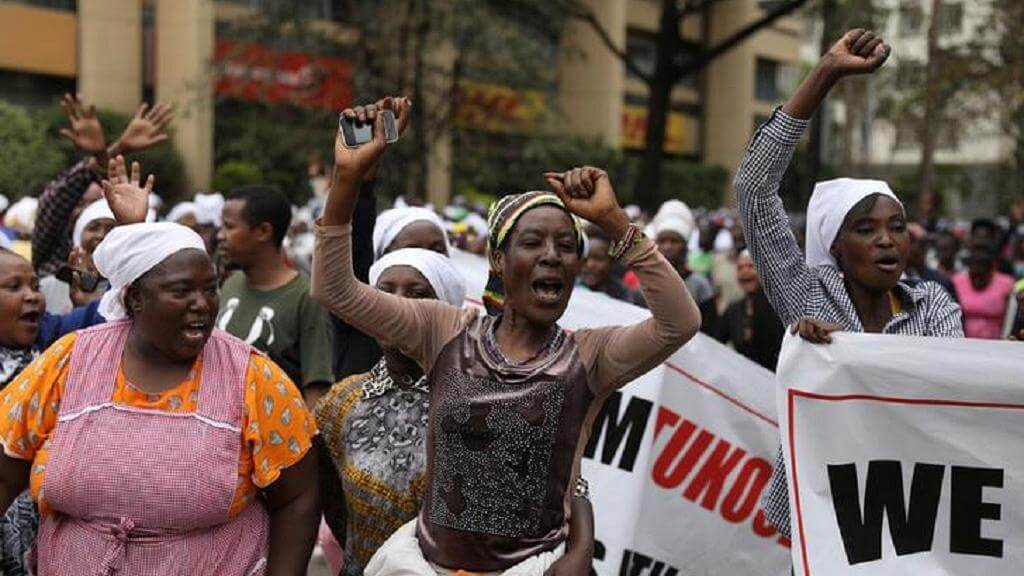
Photo: Women protested the government’s failure to comply with a gender quota in the Kenyan government (via africanews.com)

Cuba

The US announced Tuesday its intention to promote “free and unregulated” internet access in Cuba, according to a statement by the State Department. Internet access in Cuba has long been a controversial and highly restricted subject, and Cuban media has already declared this plan an “attempt to destabilize the island”. Currently, the government has approximately 500 wifi hotspots set up around the country for citizens to use, however all of them are restricted and none of them are free of charge. Furthermore, with a monthly average salary of $25 in the country, the current usage fee of around $2 per hour excludes a huge portion of the population from access.

The plan is part of US President Trump’s efforts to redefine the relationship between the countries after many changes made during the Obama era. While the plan was denounced by Cuban Communist Party Newspaper Granma as a move to “subvert Cuba’s internal order”, and covered by the Havana Times with the headline “US Wants to Force Feed Cuba with Free Internet”, articles by younger Cubans tend to see the news rather differently. An op-ed by Yudarkis Veloz Sarduy discusses the exciting developments that more widespread internet access could bring to the island. It describes the government opposition to the US’ decision as a mechanism of subversion, rather than as a benevolent protection of the people’s social order. In any case, both opinions reflect the strong control that the government strives to maintain over the society.

In other news from Cuba, a same-sex couple has been granted custody of two children. One of the women in the relationship is the children’s grandmother, the other their godmother. When the kids’ single mother passed away unexpectedly, the court had to assign guardianship. This went to the children’s grandmother, with recognition that her same-sex partner would help raise them. Cuban marriage rights group Acepto shared that this is likely the first time legitimacy of a non-heteronormative family has been legally recognized on the Communist island.

Havana Times
VOA

Myanmar

American Diplomat Bill Richardson on the Advisory Commission Board on Rakhine State quit after attempting to broach the subject of the two reporters detained in Myanmar and receiving an acerbic answer from de facto leader Aung San Suu Kyi. Suu Kyi said that it was not within the mandate of the board to examine this affair. Richardson also criticized Suu Kyi for declining to denounce the military’s actions of execution, rape, and arson against the Rohingya while the country is in the midst of what the UN has strongly described as an ‘ethnic cleansing. He stated she “has developed an arrogance of power.” He remarked also on the ‘shocking’ amount of disparagement toward international media and UN efforts by Myanmar officials during his time on the board.

On another panel, former UN Secretary General Kofi Annan recommended that the government allow full humanitarian access to the state of Rakhine. In keeping with the official’s attitude toward international presence, the Myanmar government still refuses free access for UN investigators and international media to Rakhine. UN Human rights special rapporteur Yanghee Lee, who is required to visit Myanmar twice a year to monitor the situation, was banned last month from the country. She describes the risk of flooding and disease as monsoon season approaches, and stresses the need for “informed consent” – the refugees must know the situation that they would return to in their home country if they are to leave the camps/Bangladesh.

As emphasized last week, the paramount issue with returning refugees to Myanmar is whether they want to return home. At present, it seems that they do not: the Rohingya who fled state security forces do not want to return to a place where “their homes were burned, their wives, sisters and mothers raped, and their friends, relatives and neighbors slaughtered,”, not without promises of their upheld security upon returning home.  A Reuters reporter was told of a petition, filled with Rohingya demands, to be presented to authorities from Myanmar and Bangladesh before a single refugee returns to Myanmar. The demands include Myanmar publicly announcing citizenship for Rohingya and adding Rohingya to the country’s recognized ethnic groups. Additionally, they want land that previously belonged to the refugees to be returned, homes to be rebuilt, and the military to be held accountable for the killings and rape.

NY Times
Al Jazeera
NY Times
Reuters

The United States of America

The government is back up and running after a shutdown that lasted several days. The shutdown happened when the US Congress failed to pass a new national budget by midnight on the 19th. Effectively, this halted all non-essential government operations until a provisional agreement could be reached for them to continue. The shutdown ended Monday night, when lawmakers settled on a budget plan, although this deal came contingent on the scheduling of new talks over immigration policy. Although the government was able to overcome this impasse and continue operating, the agreement funds operations only through February 8, which means that in less than two weeks, these complicated negotiations will resume, and the threat of another shutdown looms.

News has recently surfaced that US President Trump attempted to fire Special Councel Robert Mueller, but revoked the order when members of the White House council threatened to quit rather than carry out the order. Mueller is currently leading the investigation into Russian meddling in the American presidential election and any possible connections between the Trump campaign and the Kremlin. Presidential advisors have consistently warned against the firing, warn cautioning the president that obstructing this investigation would be catastrophic for the presidency. Even though Trump did not carry out the firing, news of this attempt has nevertheless stoked the fears and doubts of many Americans.

Three weeks into 2018, there have already been 11 school shootings in the US. In the latest of these incidents, two students were killed and 18 were injured. Many Americans were shocked by the lack of news coverage of the shooting, which seems to point to the desensitization of the overall population for this type of violence. Across major US news networks, the shooting received a total of approximately 16 minutes of television coverage. US Senator Chris Murphy, representing the district where a shooter at Sandy Hook Elementary School tragically killed 20 children and six adults, commented, “Are we so numb to this violence that more than a dozen children getting shot in a high school barely registers in the collective conversation?”. Beyond desensitization, however, it remains incredibly important to acknowledge the powerful role that the pro-gun lobby plays in defending the ‘right to bear arms’ in the United States.

BBC
New York Times
CNN

Zimbabwe

As Zimbabwean President Emmerson Mnangagwa traveled to Davos this week for the World Economic Forum, BBC´s Mishal Husain was able to sit down with him for an interview. Mnangagwa claimed here that, despite the fact that no individual was granted immunity after the changes in power late 2017, Zimbabwe’s long-time leader Robert Mugabe will be “left in peace” with a “lucrative” retirement package. Mnangagwa also stated firmly that he and the ruling ZANU-PF party would accept the results of the upcoming elections, whatever the outcome. “If we lose elections, that’s it,” he said. “Whichever party wins the election will proceed to take the reins of power.” The President confirmed that the elections will be held before July 2018.

While the Zimbabwean President is looking ahead, opposing political forces are still debating the current government’s legitimacy. On Thursday, Newsday wrote about National People’s Party leader Joice Mujuru and her rekindling of an old internal ZANU-PF rivalry with President Emmerson Mnangagwa. This week, Mujura called Mnangagwa an “illegitimate coup leader” whose power rests in the military. She added that “there can be no doubt that the country is in need of genuine political transition back to the imperatives of constitutionalism and the rule of law,” according to Newsday. Meanwhile Mujuru, as the leader of the People’s Rainbow Coalition (PRC), is rolling out her own personal campaign at the end of this week, which will lead her through all of Zimbabwe’s provinces.

As for some hopeful news, two business-intelligence organizations have expressed their trust in the recovery of the Zimbabwean economy this week. The United Kingdom-based business intelligence consultancy firm, Alaco Limited, said Mnangagwa would fix the country’s economy, judging by his partial repeal of the Indigenisation and Economic Empowerment Act and pledge to compensate and reintegrate white farmers who lost their livelihoods during the land reform program. Then, German-African Business Association and international law firm Pinsent Masons hosted a forum on Zimbabwe in Johannesburg this week, where organizers heard that the government of president Mnangagwa was showing signs of a willingness to re-engage international investors to boost the ailing economy. Finally, Newsday reported on Tuesday that exiled Zimbabwean musician Thomas Mapfumo is to return home for his first performance in the country since 2004.

BBC
Newsday
Newsday

Venezuela

The opposition in Venezuela further fractures in the wake of Maduro’s announcement that he will run for re-election. This period in time would call for greater unity, as Henrique Capriles urges, to put forward a strongly-backed presidential candidate for the opposition. Yet, since the municipal elections, the opposition has been divided over whether to participate in the elections or to boycott them altogether. The allegations of fraud in the regional elections and the crackdown on political protests have led the Lima Group to release a statement declaring that the early elections contradict democratic principles and lack legitimacy.

For the past three months, opposition and government representatives have been engaged in negotiations, in an attempt to set minimum election guarantees, but these have not yet been reached. The opposition has emphasized the need for an international monitoring body to oversee the election process and ensure legitimacy. The government’s announcement of the elections before an agreement demonstrates that these guarantees will never be realized (or will be ignored if they are). Maduro has encouraged the National Electoral Council to “fix the earliest possible date” for the election, saying further, “if it were for me, the election would be held next Sunday.” No date has yet been set, merely an official expectation to hold the election before the end of April.

Prominent opposition member Capriles declared that even with the possibility of voter fraud and manipulation, the administration is so unpopular with Venezuelans that Maduro could lose, despite his confidence. Capriles cannot run for the presidency, having been banned from public office for 15 years after mismanaging funds.

Venezuela has expelled the Spanish Ambassador following the EU instituting a travel ban and freezing the assets of a number of officials. President Maduro has accused Spain of ‘plotting to oust him’ and of meddling in the country’s internal affairs.

Al Jazeera
Washington Post
BBC

Cambodia

While some have been reflecting on the prospects for Cambodia’s opposition after the formation of the new Cambodia National Rescue Movement (CNRM), jailed and former CNR Party leader Kem Sokha has stated that even though his name had been mentioned in the CNRM manifesto, he did not support the movement. After signs of divisions became apparent last week, Kem Sokha’s lawyer Pheng Heng told Reuters that the opposition politician did not want to join or support any movement, but will continue in line with the CNRP, which more than three million Cambodians voted for in recent elections. Wednesday, The Phnom Penh Post reported on different comments by government officials. By some, the movement has been called ‘illegal’, ‘just a front to raise money’ and even labelled a ‘terrorist organization’, besides being ‘under observation’.

Meanwhile, Prime Minister Hun Sen paired the gathering of over 3,000 journalists and media representatives on Sunday with accusations of ‘a media mafia’ cooperating with illegal logging activities, spreading fake news, and avoiding tax payment and registration. Alongside the shutting down of one of Cambodia’s last remaining independent newspapers, other news outlets had to cease their work as well. Also on Sunday, the ruling Cambodian People’s Party (CPP) held an extraordinary party congress, expanding its central committee by 342 members to 865 and setting strategic political goals and policies for the party in the next five years.

On Friday, a Cambodian court sentenced two environmental activists to one year in prison with a suspension of seven months, after they had allegedly filmed an illegal sand export activity. Their defense lawyer considers them ‘innocent all along’ and Amnesty International says they are ‘prisoners of conscience’, reported Reuters. A former Cambodian deputy prime minister who had served in Hun Sen’s government for 15 years, now living in exile, was ordered to pay about US$125,000 for defamation on Thursday, after alleging “Hun Sen [had] bribed a minor political party to help him dissolve the opposition.” Radio Free Asia further explained that “Hun Sen’s government has used defamation cases to hobble opposition figures.”

Reuters (Kem Sokha)
Reuters (media)
Reuters (activists)
Radio Free Asia

The Maldives

Former President Mohamed Nasheed, who lives in self-imposed exile, accused China of a land grab in the Maldives, threatening peace and stability in the whole region. This comes in the context of a new trade agreement signed by the two countries late 2017 and the Maldives’ increasing pull towards China to realize ambitious infrastructure projects. Speaking to reporters in neighboring Sri Lanka, Nasheed said, “’We definitely subscribe to FDIs [foreign direct investment]. We subscribe to international trade. But we will not subscribe to relinquishing our sovereignty‘“, wrote Avas. The Maldivian government then responded by stating that they were opening their economy to encourage free trade and were seeing positive outcomes of the changes made.

Meanwhile, a letter signed by the four Maldivian opposition leaders to the Indian Prime Minister reported unlawful actions ahead of this year’s presidential election. This comes amidst heightened tensions between the two countries. The document was delivered to the Indian embassy by secretary general of the Maldivian Democratic Party and secretary general of the Jumhoree Party. Two other letters were sent to the Supreme Court and the Elections Commission, reported Rajje. Speaking on a TV program, chief opposition lawmaker Solih opposed the notion that the incumbent president Yameen would not hold elections at all if his victory was not guaranteed. However, he did not rule out that Yameen might seek the delay or rigging of elections later this year, according to Avas. Solih asserted the opposition would have to put in more effort to ensure free and fair elections, like ‘freeing’ the parliament, having dozens of disqualified lawmakers returned to parliament and freeing the election commission and judiciary from political influence.

Avas (Nasheed)
Raajje
Avas (Solih)

Syria

Syria is stressing the importance of international respect for its sovereignty as Turkey commits aggressions within its borders. Foreign fighters in Syria have moved to turning their weapons on Turkish forces that infringe on Syrian territory.

As conflict persists in Syria, peacemaking efforts continue, and plans are being formed to redevelop the country after all the destruction. At the UN headquarters in Vienna, the Delegation of the Syrian Arab Republic met with UN Special Envoy for Syria Staffan de Mistura. This was a critical meeting, revolving around intra-Syrian dialogue as part of the political process in Geneva.

There is discussion between Syria’s Information Minister, Imad Sarah, and the Iranian Ambassador in Damascus, Javad Turk-Abadi, about prospects of media cooperation between the two countries. The intention is to “develop and support media work in a way that would serve the two countries’ interests”. Moreover, through Syrian media, the aim is to eradicate any practices of falsification and media misleading which target the resistance axis in the region.

On Sunday, the Syrian Public Works and Housing Ministry signed a memo of understanding with the Russian Story Expert Company on cooperation regarding public construction and the implementation of housing projects. The memo “aims at enhancing cooperation between the two sides in the domains of rapid construction technology, unified construction systems, and the strategies of implementing and rehabilitating public constructions, in addition to the strategies of planning, funding, and implementing housing projects”.

CNN
Syrian Arab News Agency (intra-Syrian Dialogue)
Syrian Arab News Agency (Syria, Iran media cooperation)
Syrian Arab News Agency (Public Constructions and Housing Projects)

CANVAS’ News

People Power – Women’s Marches Around the World: January 21st, 2018 marked the one-year anniversary of the Women’s March in Washington DC last year. Over the weekend, thousands of women, men, and children around the world marched in solidarity this weekend at over 500 events across six continents including in: France, New Zealand, Kyrgyzstan, Zambia, Spain, Ecuador, Italy, the United Kingdom, the US, and more. Their mission: to “Look Back, March Forward and launch [their] collective 2018 Women’s March agenda: #PowerToThePolls”.

Public transport moves – also in nonviolence: Public transport concerns virtually everyone and it has mobilized people in both the past and present to raise their voices throughout the world. This week in India, other times in the UK, Peru and oftentimes in Brazil. Could this be a chance for nonviolent campaigns?

Other News

Kenya – On Monday, hundreds of mostly female activists took to the streets of the capital Nairobi, protesting the government’s repeated failure to apply laws for the minimum number of parliament and executive posts held by women. After last year’s contested elections, President Uhuru Kenyatta has so far named only male cabinet staff, though vacancies remain. – africanews

Vietnam – A court in Vietnam sentenced the former chairman of a PetroVietnam subsidiary to life in prison for embezzlement and mismanagement. Germany accuses Vietnam of kidnapping him while in Berlin last year and forcibly returning him to face a trial in Vietnam, which could have brought him the death penalty. In the context of the corruption crackdown, critics have accused the Vietnamese government of pursuing politically motivated charges.  – DW

Honduras – Last weekend, almost two months after the controversial presidential elections in Honduras and subsequent demonstrations, Honduran security forces again clashed with protesters and center-left Opposition Alliance Against the Dictatorship supporters in the capital, resulting in at least one death. – Reuters

Bolivia – As Bolivia celebrated the 12th anniversary of their Plurinational State this week, opposition sectors in the Bolivian cities of Santa Cruz, Sucre, Potosi, Oruro, La Paz and Tarija took to the streets Monday, calling for the elimination of the Penal Code and expressing opposition to President Evo Morales’ 2019 presidential run. – Telesur

Romania – On Saturday, an estimated 50,000 people marched in Romanian capital Bucharest after the ruling party had passed new legislation last month that could hamper the persecution of crime and high-level corruption, according to critics. It now awaits the signing in by President Klaus Iohannis who criticizes the bill. – Al Jazeera. Some activists have been getting more creative, wrote Balkan Insight. The EU stated it was closely following the latest developments in Romania, and that the country should rethink the controversial reform. – DW

Poland – Three people have been arrested this week for propagating fascism. A news program recently revealed details about a neo-Nazi group that celebrated Adolf Hitler in a ceremony last year. Prime Minister Morawiecki, an anti-immigration conservative, spoke out against the demonstration, saying, “In Poland we cannot have the slightest tolerance of Nazi, fascist or communist symbols”. – ABC

Egypt – The last main challenger to incumbent President Abdel Fattah el-Sisi dropped out of the coming presidential election, effectively clearing the field for him to run virtually unopposed. – NYTimes

Mexico – This week, Reuters released a special report on the link between Mexican drug cartels and fuel theft. The report describes the threats made against refinery employees to extort information about the fuel lines. Authorities say that gangs target storage facilities and fuel trucks, not just pipelines, and unauthorized taps have almost quintupled in the last few years. – Reuters

Ethiopia – Local media has again reported on violent protests in the Northern Ethiopian Amhara region, where a crackdown by security forces left seven dead last Sunday. From late 2015 onwards, Ethiopia has seen a number of protests, often accompanied by the army clashing with civilians, with the most prominent wave of protests taking place in 2016. – africanews

Democratic Republic of Congo – Six people were killed Sunday as the authorities cracked down on a banned protest against President Joseph Kabila. 57 were injured nationwide in the rallies and 111 people were arrested across the country. The demonstration, a peaceful one, called for by Catholic church leaders, was against Kabila’s 17-year rule. – eNCA

Public transport moves – also in nonviolence

Photo:  Left: “Members of DYFI ride bullock carts and stage a novel protest against the hike in bus fare in Salem on Sunday.” (E. LakshiNarayanan, via thehindu.com) – Right: “Demonstrators in Sao Paulo, Brazil, carry banners that read in Portuguese “Against the Fare” and “No Rise” during a protest against the bus fare increase.” (Andre Penner / Associated Press, via latimes.com, 2015)

An issue that affects almost everyone, that has mobilized people in both the past and present to raise their voices throughout the world, is public transport. This week, hikes in bus fare in Tamil Nadu inspired people to get involved in various cities throughout the Indian state. Students who often led the protests were joined by youth organizations and government employees, among others. Wednesday marked the third consecutive day of protests. Tactics to grab attention, to make their statement against the increase in fares, involved road blocks, demonstrations, the hand-over of a petition – and the riding of bull carts through the streets.

Earlier this month, the Rail, Maritime and Transport Workers (RMT) union called for protests at busy train stations throughout the UK over an increase in train fare prices. Late-2017 protesters took to the streets of the Canadian city Winnipeg to oppose a raise in bus fares. Another slightly more dramatic example comes from Peru in 2016. The population of marginal Lima-neighborhood Manchay protested the introduction of a new government-run transportation system that was to replace the existing privately-owned options and would have more than doubled the costs. The inhabitants of Manchay blocked their streets, leading to clashes between police and protestors that involved the use of teargas against civilians, and culminating in injuries and arrests. Resistance by the people did, however, bring the authorities to overrule their decision and keep the old system. Whether one supports such informal solutions or not, for the people of Manchay, the old system had been not only a cheaper option, but had provided a source of income as well.

In yet another case from South America, public transport has not merely been subject of such protests, but rather a trigger for much larger protest movements. In early June 2013 after public transportation fares had been raised, demonstrations erupted in São Paulo, Brazil’s biggest city, largely led by the Movimento Passe Livre (Free Fare Movement) advocating for free public transportation. Day by day and with growing media attention, the protests quickly attracted even more sympathizers with various social and political backgrounds and additional complaints. These qualms included the tremendous amounts of money spent on projects for the then upcoming World Cup and Confederations Cup, at a time when Brazil was struggling with many more basic problems, aggravated by economic downturn and inflation. Other issues brought to the front were those of prevailing corruption, as well as the police’s violent response to the demonstrations.

On June 20, more then a million Brazilians united for the protests, which had by then spread to dozens of cities throughout the country. It was then that former President Dilma Roussef announced concessions to the protesters’ demands. The following years have been witness to numerous large-scale protests in Brazil, but they deserve separate attention. While the violence during demonstrations should be condemned, Brazilian society seems to have become polarized and the country’s political situation is complicated. This particular example simply shows how public transportation became a matter of contention and trigger of mobilization for many.

One of the crucial aspects of nonviolent campaigns is mobilization – if you mobilize an insufficient number of people for your cause, it will be hard for your movement to succeed. It is thus essential to think about issues that concern large swaths of society and can motivate many to get involved, creating an incentive to stand united in support of your campaign. As illustrated by the examples above, public transport has proven to be one of them.

People Power – Women’s Marches Around the World

Picture – Chicago Tribune. “Weekend of women’s marches promises continued momentum”

As CANVAS aims to spread the word of “people power” to the world, nonviolent struggle proves a powerful tool for achieving freedom, democracy, and human rights. In line with CANVAS’s mission, this weekend bore witness to a global Women’s March.

January 21st, 2018 marked the one-year anniversary of the Women’s March in Washington DC last year. Over the weekend, “thousands of women, femmes, and allies” came together around the world in commemoration and advancement of their cause. Their mission, to “Look Back, March Forward and launch [their] collective 2018 Women’s March agenda: #PowerToThePolls”. The goal is to empower women and their allies, first by having their voices heard through their votes, and then further through their inclusion in positions of influence and power, especially in government. Moreover, the marches also highlighted the #MeToo and Time’s Up movements against sexual assault and harassment.

Marching in Solidarity

Women, men, and children around the world marched in solidarity this weekend at over 500 events across six continents including in: France, New Zealand, Kyrgyzstan, Zambia, Spain, Ecuador, Italy, the United Kingdom, the US, and more.

USA Dozens of Women’s Marches filled cities across the United States, at which attendees supported and advocated women’s rights and equality. This year’s main focus was on making people’s voices heard by urging supporters and allies to vote in the upcoming midterm elections. The rally held in Las Vegas, Nevada marked the official anniversary rally of last year’s Women’s March held in Washington DC. The main focus was “using activism to generate concrete action at the ballot box”. Tamika Mallory, co-chairwoman of the national Women’s March organization, proclaimed: “We have to march together, we have to organize together, we have to mobilize together and we have to vote together, even when we don’t like one another”. Other marches were simultaneously taking place in Seattle, Miami, Phoenix and several other cities across the country and even around the world.

Toulouse, France A #MeToo gathering was organized on Sunday the 21st for the Women’s March anniversary weekend. Both women and men gathered to share their experiences, while at the same time learning about others’ experiences, in an attempt to produce ideas for positive change. The vision is to create a world in which the sons and daughters of people around the world are respected and treated equally. Power and change comes from people gathering and sharing their experiences, while at the same time supporting each other.

Athens, Greece The people of Greece marched for change, highlighting that it is time to make a difference and “press for the world that we want”. They marched for women’s rights, LGBTQ rights, equality in the workplace, refugee rights, climate change, gender equality, and religious tolerance.

Munich, GermanyPeople marched from Siegestor to Marienplatz “to rally for the foundational rights and dignity of all people and register US citizens to vote in upcoming elections”. Meghan Driscoll, the Munich chapter chair of Democrats Abroad, emphasized that “while this march supports women taking on greater leadership roles, a fundamental part of that empowerment is to first listen to women and believe in them”. A significant goal of the march was to send a loud and clear message to Washington that “President Trump’s personally abhorrent behavior (accused of sexual assault and harassment) will not be tolerated in the future”.

“Every little step we take together for a good cause will take us into a better future.”

Weekly Report: 19 January 2018

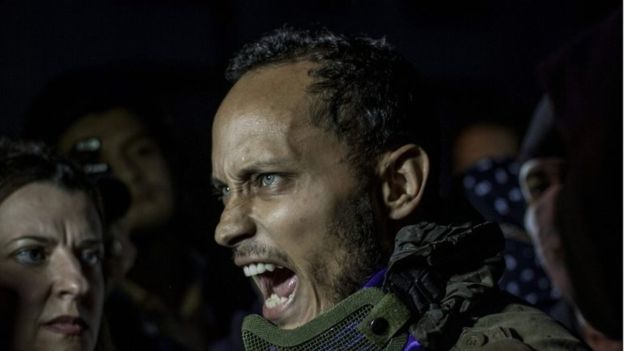
Photo: “Renegade helicopter pilot Oscar Pérez was killed in a nine-hour long siege near the capital, Caracas, on Monday, the Venezuelan government has confirmed.” Though on the run, he attended at least one opposition march. (via BBC News)

Democratic Republic of Congo

After the UN human rights office called on the DRC to not use force against protests, Congolese police have completely ignored this request. On Friday the 12th of January in the capital Kinshasa, they fired teargas at dozens of churchgoers, who were mourning the deaths of seven people killed in the protests that took place two weeks ago against President Joseph Kabila. This was done supposedly to prevent the gathering from evolving into a political demonstration. As a result of Kabila’s refusal to step down, there have been several protests and consequent deaths and militia violence in the past two years. There is deep fear that the DRC will relapse into civil wars.

The persistence of Kabila to remain in power with no mandate and to keep his opposition weak and fragmented is fueling resistance amongst several institutions and groups. For instance, the Catholic church, with broad credibility in the DRC, “has emerged as a lightning rod for opposition” against Kabila. Moreover, as announced by a senior UN official on Wednesday at a news conference in Geneva, militias in eastern DRC are uniting in opposition to Kabila. They, along with additional militia groups in the country, are in agreement with regards to the political agenda and the transition of the DRC without President Kabila.

The IOM has furthermore stressed the gravity of the situation in the DRC and that its breaking point has been reached with around 7.7 million people suffering an acute food emergency and 4.3 million displaced.

As political impasse and violence persist in the DRC, the UN Security Council (UNSC) is voicing serious concerns and calling “upon all political actors to exercise maximum restraint and to address their differences peacefully”. They reiterate the significance and importance of a timely and swift implementation of the 31 December 2016 Agreement and the recently adopted electoral timeline. The UNSC stresses that they “are essential for a peaceful and credible electoral process, a democratic transition of power, and the peace and stability of the DRC, as well as in supporting the legitimacy of the transitional institutions”.

Reuters
VOA
International Organization for Migration
UN News Centre

Poland

In a movement of opposition to new proposals in parliament that further restrict abortion access, thousands of Polish women took to the streets this week. The demonstrations were organized in more than 50 cities across Poland by a coalition of women’s rights groups. The proposal they’re presently protesting eliminates one of the last legal reasons for abortion – severe illness or deformation of the fetus that endangers its or the mother’s life.  In the same week, parliament rejected a separate “Save Women” proposal that would have moderately liberalized abortion access for women in this country with some of the most restrictive abortion laws in Europe. The failed proposal had advocated greater access to abortion, free contraception, and sex education in public schools. The ruling Law and Justice party, in close association with the Catholic Church, has been continuously eroding abortion legality in Poland and will likely continue forward with these aims.

In the international sphere, Poland’s relations with the EU are becoming ever tenser. On Wednesday, European Commission President Jean-Claude Junker stated, “We are not at war with Poland. We have a dispute with the Polish government”, to address growing concerns about the country’s failure to yet comply with the EU and reverse its controversial judicial reforms. Three months remain for the country to comply, but negotiations have not led to any concrete progress thus far. Also in EU relations, the Polish Energy Minister has stated that he does not expect the country to be able to meet the ambitious targets set by European lawmakers for renewable energy. This is in accordance with the policy of the Law and Justice party that sees “renewable energy as unstable and a threat to the country’s heavily coal-reliant industry”.

Relations between Poland and the US seem to be friendly this week as Polish President Andrej Duda compliments Donald Trump on his war against ‘fake news’, saying that “his country’s leaders are also the victim of false reports accusing them of undermining democracy and the rule of law”. At the same time this week, Poland is requesting an increase in the number of US troops in Poland. This comes after and in addition to the 2016 announcement that NATO would deploy additional battalions to the region against Russian threats.

Independent
Radio Poland
Reuters

Venezuela

In the summer of 2017, a pilot named Oscar Pérez used a stolen helicopter to throw grenades at a government building. On Monday this week, the Venezuelan government located him, and Pérez posted a video of himself stating he and his compatriots were attempting to negotiate with officials. In the video, one of several on social media, he is holed up in a house outside Caracas that the government is targeting as a ‘terrorist cell.’ Pérez declares they do not want to fight, that there are civilians inside whose lives should not be endangered, and that they want to see their families. In his first video, he appears calm and composed. Later in the day, his videos show him tired and bloodied, claiming that the officials aren’t looking for a surrender, but instead to kill Pérez and his collaborators. “They’re shooting at us with RPGs”, he said. The shootout concluded with several deaths, both of police and of those with Perez. Perez’s body was among the seven dead on his side. A top opposition leader, Henrique Capriles, has accused the killings of being extrajudicial, as there was no due process of law. The government released a press statement saying the officer’s lives were in danger as Pérez and his followers continually fired on them, although this contradicts Perez’s narrative. Rights advocate groups and opposition party members are calling for an investigation into the killings. Regrettable as his death is, Pérez may now become a martyr for opponents of Maduro.

Since last summer, Perez had been on the run while the government searched for him, the subject of ‘Wanted’ posters posted around Venezuela. In December, he posted a video of himself and a small armed group taking control of a military outpost and smashing a portrait of President Maduro. His summer attack coincided with a wave of protests against the socialist government. Perez, during his hiding for the past six months, released videos calling for citizens to resist the government and rebel against Maduro, blaming it and him for the country’s economic issues. He called for Venezuelans to fight back, but was perhaps demoralized by the dissolution of protestors following Maduro’s consolidation of power when he established his own loyal Congress.

NY Times
BBC
Public Radio Int.

The United States of America

It has been one year since the inauguration of US President Donald Trump, but the government is still working to resolve the chaos of that day. In the face of mass protests, police used pepper spray and flash-bang grenades against demonstrating citizens. The American Civil Liberties Union is suing members of the Washington DC police department for assault and deprivation of constitutional rights, like free expression, freedom from unreasonable searches and seizures, and due process. It also raises claims for “false arrest and imprisonment, intentional infliction of emotional distress, and violations of the DC First Amendment Assemblies Act”. Spencer Kaaz, a DC protestor, says “It’s textbook 101 repression procedure. Arrest dissidents, intimidate and harass them, cause financial and emotional difficulty” about the response to the inaugural turmoil. His trial is scheduled for March of 2018.

Last year, 234 people were arrested or charged with a crime, and of them 59 still await trial. Protestor Dane Powell pleaded guilty to felony rioting and assaulting a police officer. He was given a four-month prison term. On Thursday of this week, the government announced dropping 129 cases against protestors: all those without felony charges. Those still awaiting decisions were charged with felonies “ranging from inciting a riot to destruction of property.” While previously, the government’s intention had been to pursue group trials through most of 2018, the acquittal of all six defendants in the first batch likely led to a shift in their approach.

President Trump sparked intense controversy over his recent ‘shithole’ countries remark, and the strong backlash continues. Protests of the remark have occurred both within the US and abroad. Some of the largest took place this past week on the streets of New York and Miami, and outside the US embassies in Haiti and South Africa. Condemnation of the comment took place in many other forms across Africa and the Caribbean, in many of the nations that Trump targeted with his disdainful comments.

ACLU
Reuters

Myanmar

Bangladesh and Myanmar have been discussing plans to return thousands of Rohingya who fled an army crackdown Myanmar over the past year.

On Tuesday, the two countries came to an agreement to return the refugees within two years. The process is to begin next Tuesday. Bangladesh is to establish 5 transit camps on its side of the border, and Myanmar has also agreed to establish a transit camp to house 30,000 people.

While the UNHCR was not officially involved in this agreement, it is expected that the organization will be heavily involved with helping coordination. A briefing note by the UN Refugee Agency underlines the importance of the refugees willingly returning home to Myanmar. In particular, the refugees note that their legal status and the security in the Rakhine state are vital factors in their decisions. The recent spate of targeted attacks by the Myanmar army on Rohingya, ostensibly to quell radical members of the Rohingya, added to years of ethnic tension, discrimination, and abuse, and causing Myanmar to come under serious international scrutiny.

The greatest issue, says UN Secretary-General Guterres, would be to leave the returning Rohingya in a permanent state of transit, stuck in the camps without a home to return to. The timeline is less important than the security of those returning.

Amnesty International advises that without a stabilization of relations within Myanmar, forcing Rohingya refugees to return there would be a ‘violation of international law,’ against the principle of non-refoulement.

On the same day that the bilateral agreement was reached, police fired on protesters in Rakhine State. More than 4,000 Rakhine Buddhists gathered around Mrauk U to protest a ban on commemorating the fall of the ancient Arakan kingdom. Seven were killed and more still rushed to the hospital with injuries.

Reuters
The Guardian
Amnesty Int.
BBC

Zimbabwe

This week, President Emmerson Mnangagwa has continued spreading his New Zimbabwe narrative, preaching unity, forgiveness, and change. During a meeting with Trevor Ncube, chairman of Alpha Media Holdings (AMH), the holding behind Zimbabwean newspapers NewsDay, Zimbabwe Independent and The Standard, Mnangagwa stated that he has discarded populist politics, but will make hard decisions to restore Zimbabwe’s lost economic glory. “As a leader, you don’t have to take the nation where they want to go, but to where they ought to go. If you want to remain in power, you will do what people want even if it’s not good (for the country). But if you want to leave a legacy, then you have to make tough and hard decisions which will change their lives,” he said. Also this week, during a visit to neighboring Mozambique, Mnangagwa promised that Zimbabwe would hold elections within four or five months. On Thursday, Mnangagwa gave his first interview with an international news organization since taking office in November. The Zimbabwean President is strongly “seeking to build bridges with the West”, he told Financial Times. Alec Russell’s full interview with President Mnangagwa will appear on FT.com on Friday.

Then on Tuesday, the BBC and Newsday report on the latest developments in the government’s fight against corruption. As several (former) high ranking government officers are summoned before Parliament over leakages and corruption in the diamond-mining sector, Robert Mugabe might be called upon to appear and be questioned intensely. “There are no sacred cows in terms of the oversight role of Parliament, and there is nothing that even stops us from calling Mugabe, who first mentioned the issue of the $15 billion, from appearing before Parliament and asking him how he came to know about that,” according to Norton MP Temba Mliswa, the chair of the Mines and Energy Portfolio Committee. In 2016, Mugabe claimed that $15 billion worth of diamond revenue was unaccounted for, a claim that continues to dominate political discussions on accountability to this day.

Newsday
BBC/Newsday

Cambodia

Sam Rainsy, former opposition CNRP leader, announced the creation of the new Cambodia National Rescue Movement (CNRM) on Sunday, reported Reuters. The CNRM “would provide a new structure that nobody can harm or dissolve”. Besides Rainsy, members include his wife Saumura Tioulong and deputy presidents of the former CNRP, Eng Chhai Eang and Mu Sochua. They invited others to join “to protect the will of the Cambodian people through free, fair and inclusive elections”, while also calling on the authorities to release former party leader Kem Sokha alongside other political prisoners. Rainsy further tweeted, the movement could call on the people for peaceful protests and strikes, as well as on the security forces to align with the people.

This move has been labeled “desperate” by a government spokesperson on Sunday, and different Cambodian opposition voices have also expressed their doubts and disapproval. Kem Sokha’s former cabinet chief stated he did not see a need for this new movement as the dissolved CNRP had gained three million votes and should continue within the same framework. Others added that this might endanger other (former) CNRP members and that people were afraid to protest.

Prime Minister Hun Sen seemed to equate the announcement of the new movement and possible protests with possible chaos. However, he pledged to not let this happen, reported the Phnom Penh Post. After Sam Rainsy had further stated that postponing the otherwise “illegitimate, meaningless and useless” elections “until they ‘meet minimum international standards’”. Among other things, Rainsy said this would avoid any violence. On Thursday, Hun Sen reacted by announcing that the elections would go ahead as scheduled. Furthermore, Cambodia’s government announced “it will closely investigate” the new movement and, if found illegal, might take legal action, reported Radio Free Asia. The news outlet also reported that the Ministry of Interior would not allow demonstrations. Meanwhile, Hun Sen appointed his son-in-law as the new deputy national police chief in what Reuters describes as “move apparently aimed at consolidating his power”.

In the new 2018 Freedom House Report, Cambodia received a downward trend arrow due to the “crackdown on the political opposition include[ing] the dissolution of the main opposition party and treason charges against its leader”. In an article for the Diplomat, David Hutt takes a closer look at the new CNRM and asked on Wednesday “Does Cambodia’s Opposition Movement Really Matter?”. Last Saturday, Vannarith Chheang made a case against Cambodia sanctions in another Diplomat article, as she thinks “a punitive approach will not stop the country’s democratic collapse.

Reuters (announcement of CNRM)
Reuters (reactions)
The Phnom Penh Post
Radio Free Asia

Syria

In their fierce struggles against ISIS, Jabhat al-Nusra terrorists, and their affiliated groups, the Syrian Arab Army units established full control over new areas in the Hama and Aleppo countrysides on Wednesday. In addition to fighting ISIS and al-Qaeda, US Secretary of State Rex Tillerson highlighted that “the US intends to maintain an open-ended military presence in Syria…to [also] provide a bulwark against Iranian influence, ensure the departure of the Assad regime and create conditions for the return of refugees”.

According to Syria’s Deputy Foreign and Expatriates Minister Faysall Mikdad, “the US announcement to form ‘an armed militia’ in the northeastern part of Syria is an attempt to divide Syria and prolong the crisis in the country”. Moreover, he stated that this does not come to the surprise of the Syrian government, as the US makes decisions “which serve American, Gulf, Israeli and western agendas whose aim is to destroy the region”. Since there is no coordination with the Syrian government, this is deemed illegitimate and a breach of international law. Additionally, this is viewed as an aggression on Syria’s national sovereignty. Staffan di Mistura, the UN’s special Syria envoy, announced “he is convening two days of talks between the regime and opposition in Vienna” next week.

Syria’s Prime Minister, Imad Khamis, has claimed that the war waged on the Syrian people is an unjust one bearing negative consequences on them and the country’s development. He stresses the significance of “a new vision” that will drive forward the development process and overcome any obstacles hindering it. Meeting with the human development committee, the aim is to develop “a work mechanism to rebuild the Syrian citizens who were affected by the war and its repercussions”. Thus, fundamental pillars were set for the government’s strategy to “rebuild the Syrian human being and enhance his/her contribution as an active member in every aspect of life”, targeting all the different spectrums and age groups of Syrian society.

The situation in Syria has affected and ended many lives as the former UK foreign secretary, David Miliband, urges Theresa May and other world leaders “not to forget about civilians being bombed in Syria at a time when the UN Security Council has been “driven out of the picture””. Moreover, there is fear that a “new wave of migration” and humanitarian catastrophe may be sparked by the current assault by the Assad regime on the 2.6 million people of Idlib, the last Syrian province under rebel control and a recently designated “de-escalation zone”.

Syrian Arab News Agency (Syrian Army)
Syrian Arab News Agency (Deputy Foreign and Expatriates Minister)
The Guardian (US military)
Syrian Arab News Agency (Human Development Committee)
The Guardian (Former UK Foreign Secretary)
The Guardian (Assad crackdown)

Other News

North/South Korea – Following several discussions between North and South Korea, a diplomatic breakthrough resulted in the agreement that athletes from both countries will march together at this year’s Winter Olympics opening ceremony under a unified flag. They also have established a joint women’s ice hockey team for this year’s games. – CNN

Tunisia – The beginning of the new year seems to mark the instigation of revolts in Tunisia as previously witnessed in 1978, 1984, 2001, 2016, and now 2018. However, there is common belief that today’s riots are more dangerous than those of 2011, as Tunisia is experiencing a complete absence of any economic and social development policies. “Citizens believe that the demands of social equality, improvement of socio-economic conditions and attention to the most disadvantaged groups are being ignored by the political parties, who think only of short-term political gain and have no interest in long-term reform.” – European Council on Foreign Relations

The Maldives – After single candidate talks started in the opposition coalition last week, Raajje reported of ongoing tensions between rivals turned allies and former Presidents Gayoom and Nasheed. Amidst a chill in bilateral relations, the Maldives now reassured its ‘India first policy’. The senior EU delegation concluded its visit to the Maldives on Monday, after it met with Foreign Minister Asim on Sunday, but not with the President or Chief Justice. – Raajje (EU visit)

Hong Kong – Joshua Wong, the public face of the 2014 Umbrella Movement, was sentenced to a second term in prison after being on bail pending an appeal in another case related to the protests. He and other activists were “found guilty of contempt of court for blocking clearance of a protest site”. – BBC

Mexico – For the first time, two women representing left-leaning political parties will compete in the election for Mayor of Mexico City. Alejandra Barrales of the CDMX Coalition Front and Claudia Sheinbaum of the National Regeneration Movement are campaigning now for the July 1 election. – teleSUR

Bolivia – In Bolivia, the nation-wide medical strike ended last week after 47 days, soon after the president threatened legal action against the doctors who continued the strike despite the deal – teleSUR. In that same week, Bolivian President Evo Morales lashed out to right wing political actors, blaming them for “lies and conspiracies”, that allegedly try to oppose his rule – teleSUR

CANVAS’ News

Article: See No Evil, Hear No Evil – Censorship in Lebanon

Article: Small Farmers Resist Palm Oil Ban in Malaysia

Article: Ethiopian Opposition Leader Merera Gudina Freed from Prison

Video: Srdja Popovic for The Economist – How to Bring Down a Dictator in 5 Simple Steps

Ethiopian Opposition Leader Merera Gudina Freed from Prison

Picture: Al Jazeera. The Omoro people protest their discrimination and disenfranchisement by the Ethiopian government.

The leader of the Oromo Federalist Congress, the opposition party representing Ethiopia’s largest ethnic group, has been released after spending more than a year in prison. Gudina, a fixture in Ethiopian politics since the 1960s, has spent his career building bridges and fighting for democracy. Along with Gudina, the government has also annulled or pardoned the cases of 115 other politicians.

In December 2016, after returning to Ethiopia from Brussels, Gudina was arrested for charges including “association with terrorist groups” that violated the state of emergency in place at the time. Gudina and his supporters claim that the charges were simply an excuse for the government to lock away the opposition, although Ethiopia has always insisted that it holds no political prisoners.

Their claim proves extremely difficult to substantiate in this case, as the arrest of Gudina was made upon his return from the European Parliament, where he had criticized the state of emergency in a public address. The state of emergency in question had been implemented as a response to protests in the region of Oromo, where the people demanded that the government open up political space, allow dissent, and tolerate different perspectives. These protests left more than 1000 dead and led to countless arrests without charge.

Gudina, among the most prominent of those arrested without clear or justified reason, has long had the Oromo public calling for his release. He has, from his arrest, been a clear ‘political prisoner’ in the eyes of the people. Even though the government has accused him of conspiring to “dismantle or disrupt social, economic and political activity”, they nevertheless deny that he was arrested in December 2016 with internal political motivations.

Many see the release of Gudina and the other politicians as a sign of hope; others are far less optimistic. When news of the planned annulments broke two weeks ago, both local and international news outlets reported on Ethiopia’s plan to release its political prisoners. Almost immediately, government agencies stepped in to correct the news, telling reporters worldwide that Ethiopia does not hold political prisoners.

How then does the country consolidate its denial of oppressive tactics with its current attempts at enhancing democracy? With no other significant developments accompanying the pardons, it seems that the government has not given the prospect as much thought as activists would like to hope. While many western news outlets frame it optimistically regardless, the African newspaper Mail & Guardian covered this development with the headline: “Ethiopia has released a handful of prisoners – but nothing else has changed”. Progress will, in reality, continue to depend on the agency and motivation of the people to hold their government accountable for its serious flaws.

Small Farmers Resist Palm Oil Ban in Malaysia

Picture: Channel News Asia. Farmers take to the street in demonstration at Kuala Lumpur

Indigenous farmers and activists in Malaysia have launched a campaign to combat the European Union’s proposed ban on palm oil in biofuels from 2021. This is an attempt to reduce the demand causing human rights abuses and environmental destruction that comes hand-in-hand with mono-production of palm oil. The European Union looked to introduce this ban as palm oil production in massive quantities causes “socio-environmental disasters without exception.”

Groups of small farmers have united in their approach: a photo campaign accompanied by press release statements, a petition, and a street protest in Kuala Lumpur, the capital of Malaysia. They call for a more nuanced take on the ban, an examination of how palm oil farming appears from an indigenous farmer’s perspective. Yesterday Jan 16, over 1,700 farmers collected in the center of the Kuala Lumpur and marched to the diplomatic offices of European representatives to deliver a petition. The petition had garnered over 103,078 signatures from around the country. The next step is possible retaliation from Malaysia “by banning all EU imports if the ban was to go ahead”.

The organizers of this campaign, Dayak Oil Palm Planters Association of Sarawak (DOPPA), released a statement in which they thank the efforts of NGOs attempting to protect indigenous communities from exploitation, but insist it is time for indigenous peoples themselves to be heard. The group points out that if the heart of the ban on palm oil is to reduce deforestation, and then Malaysia should be an exception to the rule as large swaths of forest are already protected.

DOPPA President Dr Richard Mani uses powerful language, saying the ban is an attack on the well-being of indigenous communities, calling it a ‘Crop Apartheid,’ and comparing palm oil to a lifeline, saying communities “have used palm oil to lift ourselves and our families out of poverty, and build new hope for the future.”

Indigenous movements are often coalition movements, perhaps out of necessity, and use clear methods of nonviolent resistance. In this case, the march in the capital is a classic tactic. The launching of a photo campaign takes advantage of the digital age. This effort may move Malaysian indigenous groups into other indigenous circles globally, those whose livelihoods have been distorted or co-opted – perhaps an angle to locate allies as this campaign continues.

You can find more information here: facesofpalmoil.org

See No Evil, Hear No Evil – Censorship in Lebanon

Since its inception, the film industry has always stirred up controversy within countries. Whether for political reasons or moral ones, film censorship or review organizations uphold standards for the banning of controversial content. More specifically, censorship is a widespread phenomenon in Lebanon. Some films, especially within the last few years, have been explicitly prohibited from public screening, causing great controversy amongst the Lebanese population.

January 2018 – Steven Spielberg BANNED AGAIN

Days before its release, it has come to the attention of the Lebanese citizens that “The Post”, yet another of acclaimed Hollywood director Steven Spielberg’s movies, has been banned. Initially passing the government’s usual screening procedures, the Campaign to Boycott Supporters of Israel-Lebanon (CBSIL) has influenced the government to block the film due to Spielberg’s ties to Israel.

The Arab League’s Central Boycott Office blacklisted Spielberg due to his $1 million donation to Israel at the time of the 2006 conflict with Lebanon. Due to Lebanon’s official status of war with Israel and laws dating back to the early 1930s, any affiliation with Israel is explicitly prohibited and banned. As a result, a six-member committee from the Ministry of Economy relayed their concern to the General Security Agency, a mechanism of the Ministry of Interior. The message was consequently elevated within the Ministry of Interior, which makes the final decision.

Criteria for Censorship

Criteria for censorship in Lebanon are depicted in numerous laws, some of which date back to 1934. At times, these laws are vague to an extent that they are paradoxical: “they permit the censoring institution to censor something, while at the same time allowing it”.

Mainly, the categories under which this censorship criteria fall are: foreign political considerations, foreign relations with friendly countries, relations with enemy states, and material on religion or which contains religious content.

“What the censors aim for, according to one of the laws, is to preserve public order, morals, and ethics and to avoid sectarianism and hurting public sensitivities.”

Controversy Sparked Amongst the Lebanese

Not the first of its kind to be banned, Spielberg’s movie joins both Wonder Woman and the Justice League, which were also prohibited from being publicly screened in Lebanon earlier in 2017. Debate surrounding these bans has become contentious.

On the one hand, people firmly believe that the issue is not up for debate, claiming that “opposition to Israel is not a matter of opinion”. Their motivation is driven by the impulse to resist Israel and to oppose any normalization of relations with a country that is declared to be at war with Lebanon.

Whereas, on the other hand, local civil society organizations such as MARCH Lebanon – a Non-Government Organization (NGO) that advocates for freedom of expression – are speaking up against this practice of censorship and banning. Those who opposed the ban believe that government and religious authorities take advantage of the broadness of censorship laws to repress certain ideologies. Thus, though they are refusing the ban of Spielberg’s recent movie, they make clear that it is not from a pro-Israeli or anti-boycott standpoint, but rather a pro-freedom of expression one. MARCH Lebanon has even sparked controversy with a contentious Instagram post, creating debate amongst the Lebanese people as to whether they are in favor of the ban or not.

Overall, Lebanon’s censorship bureau is active and operating at full capacity. The controversy, however, remains whether the tactics and reasoning for banning actually serve the best interest of Lebanon.

**UPDATE**
As grassroots organizations and NGOs in Lebanon boycotted the banning of the film “The Post” by Steven Spielberg, the government has reversed its decision and the film will be released on January 18th in all cinemas in Lebanon. The initiative to reverse the governments’ decision is part of a larger scale movement by the Lebanese citizens to curb “unjust and inconsistent censorship of arts and culture in Lebanon which has been on the rise recently” (MARCH Lebanon).