Palestinian Nonviolence in the context of Trump’s Jerusalem announcement

Photo: “Jerusalem itself has seen some of the largest protests, as here in front of the Dome of the Rock Islamic shrine at the al-Aqsa mosque compound in the Old City. Hundreds of additional police were deployed to control the masses after Palestinian calls for protests after Friday prayers.” (Getty Images/AFP/A.Gharabli, via Deutsche Welle)

Published on 13/12/2017

A week ago, President Trump’s announcement of recognizing Jerusalem as Israel’s official capital and moving the US Embassy there has sparked strong reactions globally and in the region, fostering ongoing tensions. BBC wrote that the “status of Jerusalem goes to the heart of Israel’s conflict with the Palestinians”, as both sides make their claims to the city. Jerusalem is home to key religious sites for Jews, Muslims and Christians, especially in the East. While Israel’s Prime Minister Benjamin Netanyahu has welcomed the US’ move and labeled it a “historic landmark” and “courageous and just”, Palestinian President Mahmoud Abbas blamed the decision to be unacceptable and to undermine every peace effort. Leader of the Islamist movement Hamas, Ismail Haniya, has called for a “new intifada” and sees the American move as an aggression against his people. Meanwhile, “Fatah Central Committee Member Nasser al-Qudwa called for participation in ‘non-violent’ and ‘unarmed’ protests“, reported The Jerusalem Post.

UN Secretary General António Guterres stated the issue “would jeopardise the prospect of peace for Israelis and Palestinians”, the status of Jerusalem better to be negotiated between the two parties. During a UN Security Council emergency meeting which was held on Friday, the move was also met with widespread international condemnation. US Ambassador to the UN, Nikki Haley, countered the criticism, calling the decision common sense due to other Israeli political institutions being in Jerusalem. She went on to say that “with its decision, the US has not taken a position on boundaries or borders; it has not advocated for any change in the administration around holy sites in Jerusalem, and it has not predetermined final status issues”, wrote Al Jazeera.

Besides the condemnation on the diplomatic level, Trump’s announcement has also caused widespread protests and sometimes violent clashes in the Palestinian territories, but also beyond the region. Not only were protests held in other countries with major Muslim populations across the Middle East, North Africa or Southeast Asia, but also in cities like London, Athens, Rome or Berlin. While some security forces, like those in Lebanon met demonstrators with means like teargas and water cannons, Israeli military has reportedly killed four in Gaza targeting “Hamas facilities” after rockets fired earlier in Israeli direction.

Where such violence by security forces should certainly be condemned, this article rather seeks to focus on acts of violence in civil society engagement. That is, because violence can be destructive for civilian-based power looking to create change. In CANVAS Guide to Effective Nonviolent Struggle, “Nonviolent Discipline” is explained as one of the three general principles for success of nonviolent campaigns and movements (pp. 88-92). In this context, nonviolent discipline is two-fold: it means “following the strategic plan for a struggle and refraining from violence” (p. 90), wherein the latter refers to members of the movement not using violence in their own actions and not participating in “threats to violence”. The importance of nonviolent discipline is due to several reasons. It makes movements more inclusive for the general population and takes away the excuse for a violent crackdown or de-legitimizes the opponent if met with violence in return. Nonviolence also creates sympathy and growing support for a cause, even with security forces who are deployed and receive orders to suppress the movement – a recent example of which has been the Honduran police defying its orders.

Furthermore, studies like the prominent example of Erica Chenoweth and Maria Stephan (2011) have shown that nonviolent civil resistance is more likely to be successful than its violent counterpart. And while some might have a contrary perception, articles have been highlighting a tradition of nonviolence in Palestinian resistance (see e.g. Peace Science Digest, Vol. 2 Special Issue, June 2017, pp. 10-13, Yousef Munayyer on Foreign Policy, 2011, or Mason & Falk, State Crime Journal, Vol. 5, No. 1, Spring 2016, pp. 163-186). Considering this and the current international attention, Palestinian protesters could build on their nonviolent past and try to push for a next step in a peaceful, constructive and inclusive resolution of the Israel-Palestine conflict.

To read more about the protests and international reactions to the announcement you can go to the following sources:

Weekly Report: 08 December, 2017

Photo: “Opposition presidential candidate Salvador Nasralla gives a speech to thousands of supporters taking part in a demonstration claiming that he won the November 26 elections, near the Supreme Electoral Tribunal in Tegucigalpa on Sunday.” (Photo: Agence France-Presse, via South China Morning Post)

Venezuela

Last Saturday, members of Venezuela’s government and opposition coalition met in the Dominican Republic to resolve the Venezuela’s political crisis. The parties however failed to reach an agreement and set a new meeting for December 15th. The talks held at the Foreign Ministry in Santo Domingo were “difficult, heavy, hard and full of debate and confrontation” according to opposition political Julio Borges, while Venezuela’s information minister Jorge Rodriguez sounded more hopeful stating his side to be “’deeply satisfied’ with the two-day talks.” Reuters stated that few Venezuelans expect further talks to bring a breakthrough, considering the opposition’s current divided and demoralized state. Opponents have accused President Maduro of exploiting the talks to buy more time, while he accuses the opposition of preferring violence. According to an anonymous source, the two sides did not compromise on any key points.

Amidst Venezuela’s deep economic crisis and hyperinflation, Nicolas Maduro announced the introduction of a new crypto-currency in the country, the “Petro”. While Maduro said it is supposed to be backed by oil, gas, gold and diamond reserves, not many other details are known about the currency, which is usually not backed by governments or central banks. The opposition said such plans needed congressional approval and many doubted credibility and any potential success for the plans. “Still, the announcement highlights how sanctions enacted this year by U.S. President Donald Trump’s administration are hurting Venezuela’s ability to move money through international banks”, Reuters wrote. Meanwhile, a subsidiary of one of China’s biggest state-owned oil companies filed a lawsuit in the US against PDVSA, Venezuela’s national oil company, which could be interpreted as a sign of shrinking Chinese patience with Venezuela’s unpaid debts.

On Tuesday, Venezuela’s UN Ambassador Rafael Ramirez announced his resignation claiming he “was removed for expressing ‘opinions’ critical of the Venezuelan president”, wrote Deutsche Welle. The news outlet further referred to analysts warning “of a growing purge as Nicolas Maduro gears up for presidential elections in 2018.” In the past week, UN Watch called on UN officials to condemn a ‘fake investigation’ into Venezuela’s human rights record by Alfred de Zayas who was set to spend a week in the country. Following his visit, some news outlets have reported about his statement of ‘no humanitarian crisis in Venezuela, […] condemning international sanctions’.  However, according to a Scoop article among others referring to UN Watch’s call, de Zayas is “known as a cheerleader of the Maduro regime”, and “a long-time defender of Fidel Castro and a hero to Holocaust deniers for his writings accusing the World War II allies of committing ‘genocide’ against Germany” said UN Watch’s executive director.

Reuters (crypto-currency)
Reuters (government-opposition talks)
Scoop.co.nz (criticism of ‘fake investigation’)

Democratic Republic Congo

On Monday, Human Rights Watch (HRW) published a new report, documenting “the repression of peaceful protesters, activists, journalists, and political opposition leaders and supporters in Congo in December 2016 and the covert recruitment” by security forces. They recruited at least 200 former rebels from the M23 armed group from Uganda and Rwanda. Among other things, the report states that the rebels were instructed to use lethal force if necessary and “suppress any threat to Kabila’s rule.” The rights group put their findings into perspective with more protests planned for the upcoming weeks and said that they “raise concerns about further violence and repression.” With the report, HRW also published an interview with the researchers about their work.

Amnesty International also called on DRC to investigate into and stop the ‘heavy-handed police crackdown’. Only last week the police arbitrarily arrested more than 200 protesters (of which 100 remained in detention on Friday) who were calling for President Kabila to step down before the end of the year, killing one and leaving dozens more injured during the protests throughout the country. Furthermore, “Journaliste en danger”, a Reporters without Borders partner, reported  and condemned last Friday that four journalists and technicians of a Catholic radio station had been arrested, held and tortured by DRC state security forces in Kabinda, wrote eNCA (an independent media outlet from South Africa). A student protest demanding their release was broken up by police as well.

BBC reported of aid agencies reporting of 1.7 million people who have fled their homes this year, making DRC “worst-affected by conflict displacement in the world”, the second year in a row. According to the news outlet, the Norwegian Refugee Council’s DRC director has called this “a mega crisis” and warned to react now to prevent worse in “a race against time.” More recently refugees have also been arriving in Tanzania, but they have especially been crossing the border to neighboring Zambia, where humanitarian activities have been ‘hugely underfunded’, just like in DRC itself, said a UN spokesperson according to VOA.

HRW
BBC
eNCA

Zimbabwe

After newly installed President Emmerson Mnangagwa installed his cabinet late last week, many saw the new cabinet as a betrayel of his promises. Critics said the line-up showed Mr Mnangagwa had no plans to bring real change to the country despite hailing a “new democracy”, according to the BBC.  Military chiefs remain in charge of the foreign affairs and land portfolios, and not even one opposition voice was included. After a massive outcry, two ministers of the original group got replaced. Education minister Lazarus Dokora, who is seen as the main responsible for the decline in educational standards over the last few years, did not return. Petronella Kagonye becomes labour and social welfare minister in place of Clever Nyathi, who becomes a special adviser to the president on national peace and reconciliation. Real reform seems to be of no priority to Mnangagwa. Opposition-leader Tendai Biti represented the disillusionment among Zimbabweans, tweeting “”We craved change, peace & stability in our country. How wrong we were”.

Pursuance and prosecution of former Mugabe-loyalists has also started in Zimbabwe. On Friday, VOA reports that Zimbabwe’s central bank has ordered banks to freeze accounts belonging to former Higher Education Minister Professor Jonathan Moyo and former Local Government Minister Saviour Kasukuwere. These measures are taken amidst claims that Moyo and Kasukuwere were involved in corrupt activities while working for the Zanu PF government. One day earlier, Ignatius Chombo got freed on bail by a Harare-court, as he faces fraud charges dating from 2004-2009 when he held a ministerial role. A close ally of former president Robert Mugabe, Chombo was the first Mugabe loyalist to be charged with a crime.

On Thursday, the UK Telegraph reports on Mnangagwa’s apparent new policy of “inclusiveness” starting to yield real results. Seventy-one-year-old Rob Smart was “whooped with joy” when he was told that he can return to his farm in eastern Zimbabwe this week. He and his family, were evicted at gunpoint from their farm in the east of the country nearly six months ago by several gangs loyal to former first lady Grace Mugabe. In a reaction to the decision, Mnangagwa-adviser Chris Mutsvangwa, said: “Land reform is over. Now we want inclusiveness. All citizens who had a claim to land by birth right, we want them to feel they belong and we want them to build a new country because this economy is shattered.” Symbolic deeds of a still fragile new regime, or real reform?

BBC
News24
Telegraph

Cambodia

This week, Cambodia and the Philippines announced to have concluded a new defense agreement, further advancing their bilateral cooperation which has been highlighted since President Rodrigo Duterte came to power in 2016. While various agreements have been signed since the end of the Cold War, the two countries only decided more recently to set up a Joint Commission for Bilateral Consultations, serving as a forum to review past agreements and explore new possibilities of cooperation, whose second meeting in six years was held this week. As for the new defense pact, few details are known.

After the US announced on Wednesday to introduce visa restrictions on “individuals responsible for undermining Cambodian democracy” in response to the ongoing crackdown against political opposition and freedom of expression, Cambodia’s government called on the US to reconsider the decision. Ruling party spokesman Sok Ey San did so, accusing the US of “’having double standards’ by contradicting what he called U.S. President Donald Trump’s ‘policy of non-interference’ in the affairs of sovereign states”, while Cambodia maintained the US decision would not impact internal affairs, wrote Radio Free Asia. Former CNRP President Sam Rainsy who lives in self-imposed exile since 2015 and whose party was recently dissolved, welcomed the visa restrictions but urged the US and other members of the international community to take further measures against the current Cambodian government. Prime Minister Hun Sen who has been in power for more than 32 years, this week accused Sam Rainsy “of ‘treason’ for calling on Cambodia’s military to disobey the prime minister’s orders to kill protesters, and said the former CNRP chief will face additional legal action for his comments” – while Rainsy is already subject to convictions “widely seen as politically motivated”. Meanwhile, the Irish Times reported of Cambodia’s independent press’ ‘fight for life’ as the government has been shutting down media.

The Diplomat (defense agreement)
Radio Free Asia
Irish Times

Poland

Poland’s governing Law and Justice (PiS) party has named its development and finance minister, Mateusz Morawiecki, to take the place of Prime Minister Beata Szydlo who filed resignation on Thursday. Morawiecki, 49, who has become known for taking on tax evasion and bolstering the welfare state, takes his new position amid what is expected to be a “borader government reshuffle to prepare the rightwing party for votes due in the next three years”. Outgoing Szydlo has overseen the “sweeping changes to state institutions in Poland” which have met critical voices for undermining democracy and the rule of law. Szydlo herself had been “one of the country’s most popular leaders”, wrote Abc News on Tuesday, when a tweet by Szydlo had already hinted at her leaving the position. The news outlet further wrote that “[w]hile the ruling Law and Justice party and Szydlo herself are both popular among Poles, Morawiecki could be better prepared to represent the country internationally as Poland faces off against the EU over legal changes seen as attacks on the rule of law.”

Meanwhile, the European Commission is to sue Poland alongside Hungary and the Czech Republic for refusing to take asylum seekers, accusing them of non-compliance with their obligations. After unsatisfactory replies to earlier procedures, the Commission has decided to move to the next stage. BBC wrote that Poland’s Deputy Foreign Minister reacted by saying that “his government was ‘ready to defend its position in the court’.”

The Guardian (new PM)
BBC (European Commission)

Myanmar

After having received criticism for not mentioning the Rohingya refugees publicly by name during his visit in Myanmar, Pope Francis explained on Sunday he did not want to risk shutting the door on dialogue with the country’s leaders, reported CNN. He said his views had already been well known and he had been able to “go beyond his public words” during private meetings. As the Pope was talking to the press after his visit to Bangladesh, he also stated he was deeply moved when meeting Rohingya refugees.

On Tuesday, Myanmar received renewed international pressure when Zeid Ra’ad al-Hussein, the United Nations high commissioner for human rights, made reference to possible genocide when addressing the situation in Myanmar and operations against the Rohingya in a special session of the UN Human Rights Council in Geneva. After he had already talked about ‘a textbook example of ethnic cleansing’ before, he now “elevates the charge to te gravest of crimes against humanity”, wrote the NY Times. Al-Hussein said that scale and gravity of the atrocities “warrant investigation by the International Criminal Court in The Hague”. Even though the team has not yet been allowed into Myanmar, an ongoing fact-finding mission by the UN Human Rights Council has been collecting information and heard “allegations of ‘extreme severity,’ including genocide.” Additional investigations are being conducted by a UN special representative, focusing on sexual assault and violence by the Myanmar military. Al-Hussein urged the UN General Assembly to establish a separate body for investigation of individual criminal responsibilities of involved authorities in Myanmar.

CNN
NY Times

The United States of America

On Saturday, the Senate decided to pass the tax reform also known as the GOP tax plan, which had been protested throughout the US beforehand. The bill was adopted by a small margin of 51-49 in the Republican-controlled Senate. Contrary to what President Trump had said about the tax reforms, economists have found that it will likely only hold limited benefits, for a short time, for the middle class and for the poorest of the country, while benefitting companies and wealthy households. The “biggest losers” of the tax reform will be mostly high-tax areas, graduate students, government workers and public school teachers, often being Democrat, claimed Bloomberg and others. Moreover, it is said to drive up national debt. As debates continue, the bill has not fully passed due to differing versions in the House and Senate, which is now being worked on by a conference committee. The Washington Post wrote that Trump said on Wednesday: “There are very, very few people that aren’t benefiting by [the tax package], but there’s that tiny little sliver, and we’re going to try to take care of even that very small group of people that just through circumstances maybe don’t get the full benefit of what we’re doing”, though it was not clear whom he was referring to. The Post article reported that rich New Yorker friends had voiced concerns “that the current plan would drive up their taxes and hurt his home state.”

On Monday, the US and South Korea jointly launched aerial-drills, to enhance readiness and operational capability and to ensure peace and security on the Korean peninsula, the U.S. military had said, according to Reuters. The exercise which North Korea called a provocation, comes a week after it had tested what it said to be “its most advanced intercontinental ballistic missile ever in defiance of international sanctions and condemnation.”

In the Middle East, President Trump’s announcement on Wednesday of recognizing Jerusalem as Israel’s official capital and moving the US Embassy there has sparked strong reactions globally and in the region, fostering ongoing tensions. BBC wrote that the “status of Jerusalem goes to the heart of Israel’s conflict with the Palestinians”, as both sides make their claims to the city which is home to key religious sites for Jews, Muslims and Christians, especially in the East. While Israel’s Prime Minister Benjamin Netanyahu has welcomed the US move and labeled it a “historic landmark” and being “courageous and just”, Palestinian President Mahmoud Abbas blamed the decision to be unacceptable and to undermine any peace effort. Leader of the Islamist movement Hamas, Ismail Haniya, has called for a “new intifada” and sees the American move as an aggression against his people. UN Secretary General António Guterres stated this “would jeopardise the prospect of peace for Israelis and Palestinians”, being an issue which had to be negotiated between the two parties. The UN Security Council has called for a meeting to discuss Trump’s decision today. His announcement has caused widespread protests and sometimes violent clashes in the Palestinian territories, but also beyond the region.

ABS-CBN News
Reuters
BBC
The Guardian

Syria

As UN-led Syian peace talks started last week, mediator Staffan de Mistura announced that the talks will be extended until mid-December. He said that current talks are taking place “against ‘quite a backdrop of intense diplomatic activity, in recent weeks to find a political solution to the Syria crisis, following important meetings in Vietnam’s DaNang, Russia’s Sochi, and Saudi Arabia’s Riyadh”, wrote the UN News Center. De Mistura highlighted that ‘no preconditions’ should be raised by the parties. The mediator noted that the warring parties not meeting in the same room was not a ‘deal-breaker.’  He said that while discussions have been covering the 12 points/principles plan including points for the future of Syria and have started addressing the issues of how to proceed on a new constitution, the issue of the presidency had not come up.

Based on the UK-based Syrian Observatory for Human Rights and local sources, Al Jazeera reported that Israel fired missiles at Syrian sites on Saturday and Monday. According to the Observatory “the targets [were] warehouses and locations belong to the regime forces and their allies”. Another source said “the Israeli raid was aimed at government military sites and positions of the Lebanese Hezbollah movement”.

The BBC reported that Jan Egeland, the UN’s humanitarian co-ordinator for Syria, has reprimanded Russia and Iran for not increasing their efforts to give aid organizations access to Eastern Ghouta, a besieged rebel enclave just outside Damascus. Egeland, who is also secretary general of the Norwegian Refugee Council, called “the failure to persuade the Syrian government, their ally […] ‘complete impotence’.” Around 400,000 people are trapped in the area, where Joint UN and Syrian Red Crescent aid convoys have not been able to supply enough nutrition and medical supplies for all the people. Among them are desperately ill children waiting for permission to leave, “despite the area, which has been besieged since 2013, being designated as a ‘de-escalation zone’ by Russia, Iran and Turkey”. A BCC journalist stated that Egeland seemed “visibly angry when discussing the inability of the UN and its partners to evacuate people with life-threatening medical conditions”. Civilians “are also reported to have been killed in air and artillery attacks by government forces in the past month, though a ceasefire is now in place.”

UN News Center
Al Jazeera
BBC

Other News

Honduras – Tens of thousands had flooded the streets of Honduras in opposition to what has been seen as a turn in the dragged vote counting in favor of incumbent President Hernandez after elections almost two weeks ago, plunging the country into its worst political crisis since a military coup in 2009. The election counts have been accused of vote count fraud, making Hernandez the winner after first polls had signaled his opponent Nasralla to win. Protests were violently suppressed, leading to 11 deaths, until the Honduran police surprisingly defied orders stating it did not want to repress and violate the rights of the Honduran people anymore. The Honduran election tribunal has now announced a recount of 4,753 ballot boxes “that have cast a shadow on the results of the country’s presidential election, […] bowing to a demand by the Organization of American States (OAS).”

Spain – On Tuesday, the Spanish Supreme Court withdrew an international arrest warrant for Puigdemont “in order to bring his case “back solely under Spanish jurisdiction, leaving him without an international legal stage to pursue his independence campaign”, as Reuters writes. On Thursday, nearly 50,000 people, many traveled from Spain, marched through Brussels’ European quarter in support of Catalan independence and the region’s ousted president who had fled to Belgium and is likely to be detained in Spain due to “pending pending investigation on charges of sedition, rebellion, misuse of public funds, disobedience and breach of trust.” Catalonia is set to go to the polls on December 21st.

Ukraine – In what Agence France Press called a “dramatic showdown between hundreds of Saakashvili supporters and the Ukrainian authorities”, the former Georgian president was freed from a Ukrainian police van. Mikheil Saakashvili had been arrested on Tuesday on “charges of assisting criminal organisations.” He had been President of Georgia until 2013 after the so-called Rose Revolution, before coming to Ukraine to work as a governor of the Odessa region until “falling out with [President] Poroshenko”, who had stripped Saakashvili of his passport. According to AFP, “Saakashvili urged the crowd to march to the Ukrainian parliament and demand the impeachment of the president”, after emerging from the van.

CANVAS’ Daily News

Also read what we featured in our daily news section this week:

Fighting Big Corporations – Attac-Activists Occupy Apple Store Paris

Fighting Big Corporations – Attac-Activists Occupy Apple Store Paris

Protest at the Apple store in Paris on Saturday Credits: Christophe Archambault/AFP 

Published on 05/12/2017

Over the weekend, Apple was the target of a wide-spread protest-campaign. Groups of activists all over France protested against alleged tax-evasion by the US-based multinational technology company.  The occupation of the Apple store in Paris was the event that generated most media-coverage. About a hundred activists invaded and occupied the expansive two-level store near the Paris Opera for several hours. Activists demanded that the US technology giant pays billions of euros of overdue taxes.  

The actions came after the August 2016 reporting by the European Commission, in which it estimated that the company owed $14.5 billion in taxes after it negotiated highly favourable tax arrangements with the Irish government. Last month “Paradise Papers” shed light on Apple’s tax avoidance strategy, by which the company transferred funds to the small island of Jersey, which typically does not tax corporate income and is largely exempt from European Union tax regulations.  

The French protesters were a part of Attac, an international organizational network of activist groups that seeks alternatives to unbridled globalization, particularly opposing its neo-liberal aspects. The group held about 30 demonstrations across France on Saturday. “From Rennes to Marseille, from Dijon to Saint Brieuc, Lille or Velizy”, Attac was everywhere in France over the weekend. The direct actions were mostly directed at physical Apple-stores, ranging from public display of discontent to exchanging ideas and information with Apple customers.  

But how does one fight the big corporates of this world? What is the ‘Grand Strategy’ used to curb the power-structures on which their malpractices rely? These companies represent immense economic interests and their powerful leadership seems to have no direct interest in seeing the current power-structures to be altered. Despite the fact that Apple might know it does something which is morally questionable, the company supports its actions by structurally stating that it follows the law in each country it operates in.  

The second target for action, perpetrator if you will, are the governments which allow these companies to make use of beneficial tax-constructions. Their conviction is that, eventually, the country will benefit from the presence of these big companies in the country. But what can you do, if you feel that this rationale does not represent your idea of how things should be. And more important, when you feel that your government ignores the popular opinion about the issue?  

Erica Chenoweth and Tricia Olsen address this issue from a quantitative social science perspective. Their research teaches us about the conditions in which big companies are more likely to concede to civil resistance campaigns. First of all, they find that big corporates will be more likely to give in when campaigns are more durable over time. Then, their study concludes that concessions are more likely when civil resistance campaigns target a large company or a company that is undergoing a leadership change. Finally, companies operating in highly competitive markets in contexts of weak rule of law, and firms operating in industries upon which the state is heavily dependent are less likely to concede. 

However, as our very own Srdja Popovic once said, “these conditions are very important for planning, but what really makes a difference is skills.” What are the methods being used by Attac in this particular Apple-tax protest? First of all, we can see that Attac fights Apple in a campaign, instead of single-protests. Instead of a one-off protest, real change needs to see “a direct-action campaign that harnesses a series of actions into an escalating sequence.” Attac’s representatives stated that they received a formal commitment from an Apple manager that the organization would be granted a meeting with national leadership within 15 days. “If this meeting does not take place, we will come back before Christmas,” spokeswoman Aurelie Trouve said.  

The French Attac campaign seems to have invested a lot of time in building a nation-wide network of activists. Their plan to take on Apple then seems to look beyond direct protests, trying to negotiate the company’s position with the top-management. A meeting with that same management will at least prove a small victory. Building does small victories will deliver you the goods in the end. 

Read more about the work done by Attac in France here! 

Weekly Report: 1 December, 2017

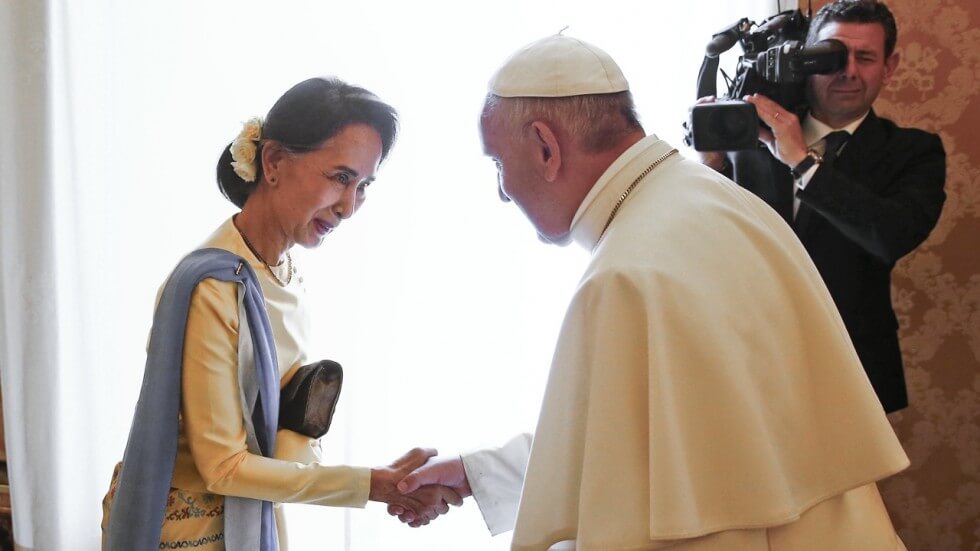
Photo: Pope Francis with Myanmar’s de facto leader Aung San Suu Kyi in Naypyidaw. While Francis has stressed the importance of “unity in diversity” while meeting leaders of several faiths as well as the army in Burma, he has made no mention of the violent campaign by the Burmese military against the Rohingya Muslims – Credit: AFP

Democratic Republic Congo

On Sunday, the Democratic Republic of Congo government banned rallies that were planned this week in the capital Kinshasa, over the extended rule of President Joseph Kabila. Both the coalition in favour of Kabila, as well as the opposition coalition had planned a march, to voice support or disagreement with the delayed elections. Despite concern over a crackdown, the head of the opposition coalition, Felix Tshisekedi, said he would not heed the ban. “There’s no question of depriving us of our rights and freedom,” he tweeted according to the Daily Nation. The opposition march was planned for Thursday this week.

Then on Monday, AFP reports that a group of influential bishops in the DRC urged President Joseph Kabila to pledge he will not seek a third term in office in order to ease fears of unrest. The Catholic church plays an important role in the country, as bishops last year already tried to help broker a deal under which elections for a new president would be held in 2017. In a statement, the bishops stated that “It is essential, on the grounds of (demonstrating) sincere political will, to reassure the Congolese people and international partners by providing guarantees that elections will effectively be held.”

On that same day, the Food and Agriculture Organization of the United Nations published their latest DRC-situation report. The report displays the unrest of the last month and the relationship between violence and food-insecurity for millions of Congolese. According to the report, “food insecurity has increased by 30 percent since 2016 due to a lack of access to food, suspended agricultural activities, insufficient food reserves and income, and the fact that previous harvests have been either looted or burnt as a result of the conflict. Between 40 and 60 percent of households were forced to adopt negative coping mechanisms.”

1. Daily Nation
2. News24
3. ReliefWeb

The Maldives

Late on Friday last week, Assad Shareef announced that he is to file a case in Court over the Council’s refusal to investigate RaajjeTV for staging a peaceful protest in MMC media awards night. Shareef, who is a member of Maldives Media Council (MMC), claimed that using the awards ceremony to stage a protest was a direct challenge to other media and journalists. Therefore, Assad argued, the case must be investigated. RaajjeTV staged a silent protest at the Media Council awards in October. Staff of the station held signs displaying sentiments against Maldives Broadcasting Commission (MBC), as to address the unfairness and bias of the Commission in penalizing the station.

On the weekend, Former President Maumoon Abdul Gayoom has expressed his displeasure about the fact that his son, Dhiggaru constituency MP Faris has been in police custody since July, and is yet to be sentenced. In a tweet, the man who ruled the nation for 30 years noted that detaining an innocent, influencing trials and embezzling from state funds, are severe injustices, the latter directed towards the mass corruption allegations against his half-brother’s administration.

On Thursday, Orlando Crowcroft for NewsWeek publishes an extensive analysis of the current situation in the Maldives and the changing image of the Indian Ocean nation. As former President Mohamed “Anni” Nasheed is waging his battle with the government of Abdulla Yameen from London, his campaign has stopped short of calling for an outright boycott of the Maldives’ tourism industry. However, the former president has called for targeted sanctions against the new regime in Malé. In response, the government has gone on a charm offensive. About Nasheed’s combined battle for democracy and environmental justice for the Maldives.

1. Raajje
2. Raajje
3. Newsweek

Zimbabwe

On Friday, Emmerson Mnangagwa is sworn in as the new President of Zimbabwe. The former Vice-President will remain head of Zimbabwe until the next elections, for which a date has not yet been set. Analysts do not predict a radically different Zimbabwe now Mnangagwa is in charge. He has been named a ‘ghost of Mugabe’, with similar affiliation to the ruling party and a big influence on the Zimbabwean army, as a former liberation-fighter and then Defence Minster. During his inauguration-ceremony, Mnangagwa mentioned his intentions to fight corruption, and kick-start the economy, with a focus on youth and agriculture. Mnangagwa also referred to the current stance of politics, to which he himself has, one would say, strongly contributed. “We must appreciate the fact that over the years, our domestic politics have become poisoned and rancorous and polarizing. We dare not squander the moment,” according to Zimbabwe’s new President. However, when Mnangagwa announced his new cabinet on Thursday, many were very dissapointed.

On Sunday, several media reported on the deal that was negotiated by the Mugabe’s before Robert’s resignation last week. The ousted president and his wife will receive a “golden handshake” worth not less than $10 million. Furthermore, both Grace and Robert Mugabe would be getting immunity from prosecution. The salary of the 93-year-old former president will also be paid until his death, the Guardian reports. That same report adds that, instead of going into exile, Mugabe’s negotiators managed to strike a deal with the generals that enables him to rather enjoy his retirement in Zimbabwe with all his benefits. Opposition politicians have criticized the deal, stating that even when the ruling party and the army make a deal with the ousted President, this does not mean that he cannot be prosecuted for his actions while in government.

Early on Wednesday, Pastor Evan Mawarire was acquitted on charges of trying to overthrow Robert Mugabe’s former government. As the case was widely seen as a test of judicial independence after the forced resignation of Mr Mugabe last week, the High Court in Harare ruled there was no evidence that he had “urged a violent removal of government”. The case had dragged on since Mawarire’s arrest on February first of this year. According to the BBC, “some Zimbabweans will see his acquittal as a symbolic victory, coming just after Mr Mugabe’s resignation and the inauguration of his former deputy, Emmerson Mnangagwa, as president.”

1. Financial Times

  1. The Guardian
  2. BBC

Syria

Last week on Friday, the Syrian opposition selected a new chief negotiator to head a unified delegation to peace talks with the Syrian government in Geneva this week, Reuters reported. Nasr Hariri said the opposition was going to Geneva on November 28 to hold direct talks and was ready to discuss “everything on the negotiating table”. Hariri replaces hardliner Riyad Hijab, who abruptly quit this week, hinting that the High Negotiations Committee under him had faced pressures to make concessions that favoured Assad. Opposition groups in Riyadh maintained the position that President Assad has no role in a transitional period under a U.N.-sponsored peace deal.

On Sunday, at least 23 people were killed in government shelling and airstrikes on a rebel-held enclave outside the capital Damascus, Agence France-Presse reported. More than 100 people have been killed by airstrikes and shelling on the Eastern Ghouta suburbs since pro-government forces, backed by Russian warplanes, launched an offensive nearly two weeks ago to reclaim one of the last rebel strongholds near the capital, the United Kingdom-based Syrian Observatory for Human Rights (SOHR) said. According to Newsdeeply, separate Russian airstrikes on the eastern province of Deir Ezzor, targeting Islamic State killed another 34 people, including 15 children.

Starting from Tuesday, peace-talks in Geneva were held, as the government and opposition would have a chance to negotiate directly for the first time. After a delay that was allegedly caused by the opposition’s insistence that Assad step down, which he has refused to do, the government-delegation finally made it to Geneva on Wednesday. ABC-news reports that, despite the fact that much has changed in Syria since the last peace-talks this summer, there is little optimism that the current round would achieve any significant breakthroughs. According to a European diplomat close to the negotiations, a real dialogue between the two sides on these two matters would already represent a “significant step forward,” considering Geneva’s past record for deadlock.

1. Reuters
2. NewsDeeply.com
3. ABC-News

Venezuela

As Venezuelan President Nicolás Maduro has named Major General Manuel Quevedo as the new head of state oil company PDVSA and the country’s energy ministry on Monday, analysts expect that the military will be given more leading posts in the countries oil sector. The appointment of the army General comes as a surprise, as Maduro claims his main reason for the appointment was the fight against corruption. After executives of Citgo, the oil company’s US refining subsidiary, were arrested over corruption allegations last week, the move by Maduro seems to be the next chapter in his polarizing tactics. According to VOA, sources within PDVSA and the oil industry said Maduro’s administration was using corruption allegations to side-line rivals and deepen its control of the industry, which accounts for over 90 percent of export revenue.

On Tuesday, online magazine the Wire publishes an in-depth article about Venezuela’s digital news upstarts and their “sense of energy and urgency […] to provide accurate, independent coverage of the turmoil engulfing the country.” With the credibility of the country’s traditional media completely shattered since 2014 by government censorship and punishing economic policies, several digital outlets now provide new sources for new audiences. Read everything about the strategies and goals of these platforms in this incredible piece by Diego Marcano.

On Wednesday, two rights groups brought out a combined report, in which the Venezuelan government is accused of “systematically” abusing anti-government protesters this year. In a joint report, New York-based Human Rights Watch and Venezuela-based Penal Forum documented 88 cases between April and September, from excessive use of force during marches to protest against arbitrary detentions. Presenting the 62-page report, “Crackdown on Dissent: Brutality, Torture, and Political Persecution in Venezuela,” on their website, HRW claimed that “while it was not the first crackdown on dissent under Maduro, the scope and severity of the repression in 2017 reached levels unseen in Venezuela in recent memory.”

1. VoaNews
2. The Wire
3. Human Rights Watch

Myanmar

Thousands of Catholics welcomed Pope Francis when he starts his three-day-visit to Myanmar on Monday. According to the Guardian, the head of the Catholic church faces a difficult diplomatic balancing act on his first papal visit to Myanmar. Even mentioning the word “Rohingya” would allegedly set off a firestorm in the Buddhist-majority country, where the military and government revile the minority group, preferring to call them “Bengalis”, which suggests they are immigrants. The pope has already spoken about the Rohingya in two appeals from the Vatican this year, calling them “our Rohingya brothers and sisters”. Francis met with the country’s de facto leader, Aung San Suu Kyi, and commander-in-chief, Min Aung Hlaing on Wednesday, but strategically avoided mentioning the Rohingya.

On Tuesday, Human Rights Watch reports that while Pope Francis has stressed the importance of “unity in diversity” while meeting leaders of several faiths as well as the army in Burma, he has so far made no mention of the violent campaign by the Burmese military against the Rohingya Muslims. Myanmar’s powerful army chief told Pope Francis there is “no religious discrimination” in Myanmar. Meanwhile, Bangladesh threatens to move 600,000+ Rohingya to Bhasanchar, a remote island in the Bay of Bengal, “if they do not leave the country shortly.”

Also this week, the South China Morning Post reports on Aung San Suu Kyi being stripped of her Freedom of Oxford honour for ‘turning a blind eye’ to the Rohingya crisis. According to the SCMP, “Oxford city council voted unanimously to permanently remove the honour given to the de facto leader of Myanmar in 1997”, and said it did not want to celebrate “those who turn a blind eye to violence”. Only five years ago, Suu Kyi was celebrated with an honorary doctorate from Oxford, and held her 67th birthday party at St Hugh’s college, where she studied politics, philosophy and economics in the 1960s.

1. The Guardian
2. Human Rights Watch
3. SCMP

The United States of America

A new chapter in the era of ‘fake news’ this week in the USA. Project Veritas, an organization that uses fake stories, and secret recordings to try and discredit news-outlets, allegedly tried to set up the Washington Post. The organization, run by James O’Keefe, had one of its colleagues reach out to the Post with a made-up account on sexual misconduct by the Republican nominee for Senate in Alabama, Roy Moore. The hope within Project Veritas seems to have been that the Post would reveal anti-Moore bias and perhaps eventually publish the lie. When the account would turn out to be fake, this would firmly discredit the Washington Post, and boost Moore’s campaign. More disturbing, finally, is that another apparent goal has been to discredit another woman who previously spoke with the Post about real alleged sexual misconduct by Moore. However, thanks to thorough fact-checking by the Post, Veritas’ operation got discovered and exposed. In a reaction, O’Keefe wrote:  “This is how undercover work goes. This isn’t the first time that has happened, and it won’t be the last time.”

On Thursday, Donald Trump told Prime Minister Theresa May to focus on “terrorism” in the UK after she criticised his sharing of far-right videos. After the US president had retweeted three inflammatory videos posted online by a British far-right group, reactions from all over the world were triggered. As one of the retweeted videos purportedly shows a “Muslim migrant” attacking a young Dutch man on crutches, the Dutch embassy in Washington DC answered by tweeting: “Facts do matter. The perpetrator of the violent act in this video was born and raised in the Netherlands. He received and completed his sentence under Dutch law.”

1. CNN
2. BBC

Cambodia

After the dissolvement of Cambodia’s main opposition party earlier this month, an NGO founded by Cambodia’s jailed opposition leader Kem Sokha is set to become the latest casualty of Prime Minister Hun Sen’s ongoing campaign to crush critical voices in his country, Voice of America reports on Monday. Sokha founded the Cambodian Center for Human Rights (CCHR) in 2002, but the organization is now forced to close its doors, because it is claimed to be a front for sinister foreign meddling. Prime Minister Hun Sen stated that “in fact, the Cambodian Center for Human Rights should be shut down because it follows order from foreigners. It is because foreigners created it, not Khmer.” For more about the spreading crackdown in Cambodia, read the full VOA-article.

Which role has the international community played in the current collapse of Cambodia’s democracy? In the days and weeks following the Supreme Court decision to dissolve the Cambodia National Rescue Party, international condemnation was poured out over the CPP-regime. In their turn, CPP-party officials defended themselves stating that “democracy and human rights in the neighbourhood are … incomparable with Cambodia,” and “no country in the Greater Mekong Subregion has a better democratic regime than Cambodia.” Although their argumentation comes very close to a fallacy, there might be some truth in it. As Andrew Nachemson, writing for the Phnom Penh Post, claims; “Indeed, with a military junta in charge in neighbouring Thailand to the west, and repressive communist regimes in power in Vietnam and Laos to the east and north – not to mention a troubled, corrupt regime in Malaysia, a sultanate in Brunei and a so-called benevolent dictatorship in Singapore – Cambodia’s comparatively liberal democratic Constitution sticks out like a sore thumb.” Was the attempt to shoehorn democracy into Cambodia by the UN naïve?

1. VOA-News
2. Phnom Penh Post

Poland

On the weekend, mocked-up pictures of opposition politicians allegedly hanging on gallows were unfurled at a far-right demonstration in Katowice, near Krakow. Members of the far-right movement ONR brought the gallows to their rally, figuratively hanging-up the pictures of six Members of European Parliament from the Civic Platform (PO) opposition party. These politicians voted in favour of a resolution adopted on 15 November by the European Parliament denouncing judicial reforms in Poland as a threat to the fundamental values of the European Union. After that vote, the six were accused by the ruling conservatives of acting “against their country”. Poland’s Minister of Justice announced an investigation into the protest. According to the NY-Times, Justice Minister Zbigniew Ziobro, said in an interview with a private radio station that the demonstration was unacceptable, but also blamed opposition parties for the escalation of tensions.

Also on Monday, the Polish authorities were looking into an act of vandalism against a Muslim cultural centre in capital Warsaw. Stones were thrown at the centre by unidentified people, smashing about a dozen windows. “I am 100 percent sure this was a racist, anti-Muslim attack,” Muslim community leader Youssef Chadid told several news platforms. According to the Imam, these acts of hatred and xenophobia are being reported more frequently in Poland since the Law and Justice party came to power two years ago. The government promotes Catholicism and refuses to take in non-Christian refugees as part of an EU relocation plan, citing security concerns, says ABC News.

1. New York Times
2. ABC-News

Other News

Spain – On Tuesday, several pro-independence parties presented their election campaigns, while more than a few of their candidates remain either in prison awaiting trial, or in exile in Belgium – CatalanNews

Uzbekistan – Where Uzbekistan was one of the world’s most isolated states, it is slowly opening up since the death last year of former president Islam Karimov, Reuters reports. Where Karimov kept an iron grip on the economy and politics and mistrusted both Russia and the West, his successor Shavkat Mirziyoyev, started tentative reforms to an economy that had failed to create jobs, fuelling discontent. Nevertheless, Mirziyoyev has maintained a strong top-down political system – Reuters

Romania – Thousands took to the streets on Sunday all over Romania, protesting a government draft law which is criticized for possibly putting the judicial system under political control – EuroNews

Australia – After CANVAS reported on different protests methods being used in the struggle for the evacuation of the immigration detention centre on Manus Island three weeks ago,  five activists chained themselves by the neck to the Prime Minister’s Sydney residence to push for the evacuation of the Manus and the Nauru offshore processing centre in a new act of protest this week – The Guardian

Vietnam – A Vietnamese court has upheld a 10-year jail sentence for a prominent blogger convicted of publishing propaganda against the state – Reuters and HRW

Honduras – As the political limbo continues, Honduras moved into a fifth day of presidential vote count on Friday, which has sparked unrest amid opposition accusations of electoral fraud. The process will likely to take up to two more days before yielding a winner – Reuters

CANVAS’ Daily News

Also read what we featured in our daily news section this week:

1. Thousands in the streets on Sunday – Romanian protests continued!

2. Lessons from radical, political art in Russia: Pussy Riot, Pyotr Pavlensky and Co.

  1. With Zimbabwe, other African states are shifting into spotlight! 

With Zimbabwe, other African states are shifting into spotlight!

Photo: People demonstrating their support for Ugandan President and the removal of the presidential age limit, in September (Associated Press, via Washington Post)

Published on 01/12/2017

As the world is watching developments in Zimbabwe, attention has also turned to other longtime rulers on the African continent. Martina Schwikowski for Deutsche Welle thought about the question which has now been raised “Will Africa’s autocrats stay in power?”, while Rodney Muhumuza’s article for the Associated Press titled “After Mugabe, Africa’s other longtime leaders feel a chill.”

The latter could have already been shown by Ugandan President Yoweri Museveni, who has been in power since 1986. Seemingly startled “by the sight of Zimbabwe’s military takeover that ended the rule of the 93-year-old Mugabe” (Muhumuza), he initiated promotions and a raise of salary for Uganda’s military and officials. “As in Zimbabwe, the military is seen as the most powerful institution in Uganda” wrote Muhumuza further, and quoted a Ugandan academic at the University of Toronto saying that Museveni is aware of the support of the army he needs to stay in power. The 73-year-old Ugandan President is currently hoping for the passing of a bill which lawmakers are working on to remove the age limit of 75 set by the constitution to be able to stay in power.

Other examples of African leaders who have been in power for more than three decades can be found in Cameroon with Paul Biya, Equatorial Guinea with Teodoro Obiang and in Republic of Congo with Denis Sassou Nguesso. Especially Cameroon could be “a powder keg that may very well explode” especially if more were to join the current main opposition party, although unlike Mugabe, Biya “has a firm hold on the military”, said a political scientist at the University of Yaounde, wrote Schwikowski.

Muhumuza expressed that like the large demonstrations in Zimbabwe urging for Mugabe to step down, “leaders across Africa risk being swept from power with support from a popular uprising, especially one angry over economic stagnation or decline.” Meanwhile, Schwikowski wrote in her article: “No Arab Spring for Africa”, warning not to “generaliz[e] the coup in Zimbabwe or drawing premature conclusions” after talking to Liesl Louw-Vaudran, a senior research consultant at the Institute for Security Studies (ISS) in Pretoria.  As our in-depth analysis With Mugabe down, the real struggle for New Zimbabwe has just begun! showed, we certainly agree with the latter point of not drawing conclusions too early. And another statement by Louw-Vaudran, saying that “’nothing happened’”, after a coup in Burkina Faso in 2014, which led former President Blaise Compaore to flee after 27 years in power, also underlines an important aspect: having a change in leadership and power does not necessarily mean positive change for the people. This has certainly been a lesson in Egypt in 2011, as already mentioned in our aforementioned analysis: “Eventually, the bad guy was kicked out, only to pave the way for another strongman in the making and people started being suppressed again as soon as they left the streets.”

According to Schwikowski’s article, Louw-Vaudran also suggested not to make too many comparisons, referring to diverging underlying situations in different countries such as Equatorial Guinea or the Republic of the Congo. However, even though the analyst is right about considering each and every case individually, we think it is still valuable to learn from good and bad examples elsewhere. Talking about the countries taken as an example in both articles in more general terms, this could mean to not only think about ‘removing the bad guy’, pushing for a change in personnel, but more importantly, to think about how to trigger meaningful, positive and sustainable transitions for lasting change. Hopefully, political opposition, civil society and other actors involved will keep this in mind when thinking about their ‘Vision of Tomorrow’, strategies and tactics.

Meanwhile, Zimbabwe’s newly installed President Emmerson Mnangagwa presented his cabinet on Thursday. Where many had hoped and pushed for an inclusive transformative body of some kind towards the next general elections, the cabinent was received with disappointment, as largely the same people that caused the Zimbabwean crisis have been recycled. The announcement caused many to argue that Mnangagwa’s main concern seems to have been “rewarding those who brought him to power and Zanu-PF unity.”

Read more about other examples and the fate of longstanding rulers in African states here and here.

Thousands in the streets on Sunday – Romanian protests continued!

Photo: “People hold placards reading ‘All for justice’ during a protest in Bucharest” (Daniel Mihailescu/AFP/Getty Images, via the Guardian)

Published on 29/11/2017

Sunday night, a typical time for protests in Romania, about 30,000 protesters went out on the streets of Bucharest while up to 20,000 demonstrated elsewhere in the country, according to the Guardian. The people were protesting a government draft law which is criticized for possibly putting the judicial system under political control, reported Euronews. Earlier this year, these latest protests had been preceded by Romania’s biggest protests since the 1989 revolution. To learn more, you can consult this article about Lessons for democracy from Romania’s protest movement by Srdja Popovic and Cristian Sallai, also featured on CANVAS’ page in June.

During the protests on Sunday which included brief scuffling with police in Bucharest, wrote the Guardian, Romanians demanded “rights and prosperity”, shouted “Thieves” and “We want justice not corruption”, blowing whistles while they marched. An especially creative and humorous protest sign read “I’ve seen smarter cabinets at IKEA”, as seen on Euronews. According to the Guardian, new protests on Friday, a national public holiday in Romania, have been called for on social media.

And not only protesters are criticizing the proposed bill. Their criticism has been joined by the European Commission, foreign diplomats and thousands of magistrates, wrote Euronews. The news outlet further reported about Laura Kövesi, head of Romania’s anti-corruption directorate (DNA), saying that “’If voted through it will have a serious negative impact on the independence of justice and it will result in political control of prosecutors’ activity’”. She added that “’It will lead to the political subordination of the prosecutors and could seriously obstruct the anti-corruption fight”, stating that “’In my view the independence of justice is not a privilege for the magistrate – it is a fundamental principle in a democratic society.’” According to the Guardian, the national and international critics have claimed that the government seeks to protect senior figures from justice.

In the bill, the government seeks to reform organizations “at the forefront of Romania’s attempts to tackle corruption” which according to the government’s opponents would reduce the power of the DNA as the justice ministry would be able to name the head prosecutors, wrote the Guardian. A judicial inspection body overseeing the work of judges would also be controlled by the ministry, while a new structure staffed by prosecutors to investigate criminal acts by magistrates is being developed. Contested judicial changes also include the president’s right to veto candidates, stated Euronews. These proposed reforms have especially incited public protest as they coincide with changes to the tax system, making employees responsible for social security payments, instead of the employer, reflected the Guardian.

The news outlet meanwhile reports that some experts have said, the proposal does have some positive aspects like including greater transparency and parliamentary scrutiny of the secret services’ work. And according to Euronews, some critics of Kövesi called her anti-corruption drive ‘a politicized witch hunt’ and denounced DNA’s alleged closeness to Romania’s secret service. The Romanian government itself has said their proposal did not include anything allowing the state to take control of the justice system, and it called for a discussion about specific points to be addressed and a reflection of arguments of both sides.

The current government is a coalition between the center-left Social Democrat Party (PSD), the center-right Liberal-Democrat Alliance and the Democratic Alliance of Hungarians in Romania. The PSD has been criticized for “harbouring former figures from the communist regime”, and its leader Liviu Dragnea has been and is involved and past and current accusations for fraud and corruption, banned from becoming prime minister after a conviction for vote-rigging, reported the Guardian.

Read more about Sunday’s protests in Romania and its background here and here, and learn more about the protests at the beginning of the year, here.

Lessons from radical, political art in Russia: Pussy Riot, Pyotr Pavlensky and Co.

Photo: “Petr Pavlensky sewed his mouth shut in protest of the incarceration of a Russian punk band” (Gleb Husky, via Politico)

Published on 28/11/2017

CNN just published an article by Marat Guelman, son of Russian playwriter Alexander Guelman, and art curator living in Montenegro, who recently opened an exhibition in London titled “Art Riot: Post-Soviet Actionism is dedicated to Russian protest art over the past 25 years.” In the CNN article on “Why Russia produces (and quashes) so much radical art”, Guelman addresses the above topic and states that “Artists have always held a special place in Russian society.”

He describes how developments during Glasnost in the mid-1980s and the return of writer Alexander Solzhenitsyn after exile in 1994, as well as rock music taking over the roles previously occupied by theater and literature, were signs of change, opening and a call for a new, open world. Recently, “contemporary art and provocative performances have proven the most effective medium for influencing public opinion. Artists have their fingers firmly on the pulse of the rapid changes taking place in Russian society”, according to Guelman. The probably most well-known performance has been that of Pussy Riot in Moscow’s largest cathedral in 2012, when they made a statement for Putin to leave his position or rather, to not be reelected. Pussy Riot’s trial and two members going to prison then captured global attention for Russia’s seemingly biased judiciary and Russia’s increasingly authoritarian path. Noah Sneider who published an article in the 1843 Magazine from The Economist Group last year, quoted Guelman saying that “From that moment, [the regime] began to seriously address the arts, to bring all their repressive methods to bear.”

Another prominent example in Russia, is Pyotr Pavlensky. His drastic actions, sometimes labeled as ‘crazy’ or ‘grotesque’, including among others, the sewing of his lips, a naked performance inside barbed wire or the cutting off of his own earlobe (like Van Gogh) confronting and criticizing the Russian state in various ways, have gained widespread attention. Sneider wrote that “Pavlensky practises actionism, an art form with a rich history in Russia. He calls his particular brand of actionism “political art” (not to be confused with art about politics).” Guelman further described that, while Pussy Riot was loud about their convictions, Pavlensky “demonstrated the strength of the weak. There was nothing the government could take away from him, because he didn’t have anything to lose.”

Pavlensky has had to spend time in a psychiatric ward as well as in prison, and has by now fled to France, were he received political asylum in May. What led to his decision to leave Russia with his family, were accusations of sexual harassment which he denied. Only last month, he staged another ‘performance’ in Paris, setting fire to a French Bank at the Place de la Bastille, referring symbolically to the historic role of the Bastille in the French Revolution.

Whether one agrees with Pavlensky’s views or the radical methods chosen, analyzing his actions baring in mind fundamental lessons about strategic planning of nonviolent campaigns, can certainly reveal some aspects about his performances. First, what did work well for Pavlensky was triggering reactions by the authorities which could be somehow described as ‘dilemma actions’. The latter “put an opponent in a situation where it must either a) grant a nonviolent movement’s demand, or b) act in a way that sacrifices some of its own support and damages its public image. […] Dilemma actions place an opponent in a situation where any action that it takes will result in a negative outcome for it. “ (CANVAS Core Curriculum, p. 144)

This is seemingly shown in what Sneider described: “Pavlensky specialises in creating situations that draw the authorities into his actions, turning them into the puppets in his theatre of the absurd.” Sneider went on to state that “the authorities respond in ways that highlight his message: after ‘Threat’, they covered the scorched doors with sheets of corrugated metal – a veritable iron curtain. During ‘Fixation’, the officers circling Pavlensky seemed disgusted by the sight of him and unsure what to do with the nail poking through his scrotum; eventually they draped him with a white sheet, turning him into a fleeting reflection of Gandhi.” Bennett adds the example of police officers refusing to carry out their orders to detain Pavlensky after his sewn-lips protest after the Pussy Riot arrest, instead waiting for doctors to arrive. Even his arrest and trial did Pavlensky see as an opportunity: “My task is to force the instruments of state power to create political propaganda. To suck them into my art. Criminal cases open a door for me to get inside the mechanics of the system — the investigators, the court system, psychiatrists — and allow me to work there”, wrote Marc Bennett about Pavlensky in an article on Politico.

The latter could also reflect one of the basic considerations for planning nonviolent campaigns, which is recognizing the current underlying power structures and trying to change it, mostly by winning over certain parts of society (for more explanations about the nature of power and power structures within society, see Chapter 1 of CANVAS’ Core Curriculum). But while Pavlevsky does seem somehow aware of such structures and has possibly managed to convince some ‘opponents’ to change their minds, like a former investigator in his case, the artists’ provocative and radical methods certainly repel others or make him seem ‘crazy’. And when planning a nonviolent campaign’s tactics, anticipating possible sympathizers’ reactions and the light the tactics will shed on your movement, is essential. Furthermore, even though Sneider states that Pavlenksy “sees no sense in art for art’s sake, believing instead in art as change, as progress, as awakening”, some aspects are frequently is not so clear: What are his intentions in each action, does he seek to mobilize others to help push for his vision of a free Russia and especially, which concrete steps would he want the country to take in order to do so? Despite these questions, his performances have certainly caused widespread attention, as have other actionists’ in Russia.

Learn more about Russian political art, actionism and Pavlensky here, here and here.

Weekly Report: 24 November, 2017

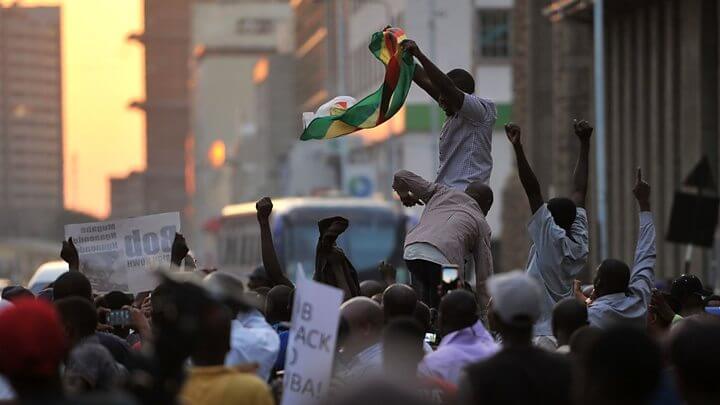
Photo: People cheering in the streets of Zimbabwe where longstanding President Robert Mugabe resigned (BBC)

Zimbabwe

After the military coup halfway last week, things developed fast in Zimbabwe this week. Mass protests on the weekend, calling for the resignation of Robert Gabriel Mugabe, united the whole of the country. However, looking at the protest signs of the Zimbabwean people, a unity of purpose for when Mugabe would be gone was hard to find. Zimbabwe reacted in shock when, on Sunday, Mugabe amazed and infuriated the country by apparently resisting calls to step aside. However, an official source with direct knowledge of the ongoing negotiations told CNN that Zimbabwe’s long-time president has agreed to the terms of his resignation and a letter has been drafted. According to the source, the aim of Sunday’s televised speech, was to ensure the veteran leader openly declared the military’s actions to be constitutional. Despite the disappointing speech, the end of the Mugabe era seemed a matter of time.

Then on Tuesday, the long-awaited news came. Robert Mugabe officially resigned as the President of Zimbabwe, after ruling party ZANU-PF already sacked him as their leader.  Mass-celebrations broke out all over the country, and the eye of the world was focused on Zimbabwe. Looking towards the future, however, one could be more skeptical. Emmerson Mnangagwa seems to be in the most prominent position to be Zimbabwe’s next leader. As Steven Feldstein puts it, “Mnangagwa is massively invested in ensuring his continued and unfettered access to power, which has proven highly lucrative for him. The vice president is “reputed” to be one of Zimbabwe’s richest people. All of this suggests he might become yet another dictator.”

So what should we expect for the future of Zimbabwe? And more importantly, how can the forces in Zimbabwean society pushing for democratic reform make use of the current window of opportunity? On Thursday, your very own CANVAS released an in-depth analysis on the ongoing situation in Zimbabwe. About the importance to distinguish between the party and the state in relation to the origination of the coup, and the role political opposition and social movements should play in the coming weeks and months.

CANVAS Zimbabwe Analysis

Cambodia

After the Supreme Court had decided to dissolve Cambodia’s main opposition party last week in what some have said to be politically motivated, allowing Prime Minister “Hun Sen to extend his more than three decades in power in next year’s general election”, elected officials from the Cambodia National Rescue Party (CNRP) started handing over their duties. Among those told to abandon their positions were councilors elected in communal elections this year, when CNRP won control of 40% of Cambodia’s local councils, demonstrating potential electoral threat for Hun Sen in upcoming elections. His party, the ruling Cambodian People’s Party (CPP) is set to take over positions in nearly all communes which had been subject to the CNRP. Mu Sochua, a senior CNRP member who fled Cambodia earlier said that they ‘rejected the decision of the court’ and that its leader charged with treason would remain president and former leader Sam Rainsy, had rejoined, reported Reuters.

The news outlet further reported that the National Election Committee announced on Thursday, that CNRP’s parliamentary seats were reallocated to five of the smaller parties which had failed to win any seats in the last election. The majority of the 55 seats went to the royalist Funcinpec party of Prince Norodom Ranariddh, now receiving 41 seats (118 of in the whole National Assembly) after only winning 4% of the vote in 2013. Funcinpec’s leader used to be Hun Sen’s biggest rival, though now being aligned with the prime minister. The remainder was awarded to four other parties, of whom two refused to take their respective 6 and 5 seats, meaning they would have to go to another party. Reuters wrote that CNRP officials had not made immediate comments. 118 of its members have been banned from politics for five years, while many of its leaders have left the country. A leaked document revealed that “Cambodian Prime Minister Hun Sen has warned his party it could still lose next year’s election even after the banning of the opposition and demanded that it improve its image.” His Party “played down the importance of the message, in which Hun Sen tells senior officials they must stop corruption, extortion and other illegal practices and start making people happy.”

After Radio Free Asia (RFA) closed its Cambodia office in September in a widespread crackdown on news outlets, two journalists who used to work for the US-funded outlet were charged last Saturday with ‘providing information to a foreign state which may damage the nation’. The journalists were detained for questioning last week after a police discovery of them renting a hotel room in Phnom Penh, allegedly using it as an office to continue providing RFA with information about Cambodia. They have denied the allegations and said they had been using the room as a new business after having lost their RFA jobs. If found guilty, the two will face up to 15 years in prison.

Reuters (CNRP start handing over duties)
Reuters (parliament seats reallocated, Hun Sen’s warning to his party)
South China Morning Post (former RFA Journalists)

Syria

In the context of their meeting in Russia city Sochi, the leader of Russia, Turkey and Iran announced their willingness on Wednesday to sponsor a conference in Sochi aimed at achieving a peaceful settlement of the Syria war. In the joint statement, the three countries “called on representatives of the Syrian opposition “that are committed to the sovereignty, independence, unity, territorial integrity and non-fractional character of the Syrian state” to take part in the Sochi conference”, wrote the NY Times. Otherwise, no further details about such a conference in Sochi are known, including its potential participants from the opposition side or when it will be held. Wednesday’s meeting coincided with one held by Syrian opposition factions in Saudi Arabia who had tried to form a unified position going into UN-organized Geneva talks on November 28, though it seemed they struggled, especially with agreeing on Assad’s future in Syria.

Earlier this week, Russian President Vladimir Putin had met with Syrian President Bashar al-Assad, indicating that the latter might have agreed to the idea. Putin further called President Trump and other regional leaders. The announcement by Putin, Rouhani and Erdogan on Wednesday underscored Russia’s growingly influential role in determining the outcome of the Syrian war, seemingly overshadowing those efforts by the UN. The latter stated however, that their main focus remains on meetings to be held in Geneva next week, hoping “that all the other processes that are underway will contribute to a successful round of talks.”

Iraqi forces launched an operation on Thursday to clear the desert bordering Syria and Iraq in a final push against the ‘Islamic State’ (IS) which has been said to have been militarily defeated, aiming at preventing remaining groups to settle in the desert region and use it as a base for further operations. Meanwhile, Iranian President Hassan Rouhani had declared the end of the IS on Tuesday. The militant group had carried out their first attack in Iran in June while Iranian forces had been fighting in support of Syrian President Bashar al-Assad and the Iraqi central government for years. Their engagement has been framed as an effort by the mainly Shiite Iran against the Sunni Muslim fighters of IS.

NY Times
Reuters (Iraq)
Reuters (Iran)

Myanmar

Amidst mounting international pressure, Myanmar and Bangladesh signed an accord over the terms for the return of the Rohingya Muslims from Bangladesh on Thursday, following a meeting in Myanmar’s capital. Myint Kyaing, a permanent secretary at Myanmar’s ministry of labor, immigration and population, told Reuters “that the memorandum of understanding was based on the 1992-1993 repatriation agreement between the two countries which had been inked following a previous spasm of violence in Myanmar.” While key elements of the deal are said to be the criteria of return of the Rohingya and the participation of the international community, other significant points such as safeguards against further violence and addressing their legal status as well as “whether they would be allowed to return to their own homes and farms”, were left without further elaboration. After a statement by Senior General Min Aung Hlaing, with whom civilian leader Aung San Suu Kyi has to share power, senior UN officials have voiced their fear of security personnel in key positions not cooperating with the return of the Rohingya.

Within the last week, China had called for a ceasefire in Rakhine State and suggested a three stage approach, while the EU and UNHCR voiced being ready to assist Myanmar in moving forward with the crisis. US Secretary of State had called the violence and following displacement of thousands in Rakhine State “ethnic cleansing”, after the UN had done so earlier. Meanwhile, Amnesty International has published a new report addressing violations and discrimination of the Rohingya, labelling their situation as “apartheid”.

Reuters (Myanmar and Bangladesh)
Reuters (China and international reactions)
Amnesty International

Venezuela

The former mayor of Caracas, Antonio Ledezma who is a known opponent of Venezuelan President Nicolas Maduro, has succeeded in escaping from house arrest and was welcomed Saturday in Spain. He had been arrested in February 2015, after accusations of his involvement in a plot to overthrow the government, before he was later released from jail and put under house arrest due to health reasons. Ledezma who was happy to have attained freedom and to be in Spain with his family, vowed to continue fighting the Venezuelan President whom he called “a tyrant”. In The Hague, Luisa Ortega, Venezuela’s ousted chief prosecutor who had fled Venezuela, called on the International Criminal Court to charge President Nicolas Maduro with crimes against humanity. She referred to more than 8,000 deaths which, she said, took place at the hands of officials receiving instructions from the government in the last two years.

At the same time in Venezuela, six executives of Citgo, a US subsidiary of Venezuela’s national oil company PDVSA, have been arrested for alleged corruption, announced by Attorney General Tarek William Saab. The Washington Post had reported that four of the arrested were US citizens. It has been speculated whether this latest move – only one in recent months leading to the arrest of around 50 people associated with Venezuela’s vital oil industry – is “mostly a high-profile effort by Mr. Maduro to reinforce his power on the cusp of a presidential election year”, wrote the NY Times. The arrests also came within discussions and uncertainties about Venezuela’s deepening economic crisis and what has already been labeled as a default by some. A general overview of the economic and default situation can be found here.

CNN (Antonio Ledezma)
The Independent (International Criminal Court)
NY Times (oil industry arrests)
CNBC (economic overview)

Democratic Republic Congo

On November 22, representatives of the Guarantors of the Peace, Security and Cooperation Framework for the DRC and the region, including the African Union, United Nations, International Conference of the Great Lakes Region and the Southern African Development Community met in Ethiopia to review the status of preparations for elections in DRC, also discussing coordinated regional and international support. During the meeting, they reaffirmed their commitment supporting “a democratic and peaceful transition in the DRC through credible and transparent elections” and called on the government to “ensure the required political space throughout the country, including freedom of peaceful assembly and equitable access to state media”, reported ReliefWeb, referring to the official statement.

New Vision also reported on the UN condemning a new spike of human rights violations, for many of which security forces were said to be responsible. Violations included, among others, extra-judicial killings and rape. The increase in violence follows an outbreak of street protests opposing the prolonged rule of President Kabila who has been in office since 2001, but refused to step down even though he would have to do so by law. Only on Saturday, six protesters were injured after police had fired during an opposition rally in Kenge (Western DRC). Meanwhile, the police claimed that only one protester had been wounded due to rocks thrown by other demonstrators. The opposition, which criticized the recent decision to schedule elections (only) for December 23, 2018, is “considering a ‘peaceful demonstration’ in Kinshasa on November 28, according to a letter seen by AFP”, published News24.

ReliefWeb
New Vision
AFP/News24

The United States of America

On Monday, the White House asked the U.S. Supreme Court to allow President Donald Trump’s latest travel ban to take full effect after a San Francisco appeals court ruled last week that only parts of it could be enacted, meaning the legislation would only apply to people from Iran, Libya, Syria, Yemen, Somalia and Chad without connections to the US. The ban had been announced on September 24th, replacing two previous ones which had been impeded by federal courts. The appeal to the Supreme Court argued that the latest travel ban differed from the previous bans and was “based on national-security and foreign-affairs objectives, not religious animus.” Trump said such a ban was needed to protect the US from Islamist militants’ attacks, while critics have called it a ‘Muslim ban’ violating the US Constitution by discriminating based on religion.

President Trump further drew criticism for backing Alabama Senate candidate Roy Moore who is accused of sexual misconduct involving teenagers and who some have called on to quit the race. However, according to previous statements Trump had also found Moore’s allegations to be “extremely troubling” and stated, according to BBC: “I think it’s a very special time, a lot of things are coming out and I think that’s good for our society and I think it’s very, very good for women and I’m very happy.”

The US President has further announced to designate North Korea as “state sponsor of terror” amid increased nuclear tension on the Korean peninsula. Trump has described the move as “part of the US ‘maximum pressure campaign’ against Pyongyang”, wrote The Guardian. Congressional lawmakers have pressured to relist North Korea after it had been removed in 2008, though some are fearing to increase the already aggravated tensions on the peninsula. With this step, North Korea would join Iran, Sudan and Syria on the above list, which has been welcomed by South Korea and Japan.

Reuters (travel ban)
BBC (Alabama Senate candidate Roy Moore)
The Guardian (North Korea)

Poland

A bill introduced by Poland’s ruling Law and Justice (PiS) party “undermine[s] the fairness of elections, opposition deputies said in parliament on Thursday”, wrote Euronews. The PiS has claimed their proposal would make voting more transparent, while critics said its real aim is boosting PiS’ prospects in upcoming elections. The party has been under criticism from the European Commission, for eroding democratic standards, by its push to bring the judiciary and state media under more direct control  in Poland, besides issues over migration and logging. The bill is being voted on by the PiS-dominated parliament today and would have to be signed into law by President Andrzej Duda. A number of rights groups have signed a petition this week stating the plan’s to overhaul the judiciary would mean an end to “Poland’s status as a democratic state based on the rule of law”, wrote Reuters.

Earlier this week, EU Council President Donald Tusk has harshly criticized the Polish government and has linked its politics to a “Kremlin plan”. The Polish government in return accused him of “attacking Poland”. French President Emmanuel Macron said on Thursday that Poland’s plans remained a cause for concern, while there were also a decreasing number of subjects for disagreement for the two countries. However, he said France would follow the EU’s conclusions of an investigation concerning Poland’s judicial reform, reported Reuters.

Euronews
Reuters

Other News

Maldives – The Maldives central bank has warned over mounting state debts and voiced concern over the country’s continued dependency on foreign financial markets. Meanwhile, President Abdulla Yameen has “warned of ‘ideological warfare and malicious economic schemes’ against his country” after Indian and US diplomats had met to discuss the situation in the Maldives, wrote the Observer Research Foundation on Eurasia Review. Internally, “[t]he opposition Maldivian Democratic Party (MDP) has called on the authorities to quit harassing social media activist Thayyib Shaheem”, reported Raajje.

Yemen – Reuters reported, a U.S.-funded famine survey said that thousands of Yemenis could die daily if a Saudi-led military coalition continues its blockade on the country’s key ports. CANVAS had already reported of the aggravating humanitarian situation in Yemen throughout the last weeks.

Kenya – On Monday, Kenya’s Supreme Court ruled unanimously to uphold the re-election of President Uhuru Kenyatta in October’s repeat presidential vote which opposition candidate Odinga had boycotted, dismissing two legal challenges. Reuters states Kenya’s current political crisis is likely to continue and clashes between opposition supporters and the police led to several deaths over the weekend, further causing riots met with tear gas.

Lebanon – Wednesday, Prime Minister Saad Hariri suspended his surprise resignation, after having announced the latter earlier this month in Saudi Arabia. It had come amidst a regional power struggle between Saudi Arabia and Iran and a renewed Saudi condemnation of Hezbollah, Hariri’s partner in government. Lebanon itself is struggling with the number of incoming refugees, tensions from Hezbollah’s involvement in the Syrian conflict alongside Bashar al-Assad, as well as internal sectarian divisions. Saudi Arabia had already persuaded most of the 22 member states of the Arab League to condemn Hezbollah as a ‘terrorist organization’ at a meeting in Cairo on Sunday.

Manus Island – Around 400 refugees have been refusing to leave a controversial immigration detention center on Manus Island (Papua New Guinea), claiming the new one they are supposed to be relocated to, would offer them less security. When police entered the center this week, refugees claimed them to have acted ‘heavy-handedly’, whereas officials state police had been peaceful. Australian Prime Minister Turnbull made clear this would not affect Australian immigration policies. Nevertheless, comments by New Zealand’s (NZ) Prime Minister Jacinda Ardern had raised speculations about Turnbull considering NZ’s offer to take up 150 of the detainees.

Philippines – President Rodrigo Duterte’s spokesman said on Thursday that there is a “strong likelihood” Duterte will lift an earlier suspension on police from his ‘war on drugs’. Almost 4,000 Filipinos have been killed in what police say are anti-drug operations, which had received international criticism. Reuters quoted Human Rights Watch Asia’s deputy director saying that “people should ‘brace for more bloodshed’ and called again for a United Nations-led international investigation.” The President also canceled peace talks with rebels from the Communist Party of the Philippines who have been involved in one of Asia’s longest insurgencies, threatening to categorize them as a ‘terrorist group’.

CANVAS’ Daily News

Also read what we featured in our daily news section this week, besides our in-depth analysis of Zimbabwe mentioned above:

Zimbabwe’s Unity of Purpose (in Protest-Signs)
Throwing a Pie – More than a Simple Act of Protest

With Mugabe down, the real struggle for New Zimbabwe has just begun! – [In Depth Analysis]

Photo Credits: BBC

Published on 23/11/2017

Coup, resignation, celebration-good news or the bad news for Zimbabwe?

Despite the dancing people in the streets of Harare, we must be aware that the coup in Zimbabwe which led to resignation of its long sitting president Mugabe, was not committed in their best interest. Not in the first place, at least. And where most analysis of the recent military intervention focuses on the outcomes of the coup, maybe we should start by realistically looking at its roots. If the ultimate goal is to create a more free and democratic society in Zimbabwe, there is both good news and bad news for the country. Only when we understand that the military intervention is focused on the continuation of ZANU-PF rule in the first place, can we decide what the role of the political opposition, civil society and international community should now be.

Let’s start with the bad news.


The difference between the Party and the State

In Zimbabwe, ruling party and state have been interwoven for over 37 years. With ZANU-PF being supreme over state institutions and -structures, whatever happens in ZANU-PF directly affects the state (Msindo 2016). The lines between the ruling party and the state have become blurred, and as a result of ZANU-PF’s monopoly on power, Zimbabwe has become a de-facto one-party state.

The ruling party uses “both tangible and intangible” state-resources for its campaigns during elections, giving ZANU-PF a decisive advantage over opposition political parties.[i] Furthermore, the party’s thorough control over state institutions such as state-media, the Zimbabwe Electoral Commission, and Registrar General’s Department has enabled ZANU-PF to control the electoral process. Finally, the party obscures the difference between ZANU-PF and Zimbabwean nationalism, in very subtle ways. Funerals of former ZANLA-fighters are turned into state-events, and the Zimbabwean flag is appropriated as a party symbol.[ii]

As much as United Kingdom Foreign Secretary Boris Johnson expressed hope that a “stable and successful Zimbabwe” will emerge from the coup, there is one thing Johnson clearly does not fully understand. The military coup is not about the future of a country, but about the power-structures within the ruling party in the first place. Unfortunately enough for the cheering people in the streets of Harare on Saturday, General Constantino Chiwenga did not have the Zimbabwean citizens on his mind when he drove down Josiah Tongogara Street towards State House late on Tuesday last week.

While the military coup might seem to be focused on those who caused the socio-economic deprivation in the state, what it essentially seeks to do is control the power-structure within the ruling party. The difference between what is good for the ruling party and what benefits the state should therefore be clearly kept in mind when developing scenarios for the roadmap to a more free and democratic Zimbabwe. Despite Major General SB Moyo’s  suggestions that the military actions were motivated by “crimes that are causing social and economic suffering in the country”, it was in fact a shifting power-balance in the succession struggle within the ruling party that eventually caused the army to move.


Succession Struggle

This succession struggle dates back to the 2014 purge of former vice-president Joice Mujuru and eight cabinet ministers. Mujuru was said to have become a too powerful force within the party, and was then accused variously of corruption, theft and even plotting to kill President Mugabe. Mujuru and her followers had to go, a practice that is said to be characteristic of Robert Mugabe’s style of ruling ZANU-PF.

When Mujuru was replaced by Emmerson Mnangagwa, a bitter struggle between two factions within the ruling party began, which continued relatively quietly until last week. The so called ‘G-40’-faction represents the younger generation within ZANU-PF, a group of politicians [most notably, Jonathan Moyo, Saviour Kasukuwere and Patrick Zhuwao] without war-credentials. G-40 allegedly backed Mugabe’s wife Grace for the party-leadership, despite the fact that ‘Gucci-Grace’ is not popular among most groups in Zimbabwean society.

On the other hand, is the so called ‘Team-Lacoste’-faction, which backs Mnangagwa as Mugabe’s successor for party-leadership. The former Vice-President has been with Mugabe from the start, as they worked together both during the liberation-struggle as well as during Mugabe’s ruling days. Mnangagwa has a strong following in Zimbabwe’s powerful military and amongst war veterans, and has kept a lot of connections from his days as both Minister of Defense and intelligence chief.

In December, ZANU-PF planned to host its last annual congress before the 2018 elections. As the party-assembly is seen as a decisive event for the future of the party, all contesters for party-leadership have tried to position themselves as best as possible. As several of the G40 faction members were discredited over the last months, Mnangagwa’s hand seemed to play out. However, early this month, the factional infighting took a different turn, as Mugabe openly accused Mnangagwa of “disloyalty, disrespect, deceitfulness and unreliability.”[iii] On November 7, Mugabe fired Mnangagwa. For many, his removal meant that Grace Mugabe was expected to be appointed vice-president at the party congress in December.

Mugaberests

Time for Bob to rest now

Why the bad news is so important

From that point onwards, we can clearly see that the conflict out of which the coup came forth is about the party and not about the country. On November 8, before the coup still, War-Veterans leader Chris Mutsvangwa stated that “[President Robert] Mugabe is not the owner of the party.” On that same day, Mnangagwa released a statement saying that he had fled Zimbabwe, lashing out to his President saying that “the ruling ZANU-PF party “is not personal property for you and your wife to do as you please.”

On Monday November 13, Zimbabwe’s army chief Constantino Chiwenga demanded a “stop” to the purge in the ruling party and warned that the military could intervene. Then, very late on Tuesday, soldiers sealed access to parliament, government offices and courts in Harare. Access to the president’s official residence was also blocked by troops, and Robert Mugabe is forced into negotiations about the end of his rule. After Robert Mugabe hijacked these negotiations to postpone his departure from power, an impeachment-procedure started on November 20.

In his Sunday address to the Zimbabwean nation, Robert Mugabe stated that he does “believe that these [issues raised by the military] were raised in the spirit of honesty and out of deep and patriotic concern for the stability for our nation and for the welfare of our people.” Seeing the cheerful and especially diverse and united front of people in the streets of Harare on Saturday, one would almost start to believe that the military decided on their move out of sincere concerns for all of those who came out on Saturday. The truth, however, is different.

The main concern of those who are now being hailed as the revolutionaries of Zimbabwe, not in the last place by the Zimbabweans themselves, is the power of the ruling party over the country. All these clues should clearly show us that this coup was not brought about because several million people are suffering in Zimbabwe, but because a handful of elite saw their power-position being given away by a 93 year old man.

This distinction is of a vital importance, as it emphasizes the risk that the ongoing redistribution of power will not change anything for the people of Zimbabwe. The de-facto one party state; the control of ZANU-PF over the electoral process; the suppression of contentious political claims; the subtle monopolization of Zimbabwean nationalism by ZANU-PF; none of this has changed with the military coup and the appointment of Emmerson Mnangagwa as the new party leader. As Steven Feldstein puts it, “Mnangagwa is massively invested in ensuring his continued and unfettered access to power, which has proven highly lucrative for him. The vice president is “reputed” to be one of Zimbabwe’s richest people. All of this suggests he might become yet another dictator.” Instead of cheering that Mugabe’s days seem to be over, let us focus on the opportunities the current developments offer for more democratically oriented forces to go against a continued ZANU-PF dominated Zimbabwe.


The Good News

As Jason Burke and Emma Graham-Harrison finally expressed in the Guardian on November 20, “the [military] purge has in effect decimated the [G-40] group and underlines the degree to which the overthrow of Mugabe’s 37-year rule has been driven more by competition for power within the ZANU-PF than popular anger at a dictatorial and corrupt regime.” However, this popular anger, or decades of build-up grievances if you will, seems to be able to more and more take over the momentum that the coup has created.

This is where the good news comes in. As we speak, the citizens of Zimbabwe could be hijacking the military coup, turning the elite’s power-quest into a bottom-up demand for a more free and fair Zimbabwe. The call for people to take their frustration over Robert Mugabe’s refusal to step down to the streets might have been insinuated by the military and ZANU-PF elite to make their purge look like the will of the people. However, as Zimbabweans continue to be on the streets of all major Zimbabwean cities, the recent developments in the country have opened up unbelievable opportunities for those forces in Zimbabwean society that can counter ZANU-PF’s continued authoritarian and corrupt rule.

The Zimbabwean military leadership is trying everything they can to make their coup look like something constitutionally legitimate. This is not without a reason. The eye of the world is on Zimbabwe. With the exception of the violence surrounding the 2008 elections, Zimbabwe has been largely ignored by the international media in the last two decades.[iv] That is different now.

partyinparliament

Zimbabwean MPs cheered and celebrated as Mugabe’s resignation was announced

Political Opposition

These newly found opportunities are especially beneficial for the Zimbabwean political opposition parties. Only a few months ago, there seemed to be not a single chance for them to play a serious role in next year’s elections. Due to big divides between political parties and coalitions, and a very ill Morgan Tsvangirai desperately holding on to the leadership of the MDC-T, ZANU-PF was looking forward to another walk-over electoral victory in 2018.

Now, the people on the streets of Zimbabwe and their call for democratic change have opened up a window of opportunity. The question is, however, can the opposition regain the trust of the people, which is currently at an all-time low. From field-research conducted earlier this year one can conclude that the hope for a better Zimbabwe that mainly the MDC brought up to 2008 was shattered in the last decade. Especially during and after the period of the Government of National Unity (GNU), that party lost a lot of public support.[v]

The party’s grassroots structures had been badly damaged by the violence preceding the 2008 elections. The actions of the MDC-T during power sharing then damaged the party’s public reputation. The side-lining of civil society from the negotiations not only put tremendous strain on the MDC-T’s relations with the civic movement that had brought it to life, but also eroded the popular support for the Global Political Agreement. Its upper leadership visibly benefiting from participation in the inclusive government[vi] fostered the perceptions that the party had “joined the gravy train”.[vii] The eventual walk-over victory of ZANU-PF in the 2013 elections sealed the fate of the political opposition. A 2017 study by Lekalake shows that trust in opposition politics collapsed, from 64% in 2008 to only 34% in 2014. Personal affiliation with opposition political parties even dropped from 74% in 2008 to 28% in 2014.


End of Political Apathy?

Over the last two decades, the aggressive strategies that characterized the sphere of party-politics in Zimbabwe developed into a heavily polarized society, which was not limited to the political realm. “Zimbabweans viewed political and economic developments through the heavily tinted lens of party affiliation”.[viii] Creating ‘insiders and outsiders’, these short-run strategies of polarization then brought with them intimidation, violence and subsequently fear.[ix]

The inaccessibility of the political realm, combined with the disappointment in the MDC described above, has resulted in political apathy among Zimbabwean citizens. Zimbabwean youth in particular respond to this polarized field of political violence and intimidation by withdrawing from that public political sphere and staying away from political actors and discourses.[x] Citizens would rather accept the inaccessibility of the party-political sphere than run the risk of getting caught up in the violence that it is characterized by, resulting in “the comfort of doing nothing”.[xi]

But with the recent events in Zimbabwe, the tables have turned. With the whole world watching, the party-political sphere cannot be dominated by violence and intimidation any longer. The mass-mobilization we have seen on the weekend, which continued on Monday, is the first proof of a re-engaged citizenry. This is an unprecedented window of opportunity, but it remains doubtful if the opposition parties can regain the trust lost in the last decade.


Chance for Social Movements to step in?

This is where Zimbabwe’s social movements step in. Where the opposition-parties should play the role of the end-vehicle to translate the mobilized momentum into political yields, a broader coalition of democratic forces in Zimbabwe should first ensure that the military coup will not end up a replacement of the one bad guy with another. In seizing the current window of opportunity, Zimbabwean social movements might play a decisive role. Where the current status of the political opposition is at an all-time low, the movements’ 2016 contentious episode is still fresh in memory.

The year 2016 proved their capability to mobilize a big part of the Zimbabwean citizenry. With #ThisFlag and #Tajamuka/Sesjikile as the main protagonists, the latest episode of social movements in Zimbabwe was able to let Zimbabwean citizens make unprecedented contentious political claims against their repressive government. Field-research carried out in Zimbabwe between March and June 2017 abstracted some of the most important factors which made this mobilization possible.

What was essential for mainly the #ThisFlag-movement in 2016 was a revaluation of active citizenship, as an alternative for participation in the party-political landscape. Values of boldness, framed as “holding the government to account without fear or favor,”[xii] and a renewed love for one’s country, opposed to selfish interests of the ruling elite, created a clear identity-divide between the movements, and those they fought against.[xiii] Today, this clear identity-divide is of essential importance to not mistake power-hungry elites for Zimbabwe’s new liberation heroes, as described in the beginning of this article.

Furthermore, part of the repressive circumstances, which made the 2016 protests such a surprising phenomenon, could be said to no longer stand in the way of mass mobilization. With the whole international community watching, ZANU-PF cannot use their repressive tactics in the way they did openly in 2008, and a little bit more hidden in 2013. Also, the low-threshold methods #ThisFlag had to offer for citizens to be able to participate in protest have now become unnecessary. If a broad spectrum of civil society actors can continue the momentum of a citizenry which seems ready to take the streets and stand for democratic changes, while the whole world is watching, that might be able to force the ruling party to allow them/the political opposition a seat at the table.[xiv]


Every Crisis Forms an Opportunity!

The parallels with a different revolution that happened in 2011 are crystal clear. After mass protests in the streets of Cairo, the military abused the Egyptian citizens by hijacking their revolution. While the people of Egypt thought they were changing their country, the military interference silently turned their “purpose” into one which legitimized internal power struggle within ruling elite, hiding it as a ‘people’s revolution’. Do we recognize this from somewhere? Eventually, the bad guy was kicked out, only to pave the way for another strongman in the making and people started being suppressed again as soon as they left the streets.

In the last week, the Zimbabwean citizens stood up and started to mobilize for that change. But a hijacking is dangerously close again. Mugabe’s resignation is not the people’s victory yet, because also here we could see one dictator being replaced by another. That is why now, the political opposition and social movements, supported by the world’s eye focused on Zimbabwe, should push as hard as they can to translate the current excitement into political concessions by the ruling party.

The way to do that would be by actively leading the “awakening of the people” and make sure that the most important problems of Zimbabwean society – such us democracy, human rights, political and social oppression and economic reforms – are on the top of the list during the transition process that will be taking place in next few months.

Anyone inclined to see the results of this strategy, might have to consider looking beyond the 2018-elections. Real political reform through cultural alteration in Zimbabwe will prove to be a marathon rather than a sprint. However, the current momentum provides an opportunity for short-term impact, and opposition political parties, social movements and other civil society actors should not let that opportunity get away. The Zimbabwean revolution should not be about Uncle Bob vs. The Crocodile – it should be about turning a suffering country away from the path of dictatorship and despair.


Bibliography:

Aeby, Michael (2016), “Making an impact from the margins? Civil society groups in Zimbabwe’s interim power-sharing process”, Journal of Modern African Studies, 54.4, 703728.

Chigora, Guzura and Ndimande (2015). The Zimbabwe African National Union – Patriotic Front (ZANU PF) Regime in Power in the 21st Century: A Question of Popular Support or Preserving Power by Undemocratic Means, International Journal of Politics and Good Governance Volume VI, No. 6.3 Quarter III 2015

Kagoro, Brian (2005) “The prisoners of hope: Civil Society and the opposition in Zimbabwe”, African Security Review, 14:3, 19-29.

LeBas, A. (2006), “Polarization as craft: party formation and state violence in Zimbabwe”, Comparative Politics, 419-438

LeBas, A. (2014), “The perils of power sharing”, Journal of Democracy, 25(2), 52-66.

Lekalake, R. “Popular views of the opposition in Southern Africa’s one-party dominant regimes”, AfroBarometer Policy Paper Nr. 38, February 2017, online via afrobarometer.org

Msindo, E. (2016). Factionalism and Robert Mugabe’s Leadership in Zimbabwe. Governance and the Crisis of Rule in Contemporary Africa, 147-172.

Oberdorf, J. P. R. A. (2017). Inspiring the Citizen to be Bold: Framing Theory and the Rise and Decline of the# ThisFlag-movement in Zimbabwe (Master’s thesis).

Oosterom, M. A. and Lloyd, Pswarayi, “Being a Born-free. Violence, Youth and Agency in Zimbabwe”, Institute of Development Studies Research Report 79, December 2014, online via ids.ac.uk

Raftopoulos, Brian (2013) “The 2013 Elections in Zimbabwe: The End of an Era”, Journal of Southern African Studies, 39:4, 971-988.

Raftopoulos, Brian (2014), “Zimbabwean Politics in the Post-2013 Election Period”, Africa Spectrum, 49, 2, 91-103.

Ranger, T. (2004), “Nationalist historiography, patriotic history and the history of the nation: The struggle over the past in Zimbabwe”, Journal of Southern African Studies, 30(2), 215234.


Notes:

[i] Chigora, Guzura and Ndimande 2015: 10

[ii] Ranger 2004, Oberdorf 2017: 39

[iii] Earlier this month, a documentary is leaked, allegedly made by Education Minister Mojo, outlining how Mnangagwa would have subverted and captured State-institutions in a power grab.

[iv] See Coltart (2008: 9) for a reflection on the reasons for this. In the instances Zimbabwe is covered by  international media, the conflict is mainly used as an arena in which the battle over meaning and definition of the crisis on a macro-level takes place, rather than  a platform to tell the story of the Zimbabwean struggle at a micro-level. See for example Williams (2005) on the British media reporting on Zimbabwe.

[v] Raftopoulos 2013: 984-985, 2014: 98

[vi] LeBas 2014: 60, 2016: 4

[vii] Aeby 2016: 719

[viii] LeBas 2006: 420

[ix] LeBas 2014: 53-54

[x] Oosterom & Pswarayi 2014: 47

[xi] Kagoro 2005: 21

[xii] Evan Mawarire, “Rehearsing the #ThisFlag six core values”, 22 of July 2016, Accessed 10 July 2017, online via instagram.com/thisflag_zw, 26th of July 2016, also see thisflag1980.com/our-values

[xiii] Oberdorf 2017: 37-38

[xiv] Besides #ThisFlag and #Tajamuka/Sesjikile, there have been other social movement making waves in Zimbabwe for the past two years. Some which have to be considered are the National Vendors Union Zimbabwe (NAVUZ), Occupy Africa Unity Square (OAUS), and #ZimbabweYadzoka (focused on the rural communities of Zimbabwe).

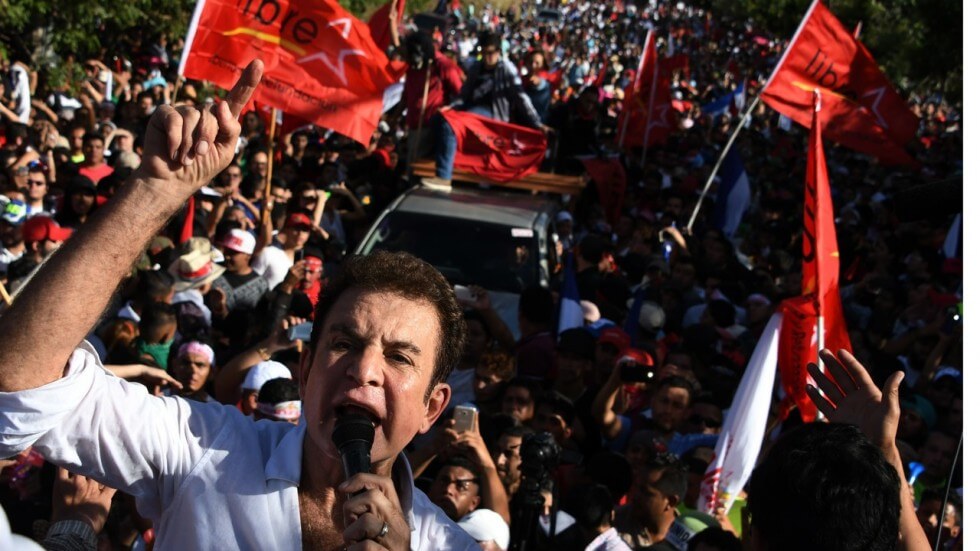


Throwing a Pie – More than a Simple Act of Protest

Published on 22/11/2017

The art of creative and humorous nonviolent resistance methods, laughtivism if you will, has been a popular topic for readers all around the world. Pie, and then especially the throwing of the object, could be considered a prototype political provocation, and a powerful punchline when staying on the surface of the act itself. David against Goliath, an “act of punching up”, mostly against a higher status person, showing that, with our face covered in pie, we all look alike, and nobody would dare to claim a superior position with a face full of cream.  

An unprecedented piece of journalism by Ben Paynter shows us the history of throwing pie as a form of nonviolent activism.  Although the record of political pie-throwing dates back to at least the mid-1600s, the recipe (of both the pie and the protest-method), have not changed much. Although maybe for one factor. Over time, “each hit became a surreal must-share moment for news agencies,” and pie-throwing “became an early political meme.” Communicating with their followers, but also more neutral audiences, “activists made sure to videotape or take pictures of each delivery, which with the growing reach of the internet were easily passed along to embolden others,” according to Paynter.  

But why exactly is throwing pie funny? Paynter claims that it is good to emphasize this for a bit, given the fact that some people involved in the act “felt the pie throwing was theater of such poor quality that it required a violent response.” To explain the humorous nature of pie, we can use something called the Benign Violation Theory, and was developed by Peter McGraw, marketing and psychology professor at the Humor Research Lab at the University of Colorado Boulder. According to McGraw, “for something to be funny in the eyes of the audience, the situation needs to be wrong yet okay, threatening yet safe. It needs to not make sense, yet make sense.” Most everyday experiences can be considered either good-natured (benign) or inappropriate (a violation). Only when a certain inappropriate action is made to be acceptable will it be considered funny: a benign violation! Throwing pie is inappropriate, but throwing a pie as a form of protest instead of using violence then makes it relatively acceptable.  

However, as with every method, there should come an underlying strategy. When this strategy is not in line with the act of throwing a pie, things might get ugly. And of course Paynter is right to conclude that, “from a strategic standpoint, pelting someone with a non-lethal, somewhat fluffy object makes sense: baked goods do less damage than bullets.” However, as our very own Srdja Popovic points out in the article, even pie-throwing can be a step to far sometimes. The best nonviolent acts are low risk and should not alienate any potential supporters, so they can be repeated by others to build momentum. How innocent pie throwing might sound, examples from Paynter’s article prove that the action can carry physical and legal repercussions. “[Pie throwing] can be funny, but it also can be offensive and insulting and people can take it differently,” Popovic says. 


Read Paynter’s full article here, and think twice before you start throwing them pies around!