Zimbabwe’s Unity of Purpose (in Protest-Signs)

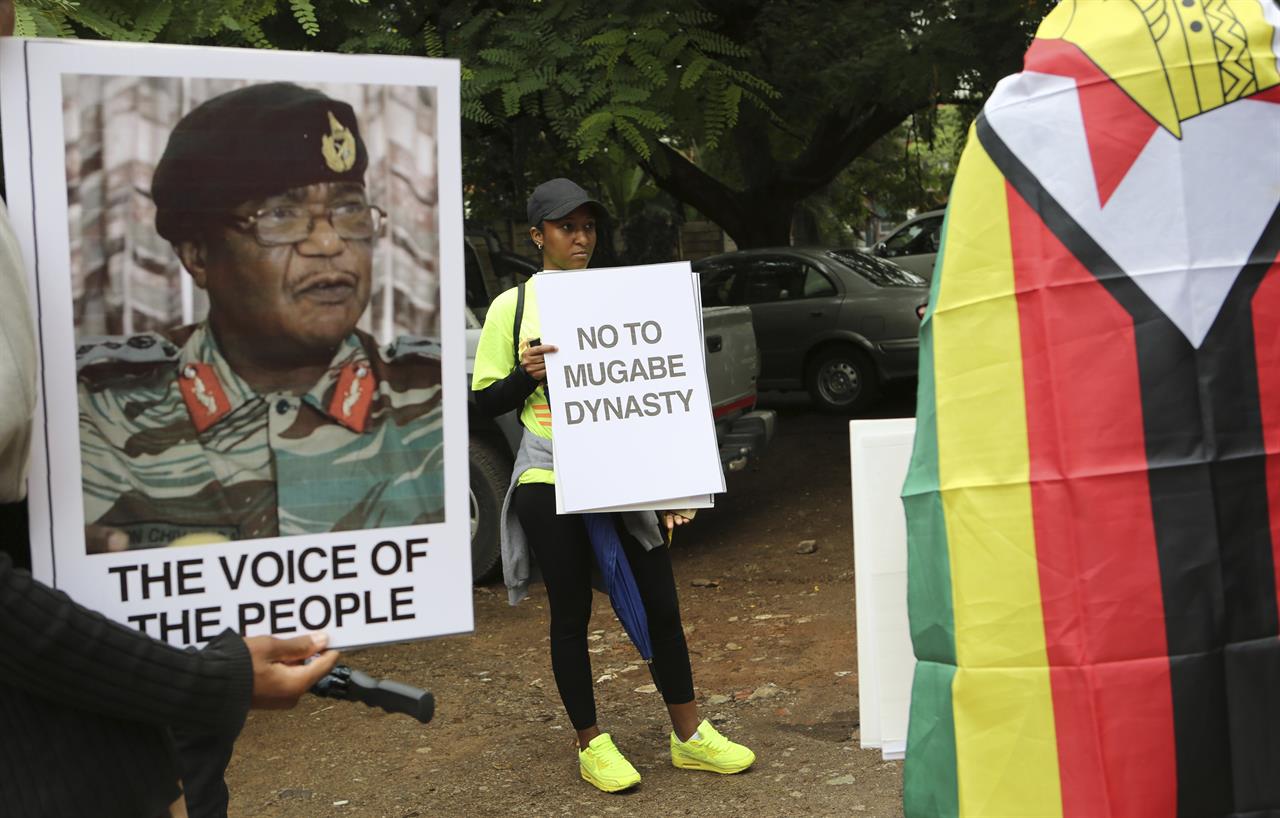
Photo: Protesters demanding President Robert Mugabe stands down march towards State House in Harare. The fact that Mugabe has to go seems to represent most Zimbabweans. But what will happen after the 93-year old is put aside? Photograph: AP (via Independent.co.uk)

Published on 20/11/2017

This weekend, Zimbabweans all over the country took to the streets. On Saturday, tens of thousands of protesters came out to demand an end to Mugabe’s rule, but seemingly also to simply celebrate that change was finally coming. And change is coming, that is for sure. An official source with direct knowledge of the ongoing negotiations told CNN that Zimbabwe’s long-time president has agreed to the terms of his resignation and a letter has been drafted. According to the source, the aim of Sunday’s televised speech, in which Mugabe amazed and infuriated the country by apparently resisting calls to step aside, was to ensure the veteran leader openly declared the military’s actions to be constitutional. Despite the disappointing speech, the end of the Mugabe era is only a matter of time.  

Saturday’s protests were described to represent an unprecedented diversity within Zimbabwean society. From war-veterans to displaced white farmers, from ZANU-PF supporters to social-movement leaders, protesters seem to agree on this one point: Mugabe has to go! However, when Mugabe goes, several different scenarios could develop. In very simple terms, the spectrum goes from continued ZANU-PF autocracy under a different leader on the one side, to a transitional coalition authority leading the country into free and fair elections on the other (most positive) side. Considering this spectrum of possibilities, it should be doubted if every Zimbabwean who found him- or herself in the streets on Saturday would still be so united as to the future of Zimbabwe.  


Unity of Purpose 

If we look at the role nonviolent strategy could play in the country, the success of the future struggle for a more democratic and free Zimbabwe will be strongly influenced by three general principles: Unity, Planning, and Nonviolent Discipline. Let us look at the first principle of unity, for now. Besides unity of people, and unity within the organizations which will have to oppose the authoritarian and repressive forces in Zimbabwe, there has to be unity of purpose. As page 87 of the Canvas Core Curriculum tells us, “a movement or campaign must have internal consensus about its goals, and these goals must resonate with significant parts of the larger population.” ‘Mugabe must Go’ might be the mantra which unites the purpose of the broadest base of the protesters on Saturday. However, after Mugabe goes, what must happen? Is there a unity of purpose among Zimbabwean on that part? Or is celebration enough for now? 


Protest-signs 

As an in-depth research on the purpose of protesters in Zimbabwe might prove hard on such a short notice, let us use a different source: protest signs. As Zimbabweans are becoming a more and more connected people, pictures and videos of Zimbo’s protesting went all over the world on the weekend. What can their protest signs tell us about the unity of purpose among Zimbabweans?  

First, we can see many signs thanking the Zimbabwean Defense Forces, for the role they played in the inevitable toppling of Robert Mugabe. Especially army General Constantino Chiwenga seems to have earned the respect of many protesters. However, would these same people vouch for a continued control of the army over Zimbabwe? Or a new intervention by the General when the developments, let’s say in three months’ time, are not to his liking? It would not be acceptable to say this opinion would resonate with significant parts of the larger population in Zimbabwe, especially not those favoring a more constitutional roadmap towards the future.  

Furthermore, Emmerson Mnangagwa was a strongly represented person in the protest signs over the weekend. The former Vice-President, who is now put forward as the next leader of ruling party ZANU-PF, could, however, not be said to represent the larger population either. As Steven Feldstein puts it, “Mnangagwa is massively invested in ensuring his continued and unfettered access to power, which has proven highly lucrative for him. The vice president is ‘reputed’ to be one of Zimbabwe’s richest people. All of this suggests he might become yet another dictator.” Although the favored option for some, it does not seem likely Mnangagwa as Zimbabwe’s next leader is in the best interest of the Zimbabwean citizen either. Many protest signs also made reference to the fact that, more than wanting Mnangagwa as their next leader, Zimbabweans would at least not accept Grace Mugabe as the next in line of the Mugabe-dynasty, adding to the division in purpose.  

What might worry some, finally, is that those signs referring to bread and butter issues, or a better life for the average Zimbabwean, are very hard to find. A democratic, constitutional process, in which Zimbabwean opposition is represented besides ruling party ZANU-PF seems like the best and most realistic option moving forward for Zimbabwe. But signs referring to the unwanted interference of the African Union or Southern African Development Community, is as far as Zimbabwean protesters get. A free Zimbabwe, for future generations is as scarcely represented. But wouldn’t that be at least part of the goals that should resonate with significant parts of the larger population?  

Luckily, protest signs will not define the future of Zimbabwe by themselves. 

 To end on a lighter note, humor is a Zimbabwean characteristic that cannot be denied. Despite a military coup, the end of a 37-year rule, and not to forget an ongoing socio-economic crisis, some protesters have other things on their mind 

Weekly Report: 17 November, 2017

Photo: Ruling Party tensions reached a peak this week in Zimbabwe, when the military forced Robert Mugabe off the stage after 37 years in power – Photograph: Philimon Bulawayo_Reuters

Zimbabwe

Martha O’ Donavan, the American woman who’s arrest CANVAS reported on last week, has been granted bail last Friday. O’ Donavan’s, who is charged with subversion over allegedly insulting President Robert Mugabe on Twitter, her bail was set on $1,000. According to the Washington Post, she did not speak to reporters as she emerged from a prison in the capital, Harare, and left in a U.S. Embassy vehicle. As are the conditions attached to her bail, O’Donovan had to hand over her passport to the Zimbabwean authorities, and has to report to the Criminal Investigation Department (CID) on Monday and Friday. On Tuesday, Human Rights Watch releases a small report on the most recent clamp down on media in Zimbabwe, calling on the government to create an independent body to impartially investigate police abuses against journalists.

Also late last week, AfricanArguments.org release an opinion-piece by Blessing Miles Tendi, on the role the British authorities might have played in the lay-off of former vice-President Emmerson Mnangagwa. “With Mnangagwa’s dismissal,” Tendi argues, “the UK’s alleged strategy [to support Mnangagwa as Zimbabwe’s next president] has not only clearly failed, but its perceived backing for Mnangagwa prompted outrage among many Zimbabweans, further weakening the UK’s image in the country. Moreover, its support for Mnangagwa may have even contributed to his downfall.” Tendi moves on to argue that, besides the fact that UK-meddling in the presidential succession process is a known stick used by Mugabe, the UK should have recognized that associating itself with Mnangagwa would provoke heated domestic opposition because the controversial Mnangagwa has a long history of human rights abuses and violence.

Early this week, Reuters covered a piece by MacDonald Dzirutwe, relating to the building economic crisis in Zimbabwe. According to Dzirutwe, the cryptocurrency bitcoin is becoming a rare protection from the onset of hyperinflation and financial implosion for Zimbabweans. As Zimbabweans are desperately looking into anything they think might retain value, “some are turning to bitcoin out of desperation as their bank deposits lose value almost by the day, while others are using the online currency for housekeeping such as funding family members studying abroad,” the article claims. Bitcoin’s attraction to Zimbabweans also lies in the difficulty of making foreign payments due to government capping or halting transactions which make more money leave the country. For those in Zimbabwe who still have assets, that is.

Then on Tuesday and Wednesday, the army takes over Zimbabwe. Read all about the developments in the last few days on our website!

1. Al Jazeera
2. Human Rights Watch
3. African Arguments.org

  1. Reuters

Cambodia

One day ahead of the court hearing, Human Rights Watch brought out a statement on the upcoming ruling of Cambodia’s highest court on opposition party CNRP. On November 16, the Supreme Court will rule on a case brought at the behest of Prime Minister Hun Sen in October to dissolve the CNRP. The Cambodian government has accused that opposition party of trying to stage a “color revolution” – a reference to popular uprisings around the globe – but has provided no evidence of illegality in its court filings. Human Rights Watch stated that “Cambodia’s Supreme Court should resist government pressure to rule on dissolving the country’s main opposition party,” and added that “Cambodia’s international donors and supporters should state clearly that dissolution of the Cambodian National Rescue Party (CNRP) will delegitimize national elections scheduled for 2018.” In the meantime, the opposition itself has seemed to have given up hope for the court-case. As the judge who heads the Supreme Court, Dith Munty, is a member of the permanent committee of the ruling Cambodia People’s Party (CPP), Mu Sochua, a deputy of Kem Sokha claimed that “there is no chance whatsoever for CNRP to escape dissolution.”

Meanwhile, on that same Wednesday, former opposition leader Sam Rainsy, who fled to France in 2015 to escape a jail term for defamation, announced he was returning to the CNRP-party. He left that same party in February over fears his membership would lead to it being banned. Rainsy is now running his political operations from Paris. “I’d like to announce that I, Sam Rainsy, became a member of the Cambodia National Rescue Party again from now onwards, whether it is dissolved or not,” he wrote on his official Facebook page. In an interview with Euronews this week, the opposition politicians claimed that he was in no hurry to return to his home country. “He [Hun Sen] would not hesitate to kill me or to kill any other leader of the CNRP…this is a different game. This time, we need a comprehensive solution to the crisis.” The components of such a solution, Rainsy stated, include the release of all political prisoners, an end to an atmosphere of political intimidation, and the re-opening of shuttered media. Although Rainsy acknowledges that this approach will “take time to achieve”, he claims it is the only way to ensure long-term results.

On Thursday, the inevitable happens, as Cambodia’s Supreme Court ordered the main opposition party to be dissolved. Dealing a crushing blow to democratic aspirations in the increasingly oppressive Southeast Asian state, the decision clears the way for the nation’s authoritarian leader to remain in power for years to come. Prime Minister Hun Sen also stated that 118 opposition party members would be banned from politics for the next five years, and the verdict could not be appealed. On that same day, The United States demands that Cambodia reverses its ban on the country’s main opposition, and warns that the dissolution of the party would strip 2018 elections of legitimacy. Reuters reports that Cambodia now faces US and EU sanctions.

1. Human Rights Watch

  1. Euronews
  2. AP News

Myanmar

Early this week, Human rights groups poured scorn on a Myanmar military investigation into alleged atrocities against Rohingya Muslims, branding it a “whitewash” and calling for U.N. and independent investigators to be allowed into the country. The reactions came after military sources posted the findings of an internal investigation on the Facebook page of its commander in chief, Senior General Min Aung Hlaing, on Monday. The report said “it had found no instances where its soldiers had shot and killed Rohingya villagers, raped women or tortured prisoners. It denied that security forces had torched Rohingya villages or used excessive force,” according to Reuters.

On Monday, Bob Geldof announced that he would returns his Freedom of the city of Dublin honor in protest over Aung San Suu Kyi, who also holds the award. In a statement, the Live Aid founder and musician blasted the Burmese Nobel peace laureate, who has faced widespread criticism over her country’s treatment of its Rohingya Muslim minority. Geldof, originally from Dublin, said: “Her association with our city shames us all and we should have no truck with it, even by default. We honored her, now she appalls and shames us. I do not wish to be associated in any way with an individual currently engaged in the mass ethnic cleansing of the Rohingya people of north-west Burma.” On Saturday fellow Irish musicians U2 also criticized Burma’s civilian leader, urging her to fight harder against serious violence inflicted by the nation’s own security forces.

On the same day Human Rights Watch calls on the Burmese government to withdraw the protest ban for Yangon, U.S. Secretary of State Rex Tillerson visited Myanmar for talks with the country’s leaders. Tillerson was expected to hold talks about the situation in northern Rakhine state, meeting with leader Aung San Suu Kyi and Myanmar’s powerful military chief, Min Aung Hlaing, who is in charge of operations in Rakhine. U.S. lawmakers and activists are urging Tillerson to sanction Myanmar’s military if it doesn’t stop what a top United Nations official has called “a textbook example of ethnic cleansing” against the Rohingya Muslim minority. More skeptical opinion makers see the visit as to show Trump administration takes human rights seriously.

1. Reuters

  1. BBC
  2. Politico

Venezuela

Late last week, VOA News reports that The United States and Italy have organized an informal U.N. Security Council meeting on Venezuela. The meeting is aimed at preventing the crisis in that country from turning into a security threat, in the face of a crumbling Venezuelan economy. U.S. Ambassador Nikki Haley will chair the informal meeting, which will include addresses from U.N. human rights chief Zeid Ra’ad al Hussein and Organization of American States Secretary-General Luis Almagro. Haley is urging the U.N. Security Council to turn its attention to the situation in Venezuela, which has until now maintained that regional organizations were best suited to address the crisis. Permanent council members Russia and China boycotted the talks.

As the meeting happened on Monday, Human Rights Watch called on the UN Security Council to put strong, multilateral pressure, on the country, without which the human rights and humanitarian crisis will only get worse. According to HRW, the council should focus on the regime’s descent into authoritarian rule, the widespread brutal force to react on protests, a humanitarian crisis evolving out of the political crisis, and the impact emigration has on neighboring countries.

Before the first round of debt-restructuring talks took place starting from Monday, Venezuela claims to have reached an agreement to refinance and restructure the debt with Russia. As that deal was finalized on Wednesday, Venezuela’s other main creditor and ally China has chosen not to go along with the offer of debt relief. The Chinese foreign ministry on Wednesday expressed confidence that Caracas could “properly handle” its debt crisis, adding that financial cooperation was “proceeding normally”.

1. VOA News
2. Human Rights Watch
3. The Guardian

Spain

Spain remains deeply divided over the independence question of its Catalonian region. The Spanish prime minister Rajoy on Tuesday ruled out negotiating the future status of Catalonia with its ousted leaders. If up to him, “all of those who deceived Catalonia should be barred from public life”, Mr Rajoy stated in his first interview after imposing direct rule over Catalonia, adding that “in political terms they are off limits”. These remarks are a smack in the face of Catalan President Puigdemont. In an interview published on Monday by Belgian newspaper Le Soir, Mr Puigdemont had said that he believed agreement with the Spanish government was possible on something short of full independence for Catalonia.

Then, early this week Madrid announced that it believes Russian-based groups used online social media to heavily promote Catalonia’s independence referendum last month in an attempt to destabilize Spain. Although Catalonia’s separatist leaders have denied that Russian interference helped them in the vote, Spain’s defense and foreign ministers said they had evidence that state and private-sector Russian groups, as well as groups in Venezuela, used Twitter, Facebook and other Internet sites to massively publicize the separatist cause and swing public opinion behind it in the run-up to the referendum. According to CNN, however, the Spanish government could not “say with certainty” if the Russian government was behind it, Defense Minister Maria Dolores de Cospedal claimed.

1. Telegraph

  1. Reuters

Syria

Early this week, close to 60 people are reported to have been killed in air strikes on a rebel-held town in northern Syria. Atareb is located in an area of Aleppo province that is part of a so called “de-escalation zone”, established earlier this year by Russia and Iran – which support the Syrian government – and Turkey, which backs the rebels. The zones are credited for creating a decline in violence, but intermittent clashes have continued while humanitarian access is minimal. It is not clear whether the strike was carried out by Syrian government warplanes or those of its ally Russia.

Then on Tuesday, a Foreign Ministry statement, carried by state-run media, said that US troops in Syria supporting the international coalition to defeat ISIS have no right to be there. “The presence of the US forces or any foreign military presence in Syria without the consent of the Syrian government constitutes an act of aggression and an attack on the sovereignty of the Syrian Arab Republic,” Syria’s state-run news agency quoted an unnamed source in the Foreign Ministry. The comments came a day after U.S. Secretary of Defense Jim Mattis said “we are not going to just walk away right now” before the U.N-backed political process yields results. The US-led coalition has cited UN Security Council Resolution 2254 to justify its presence in Syria, which calls for “member states to prevent and suppress terrorist acts” specifically committed by ISIS, al-Nusra, al-Qaeda, among others. Kurdish officials also stated that they want the U.S. troops to remain in the country to help prevent clashes with pro-government forces, which are also battling IS.

On Thursday, the United Nations Security Council is due to vote on rival U.S. and Russian bids to renew an international inquiry into chemical weapons attacks in Syria. Washington and Moscow have put forward a draft resolution on renewing the mandate of the Joint Investigative Mechanism (JIM), tasked with identifying perpetrators of Syria’s toxic gas attacks. According to Reuter, “diplomats say there is little support among the 15-member council for the Russian draft, which Russian U.N. Ambassador Vassily Nebenzia has said aims to correct “systemic errors” of the inquiry.” Late on Thursday, Russia vetoed a US-sponsored resolution that would have extended its mandate. “For the tenth time on Syria, and the fourth time on chemical weapons, Russia has actively obstructed the international community’s ability to identify the perpetrators of chemical weapons attacks,” Nikki Haley, US ambassador to the UN, said after the vote. After Russia lost a procedural vote at the Security Council on Thursday and was ordered to put its resolution up for a vote before the US proposal, it withdrew its own resolution.

1. BBC

  1. Newsweek
  2. Reuters

The United States of America

Despite the fact that the ongoing situation between the United States and North-Korea proceeds to scare many on this planet, the battle of words between the Trump-administration and Kim Jong-un also develops into something which looks like a fight between two six-year old’s. Late last week, after President Trump claimed North Korea’s leader insulted him by calling him an ‘old lunatic’, he hit back with a tweet saying: “Why would Kim Jong-un insult me by calling me ‘old,’ when I would NEVER call him ‘short and fat?’” As Trump has been working hard to rally global pressure against North Korea’s nuclear weapons program on his most recent Asia-trip, one could wonder if the laughtivism is part of his tactic, demonizing North Korea, and keeping it apart from the international community.

On the weekend, right before Trump’s last stop on his Asia-tour, various groups staged a series of protests against the scheduled visit of US President Donald Trump in the Philippines. At least 1,500 protesters gathered on Monday at the beginning of the ASEAN Summit activities. According to the protests groups, their biggest concern is “US encroachment on the sovereignty of nations in Asia through war and one-sided economic relations.” The activists are also protesting against the plan of the US government to fund the administration’s campaign against illegal drugs. The Philippines will be Trump’s last stop on a marathon tour that has taken him to Japan, South Korea, China as well as Vietnam.

1. South China Morning Post

  1. Straits Times

Democratic Republic Congo

Late last week, the UN Human Rights Committee told the DRC to get their human rights record in order. The U.N. watchdog gave Democratic Republic of Congo a year to report on actions it has taken to hold free and fair elections and clean up its rights record. Congo should come back with an explanation by November 2018, rather than after the regular four years between reviews. The Kabila-regime has scheduled elections for December 2018. Where the main opposition parties have rejected the date, other institutions seem to accept that the elections will be delayed more than two full years. The African Union has said the new electoral timetable must be “scrupulously respected” and US Ambassador to the United Nations Nikki Haley stated that citizens are “hungry for democracy and new leadership”.

The streets stayed empty in Kinshasa on Wednesday. Where several civil-movements have called for protests in the last week, on Wednesday the streets stayed calm, after these same movements organized a mass stay-away (une journée ville-morte). The protest was organized by one of the biggest social movements in Congo, named Lutte pour le Changement (#LUCHA), to refuse the election-calendar which was published by CENI last week, and to demand Joseph Kabila to step aside. The call was supported by the biggest opposition fractions. The tactics of a stay-away was also chosen after police forces announced they would hit hard on all gatherings of more than five people around Congo.

1. EWN

  1. Actualite.cd (article in French)

Poland

The far right seems on the rise in Poland, as 60,000 people marched through Warsaw on Saturday (Poland’s Independence Day), seeing demonstrators tout white supremacist, anti-Semitic and Islamophobic messages. The most disturbing fact, however, might not be a banner which said, “pray for Islamic holocaust” and carried signs with slogans like “white Europe of brotherly nations”, while others chanted “pure Poland, white Poland” and “refugees get out!” Most disturbing, however, must have been the fact that, although the country’s government condemned racist and xenophobic ideas, it called the event “a great celebration of Poles, differing in their views, but united around the common values of freedom and loyalty to an independent homeland”. According to New York Times, “the more salient point was the ministry’s defense of the demonstration as an outpouring of patriotism. The only people arrested were some pro-democracy counter-protesters.”

A wholly different protest in Poland late last week, as police had detained 22 people “for disturbing the peace” at the headquarters of Poland’s forest management agency. The activists were calling for the withdrawal of heavy machinery from the Bialowieza forest. For this area, the only remaining primeval forest in Europe, the EU’s high court issued an injunction forbidding the country from continued logging, but Poland’s government has ignored the order, and continued to allow logging. That move unprecedented move, as the first case that an EU member state has ignored such an injunction. According to Deutsche Welle, “many believe the move to open up logging in the Bialowieza forest is a show of strength by the nationalistic Law and Justice (PiS) government, intent on showing the EU, which has accused the government of undermining democracy in the last two years, that it has the power to do what it wishes with its own land.”

1. New York Times

  1. Deutsche Welle

Other News

The Maldives – On Thursday, the Maldivian Civil Court accepted a case filed by RaajjeTV, over the MVR 500,000 imposed on the station by the Maldives Broadcasting Commission (MBC). One of the most important sources of independent news in the Maldives was fined MVR 500,000 on 8 October this year, for allegedly broadcasting content that “threatens national security”. The station has been fined thrice this year, under the controversial defamation law introduced in August 2016. The first fine, MVR 200,000, was imposed in March, while a second fine of MVR 1 million was imposed the same day it paid the first fine. All three cases have been appealed at the Civil Court – Raajje

Kenya – On Tuesday to Kenya’s Supreme Court reviewed petitions challenging President Uhuru Kenyatta’s victory in last month’s presidential election, in what may be the last chance for legal scrutiny of the vote – Reuters

Hong Kong – The Court of Appeal granted several activists, who were jailed for between eight and 13 months over their involvement in the protests outside the Legislative Council, to proceed to the Court of Final Appeal for permission to appeal. Their 2014 protests were aimed at then-Finance Committee chair Ng Leung-sing forcing a vote on a HK$340 million funding plan for a controversial northeast New Territories development plan – Hong Kong Free Press

CANVAS’ Daily News

Also read what we featured in our daily news section this week:

Animal rights protest in London – what to learn from animal rights activism

Peace Science Digest focuses on Nonviolent Resistance

Zimbabwe Coup November 2017 – Developments and Analysis

Published on 17/11/2017

Seeing the recent developments in Zimbabwe, with an alleged coup on Tuesday/Wednesday as the peak so far, we are in dire need of some background and perspective. Below you will find a small analysis on the most recent developments in the country.

Splits in the ruling party over succession

As Robert Gabriel Mugabe does not have the eternal life, the battle for his succession has started within ruling party ZANU-PF. However, the current president has set out to rule Zimbabwe unchallenged for the rest of his life. His favored technique for guaranteeing his dominance is to build up potential successors only to destroy them, when coming to close to power.

The succession struggle has not started only last week, but dates back to the 2014 purge of former vice-president Joice Mujuru and eight cabinet ministers. Mujuru was said to become a too powerful force within the party. She was then accused variously of corruption, theft and even plotting to kill Mr Mugabe, and therefore she and her followers had to go. Mujure was replaced by Emmerson Mnangagwa.

Then, a bitter struggle between two factions within the ruling party began, which continued relatively silently until last week. On the one hand, there is the so called ‘G-40’-faction. This faction is supposed to represent the younger generation within ZANU-PF, and is allegedly led by Education Minister Jonathan Moyo and Zanu-PF political commissar Saviour Kasukuwere. The faction’s main point of existence seems to be to fight against Vice-President Emmerson Mnangagwa succession as party leader. As an alternative, G-40 seems to support Mugabe’s wife Grace, who is more and more profiling herself as the main guard for anyone and anything who will put the position of her husband under attack. Grace (nicknamed Gucci-Grace for her exorbitant shopping sprees), is not popular among Zimbabwean citizen. Although G40 is believed to be fronting the First Lady for succession, there have been no official statements she would be running for the position when her husband dies.

On the other hand, there is the so called ‘Team-Lacoste’-faction, which backs up Mnangagwa as Mugabe’s successor for party-leadership. The former Vice-President has been with Mugabe from the start, as they worked together both during the liberation-struggle as well as during his ruling days. Mnangagwa has a strong following in Zimbabwe’s powerful military and amongst war veterans, and has kept a lot of connections from his days as both Minister of Defense and intelligence chief.


Latest Developments

In December, ZANU-PF will host its last annual congress before the 2018 elections. As the party congress is seen as a decisive event, all contesters for party-leadership are trying to position themselves as best as possible. As several of the G40 faction members were discredited over the last months, Mnangagwa’s hand seemed to play out. However, early this month, the factional infighting took another turn, as Mugabe openly accuses Mnangagwa of “disloyalty, disrespect, deceitfulness and unreliability.” A documentary is leaked, allegedly made by Education Minister Mojo, outlining how Mnangagwa would have subverted and captured State-institutions in a power grab. On November 7th, Mugabe fires Mnangagwa. For many, his removal meant that Grace Mugabe is expected to be appointed vice president at the party congress in December.

From that point, we could slowly see the signs of what eventually happened this week. On November 8, war veterans head Chris Mutsvangwa said that “[President Robert] Mugabe is not the owner of the party,” and called on almost every group thinkable in Zimbabwean society (churches, whites, MDC, the diaspora and South-Africa) to address the “menace that Zimbabwe now faces with Mugabe a senior old man with a mad wife.” On that same day, Mnangagwa released a statement saying that he had fled Zimbabwe, lashing out to his President saying that “the ruling ZANU-PF party “is not personal property for you and your wife to do as you please.”


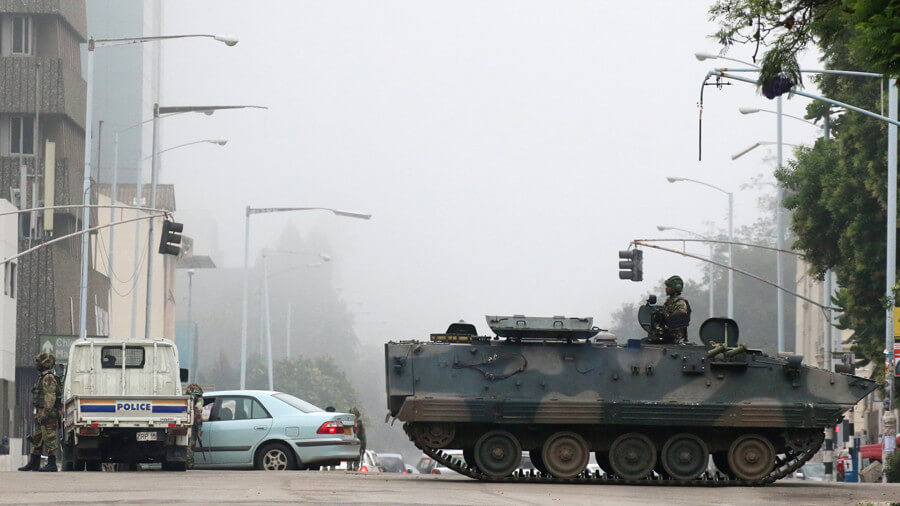
Military coup

On Monday, Zimbabwe’s army chief Constantino Chiwenga demanded a “stop” to the purge in the ruling party and warned the military could intervene. Then, very late on Tuesday, soldiers seal access to parliament, government offices and courts in Harare. Access to the president’s official residence is also blocked by troops. The first official statement comes very early on Wednesday-morning, when the military takes over state broadcaster ZBC and military spokesman, Major General SB Moyo makes an announcement on state television. In this statement, the military explains it has temporarily taken control of the country to “target criminals” around President Robert Mugabe. They also immediately state that Mugabe and his family are “safe and sound and their security is guaranteed”. Finally, the statement also emphasizes that “this is not a military takeover of government,” but an act committed “to pacify a degenerating political, social and economic situation in our country which if not addressed may result in violent conflict.”


Towards the Future

After a day of house-arrest, talks between the president and senior military officers continue on Thursday, with senior church leaders and envoys sent from neighboring South Africa involved in mediation efforts. Emmerson Mnangagwa was reported to have returned to Zimbabwe on Tuesday evening from South Africa. Speculations about him replacing Robert Mugabe as the leader of Zimbabwe continued up to this moment. Mnangagwa’s particular role in the coup remains unclear. Reports that Grace Mugabe had fled to Namibia on Wednesday appeared false, with several sources saying she was detained with her husband in their residence in Harare.

According to the Guardian, several opposition officials have stated that negotiations had been ongoing for several months with “certain people within the army”, with that same army reaching out to different factions to discuss the formation of a transitional government. One opposition official said Mugabe would resign this week and be replaced by Mnangagwa, with opposition leaders taking posts as vice-president and prime minister, although there have not been any official statements as to this moment. However, Robert Mugabe seems to stubbornly hold on, demanding that he can finish his term in office.


Pillars of power

The early Wednesday speech by Major General SB Moyo on state television is very important to understand the movement of different power forces in Zimbabwe right now. Instead of speaking of their military takeover in bold and powerful terms, his argumentation is very inclusive, almost humble. Moyo addresses Robert Mugabe as “His Excellency, the president of the republic of Zimbabwe and commander in chief of the Zimbabwe Defence Forces”, as if Mugabe is still fully and solidly in power.

Moyo then continues to address all stakeholders in society (civil servants, judiciary, parliament, citizens, political parties, religious groups, the media and the war-veterans). Goal seems to be to facilitate this transition of power as calm and clean as possible. But is that an option in such a fractured and tense political arena? And wouldn’t it be naïve to see the military coup as such an altruistic deed? Let us look at some of the main players up close.

President Robert Mugabe

One has to understand that, even at this moment when President Mugabe’s role seems to have played out, it is not. Despite the fact that he has mistreated Zimbabwe for the past 30 years, his support-base is still incredibly strong. As Piers Pigou, a South Africa-based analyst for the International Crisis Group put it. “The [army] still need him to provide a veneer of legitimacy and constitutionalism. If he doesn’t want to play ball that is a bit of a problem.” It is not without a reason that the military statement on Wednesday began with saying that the President is safe and that this military takeover was not directed towards him. Nevertheless, there is no doubt that the events of the last 72 hours in Zimbabwe mark the beginning of the end of Robert Mugabe’s reign.

Grace Mugabe and the G40-faction

Can the faction of young Turks within the ruling party still play a role, influencing the process towards a new power divide in Zimbabwe? This does not seem to be likely, as they are (more than President Mugabe) the target of the military take-over. According to the BBC, several ZANU-PF officials are reported to be in custody including, Mr Mugabe’s former spin doctor Jonathan Moyo and Finance Minister Ignatius Chombo. Zimbabwean newspaper NewsDay is reporting that MP and government minister Paul Chimedza has been arrested at a road block trying to flee to South Africa.

The question now is how different organizations in society who used to back G40 or Grace Mugabe will react. As an example: ZANU-PF Woman’s League used to be backing Grace very firmly. At last year’s annual ZANU-PF conference, the Women’s League had moved that President Mugabe should appoint a woman into the presidency; a trick designed to influence the reassignment or expulsion of Mnangagwa to make way for a female Vice President. No official statement has come from their side yet.

Zimbabwean Military

A force which has always been strongly in the grip of the ruling-party, now has chosen a clear side. This has only been possible because of the rifts within ZANU-PF. It has to be understood that, in the revolt against specifically Grace Mugabe, the military top in Zimbabwe would never allow somebody without liberation-war-credentials to be the leader of the country. The military has strong ties to ZANU-PF as the liberation party, not to just any person who might want to lead that party.  Mnangagwa has these credentials, and his connections stemming from former positions as Minister of Defense and the intelligence-services give him a clear head start.

ZRP

Because police officers are believed to be on President Mugabe’s side, the army moved in to take power over the police forces early on Wednesday. The Zimbabwean military is in charge of a paramilitary police support unit depot in Harare and has disarmed police officers there, an army source told Reuters. Only in August, there were clashes in central Harare between the Zimbabwe Republic Police – loyal to first lady Grace Mugabe and her allies in a Zanu-PF faction, G40 – and soldiers who are loyal to Mnangagwa. The role of the ZRP seems to be played out for now.

War Veterans

Zimbabwe National Liberation War Veterans Association (ZNLWVA)’s members have been an integral part of President Mugabe’s election campaign machinery since the emergence of the Movement for Democratic Change led by Morgan Tsvangirai. However, the War Veterans are now firmly opposing Robert Mugabe’s increasingly authoritarian rule. Already in 2016, the veterans announce a split from Mugabe, after which a personal with Mugabe develops.  Christopher Mutsvangwa, chairman of the ZNLWVA, was one of the victims of the purge of Mnangagwa’s allies from the party over allegations of indiscipline and plotting against President Mugabe. As well as for the military leadership, the war veterans find it very important for somebody with actual liberation war credentials to rule over ZANU-PF and thus over Zimbabwe. However, the stance of the war veterans is different to that of the military, in that their struggle is essentially against Robert Mugabe and his dictatorial tendencies. The military looks beyond this and tries to guide the future direction of the ruling party itself.

Political Opposition

As for the political opposition, the coup all of a sudden offers possibilities of which nobody had dared to dream a few months ago. None of the key players in the opposition have condemned the military coup so far, and some even dare to speculate on their role in the “roadmap back to legitimacy”. Truth is, however, that the political opposition seems to have had no hand whatsoever in the current developments in Zimbabwe. The opposition is fractured, but more importantly has lost its popular support over time. The hope for a better Zimbabwe that the MDC brought up to 2008 was shattered in the last decade. Especially during and after the period of the GNU, the MDC lost a lot of public support. The party’s grassroots structures had been badly damaged by the violence preceding the 2008 elections, and the actions of the MDC-T during power sharing damaged the party’s public reputation. The MDC side-lined civil society, while its upper leadership visibly benefitted from participation in the inclusive government. That fostered the perceptions that the party had “joined the gravy train.” The eventual walk-over victory of ZANU-PF in the 2013 elections sealed their fate. Now, all of a sudden, we can think of a scenario in which the opposition parties would join a transitional government. Where this might offer new opportunities to build their support towards the 2018-elections, it would be naïve to think that a new ZANU-PF leadership would allow their power to be taken away by the opposition.

South Africa – International Community

As the regional superpower, South Africa appears to be backing the takeover, as they are sending ministers to Harare to help with negotiations to form a new government and decide the terms of Mugabe’s resignation. The South-Africans, as well as the rest of the international community will mostly profit from a relatively calm take-over of power, as this will benefit the stability in the region. Despite the fact that Mnangagwa is not their dream candidate for the Zimbabwean leadership, this might be of minor importance for now. Alpha Conde said Thursday that the African Union “will never accept the military coup d’etat” in Zimbabwe. The head of the African Union stated that, despite the fact that there are internal problems, these have to be solved politically by the ZANU-PF party and not with an intervention by the army

Civil Society and Social Movements

In line with the Zimbabwean political opposition, the civil society is also fractured, seeming to play no role in this episode of hard power. This week’s events also simply shift public attention away from their efforts. Nevertheless, civil society organizations such as #ThisFlag, the Zimbabwean Heads of Christian Denominations, and others call on the people in power, especially the military, to provide them with a clear roadmap back to constitutionalism. Some of them even pledge for a solution in the form of an inclusive government or another kind of transitional authority to be put in place. The role of these groups seems to be to focus the Zimbabwean citizen’s attention on the issue of what happens after the military coup is over, and the battle for power has been settled.


Possible Scenario’s

It is important to emphasize that this coup is essentially and foremost a party occasion. Despite the fact that the military is of course a state-institution, the power-struggle revolves around the party in the first place. Because ZANU-PF and the Zimbabwean state are so interwoven, one tends to forget that the coup is not so much focused on taking control over the country, as well as over the direction in which the leadership of the ruling party is headed. This is essential in realistically assessing what might be the outcome of the restructuring of power in Zimbabwe. Simply said, the leadership of the ruling party is subject of negotiation, the leadership of the country by the ruling party is not.

That being said, several news sources claim that Robert Mugabe would announce his resignation somewhere on Friday, although until now this has not been confirmed. According to South Africa’s Times Live, based on a senior intelligence source, Mr Mugabe is insisting he remains Zimbabwe’s only legitimate ruler in Zimbabwe. In any case, the Zimbabwean leader is stalling the process until today

Although there is a slight chance of the President staying in power at the end of this, the days of Robert Mugabe as Zimbabwe’s leader seem to be over. The seemingly most logical development would now be for Mugabe to announce his own resignation (probably mentioning health as the official reason to safe face), and putting forward Mnangagwa as his successor. Possibly, the Mugabe-family would negotiate a free passage out of Zimbabwe, opting to go into exile. Then, the December ZANU-PF party congress will elect the former Vice-President as the new party-leader, who is running for the presidency in the 2018 elections. However, this is not the preferred option of those in the opposition, as well as many western governments, who fear Mnangagwa would be in many ways a continuation of Mugabe. As the New York Times puts it on Wednesday, it would be “naïve to believe that any leader who takes power under such conditions will strive for democratic reform.”

An alternative scenario would include opposition political parties in negotiations towards a transitional government following the military takeover. Although speculative, this would be the preferred option for Mnangagwa, with economic recovery as the first priority. Main opposition party MDC-T (in the person of Secretary-general Douglas Mwonzora) has, however, already stated that this is possible “only if certain conditions were met,” alluding to the unfortunate process during the 2009-2013 Government of National Unity.

A final scenario could be a continued control over Zimbabwe by the military. Despite their apparent humble attitude, there is no more powerful force in Zimbabwean society at the moment. When the military leaders will not see a solution with enough beneficial guarantees for their people, holding on to power a little longer is a likely possibility. With the power in the hands of the military, Zimbabweans will be left at the mercy of a very unpredictable group that has rarely worked on behalf of the people in the past.


Photo: In his first public appearance after the coup, Zimbabwe’s President Robert Mugabe arrives to preside over a student graduation ceremony at Zimbabwe Open University on the outskirts of Harare Photograph: AP – via Telegraph.co.uk

Peace Science Digest focuses on Nonviolent Resistance

Published on 16/11/2017

Peace Science Digest is a project by the War Prevention Initiative and on a bi-monthly basis, covers selected research and findings in the field of Peace Science (Peace and Conflict Studies), seeking to “enhance awareness of scholarship addressing the key issues of our time by making available an organized, condensed, and comprehensible summary of this important research as a resource for the practical application of the field’s current academic knowledge.” It is Peace Science Digest’s goal to create “a mutually beneficial link between the field’s academic community and its practitioners, the media, activists, public policy-makers” and others.

The War Prevention Initiative envisions “a world beyond war by 2030 and humanity united by a global system of peace with justice”, while its mission “is to advance the Global Peace System by supporting, developing and collaborating with peacebuilding efforts in all sectors of society.”

In its June 2017 Special Issue, Peace Science Digest focused on the topic of Nonviolent Resistance, covering publications on the following five topics:

  • “Adding Humor to the Nonviolent ‘Toolbox’”
  • “Diversity, Identity, and Privilege Among Multinational Activists in Palestinian Civil Resistance”
  • “Creating a Broad-Based Movement for Black Lives”
  • “Indigenous Civil Resistance and Treaty Rights”
  • “Nonviolent Resistance and Government Repression“

In these articles, Peace Science Digest compiles and discusses the main findings of other authors’ publications, also addressing the respective topic’s contemporary relevance and practical implications. Moreover, the publication points towards further useful sources concerning the issues.

And not only the Special Issue of Peace Science Digest comprises topics relevant for nonviolent struggle. If you are interested, take a look at other articles the Peace Science Digest has published, as well, or check out other suggested resources on the War Prevention Initiative’s website. To find the Peace Science Digest’s Special Issue on Nonviolent Resistance and download it for free, follow this link.


Photo: Cover of Peace Science Digest, Vol. 2 Special Issue “Nonviolent Resistance”, June 2017

Animal rights protest in London – what to learn from animal rights activism

Photo: PETA protest outside the London store earlier last week (PETA, via standard.co.uk)

Published on 14/11/2017

Last Saturday, crowds of animal rights activists gathered outside a high-end clothing store in central London to protest their alleged mistreatment of coyotes and geese used to make their products. Canada Goose opened a new store in a popular shopping area in England’s capital, causing animal rights activists to go demonstrate.

The fashion brand had received global criticism, as Coyotes are caught for their fur in the wild in steel traps and then shot or bludgeoned to death, according to animal rights group PETA. The rights group also claims that the geese used for downs are mistreated in the making. Canada Goose previously responded to the allegations by stating that “’Surge, PETA and other activist groups misrepresent the facts and use sensational tactics to try to illicit a reaction and mislead consumers… They ignore the strict government regulation and standards that are in place, as well as our commitment to ethical sourcing practices and responsible use of fur and down’”, wrote the EveningStandard. During the nine-hour protest, demonstrators held up signs reading “fur is murder” or recited chants like “fur trade, torture trade”, among other things.

Earlier in September, several thousand activists protested during a march in London to end animal cruelty, as did others in various cities worldwide. Reports even claimed that some 30,000 activists had come to the streets in Tel Aviv which marked the largest animal rights march in Israel’s history. PETA reported on its President Ingrid Newkirk highlighting “the point that powerful marches like this one lead to impactful change” and that “[t]he world is waking up thanks to activism.”

However, animal rights activism has sometimes faced criticism, not only from their ‘opponents’ as in the London Canada Goose case. And neglecting the ethical and ideological dispute behind some of the criticism, the animal rights movement could reflect on some of its critique to think about improvement of their campaigns. As becomes apparent in an article about activists protesting in front of a small butcher selling “‘locally sourced, sustainably raised’ meat” in Berkeley, forcing the owners to put up an animal rights sign in the shop window, animal rights activists sometimes could (re-)consider their chosen tactics, strategies and goals.

In their actions, activists were perceived to be bullying and threatening the shop owners who claimed “’[t]heir tactics are really extremist’”, wrote the Guardian. The newspaper further stated that the Berkeley case as well as the “threat of similar protests have sparked backlash across the state.” Some have voiced their lack of understanding for why the activists had targeted such a shop instead of big ‘animal factories and meatpackers responsible for brutality on an unimaginably greater scale’, suggesting that the total abolition of meat-consumption could be unrealistic. Another article also reflected on the “Five fatal flaws of animal activism” already in 2010, though arguing from a more pro-animal rights perspective. Disregarding the points made in favor of being possibly more ‘radical’ in their claims and agenda, the author made valuable comments on the movement.

Reading the criticism of the Berkeley case and animal activism in general could then lead us to some questions to generally keep in mind when planning campaigns and movements:

  • Can our vision of tomorrow and objectives attract a wide base of support, and are they reasonably attainable?
  • Do we have a clear message and how do we communicate it?
  • Are the tactics we are using helping our overall strategy and thus, to achieve our vision of the future?
  • Are the tactics we are using attracting more people to our cause or could they possibly push away potential allies?
  • Which other groups and agendas could we cooperate with to make the movement stronger and help achieve our goals?

So no matter what your stance on the issue of animal rights is or which other cause you support, keep in mind these points when planning your actions and evaluating past operations. What else to consider, and to learn more about planning nonviolent movements, you can also consult our online publications for free.

For reading more about what the above thoughts on animal rights are based on, read the article on last week’s protest in London here, find the reflections on the case of animal rights protests in Berkeley here and read the 2010 article on flaws of animal activism here.

Weekly Report: 10 November, 2017

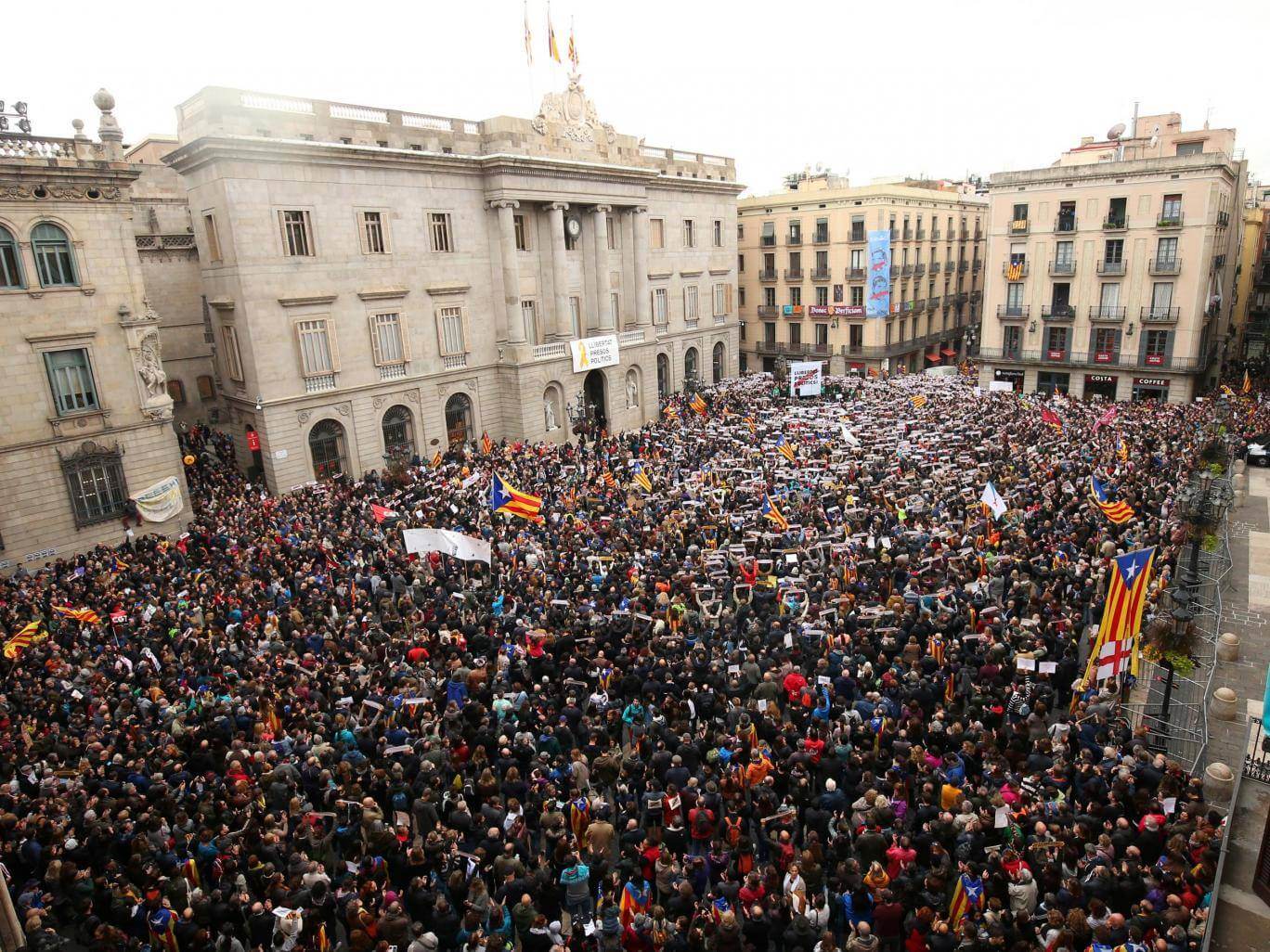
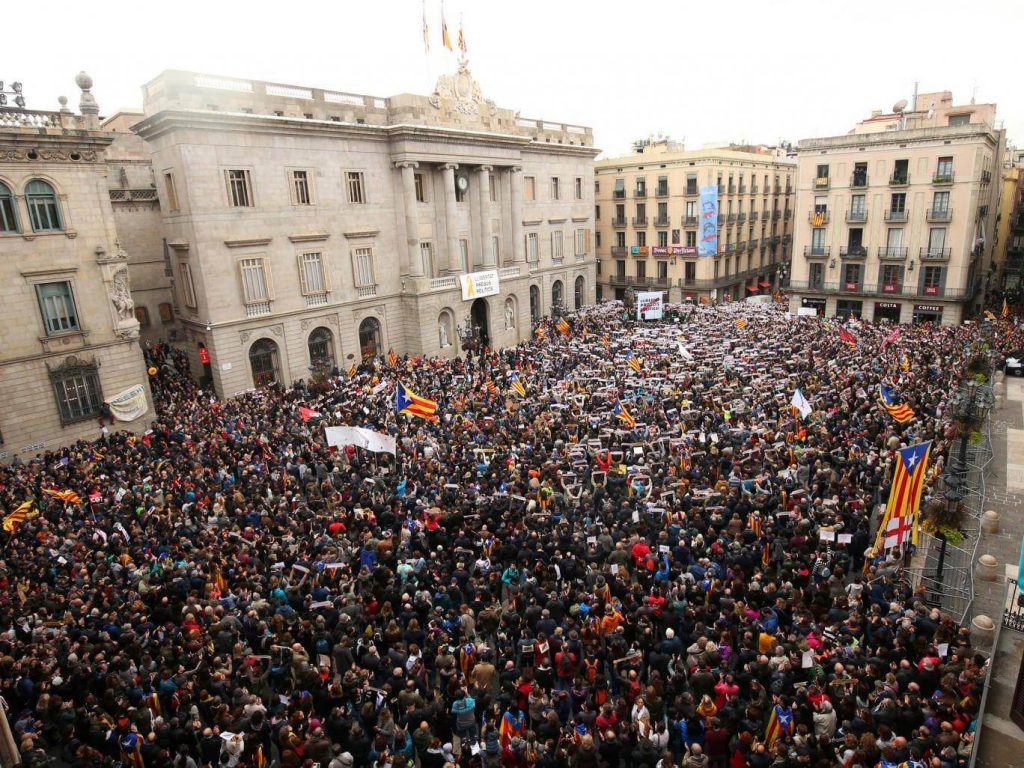
Protesters rally at St James’s Square in Barcelona (Credit: Reuters / via The Independent UK)

Zimbabwe

Last week Friday, US citizen Martha O’Donovan was arrested during a raid at her house in Harare at dawn. O’Donovan who works for Magamba TV is accused of allegedly insulting President Mugabe in a shared tweet, and her arrest is the first after last month’s creation of the Ministry of Cyber Security which focuses on crimes on social media and the Internet in general. If convicted, Martha O’Donovan could face up to 20 years in prison as she is not only charged with insulting the president, but with “’subverting a constitutional government […] [which] is directly related to her role with Magamba TV […] [and it] is what we expected all along, that it was not really about the retweet’”, but a “fishing expedition to get information about her work at Magamba TV”, Doug Coltart, a human rights lawyer in Harare, told Al Jazeera. Among others, Amnesty International condemned the arrest, stating the charges to “confirm fears that this new portfolio will simply be used to punish anyone speaking out against the authorities on social media platforms”. Following the arrest, Zimbabwean officials did not react immediately to requests for comments on the case, reported Al Jazeera.

On Monday, President Robert Mugabe fired his longtime ally and vice president Emmerson Mnangagwa, accusing him of “’disloyalty, disrespect, deceitfulness and unreliability,’ according to a press statement”, reported CNN. This move is expectedly clearing the way for Mugabe’s wife Grace, leader of the party’s so-called Generation-40 which had opposed Mnangagwa, to take over the vice presidency and eventually succeed Robert Mugabe’s rule. In order for the latter to happen, however, an amendment to the party’s constitution will have to be made to allow a woman to take the vice presidency – expected to take place within the next month. Nevertheless, Minister for Defense Sydney Sekeramayi could represent a competitor for the vice presidency as well. A Southern Africa analyst said that “[Sekeramayi’s] elevation to the VP post would be a strategic move to curb perceptions of a Mugabe dynasty.” This followed President Mugabe having already signaled a deepening divide within Zanu-PF at a rally on Saturday. Meanwhile, Grace Mugabe had “accused Mnangagwa of attempting to ‘carry out a coup’” and said she is ready to become her husband’s successor, wrote Zimbabwe Election earlier on Monday.

A close ally reported, Mnangagwa then fled Zimbabwe and is expected to arrive in South Africa late this week, stating he had “fled from ‘assassins’”, wrote The Guardian. However, in a statement Mnangagwa announced he would come back to lead Zimbabwe. Robert Mugabe is said to be facing unprecedented political challenge and Grace Mugabe is “far from a popular person”. Sections within Zanu-PF, Zimbabwe’s security establishment and much of the international community would have preferred Mnangagwa as a candidate, though he is despised by other parts within Zimbabwe.

Al Jazeera

CNN

zimbabweelection.com

The Guardian

Venezuela

On Wednesday, the Constituent Assembly passed a wide-reaching law also known as the “anti-hate law”, as it prohibits Venezuelans to spread messages instigating violence or hate through television, radio and social media, instead obligating public and private media “’to broadcast messages aimed at promoting peace, tolerance, equality and respect’”, reported the Associated Press. The law has been criticized for “crack[ing] down on dissent by criminalizing peaceful protests” and for further limiting free speech. The legislation also addresses political parties promoting “‘fascism, intolerance or national hate’” which cannot register with the National Electoral Council, seemingly targeting opposition parties. Opposition leader Maria Corina Machado has, however, stated that this will not intimidate the opposition, “’[w]e are not afraid of them.’”

Freddy Guevara, Venezuelan opposition politician, has been seeking refuge in the Chilean embassy since Saturday, as Venezuela’s Constituent Assembly had been investigating against him for the suspected involvement in anti-government protests and the Venezuelan Supreme Court ordered him to be stripped of his immunity and prosecuted. As of Tuesday he had not yet applied for asylum, but the Chilean Foreign Minister had stated on Monday that Chile would be willing to grant political asylum. Guevara, who is the vice president of the opposition-dominated National Assembly which had been replaced earlier this year by the Constituent Assembly introduced by Nicolas Maduro. Other Venezuelans have sought protection from Chile as well.

Last week, President Maduro invited bondholders to attend a meeting to address possible debt restructuring for Venezuela in Caracas on November 13. However, some investors have voiced concern about holding the meeting there and are now calling for a more “neutral and safer”, reported Reuters. Besides, they criticized the decision to put Vice President Tareck El Aissami who is accused of drug trafficking, in charge of the proposed meeting. Another main actor within the negotiations would be economy minister and financial head of the state oil company PDVSA, Simon Zerpa, who is alleged of corruption. Both El Aissami and Zerpa are on US sanctions and on the Specially Designated National list which could make a possible negotiation for US bondholders illegal. Meanwhile, Venezuela is further struggling with its debt situation and a possible default, as important PDVSA payments are still missing when they had been due last Friday, reported the Financial Times. Some bondholders were expecting the money to arrive soon, speculating about a delay’s possible reasons as there had not been an official statement about such. Others pointed out, Venezuela had clearly missed the deadline anyhow. At the same time, the Russian Finance Minister announced on Wednesday that Russia agreed to the restructuring of about $3 billion of loans. Though a small amount in comparison to the total debt, this could help Venezuela with other payments, wrote the NY Times.

Associated Press

Reuters

Financial Times

Deutsche Welle

The United States of America

On Sunday, another deadly mass shooting in Sutherland Springs, a small community in Texas, shocked the United States when a gunman entered a church with a semi-automatic weapon. 26 people were killed and 20 others wounded (10 of them in critical condition as of Tuesday) by the perpetrator who was reported to have been found dead in his car after a short chase. This devastating event followed only after about a month of the Las Vegas shooting, the deadliest in US history. While on an official trip in Asia, President Trump voiced his compassion with the victims and their families. It became known that the Pentagon “had failed to furnish information about the gunman’s criminal record from his U.S. Air Force service to a national database that should have prevented him from legally purchasing the firearms he bought”, wrote Reuters. The incident then sparked renewed discussion about gun violence in the US. Whereas Donald Trump had stated a mental health problem, not gun laws to have been the problem in this case, others have called for tighter regulation. CNN reported on gun violence being a more complicated issue than just ‘mental illness’, referring to Jeffrey Swanson, a professor of psychiatry and behavioral sciences at Duke University who said “’[a] history of violent behavior…a far better predictor of future violence than mental illness’” and “[c]alling gun violence a mental health issue is to scapegoat and stigmatize people with mental illness”. Relating to various studies conducted, a column in the NY Times reported on a correlation between gun ownership and lose gun regulation, and mass shootings.

Another topic constantly present in the media, was President Trump’s visit to several Asian countries, starting with Japan, going to South Korea, China and later Vietnam. The two major topics for his trip have been US trading relations in the region, as well as dealing with the current North Korean crisis. In this context, Foreign Minister “Tillerson pointed out that Trump, in a speech in Seoul, had ‘invited the North Koreans to come the table,’ in line with the Chinese desire for a negotiated solution” though Trump was also prepared for a “’military response’ if he deemed the threat serious enough”, wrote Reuters on Thursday. In South Korea, protesters called for peace ahead of the US President’s visit to their country. There, a canceled visit to the Demilitarized Zone (DMZ) between South and North Korea had caught the media’s attention. The South China Morning Post had speculated on Monday, that President Trump “may appear so focused on North Korea that he shows little affinity for the broader range of issues in the region, from South China Sea tensions to regional counterterrorism. This could fuel concerns in some countries that agendas are not aligned and that the administration cares little for them.” A conclusion on such a question can probably only be answered after Trump has finished his trip with his last stop in Vietnam, where the US President might also meet Russian President Vladimir Putin. Ahead of this visit, Vietnamese President Rodrigo Duterte had warned Trump of addressing the country’s human rights issues.

Reuters (Sutherland Shooting)

Reuters (Trump in China)

Reuters (Trump in Japan)

CNN (Trump in South Korea)

South China Morning Post

Democratic Republic Congo

While aid organization Caritas continued to highlight the ongoing humanitarian crisis in Kasai, DRC’s electoral commission announced the long-awaited presidential elections to take place on December 23, 2018, after it had been repeatedly delayed. Official results are then scheduled to be announced on January 9, 2019, followed by the inauguration of the new President on January 13. Incumbent President Kabila has ruled the country since 2001 and was supposed to step down after his second term had ended in December 2016. Kabila however refused to do so, triggering protests during which dozens of people were killed. Reuters wrote that “[w]ith no imminent election in sight, a political crisis has set in that is fueling increasing militia violence and lawlessness in Congo’s east and center.” The opposition has claimed Kabila is using the delays to remove term limits preventing him from running for election again, following examples of presidents in Rwanda and Congo Republic. “He denies that, but has not categorically said he will step aside”, while claiming delays are due to complicated registration conditions, reported Reuters. In reaction to the late announcement of election-day, the opposition accused the electoral commission to work in favor of Kabila and three large opposition parties “presented a united front to reject plans for elections in December 2018”, stated Bloomberg. They urge President Kabila to step down by the end of 2017 and hold new presidential elections no later than mid-2018.

Reuters

Bloomberg

Syria

Last weekend, Turkish President Erdogan’s spokesman announced that the Russian-sponsored Syrian peace congress would be postponed, originally scheduled for November 18. Though an official new date has not been announced, Russian Foreign Minister Sergei Lavrov stated on Tuesday he hopes for them to take place in the near future and for the UN to support holding the congress.

Meanwhile, the Syrian army declared victory over ISIS as their last stronghold was captured in Albu Kamal, though some fighting continues in the desert area close to the town. Reports said that during the fight in Albu Kamal, many had surrendered or fled. The fate of ISIS’ last commander Abu Bakr Al-Baghdadi, however, remains unknown. Moreover, a new phase of guerilla warfare is somehow expected, considering experience in the past and ongoing tensions within Syria and Iraq, as well as the region as a whole, involving Saudi Arabia, Iran and Hezbollah. Reuters also referred to Western security chiefs stating that ISIS’ loss of territory “does not mean an end to the ‘lone-wolf’ attacks with guns, knives or trucks plowing into civilians that its supporters have mounted around the world.”

The Associated Press reported via The Washington Post that in the meantime, the United States and Russia are nearing an agreement on the resolving of the Syrian civil war, said to focus on “’deconfliction’ between the U.S. and Russian militaries, reducing violence […] and reinvigorating U.N.-led peace talks.” With ISIS defeat, both countries “are losing their common enemy in Syria and will remain in a proxy battle” in which both support different actors within Syria, increasing the need for closer communication. The two countries “have been at odds for years over” Assad’s involvement in the future of Syria. An illustration of the divide between Russia and other Western countries this week, was a clash during a Security Council meeting about a report accusing Syria of a chemical weapon attack.

Reuters (Russian-sponsored peace congress)

Reuters (ISIS defeat)

The Washington Post

TIME

Myanmar

In a unanimous statement made on Monday, the UN Security Council strongly condemned the violence forcing thousands of Rohingya to flee from Myanmar to Bangladesh. It expressed “grave concern” on reported human rights abuses, called on the government to “ensure no further excessive use of military force in Rakhine State, to restore civilian administration and apply the rule of law”, and urged both the governments in Myanmar and Bangladesh to work together to “allow the voluntary return of all refugees in conditions of safety and dignity to their homes in Myanmar”. The Guardian wrote that the Council further “said the government must address the root causes of the crisis by allowing ‘equal access to full citizenship.’” The newspaper further reported that the statement included most demands which had been part of a draft resolution presented last month by Britain and France, while China had opposed some of its details. According to diplomats, before China agreed to the statement, “language on citizenship rights was watered down, along with a demand that Myanmar allow a UN himan rights mission into the country”, wrote the Guardian. In the statement, the Security Council calls on Myanmar for cooperation with the UN and encourages UN Secretary-General Antonio Guterres to appoint a special advisor on the crisis. The statement caused criticism from both, the Myanmar side for exerting “’undue political pressure on Myanmar’”, warning of sanctions possibly exacerbating religious tensions, as Myanmar’s ambassador Hau Do Suan stated, as well as from rights groups which accused the Council for not doing enough by not including the threat of sanctions.

After a land rights activist died of his injuries being beaten in the context of claiming back land, activists are calling for a thorough investigation, beside a general urge to address rising territorial disputes and land rights in Myanmar. A majority of the population lives in rural areas, depending on agriculture for their living. On Friday, a court in Myanmar sentenced a Singaporean and a Malaysian journalist, along with their local driver and interpreter, to two months in prison, after an arrest last month for flying a drone over the parliament.

The Guardian

The Washington Post

Reuters

Poland

On Monday night, several hundred of people walked silently in Warsaw in memory of Piotr Szczesny, a man who died at the end of October after setting himself on fire in front of the Palace of Culture, a landmark in Warsaw, in protest of the current government’s policies. The Polish government has been led by the right-wing Law and Justice party (PiS) for two years and has been, among other things, criticized of jeopardizing the freedom of the media and judicial independence (also see our last Weekly Report featuring Poland). Reuters reported that Piotr Szcezsny had scattered leaflets around himself stating he loves freedom above all and that was the reason for committing the act of self-immolation, hoping his death would shake the conscience of people.  A protester on Monday told Reuters, he “was full of respect” for Szczesny and that he was worried about the political situation in his country. He said “Many people live in the conviction that politics doesn’t concern them. Politics is us, we ordinary people create politics.” Project Syndicate wrote in more detail about what Szczesny addressed in his letter, and further presents some of the mixed reactions to his drastic action. It concludes that “[a]fter an act of despair such as what Poland witnessed this month, the first priority should be to mourn the victim. The second should be to channel the despair that many are feeling in ways that nurture hope.”

Further underlining its current nationalist stance, Poland announced planning to ban Ukrainians with “anti-Polish views” at the end of last week, though little is known about the details of the policy. Polish Foreign Minister Waszczykowski said this measure followed disrespect exhibited at a Polish cemetery in Lviv which had been part of Poland before World War Two. Waszczykowski also said that while Poland is sympathetic of Ukraine’s struggles with Russia, “historical issues” should not be pushed aside. Poland itself is currently home to 1.5 to 2 million Ukrainians.

Foreign Affairs published an in-depth article assessing the reasons for continuing popularity of PiS within Poland despite international criticism, stating an effective combination of social conservatism and nationalism with welfarism to be the crucial factor. “Poland’s ruling party has responded to two of the major issues of contemporary European politics—identity and inequality” and “has cleverly positioned itself as an anti-establishment party representing the Polish people against corrupt liberal elites”, as well as against Western Europe, making use of a current unpopularity of Western social models. Another aspect mentioned in the article is the weak, divided and unsure state of the current opposition.

Reuter (silent march in Warsaw)

politicalcritique.org

Reuters (ban of anti-Polish“ views)

Foreign Affairs

Spain

This week, road and rail service blockages and other demonstrations by pro-independence groups, were disrupting life in Barcelona also affecting universities and schools, though the call for a general strike was left unheard. On Wednesday, the Spanish Constitutional Court officially annulled the unilateral declaration of independence by the Catalan parliament, as had been widely expected after an earlier suspension by the court. However, according to a BBC interview, Foreign Minister Alfonso Dastis stated that the Spanish government will, in recognition of the recent developments in Catalonia, consider changing the constitution to allow legal, nationwide independence referendums in the future. The issue will be addressed by a special committee in the Spanish parliament, the Foreign Minister said, highlighting it was clear that if such referendums would be allowed, only when the whole Spanish population participated. European Commission President Jean-Claude Juncker urged Europe this week, to stand up against separatism when Catalan independence has deeply divided Spain.

After ousted Catalan president Carles Puigdemont and four ex-Catalan ministers had fled to Brussels, later turning themselves in to Belgian authorities on Spanish arrest warrants, a judge saw no reason to keep them detained and released them quickly on condition they would stay in Belgium and attend court sessions within two weeks. The Catalan politicians had fled Spain and did not show up for questioning in Madrid last week, stating “they wanted to make their voices heard in the heart of the European Union […] maintaining they could not get fair trials”, wrote the Chicago Tribune.

The speaker of the Catalan parliament Carme Forcadell and four other Catalan government members had appeared at Spain’s Supreme Court and were eventually granted bail after they had testified for their role in the context of the referendum and declaration of independence in Catalonia. Along others, they are facing “charges of rebellion, sedition and misuse of public funds”, wrote The Guardian. This ruling might have relieved Puigdemont and others who had fled. Nevertheless, eight other former Catalan ministers along with leaders of the two main pro-independence groups are already in custody, waiting for investigations by Spain’s highest criminal court, the Audiencia Nacional, following a rejection of an appeal for their release by the high court.

BBC

Chicago Tribune

The Guardian

Cambodia

After Cambodia has been tightening its grip on the opposition ahead of next year’s crucial vote and the government asked the Supreme Court to dissolve the main opposition Cambodia National Rescue Party (CNRP), Prime Minister Hun Sen called on people to ‘bet’ on the dissolution of the CNRP, saying “’it’s a 1 against 100 odds’” and “’it’s all open for betting’”, wrote Reuters. The news outlet also reported on attempts of showing local populations the benefits of grassroots democracy, such as by local council leader Sin Rozeth who had profited from the US funded National Democratic Institute (NDI). However, as the government is cracking down on opposition activities on all levels and only a small percentage of people who should have registered to vote by November 9 had done so, the “shaky democracy” of Cambodia is at stake.

Reuters (Hun Sen comment)

Reuters (grassroots democracy)

The Maldives

Reports have stated that Indian and US representatives held talks addressing the current political situation in the Maldives, also touching upon the issue of extremism. Raajje wrote that key points on the agendas had been political detainees, former President Mohamed Nasheed, the trials of a Maldivian MP, as well as events in the Parliament, such as a military siege in Parliament premises. Meanwhile, on a press conference on Tuesday, Maldivian Member of Parliament Riyaz Rasheed “has accused Sri Lanka of assisting alleged opposition efforts to overthrow the Maldivian government”, wrote DaillyMirror Sri Lanka. He said to be concerned about Sri Lanka allowing Maldivian politicians in exile to plot attempts of ousting President Abdulla Yameen, reported DailyMirror referring to the Maldives Independent.

Raajje

DailyMirror.lk

Yemen

The Saudi Arabia-led coalition forces decided to temporarily close all Yemeni air, sea and land ports, following an intercepted missile which had been fired towards Riyadh by the Iran-allied Houthi militia on Saturday. Human Rights Watch stated that the attack can likely be classified as a war crime. While it had been announced that aid workers and humanitarian supplies would still be able to pass the blockage, the Red Cross reported it had not been able to deliver some of its supplies. This could threaten the Yemeni population even further, confronting what UN official Jens Laerke called “the world’s worst humanitarian crisis at the moment”, according to BBC. Yemen is facing a cholera epidemic and the UN says millions of Yemenis are on the brink of famine. “The United Nations and international aid organizations have repeatedly criticized the coalition for blocking aid access, especially to the rebel-held north.”

Reuters

Human Rights Watch

BBC

Other News

Saudi Arabia

Another headline present in the News this week, was the start of an anti-corruption campaign at the weekend against Saudi Arabia’s political and business elite, including the arrest of 11 princes. This move seems to be part of Prince Mohammed bin Salman’s campaign of reform and substantial political, societal and economic change in Saudi Arabia, but also a measure to further tighten his grip on power, as reported in these Reuters and The Guardian articles. Meanwhile, Human Rights Watch raised concerns about the legal process and a lack of presented evidence for the detentions, and further referred to “a wave of other recent arrests, including of clerics, human rights activists, and intellectuals” in their article.

Paradise Papers

Another topic which repeatedly headlined international news were the “Paradise Papers”, the world’s second biggest data leak, including 13.4 million documents which were investigated by 96 media companies worldwide. They mostly reveal offshore investment activities and information surrounding ‘tax havens’. The Guardian assembled some of the key findings.

CANVAS’ Daily News

Also read what we featured in our daily news section this week:

Bonn Protests at COP23 – How do mass-protests cause change?

South-Koreans are protesting against Donald Trump ‘War Mongering’ – and in support of it

Evacuate Manus now! – Australian activists stage multiple protests over conditions in Refugee-detention center

Evacuate Manus now! – Australian activists stage multiple protests over conditions in Refugee-detention center
Photograph: Workers prepare to tow the protesters’ car from the tracks at Ascot Vale. Photo: Jason South/ The Age.com

Published on 10/11/2017

Evacuate Manus now! This week, several protests were staged throughout Australia, by social groups who condemn the inhumane treatment of refugees at Manus Island. On Tuesday, WACA-activists climbed to the top of the Sydney Opera House to protest against the treatment of refugees on Manus. Also on Tuesday, surrounding the world famous annual Melbourne Cup horse races, protesters climbed a crane and unfurled a banner above the racecourse calling for Manus Island refugees to be evacuated. Several hours earlier, a different group of protesters drove a Ford Laser onto the train-tracks at Ascot Vale, deflated the car’s tires and bolted a woman to the steering wheel. When police arrived at the scene about 20 protesters fled, leaving the woman in the car to be extracted by firefighters. The car was removed but passengers heading for the races were delayed for up to an hour, according to The Guardian.  

Protesters did not target the Melbourne Cup-event without a reason. “We are really appalled at the situation on Manus Island and we think it’s really inappropriate for people to be celebrating when there are individuals with no water and no security,” one activist said. Charlotte Lynch from the Whistleblowers, Activists and Citizens Alliance (WACA), a grassroots community that mobilizes for change from the local to the global level, said the organization will be escalating their actions and civil disobedience throughout the week “and if takes breaking the law to get these men off Manus we’ll do it.” 

The Manus- struggle revolves around a refugee detention center on Manus Island, in northern Papua New Guinea. Annually, thousands of people attempt to reach Australia on boats from Indonesia, looking for a better life there. Australian leading political parties say the journey asylum seekers make is dangerous and controlled by criminal gangs, and claim they have a duty to stop it. In 2013, the Australian government toughened their stance even further and put the military in control of asylum operations, now claiming that their policies have restored the integrity of its borders, and helped prevent deaths at sea. 

However, since the reopening of the detention center on Manus Island in 2012, it has seen nothing but scandals and human rights violations. In 2014, escalating protests at the center resulted in 77 people injured, one fatally. In May this year, PNG immigration officials confirmed the centre will close on 31 October, and told detainees that over the following months basic services were shut down, to encourage them to leave. This is how the situation remains until this day. Amir Taghinia, a refugee from Iran who was transferred to Canada only recently, claimed that although he was grateful to be in Canada, he could not forget about his friends. “They are starving, they have no water to drink. It is very, very likely we will have more deaths in the next coming days,” Taghinia told the Guardian on Monday.

Australian activist have been fighting for the closure of Manus and two other offshore island detention camps for the last year. In December, protesters abseiled down Parliament House in Canberra, unfurling a banner saying “close the bloody camps now”, while 13 more demonstrators held placards in a pond they dyed red to symbolize blood. By organizing a boycott against Australian security company Wilson, who provides security services on Australia’s offshore detention centers, the activists tackle another pillar upholding the human rights violating practices.  

Read more about the Manus- Island protests herehere and here 

South-Koreans are protesting against Donald Trump ‘War Mongering’ – and in support of it

Photograph: South Korean antiwar protesters at a rally for peace in Seoul, South Korea, November 7, 2017. (Sipa via AP Images)

Published on 08/11/2017

Less than a year ago, South-Koreans stood united in their call for the impeachment of their leader Park Geun-hye. Several weeks of massive protests against Park and the political scandal she was involved in led to the resignation of the former President. With new President Moon Jae-in pursuing a more liberal course, South-Koreans are mobilizing again, and this time Donald Trump is their target. 

The American President, on a 12-day Asia tour, landed in South-Korea on Monday, while a coalition of antiwar, trade-union, and civil-society groups organized a “No Trump, No War National Rally”. On Saturday, days ahead of President Trump’s visit, hundreds of South Koreans took over their capital in protest. Just a few days later on Tuesday, thousands of Koreans flooded the streets in eight Korean cities to tell the militaristic president to go home. The core of their message is that, while South Korea is not seeking a conflict, Trump’s outspoken and sometimes aggressive tone does the situation on the Korean peninsula more bad than good! “He could be welcomed here, if he was the messenger of peace,” one activist told CNN. “But he is the messenger of war […], and he is not afraid of war again in this world.” 

Activists also protest a hidden agenda they seem to see underlying Trump’s tough stance against the North-Korean regime. According to ABC-news, demonstrators accused the outspoken president of not only raising tensions with North Korea but also “pressuring Seoul to buy more U.S. weapons. They also criticized him for pressing Seoul to re-do a bilateral free trade deal between the countries so that it’s more favorable to the United States.”   

However, not all South-Koreans stand united in their resistance against the US-President. Across the street of the anti-Trump protests on Tuesday, hundreds of Trump supporters waved the U.S. and South Korean flags and held signs that read ‘Blood Allies Korea US’. Mainly the older Korean generations, who tend to be more conservative, are supportive of Trump’s tough stance against the North. They accuse liberal South Korean President Moon of being too soft on Pyongyang. 

Read more about the South-Korean protests, the chances of a US – North Korea war, and the reasons for many Moon Jae-in followers to be disappointed in their President in this article by the Nation 

Bonn Protests at COP23 – How do mass-protests cause change?

Photograph: People march during a demonstration under the banner “Protect the climate – stop coal” two days before the start of the COP 23 UN Climate Change Conference hosted by Fiji but held in Bonn, Germany November 4, 2017. REUTERS/Wolfgang Rattay

Published on 07/11/2017

A smartphone without an operating system. Or a brand-new car without the road-network to drive it on. The 2015 landmark Paris agreement at COP21 delivered the first truly global deal to tackle climate change, but national action needs to be significantly toughened to meet the goal of keeping global temperature rise on the low. That is why half of the world moves to Bonn this week. Where the Paris agreement set out principles, the 23rd annual ‘conference of the parties’ (COP23) under the UN Framework Convention on Climate Change (UNFCCC) is looking to build structures and rules that will enable the Paris deal to work. 

With all the world-leaders and influencers in the field of climate in one place, Bonn seems to be the place where everybody wants to show their stance. As the COP23 Climate Summit has started on Monday, several activist groups and protesters have tried to make their mark. Over the weekend, thousands of people had gathered in Bonn ahead of Summit, calling for the measures set out in the accord to be implemented faster. For Germany specifically, this means a move away from coal to renewable resources. More protests were staged in the nearby town of Kerpen on Sunday 

Early July, we have seen similar forms occurring, with mass protests surrounding the G20-Summit in Hamburg. In most recent years the G20 has caused mass protest in the host-city. And also the 2015 Paris based COP21 saw thousands defy a protest ban to call for climate action. Where the nature and goals of these protests differed from those in Bonn (as well as the amount of violence used in some occasions), we can see how large, international conferences like the G20 or COP often result in protests by advocacy groups calling for change on a variety of topics. 

The question which automatically occurs, or that should occur anyway, is one of effectivity. How effective are the mass protests on the sidelines of these events where the rich and powerful of the world meet? Al Jazeera’s Srecko Horvat writes, public demonstrations might be necessary “to show the massive dissatisfaction with the current global system. But even if there are 150,000 people in the streets, this massive mobilization won’t produce any concrete change.” 

There are, of course, several answers to this question. But let’s go with a rather positive one. The answer is yes; these forms of protest do matter, but in a more indirect way than we might think. In a 2011 study, economists from the Universities of Harvard and Stockholm found that protests do in fact have a major influence on politics. Their research shows that protest does not work because big crowds send a signal to policy-makers—rather, it’s because protests get people politically activated. More than directly influencing their apparent targets at the summit or conference, “protests can build political movements that ultimately affect policy.” 

Although the study is of a mostly quantitative nature, and has more implications than just this one, we can see the logic. Change is not the result of influence the actual protest has on policy-makers, but of the way it motivated attendees of the protests. Protesters may be affected by interactions with other protesters, and non-protesters may be affected by interactions with protesters during and after a rally has taken place. Opponents become neutrals, and neutrals might be pulled to your side! What protesters in Bonn might not achieve, is a direct influence on the decisions made at the GOP23 in 2017. However, their protests will be a breeding-ground for debate and a growing political movement. Although this developing political consciousness is what will cause change in the end, the spark of the protest is indispensable in the process.  

Read more about the article on which our thoughts are based in a summary, or the full article. Want to read more about why the Cop23-Summit in Bonn matters? Read this article by The Guardian. 

“Dictators aren’t known for their sense of humor” – Cartoonist arrested in Equatorial Guinea

Photo: Cartoon by Ramón Nsé Esono Ebalé featured in the VQR article

Published on 04/11/2017

When Equatoguinean cartoonist Ramón Nsé Esono Ebalé returned to his home country this September to renew his passport, he was arrested. Since then, he has been kept in detention in a notorious prison in the capital Malabo, and Equatoguinean authorities might be preparing a criminal defamation case against Esono. Public Radio International (PRI) writes: “Moore Gerety [see below] says Esono is not likely to see a courtroom. It’s a political case.“ Human Rights Watch reports that it had documented an increase of incidents “in which the government has retaliated against artists and cultural groups”, and that art has been used for independent voices to provoke public debate on social issues in Equatorial Guinea where political dissent is met with little tolerance. “Dictators aren’t known for their sense of humor. At least when the jokes are about them” commented PRI. This reminds us of the power of humor in nonviolent struggle.

What initially brought us to the cartoons of Ramón Nsé Esono Ebalé alias “Jamón y Queso” (Ham and Cheese), was this in-depth article about Esono’s work in criticism of (political) life in Equatorial Guinea and especially its longstanding President Teodoro Obiang Nguema Mbasogo. In his article “Comics without Captions: Can a cartoonist help unseat a dictator?”, Rowan Moore Gerety recounts how Esono came to draw cartoons, how he started his “career” when such was not really possible from within Equatorial Guinea, and what the cartoonist had to tell about his work. But Gerety also includes accounts from other African countries, such as Nigeria or the Democratic Republic of the Congo, which he describes as “the closest thing there is to a continental comic book hub”, with the exception of South Africa, mainly owing its legacy to the famous Tintin au Congo comic and the former colonial power Belgium.

Esono told Gerety, that he got his first comic book from his father, who worked as a civil servant for many years returning from travels to Spain on government business. After discovering his own talent, what brought him to go beyond the Superheroes he had been drawing before and to become more political himself, was an encounter with political cartoonist Pahé in Gabon. Since then, he has been using “his drawings to expose the gross inequality in Equatorial Guinea”, focusing mostly on the country’s president and his repressive leadership, and in his style, Esono is “often crude and outrageous”, as PRI describes it.

In 2014, Esono illustrated the book La Pesadilla de Obi (Obi’s nightmare), written by an anonymous collaborator. It sets President Obiang who has tightly ruled Equatorial Guinea as Africa’s longest-serving dictator since independence in 1979, waking up to be just a ‘regular’ citizen as the piece’s main character. The cartoonist had distributed copies at the US-Africa Leaders Summit in 2014, “hoping to push conversations about authoritarianism and human-rights abuses above the din of billion-dollar investment initiatives and strategic partnerships”, wrote Gerety. It was Esono’s plan to clandestinely distribute several thousand copies within his home country as well. Until 2011, he had produced his cartoons from within Equatorial Guinea. But as his work became more dangerous, increasingly receiving international attention, he took the chance to go to Paraguay where he has been living in exile.

What happens to Esono after his detention, remains to be seen. Human rights organizations and activists have urged for the cartoonist to be released, have created the hashtag #FreeNseRamon and are collecting signatures for a petition to President Obiang.

To learn more about Esono, his stories about his work and life in and beyond Equatorial Guinea, as well as some background information on the role of comics on the African continent and the situation in Equatorial Guinea, read Rowan Moore Gerety’s 2016 article for the Virginia Quarterly Review (VQR) online.

For more information about the detention, consult these Human Rights Watch and PRI articles.