Weekly Report: 3 November, 2017

Do you want to receive our Weekly Reports in your e-mail? You can subscribe to our Weekly Briefing via THIS LINK 
Spain

After the Catalan parliament meets and unilaterally declares independence on Friday, Spain’s senate approves new powers for the Madrid government to impose direct rule on Catalonia that same day. As pro-separatist movements protests dominated the news for weeks, police said at least 300,000 people had turned out in Barcelona, Catalonia’s largest city, for a pro-unity rally on Sunday. Catalonia’s main opposition party said the region’s “silenced majority” was now speaking, according to BBC.

Then, early this week, ousted Catalan leader Carles Puigdemont left Spain and travelled to Brussels, as he is facing sedition charges from the Spanish government after Catalonia declared independence. According to the Independent, “the move comes after Belgium’s asylum and migration affairs minister Theo Francken said the former president could seek asylum in the country.” Saillant détail is that Francken hails from the Flemish nationalist party New Flemish Alliance, which has close ties to the Catalan separatist movement, while the party advocates an independent Flanders and wants it to secede from Belgium. Late on Tuesday, Puigdemont declared he is not seeking assylum in Belgium, but simply working from the countries capital until “a fair judicial process was guaranteed.”

Early on Friday, the crisis in Spain dramatically deepened and extended across the Continent after eight Catalan ministers were jailed by a court in Madrid and a European arrest warrant was issued to extradite the region’s disputed president Carles Puigdemont from Belgium on charges of rebellion and sedition. According to the Guardian, it is understandable “that there is a more than reasonable doubt about the fairness of the highly politicized Spanish courts. The charges launched today are eminently political, and have the objective – as openly stated by various PP party officials – to severely punish and make examples of the leaders of Catalonia’s political and civil society self-determination movement.” Thousands of people took to the streets in Catalan cities to protest the jailing of the politicians, which follows the detention of two other separatist leaders last month on grounds of sedition.

BBC News

The Independent

The Guardian

The United States of America

On Tuesday, New York was hit by the deadliest terrorist attack since 9/11. A 29-year-old man drove a truck into a Manhattan crowd, killing eight and wounding almost a dozen. The man accused of these despicable deeds is an Uzbekistan national who lived in New Jersey and drove for Uber. President Trump reacted on Twitter, claiming that “law enforcement is following this closely.” As the attacks come at a time when the President is pushing for his US travel-ban harder than ever, popular media will not let the attacks unused to prove Donald Trump’s right on the issue.

On Wednesday, the President himself starts phrasing the terrorist attack by the lines of his political stakes. In a tweet, Trump says: “The terrorist came into our country through what is called the “Diversity Visa Lottery Program,” a Chuck Schumer beauty,” referring to the Democratic Senator who introduced the program. Where it was “too early” to talk about weapon-legislation reform after the mass-shooting in Las Vegas last month, Trump has no troubles immediately asking Congress for action after this tragedy. “The United States will be immediately implementing much tougher Extreme Vetting Procedures. The safety of our citizens comes first,” says another one of his tweets.

The Guardian

The Economic Times
Venezuela

On Monday, Amnesty International published their latest report on the illegal practice of home-raids as a repressive tactics by the Venezuelan authorities. According to AI, “a vicious campaign of illegal home raids on citizens suspected of dissent” has taken place over the last months, as the report focusses on the period between April and July of this year. Those targeted told Amnesty and local human rights organizations that “security forces and armed men, believed to be members of government-sponsored illegal armed groups, would violently force their way into their homes without judicial orders or any explanation of why there were there.”

On Thursday, TheConversation.com releases a strong piece on the contradictions that characterize the current position of the opposition-coalition in Venezuela. International support has been unprecedented after Maduro’s increasingly authoritarian actions, as a reaction to six months of daily street-protests by the opposition. Back at home, however, things look much more grim, as the opposition coalition has been a fractious and delicate alliance. Moreover, the decision to compete in instead of boycott the October 15 gubernatorial polls under the current circumstances turned out to be a costly misstep. The group is now fighting over whether to boycott December’s municipal elections.

Meanwhile, Venezuela’s economic crisis is worsening. Late on Thursday, President Nicolas Maduro said in a televised speech that Venezuela and its state oil company, PDVSA, will seek to restructure their debt payments. After the oil company made a $1.1 billion payment on Thursday, Maduro said that “after this payment, starting today, I decree a refinancing and a restructuring of the external debt.” Meanwhile, Maduro and others in his government have tried to pin the blame on President Trump for Venezuela’s debt problems after Trump slapped stiff financial sanctions on the country in August. If Maduro’s government can’t reach a new agreement with bondholders over the debts it will end up defaulting, which, according to CNN “would trigger a potentially ugly series of events.”

Amnesty International – full report
The Conversation

CNN

Democratic Republic Congo

Late last week, after her visit to the country, U.S. envoy Nikki Haley said the Democratic Republic of Congo must hold long-delayed elections next year or it won’t receive international help with the vote. After a meeting Friday with the country’s electoral commission, Haley spoke to reporters in the Congolese capital, Kinshasa, stating that the DRC needs “free and fair elections to happen in 2018 at the latest, and not the end of 2018 — we need to have them sooner,” calling on President Joseph Kabila to announce elections will take place next year. “The U.S. will not support anything in 2019. The international community will not support anything in 2019,” Haley stated.

Early this week, UN World Food Program head David Beasly stated that a looming humanitarian catastrophe could see 250,000 children starve within months in the Kasai region. The region, which is the size of Germany, has historically suffered from malnutrition, but this was further exacerbated in 2016 by inter-ethnic violence resulting in large-scale killing and the mass destruction of villages and crops. “3.2 million people are at severe risk as we speak. Hundreds of thousands of children are on the brink of starvation. So we need to ramp up. We’re there, we’re ready to go, we need the donors to step in now. If they don’t, not only are people going to die, children are going to die and you’re going to have long term chaos that’s going to cost a lot more,” said Beasly.

AfricaNews.com

World Food Programme
Zimbabwe

Early last weekend, police arrested aspiring Mt Pleasant (Harare) independent MP candidate Fadzai Mahere at a soccer tournament she had organized as part of her campaign activities in the constituency. According to The Standard, “social media was abuzz with opposition activists and other people condemning the arrest,” as it was seen as another episode in Zanu PF “stifling the electoral space as a way of pushing out other players.” Mahere, who has been involved in last year’s #ThisFlag-movement, is known as a fervent ZANU-PF criticaster.

After the re-shuffle of ministerial positions, and the origination of a new ministry responsible for Cyber Security, Threat Detection and Mitigation, online surveillance remains a hot topic in Zimbabwe. On Monday, Daily News claims that media platform Facebook has assured its Zimbabwean network users that it will not share their private communication on the platform with the Mugabe-government when there would be such a request. Zimbabwe’s government has been uneasy about social media after several online movements i.a. pastor Evan Mawararire’s #ThisFlag movement, were able to make waves last year. Early last week, BBC reflected on several implications the new ministry will or might have.

On Wednesday, Robert Mugabe raised some eyebrows, by claiming he is in favor of resuming executions in the country in response to rising murder rates.  At the burial of a veteran of Zimbabwe’s independence struggle in Harare, the 93-year-old Zimbabwean President stated that “if you hear people are being executed, know Mugabe’s thinking has prevailed.” Human rights groups including Amnesty International have often called on Zimbabwe, which has 92 inmates on death row, to permanently abolish capital punishment.

The Standard

BBC News

The Guardian

Syria

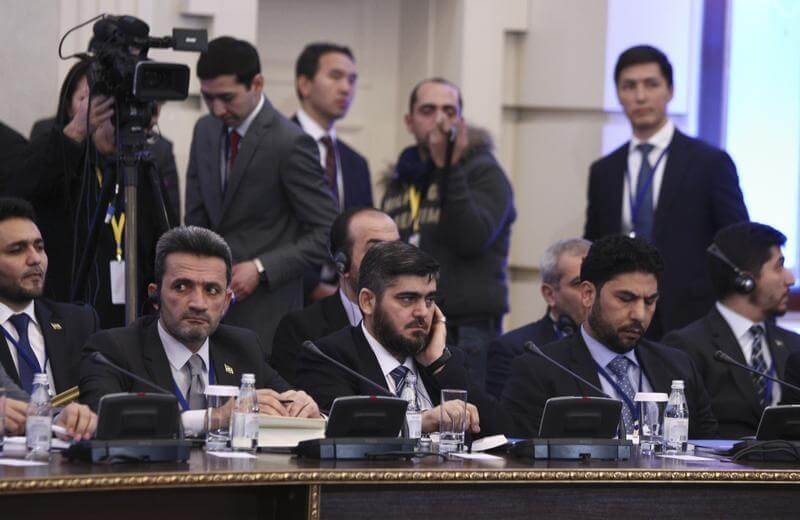
On Monday, new talks on the Syrian situation kicked off in Kazakhstan. The Syrian government and several armed opposition groups are meeting in Astana for talks aimed at implementing a lasting ceasefire agreement. According to Al Jazeera, “the latest round of Astana-talks is aimed at establishing four so-called “de-escalation zones” in mainly opposition-held areas of the country, with Russia, Turkey and Iran acting as guarantors.” The top-level meeting is expected to call for a six-month ceasefire and the establishment of several no-fly zones. The October 30-31 meeting has also discussed the release of hostages, prisoners, delivery of food and aid to besieged areas, the transfer of dead bodies and the search for missing persons.

On Wednesday, other peacemaking efforts hit their first complications, as a new, Russian-sponsored initiative to reach a political settlement was rejected by the Syrian opposition. Officials in the anti-Assad opposition rejected the congress scheduled for November 18th to take place in Sochi. Instead, they insisted that any peace talks be held under U.N. sponsorship in Geneva. In their turn, Turkey protested against the invitation of the Syrian Kurdish side to the talks. “Ankara, which views the dominant Syrian Kurdish groups as a national security threat, said it was unacceptable that the Kurdish YPG militia had been invited,” according to Reuters.

Al Jazeera

Reuters

Cambodia

On Tuesday, Cambodia’s top-court rejected an appeal to free opposition leader Kem Sokha. According to Reuters, the court argued that “his release could be a public risk as the threat of dissolution looms over his opposition Cambodia National Rescue Party (CNRP).” In two weeks time, he Supreme Court is due to rule on the dissolvement of the CNRP, after the government last month filed a lawsuit asking to do so on grounds it was involved in a plot to topple the government.

On that same day, a European Parliament delegation warned Cambodia, as the country could face EU action over aid and vital trade preferences if the human rights situation worsened further. “A serious deterioration of the human rights situation might have implications for development assistance programs and trade preferences,” said the delegation’s chairman Werner Langen. In a reaction to these allegations, undersecretary of state at Cambodia’s Interior Ministry, Huy Vannak, said the European Parliament should keep trade and politics separate.

Reuters

Reuters
The Maldives

The European Union will be dispatching a team of their researchers and surveyors to Maldives this week, in order to identify the political condition of the country. The team will also assess the upcoming presidential elections of 2018, basing their research mainly on interviews with MP’s from both the ruling party and the opposition. The visit be the first from an EU delegation since the European Parliament adopted the Resolution No.RC-B8-0549/2017 on the Maldives on 5 October this year, harshly judging the political- and civil rights situation in the country.

The Apolitical
Myanmar

On Sunday, a big pro-army rally was hosted in Myanmar’s Yangon. According to the South China Morning Post, “Military songs rang out across downtown Yangon […] as tens of thousands rallied in defense of Myanmar’s army.” Their article goes on to pin-point an interesting contradiction, with that same army as the main subject. Where the international community has widely judged and condemned the army’s “clearance operations” against Rohingya Muslims, support for the army has surged inside Myanmar.  An unlikely turnaround, for an institution once feared and hated after 50 years of repressive rule.

After weeks of intense global pressure and UN accusations of ethnic cleansing, Myanmar vowed to take back Rohingya who meet “verification” standards. However, the criteria remain vague, and on Wednesday, Myanmar government spokesman Zaw Htay pointed the finger at Bangladesh for allegedly delaying the repatriation. “The Myanmar government already declared we are ready to receive [the refugees] at any time … but the Bangladeshi government is still considering the agreement between the two countries,” Htay stated.

On Thursday, the United States State Department announced that Secretary of State Rex Tillerson would visit Myanmar later this month. Tillerson will visit the country’s capital, Naypyidaw, where he will meet with senior leaders and officials on actions to address the humanitarian crisis in Rakhine State and push for an end to the violence. According to CNN, Tillerson has been increasingly vocal in condemning attacks on Myanmar’s minority Rohingya Muslims. “What’s most important to us is that the world can’t just stand idly by and be witness to the atrocities that are being reported in the area,” Tillerson said at a Washington, DC, think tank earlier this month.

South Chinese Morning Post

Reuters

CNN

Poland

According to United Nations Special Rapporteur Diego Garcia-Sayan, the Polish independence of the judiciary and rule of law are threatened. Garcia-Sayan visited Poland last week and the UN-envoy commented on the government’s planned reforms to Poland’s judiciary, Poland’s Constitutional Tribunal as the “first victim” of sweeping changes under the conservative Law and Justice (PiS) government, and the president’s proposed changes the Supreme Court and the National Council of the Judiciary. Despite the fact that Poland’s Foreign Minister Witold Waszczykowski denied the allegations, Garcia-Sayan urged Poland’s political establishment to open up negotiations on proposals to reform the country’s courts to avoid further damage to the country’s judicial system.

The allegations come at a time when the international pressure on Poland increases. Early last week, Human Rights Watch published a new report on the “Eroding Checks and Balances” in the Eastern-European country. According to HRW, the Rule of Law and Human Rights are under attack in Poland. The report provides analysis of the PiS government’s legislative and policy measures that impact human rights and the rule of law in several areas.

On Sunday, the man who set himself on fire ten days earlier and has been identified as Piotr S, died from his injuries. Before setting himself on fire outside of the Palace of Culture and Science in Warsaw, Piotr S distributed leaflets accusing the right-wing government of “breaking the rules of democracy, damaging Poland’s reputation, destroying the country’s judicial system, and limiting civil rights by discriminating against minorities, immigrants, women, Muslims, and the LGBT community,” according to Buzzfeed.

Reuters

Human Rights Watch

Project Syndicate.org

Other News

Iraq – On Sunday, Massoud Barzani, the region’s president since 2005, and the man who led an independence push for the Kurdish region of Iraq for more than a decade, announced that he would quit as president. Barzani’s departure comes after weeks of humiliating battlefield defeats for Kurdish fighters against overpowering Iraqi forces. The Kurds also lost their main economic assets – New York Times 

Hong Kong – While on Tuesday the Asian Football Confederation has warned the Hong Kong Football Association over the conduct of fans who booed the Chinese national anthem last month, Hong Kong democracy activist Avery Ng was sentenced to three weeks in prison for throwing a sandwich towards the city’s then-leader which hit a police officer. 

Kenya – After HRW’s mid-October report on severe violations by security forces in the electoral period of August 2017, Amnesty International published a similar report this week. While Uhuru Kenyatta was proclaimed as the winner of the latest round of election in Kenya, a whole nation was nervous this week to see what main opponent Raila Odinga’s reaction to his fourth defeat would be.

Tanzania – After a speech on October 29 in Dar es Salaam, Tanzanian opposition-Alliance for Change and Transparency Zitto Kabwe’s was arrested on Tuesday. Kabwe’s speech covered issues including “the quality of life of Tanzanians, the state of the economy and how to defeat the ruling party,” ATC Spokesman Abdallah Khamis said. Tanzanian President John Magufuli has cracked down on opposition to his administration since he came to power in November 2015. Kabwe was released later this week and charged with an act of ‘cybercrime’.  
“Cows are more important than a woman’s life” – cow mask photo protest in India

Photo: This is a snippet from one of Sujatro Ghosh’s photos. He told France24 this picture in front of the meat shop is one of his two favorites from the project (Sujatro Ghosh / via theweek.in)

Published on 02/11/2017

Earlier this year, the photographer Sujatro Ghosh started a photo project on Instagram, receiving widespread (social) media attention for addressing the status of women in India. In a contribution for “The 51% – A show about women reshaping our world”, France24 talked to him about his photo project.

Sujatro took pictures of women from different parts of society, sometimes posing in front of known monuments, other times simply in everyday situations – always wearing cow masks! Sujatro Ghosh stated that for him, this photo project was a silent form of protest and that he wanted to raise awareness for the issue. On his pictures on Instagram he writes: “In my country Cows are more important than a woman’s life with more security”.

Sujatro refers to the current social and political situation in India. An ongoing debate addresses the status of cows in India, where a lot of Hindus worship the animals while Muslims would eat their meat. Following the photographer’s statement, sexual assault and abuse of women on the other hand, are a severe problem, but should receive more attention. Though a rape is reported every 15 minutes (according to France24), waiting times for convictions are long and conviction rates remain low.

The photographer has not only received praise, but people have also sent him threats. Sujatro recognizes that such a deep-rooted problem “cannot change overnight” and points out that implementation of existing laws is difficult. But through his photos, he hopes to make people think about the issue and eventually contribute to change in India, in this generation or the next.

For more information and pictures, watch the whole interview (first half of the video) on YouTube or go to @sujatroghosh on Instagram.

Using Gandhi’s philosophy of Satyagraha – Land acquisition protest in India

Photo: Celebrations of Diwali, the Hindu festival of lights, were also held during the month of protest (Hindustan Times)

Published on 01/11/2017

On Tuesday, hundreds of farmers who had been protesting in Nindar village in Rajasthan, Northwestern India, ended their monthlong strike. What was special, was their unusual form of protest which they called zameen samandhi satyagraha, which translates to Burial Satyagraha* (for more information see below). At the occasion of Gandhi’s birthday on October 2, men and women buried themselves until their waist or neck, going on a hunger strike.

They did so in protest against acquisition of their land for a housing project, refusing to accept the proposed compensation. Different claims estimated the number of families who would be affected, leaving them homeless, between 1000 and 5000 (see Al Jazeerah). Since 2010, the Rajasthan government has involved itself in the process of acquiring an area of about 540 acres of land (according to Vice), a majority of which is privately owned. A group called Neendar Bachao Yuava Kisan Sangharsh (NBYKS) led the protest to gain the government’s attention and initiate talks addressing a proposal of a new land survey. Besides claims of inadequate compensation, they accused the former survey of falsely marking the land. A state official, on the other hand, declared “that people with ‘vested interests’ were behind the agitation” and “accused protest leaders of playing politics over the issue of development”, reported Al Jazeerah.

After about a month of deadlock, the protest ended when representatives from NBYKS and the Rajasthan government met on Tuesday. The government assured in written to conduct a new survey, while the village agreed to give part of the land for construction to start, awaiting the survey to re-evaluate the rest of the area, wrote The Logical Indian. The Hindu reported the farmers to be hopeful for the new survey to “reflect the ground situation and ensure a better compensation.”

Nevertheless, a video on Vice dating back two weeks, painted a more drastic picture of the situation. It reported that people were largely dependent on the land, being their only source of income. Two women said in an interview that they would not leave their home and surrender their land. “They can take it after we die”, one stated.


*The Satyagrahic fast is an example of the 198 Methods of Nonviolent Action, more specifically, it is a nonviolent (psychological) intervention. Robert L. Helvey described the concept of Satyagraha (meaning something like “truth-force” or “holding onto truth”) as “a type of principled civil disobedience against unjust laws that included the concept of ahimsa, the notion that no harm should be done to any living thing” (2004, p. 97). Rather than being just a strategy in conducting nonviolent struggle, Satyagraha is more of a philosophy. Gandhi incorporated this as a means to include many in his acts of noncooperation and civil disobedience throughout his nonviolent struggle in the 20th Century.


You can watch the video on Vice from earlier this month, or read these articles by Al Jazeerah, The Hindu and The Logical Indian, for more information about the strike in Rajasthan.

To read more about Nonviolent Action by Robert L. Helvey, you can consult his work On Strategic Nonviolent Conflict: Thinking About The Fundamentals from 2004. For the 198 Methods of Nonviolent Action by Gene Sharp, see our Must Read page.

Activists blocking Tower Bridge – successful disruption or missing their point?

Yesterday, a group of activists blocked the road crossing Tower Bridge, halting traffic in England’s capital to protest air pollution. The blockade on Monday was only the first of several to come this week by “Stop Killing Londoners”. An interview showed people in London agreeing with the importance of the issue and supported the agenda of the group.

“Stop Killing Londoners” certainly caught attention and caused disruption in the form of traffic jam in London. However, some have criticized the group for missing its point. Critics pointed out that causing traffic to stand still, the group might have caused even more pollution. Whether one agrees or not, this supports one important lesson to remember when planning nonviolent action, which is to be clear about your message and “evaluate how the methods you are considering relate to the goals of your overall movement or your campaign” (CANVAS Core Curriculum, p. 76).

Read more about the blockade and some reactions here, and here.

Photo: Stop Killing Londoners, via getwestlondon.co.uk

“March of the Mummies” – Halloween Protest for Parents’ Rights

On the 31st of October, Halloween is an occasion for many people around the world to dress up in costumes, eat candy and go to Halloween parties. For the organization “Pregnant then Screwed”, it was an occasion to organize the demonstration “March of the Mummies” to advocate for parent’s rights.

The organization invites families to join their protest on Halloween, dress up as bandaged-wrapped mummies and make a statement for the rights of working mothers as well as fathers in several cities throughout the UK. “Pregnant then Screwed” offers a platform for those who have faced discrimination related to their pregnancy, offers help in various ways and stands up for the rights of (to be) mothers and fathers. Among other things, their specific demands address parental leave options and flexible working arrangements.

We think, that their humorous approach of organizing a protest and making use of the popular day of Halloween to create awareness for their cause through the “March of the Mummies”, deserves some attention. To read more on challenges some women have faced and what “Pregnant Then Screwed” advocates for, you can read this blog article on the Guardian, or visit the March’s website.

Photo: A poster advertising the March (via viewdigital.org)

Weekly Report: 27 October, 2017

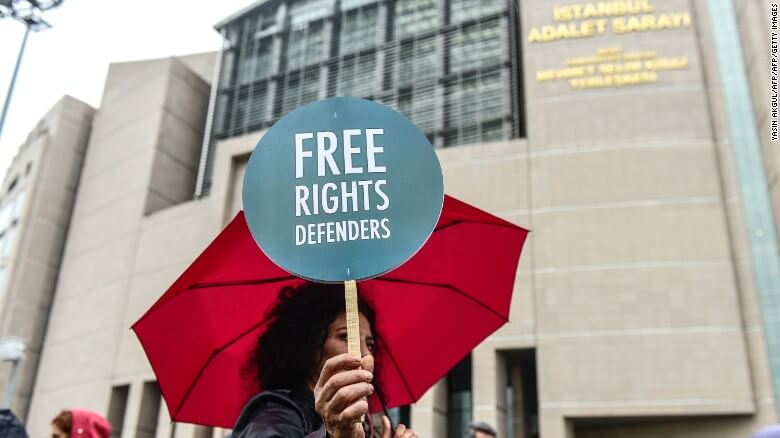
Photo: Rights activists gathered in Turkey before the trial of other activists (REUTERS/Osman Orsal)

Zimbabwe

After Zimbabwean President Mugabe’s appointment as a WHO goodwill ambassador for non-communicable diseases last week had caused national and international criticism, the organization’s director Tedros Adhanom Ghebreyesus revoked the decision on Sunday. Reactions included surprise and disappointment, as critics stated that in contrary to Tedros’ statement on Zimbabwe prioritizing the issue of health in its policies, the country has faced a highly deteriorating health system. News24 also reported on Zimbabwe’s severe health situation and reactions after the WHO’s decision(s). The media outlet further wrote that Zimbabwe’s government declared Mugabe did not have notice of the appointment and would have declined anyway.
At the same time, there have been reports about ongoing intimidation and violence, especially by Zanu PF supporters against those in favor of the MDC, during the Biomentric Voter Registration (BVR) that started earlier this month. The NGO Election Resource Center (ERC) called on the Zimbabwe Electoral Commission (ZEC) to take actions against those parties and supporters hampering the process of registration in preparation for peaceful, free and fair election, wrote allAfrica on Wednesday.
Late last week, MDC leader Morgan Tsvangirai had taken further steps to form his alliance with five other opposition parties, announcing Welshman Ncube to be the new spokesperson. The alliance also established numerous natioal alliance committees, to create joint efforts especially for voter education and registration mobilization. Meanwhile, all Africa reported on MDC opposition spokesman Obert Gutu voicing his doubts about the ZEC’s capabilities and pointed out the likelihood of next year’s elections being rigged in favor of the ruling party. Gutu “suggested it was therefore important that the nation consider pushing forward the election until the voters’ roll is ready and other proposed electoral reforms have been addressed”, besides pointing towards current ill-preparedness of the opposition.

https://www.theguardian.com/world/2017/oct/22/robert-mugabe-removed-as-who-goodwill-ambassador-after-outcry
https://www.news24.com/Africa/Zimbabwe/zimbabwes-grim-hospital-wards-fuel-outrage-toward-who-20171025
https://allafrica.com/stories/201710260125.html
https://allafrica.com/stories/201710250219.html

Democratic Republic Congo

The UN recognized the Kasai, South Kivu and Tanganyika regions as Level 3 (L3) emergency territory, highlighting the graveness of the current humanitarian crisis. The only three other countries labeled L3 are Syria, Irak and Yemen. The Norwegian Refugee Council hopes that the labeling of L3 will attract much-needed financial support for the underfunded crisis, “having the highest increase of newly displaced in the world in the last year”.
Meanwhile, one of DRC’s key opposition parties, the Union for the Congolese Nation (UNC), announced on Monday to withdraw Pierre Kangudia Mbayi from the transitional government. Kangudia is currently serving as minister of state supervising budget. News24 writes that the UNC had stated it decided to pull out Kangudia “after “an evaluation of the level of implementation of the agreement’”, while lamenting the delay and non-organization of elections as well.
On Wednesday, Union for Democracy and Social Progress (UDPS) opposition supporters were released, after they had been dispersed with teargas and arrested on Sunday and Monday during a visit by opposition leader Felix Tshisekedi in Lubumbashi. “The releases followed diplomatic pressure in the form of a joint statement from EU officials and UN diplomats” from the US, Switzerland and Canada, wrote New Vision.

https://www.nrc.no/news/2017/october/un-level-3-emergency-declared-in-dr-congo-highlights-scale-of-crisis/
https://www.news24.com/Africa/News/key-opposition-figure-quits-drc-coalition-government-20171025
https://www.newvision.co.ug/new_vision/video/1464408/drc-releases-detained-opposition-supporters

Venezuela

On Thursday, the EU Parliament announced the democratic opposition and political prisoners in Venezuela to be this year’s winners of the EU Sakharov Prize, which had been created in 1988 to honor defendants of human rights and fundamental freedoms. Through this decision the European Parliament “wanted to reward the courage of students and politicians fighting for freedom in the face of a repressive government”, reported the Independent.
The media has also been addressing concerns about a possible Venezuelan default, considering two due repayments of bonds this and next week, without having ‘grace periods’ for its payments. While the Financial Time reported of a Venezuelan Think Tank hinting at the country being able to pay, other experts have pointed out that a possible Venezuelan default could entail an even worse economic situation than already now. While sanctions had been imposed by the US, “Venezuelans continue to look to Russia for help”.
In the meantime, Human Rights Watch called on “international pressure to restore democracy” to continue after “Questionable elections in Venezuela” on October 15.

https://www.independent.co.uk/news/world/americas/sakharov-prize-eu-venezuela-opposition-political-prisoners-students-a8020746.html
https://www.ft.com/content/b1f9373e-b987-11e7-8c12-5661783e5589
https://www.hrw.org/news/2017/10/23/questionable-elections-venezuela

Myanmar

On Tuesday, Myanmar and Bangladesh signed an agreement for repatriating Rohingya who had come to Bangladesh back to Myanmar. So far, no details on the exact proceedings are known, and hundreds had protested in Rakhine, urging the Myanmar government not to repatriate the Rohingya. The US signaled on Monday that it was considering further action against Myanmar, following their treatment of the Muslim minority. There have been numerous reports about what the Rohyngia have been facing during this humanitarian crisis and especially women and girls have suffered. Médécins sans Frontiers accounted that more than half the girls treated after sexual assaults are under 18. Speaking to the Guardian, a leading Red Cross official warned the international community to take the situation seriously and that it was failing in its response so far. The South China Morning Post also reported on a large numbers of Rohingya women prostituted in overcrowded Bangladeshi refugee camps.

https://www.reuters.com/article/us-myanmar-rohingya/myanmar-bangladesh-agree-to-cooperate-on-rohingya-refugee-repatriation-idUSKBN1CT29C
https://www.theguardian.com/world/2017/oct/26/world-failing-myanmars-rohingya-muslims-top-red-cross-official-says

Syria

As a new round of Syrian peace talks have been scheduled for November 28th, a UN investigation found that Assad’s forces are responsible for a deadly sarin gas attack in Khan Sheikhun in April this year. New talks in Geneva are said to focus “on drafting a new constitution and holding UN-supervised elections in a country devastated by several overlapping bloody civil conflicts”, wrote the Guardian. US Secretary of State, Rex Tillerson, has stated that the United States do not see a role for Bashar al-Assad, or rather the whole Assad family, for the future of Syria. Russian UN ambassador Vassily Nebenzia, on the other hand, stated that “we should not pre-empt any future for anybody”.
While the US-backed coalition efforts against the Islamic State (ISIS) have captured Syria’s largest oil-field which had been in the hands of ISIS forces since 2014, a rising number of civilian deaths caused during coalition operations become also known. Moreover, reports have pointed out the devastating humanitarian situation in eastern Ghouta near Damascus, currently being blocked by the Syrian regime. As the regime has tightened its siege, basic supplies were not able to reach the region, leading to lack of food and medicine, causing a large number of infant death and general malnutrition.

https://www.theguardian.com/world/2017/oct/26/syria-gas-attack-bashar-al-assad-un-tillerson

The United States of America

This week, traditional and social media continued addressing the #MeToo campaign which reached the European Parliament on Wednesday, as a session in Strasbourg was addressing sexual harassment and assaults. Another topic which of interest in the US, was lawmakers deciding over the passing of a bill addressing child marriage in Florida, which is among the states with the highest child marriage rate in the US. A HRW article stated that for now, “Afghanistan has a tougher law on child marriage than Florida”, but also said that if passed, the new law would make Florida the first state to ban any marriage under 18. The first step was taken on Tuesday, when a Senate committee unanimously approved a bill. What caught attention on the federal level, were rising tensions within the Republican Party about Donald Trump, as two senators accused Trump of “debasing U.S. politics and the country’s standing abroad.” Via Twitter, Trump had been criticizing the two Republicans as well.
Causing new criticism, the US is now left as one of the only two countries, beside Syria, not having joined or signaled to join the Paris Climate Accord (anew), after Nicaragua had announced it would do so a few days ago. In June this year, President Trump declared the US would withdraw from the accord as it was, according to him, “excessively onerous and hampered American business”, wrote the New York Times. Nevertheless, US officials will be travelling to Germany next month for United Nations climate change discussions, “effectively putting them in the position of negotiating a deal they have said they are leaving.”

https://apnews.com/63488138c5e544cf9a92dd2b0c9f9170/Woman-who-married-at-11-seeks-to-change-Florida-marriage-law
https://uk.reuters.com/article/uk-usa-trump-republicans/two-republican-senators-blast-trump-as-party-feud-deepens-idUKKBN1CU0L0

Cambodia

On Wednesday, Cambodia‘s Prime Minister Hun Sen pardoned a senator from the main opposition party CNRP from a seven-year jail sentence. The senator had been sentenced after a Facebook post last year. While the opposition welcomed this pardon, Hun Sen did not ease his stance on the CNRP, which he reiterated would be dissolved and those officials who defected to his party could stay in office.
The Economist published an article about foreign textile companies lobbying for Cambodia’s government to loosen its tightening labor laws. The government had been introducing stricter regulations throughout the last year, especially affecting the heavily unionized textile industry – Cambodia’s biggest. Activistst have stated that the foreign companies should acquire the sewing mills and make them into subsidiaries if really wanting to help on a greater scale. Regarding the struggle for land rights in the country, Reuters reported on Buddhist monks who are highly regarded within Cambodian society, taking a leading role in this issue.

https://www.reuters.com/article/us-cambodia-politics/cambodian-opposition-member-pardoned-at-pms-request-idUSKBN1CU17M
https://www.economist.com/news/business/21730633-textile-workers-find-unlikely-ally-against-state-repression-cambodian-government

Spain

Yesterday, Catalan leader Carles Puigdemont had been expected to call for new regional elections “to break the deadlock between Madrid and separatists”, wrote Reuters. However, Puigdemont did not, arguing that the government had not given sufficient guarantees to hold an election and eventually left further steps to the Catalan Parliament. Meanwhile, the Spanish Senate will decide on Friday on approving the government’s take-over of Catalonia’s institutions and provide them with the power to remover the Catalan president. Not only did Puigdemont’s move sharpen the political crisis which could possibly turn into direct confrontation, but it also further drove apart a divided Catalan independence movement.

https://www.reuters.com/article/us-spain-politics-catalonia/catalonias-leader-rules-out-snap-election-crisis-deepens-idUSKBN1CV2B9

The Maldives

The Committee to Protect Journalists (CPJ) reported on ongoing injustices against RaajjeTV station which had faced various fines under the  Maldives’ controversial defamation act introduced last year. “Criminal defamation laws are often used as tool to jail journalists and silence dissent, particularly by authoritarian governments”, stated CPJ. Meanwhile, RaajjeTV asked for a review of two dimissed cases which they had filed earlier this month regarding a 2013 arson attack and a fine imposed by the Maldives Broadcasting board.

https://www.raajje.mv/en/news/20173
https://raajje.mv/en/news/20218

Other News

Kenya – Following confrontations between the police and protesters, part of Thursday’s re-run elections in Kenya were postponed until Saturday. Though most of the voting happened peacefully, at least three people had been killed yesterday. The contested elections with incumbent Kenyatta’s main opponent Odinga boycotting the vote, happened after the Supreme Court had been unable to hear a case that could have postponed the elections on Wednesday. – https://www.nytimes.com/2017/10/26/world/africa/kenya-elections-police.html

Poland – This week, a Human Rights Watch report drew new attention to Poland and how the ruling party has used its parliamentary majority to curb various human rights and the rule of law. In an article, a HRW researcher called on the EU to sanction Poland more harshly and trigger Article 7 (1) of the EU treaty which could result in the suspension of a member’s rights to vote on the Council. – https://www.hrw.org/news/2017/10/24/poland-dismantling-rights-protection

Hong Kong – Two Hong Kong activists who had been jailed in August for their involvement in the 2014 ‘umbrella movement’, were released on bail at the beginning of the week. On Thursday, a lower Court of Appeal rejected their appeals to jail terms, but they had already filed a separate case directly at the Court of Final Appeal scheduled to hear their case on November 7th. – https://www.scmp.com/news/hong-kong/law-crime/article/2117122/hong-kong-court-rejects-appeal-bids-two-jailed-occupy

Turkey – This week, international attention focused on court trials being held in Turkey. Eleven human rights activists, one Swede, one German and nine Turks, had been detained and remained in prison for several months, causing widespread European criticism. Charges against them included having connections to “terrorist organizations” such as the Gulen group and Kurdish separatist factions. As the trial continues, two activists had been released on bail prior to the trial and eight of them were released from prison in Istanbul this Wednesday, while one remained in prison in Izmir.
https://www.reuters.com/article/us-turkey-security-rights/turkish-court-releases-eight-rights-activists-on-bail-in-terrorism-trial-idUSKBN1CU0BM
https://www.aljazeera.com/news/2017/10/amnesty-turkey-chair-taner-kilic-remanded-custody-171026142521574.html

Vietnam – This week, a Vietnamese student was convicted “for propaganda against the state” criticizing the government online, and now faces six years of prison plus four years of probation, reported Reuters. Citizens have been facing tight media censorship and intolerance of criticism by the government. Human Rights Watch also called on Vietnam to release the student and drop all charges against him, while a Vietnamese lawyer stated the proof being vague. – https://www.reuters.com/article/us-vietnam-dissident/vietnam-jails-student-activist-six-years-for-propaganda-against-the-state-idUSKBN1CU11D

Iraq – On Wednesday, Kurdish authorities offered to put a hold on the independence referendum’s result and proposed an immediate ceasefire to start dialogue with the Iraqi federal government. However, an Iraqi military spokesman suggested the military offensive would continue. The Iraqi Prime Minister had called on the Kurds to cancel the referendum’s outcome for good as a pre-condition for talks. – https://www.reuters.com/article/us-mideast-crisis-iraq-kurds-referendum/kurds-offer-to-suspend-independence-drive-seek-talks-with-baghdad-idUSKBN1CT37M

China – At the end of China’s quinquennial Communist Party Congress, President Xi Jinping further consolidated his power, the party elevated him “to the same exalted status as the nation’s founder, Mao Zedong” and there was no introduction of a younger member as a potential predecessor in the reshuffled Politburo Standing Committee, as had been an unwritten convention in past years. Some have speculated that this could indicate Xi Jinping’s aspirations to continue dominance after the next five-year term, or to further assess possible successors. – https://www.nytimes.com/2017/10/24/world/asia/xi-jinping-china.html

Rome’s Trevi-fountain turns red – Graziano Cecchini’s vandalism art-protests

Late on Thursday, the water in Rome’s famous Trevi-fountain turned red. It wasn’t just a mistake which drew big crowds to one of the Italian capital’s best known tourist hotspots. Protesting against Rome’s “corruption and filth”, Italian activist Graziano Cecchini managed to climb onto the side of the fountain and pour the dye in. According to the Guardian, Cecchini said the protest was a “cry that Rome isn’t dead, that it’s alive and ready to return to be the capital of art, life and Renaissance.”

The stunt performed at the fountain was not Cecchini’s first public performance. His first red Trevi-protest dates back to 2007. After the act was initially considered some kind of hooligan prank, Cecchini told the New York Times that “if it had been me, wink wink, I’d say that this had been a media-savvy operation in the face of a very gray society.”

Early 2008, half a million multi-colored plastic balls bounced down Rome’s famed Spanish Steps, in another self-styled protests at on of the city’s landmarks. “Italians’ balls are broken,” was written on leaflets distributed at the time. Talking to Reuters, the Italian artist said his protest was “an artistic operation which shows, through art, the problems we have here in Italy”.

This work reminds us of the power of ‘Guerilla-art‘, or artwork which has no external boundary between the image and the environment, as a form of protest. Cecchini’s protests, or works of art, have also been conceptualized under the name of ‘vandalism-art’, which makes us think about these performances: While acts of civil disobedience might include aspects with are technically a crime, should they be judged in the same light?

Read more about Cecchini’s latest protest here. Want to see some more positive acts of vandalism-art? Check this link.

Picture: Antonio-Masiello/Getty-Images

The Post-Marches and -Rallies era: Trump protests get creative

In the era of social media and 24/7 news coverage, people tend to get creative. Almost a year after Donald Trump became the President of the United States of America, we have seen a unprecedented amount of anti-Trump protests, in the U.S. as well as in other parts of the world. The January 2017 Women’s March, (which was not exclusively but definitely) aimed at the Trump-administration, might have even been the largest protest in U.S. history.

But marches and major rallies of the kind of proportions as the Women’s March are not an easy thing to pull off. How can the agitated individual, make his or her contribution? Although their impact might not be as big, many small, creative initiatives can be an outcome for those who are willing to act, now. Almost a year after Trump’s inauguration, the storm of ignorance and negativity has not stopped causing stupefaction yet. With ammunition provided to them by their own President on a daily basis, people get creative. A brief anthology:

On October 6, a small group of protesters neared the Washington Monument. At a spot with a good sight line to the White House, they set up a 160-square-foot video screen, hooked it to a laptop and hit play. What ran on the screen for the next 12 hours was a relentless rewind of Donald Trump’s infamous “Access Hollywood” tape.” Three minutes of vulgar chatter by the U.S. President, (“Grab them by the p—y. You can do anything.”) looped over and over through the day, within view of that same guys new office. Dozens of onlookers posted their own videos of the video, a brainchild of protestgroup UltraViolet, with the White House in the background, causing countless mentions in the mainstream news media and on social media.

The Washington Trump International hotel has functioned as a second White House for creative protesters, one without fences and security agents. D.C. based artist Robin Bell has projected provoking slogans onto the building, including “Pay Trump bribes here” and “The president of the United States is a known racist and a Nazi sympathizer.” Washington marchers have made it a proper tradition to dump their protest signs at the hotel after a rally.

“This is Washington protest in the age of Trump, when public actions increasingly combine performance art and catchy visuals to toss a made-to-go-viral insult straight at the president. It is trolling as dissent,” according to Steve Hendrix and Perry Stein for the Washington Post.

Finally, the newest form of protesting the Trump-administration: Screaming helplessly at the sky! What started with a Boston based event organized via Facebook, has snowballed into a national movement of people wailing into the void, with similar events all over the United States. Productive? Maybe not, but for a lot of people, it is an expression which is as close as one can get to their current feelings of frustration.

“Listen, there’s a lot of shit I care about […] But frankly, I can’t keep up with it all. Every time I think of the laundry list of social injustices on top of my own shit like my actual laundry I get overwhelmed. Every news notification on my phone is a reminder of something over which I am powerless. And I think a lot of people feel that way. So fuck me for thinking it’d be nice to yell about it,” according to New York organizer Nathan Wahl.

Read the full Washington Post article on creative protests here, or (if WP puts you in front of a paywall) check the article via this link. Read more about the screaming-protests right here. Based in New York and want to join for some screaming? Check the Facebook-event here.

Photograph: Still of a video by Robin Bell – Twitter/bellvisuals

Taking Over Trump Tower – Pussy Riot is at it again

Early this week, the headquarter of The Trump Organisation was taken over by members of the Russian feminist punk rock group Pussy Riot. Several activists staged the action in New York to draw attention to the incarceration of political prisoners, two of them in specific; Ukrainian director Oleg Sentsov and anarchist Olexandr Kolchenko, both of who are currently in Russian prison. The trial of the both men was labeled ‘unfair’ and ‘marred by credible allegations of torture’, by Amnesty International halfway 2015.

“While Sentsov got 20 years in prison, Kolchenko got ten years. Because they, like you, did not sit by – they were fighting for their freedom in Crimea, which was annexed by Putin,” Pussy Riot stated on their Facebook. In that same statement, the group referred to a time in which several of their members were imprisoned, and the importance of the support they received in those days:

“We remember when we were imprisoned, we received news about hundreds of activists around the world putting on balaclavas and going to the streets to support us. That was the moment we understood we are not alone. But we should not forget that even though we’ve come to the other side of the fence, there are still hundreds of political prisoners behind bars waiting for your support. We received a lot of letters, smiles, and noise from you.”

Their statements strongly accords with one CANVAS-publication in particular: Making Oppression Backfire by Srdja Popovic and Tori Porell. This work does not only focus on the key element of supporting your fellow activists when they end up behind bars, but also looks at the essential features of making the particular form of oppression public and supporting your activists during the trial phase. In this same work, CANVAS captures the importance of not only executing nonviolent actions, but also recording and spreading these actions, to have maximum outreach and impact.

With their action in the Trump-tower, Pussy Riot does exactly that. The location to perform their action was not chosen randomly. Although the direct cause for their protest was the imprisonment at the hands of Russian leader Vladimir Putin, there are clear parallels with the American President and his style of leadership. “We are acting in solidarity against leaders like Putin, who has exercised authoritarian force and Trump, who is displaying authoritarian tendencies — because we all need to be fighting together on behalf of dissidents everywhere,” according to Pussy Riot.

Read more about Pussy Riot’s New York protest here, here and here.

Photograph: Screenshot Video Pussy Riot Facebook

Taxi Industry’s Protest Against Ridesharing Apps – Backfiring Methods?

On Monday, thousands of taxi drivers protested transportation network companies (TNCs) such as Uber, in the Colombian capital Bogota. The protesters blocked roads and clashed with police, as drivers object to what they say is an unfair advantage awarded to app-based services in their country.

In recent years, almost every major town around the world has seen similar forms of protests. Taxi industry groups argue that TNCs are illegal taxicab operations which take away their business. The decline in ‘traditional’ taxi rides, according to these organizations, has to do with unfair competition, through which TNCs can simply offer cheaper rides. The protesters are calling for more regulation on technology companies like Uber and Cabify, who they say are not obliged to pay insurance.

Where some federal and local governments engage with all parties involved, to create a level playing field, other argue that it is simply a better and more affordable quality of transportation offered by apps as Uber, Cabify and Lift that makes the difference. “A point that rarely gets talked about is how you can’t reverse the consumer behavior,” sharing economy expert Rachel Botsman told The Huffington Post. “The public has experienced a new way to get from A to B and in many instances decided the new way is better. Once the genie is out of the bottle, that new way exists, you can’t reverse the story.”

Whatever your verdict on the TNCs takeover of the transport-industry is, one thing we could argue is that taxi-drivers’ methods for defending their position might not be all that effective. First of all, the common goal of their effort seems to ignore the root of the issue they are battling. Where the protesters in Bogota demand a level-playing field in their sector (or rather a ban on TNC-services all together), shifting consumer behavior seems to be guided by convenience and quality of service, rather then simply depend on the price of the ride.

Building on the latter, protest-techniques used by the taxi-drivers might not be the most suited to win back the consumers confidance. Where their disruptive techniques of  blocking roads or ‘go-slow‘-actions seem to speculate on forcing the authorities to act, these actions will be counterproductive in winning back consumer confidence.

Finally, the protesters might have to reconsider their Vision of Tomorrow; is their goal to eliminate the competition, which offers better quality for less money? Or should the goal be to assure stable work for a decent pay? If that is so, the traditional taxi-industry could incorporate their apparent enemy in their struggle. Less then a year ago, London’s Uber-drivers protested their San Fransisco-based employer, disapproving the low pay for long hours. Could drivers from both sides of the divide work together towards their shared interests?

Read more about taxi-protests all over the world here, here and here!

Photograph: Ricardo Moraes/Reuters