“Do protests and social movements matter? Do they really bring about change?”
Every day, we can see tens, maybe hundreds of individuals and groups, fighting for their different causes, everywhere around the world. Their effort is not focussed on the fight itself, but is pointed towards social impact. Activist want to make a difference; they want to cause change where they can! But measuring this change, or the influence a movement has, is a tricky challange. Sociological conceptions of measuring impact can help us to learn about the structures of change, to analyse the movements we see around us, and in setting up our own.
Kenneth T. Andrews, professor of sociology at the University of North Carolina, studies the impact of movements. “When social scientists do uncover evidence of a movement’s influence, we have tended to focus on three main pathways by which movements gain power: cultural, disruptive and organizational,” according to Andrews.
Cultural influence refers to the power of movements to “shape public opinion, language and everyday behavior.” If a movement is able to introduce a new lingo, or spark a debate around a new concept or idea, this is one way to conceptualize influence. Then, a movement is said to be disruptive, when it has the power “make it more costly for people to support the status quo.” Finally, organizational power makes it possible to make a long term player out of a movement, by sustaining participants and their short term efforts.
On their own, Andrews argues, cultural, disruptive, and organizational influence are limited in their effect. Where the Occupy movement was able to spark a new conversation about “the 99 percent”- concept, their organizational and disruptive capacities were not able to translate these cultural gains into other kinds of lasting institutional changes. Therefore, movements that have managed to combine all three factors, can be said to have had a more influential and lasting impact, Andrews concludes.
Can we think of other examples of cultural, disruptive and organizational power? And what are the risks every of these forms of influence incorporate? Read the full opinion-article by Kenneth Andrews in NY-Times via this link.
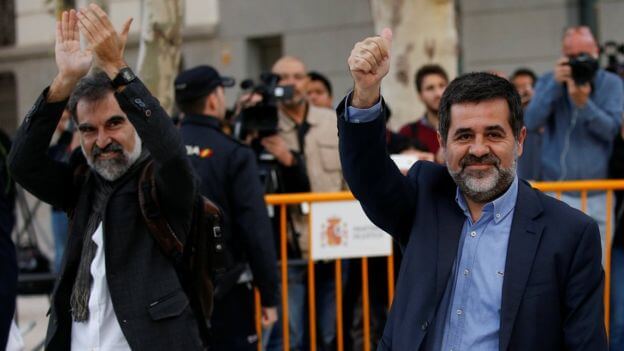
Photo: Jordi Sànchez (Catalan National Assembl) and Jordi Cuixart (independence group Omnium leader) were arrested and faced a judge in Madrid on Monday, in an investigation for alleged sedition. The arrests of the both ‘Jordis’ is the first imprisonment of senior secessionist figures since Catalonia’s 1 October independence referendum. Photograph: Reuters (via bbc.com)
Also this week we are proud to inform you that executive director of CANVAS Srdja Popovic has been elected rector of St Andrews, one of the oldest English-speaking schools of our world. Read what the BBC wrote about the election here.
Cambodia
On Monday, Cambodia’s parliament voted to make it part of party-law that if a political party is dissolved, seats in parliament should be re-distributed. The vote happened after the government filed a lawsuit earlier this month to dissolve main opposition party Cambodia National Rescue Party (CNRP), part of an escalating political crisis. Monday’s parliamentary vote on the new amendments was supported by all 67 parliamentarians present from Hun Sen’s ruling Cambodian People’s Party (CPP), while the CNRP boycotted the morning session. According to Reuters, under the new laws, “if a political party abandons its seats, is delisted, is disbanded or dissolved, a list of candidates or members of parliament of that party are no longer valid and beneficial.” The vote comes at a time when around half the opposition members of Cambodia’s parliament have allegedly left the country in fear of Prime Minister Hun Sen’s repressive regime, as we reported earlier this month.
On Thursday, the South Chinese Morning Post publishes an interesting column dealing with particular historical explanations behind Hun Sen’s current crackdown against opposition forces ahead of next year’s election. “To understand, we must go back 47 years,” Jonathan Power writes. When the North Vietnamese invaded Cambodia in 1979, they installed ex-Khmer Rouge dissidents as the country’s leaders. One of them being current Prime Minister Hun Sen. As a counter-action, the US, who had then only recently lost the Vietnam war, started backing the Khmer Rouge. The frustration of over a decade of US-backed killing by the Khmer Rouge has contributed to Hun Sen cling to power, Power concludes. “The long period when the US and Europeans supported the Khmer Rouge embittered Hun Sen and most Cambodians. It helped build his popularity.”
Late on Friday last week, Robert Mugabe’s ruling ZANU-PF has called for an extra-ordinary congress in December. Where the next congress was only scheduled for 2019 (the gathering takes place every four years) an early congress is necessary to deal with internal divisions threatening to destroy the party, ahead of next year’s general elections. “Team Lacoste” is led by one of Mugabe’s deputies, Vice-President Emmerson Mnangagwa. The other camp, made up of young Turks calling themselves “Generation 40”, is backing First Lady Grace Mugabe to block Mnangagwa’s presidential ambitions. According to an anonymous source who spoke to news platform News24, “a meeting of the Politburo took note of the infighting within the party and it was suggested by members of the G40 that we turn our annual conference into an extra-ordinary congress that would address the problems that we have.”
Late this week, former Vice-President Joyce Mujuru’s National People’s Party (NPP) were to launch a separate opposition-alliance ahead of the 2018 general elections. Mujuru’s NPP would team up with smaller opposition parties Zapu, People’s Democratic Party (PDP), and Democratic Assembly for Restoration and Empowerment (Dare). The alliance would counter the MDC Alliance led by MDC-T leader Morgan Tsvangirai. “The main reason we refused to get into bed with MDC Alliance is because we said we want a neutral name. We are, therefore, not going to be forming an alliance that bears our name. Those who have proposed that name are just mere dreamers,” NPP spokesperson Jeffreyson Chitandosaid told NewsDay. A split opposition vote could frustrate the opposition’s effort to counter the 2018 ZANU-PF campaign.
Where the DRC secured a seat at the United Nations Human Rights Council early this week, the Maldivian mission to the United Nations had announced in July that it would withdraw its candidacy from the vote. The withdrawal was partly guided by allegations of harboring human trafficking cells and being used as a hub for large-scale money laundering. Maldives is also under considerable fire for restrictions to the freedom of expression in the country, caused by recent laws, such as the re-criminalization of defamation in 2016.
Reacting on the UNHRC’s electoral process, former president and opposition leader Mohamed Nasheed has now insinuated that Maldives would never have been able to secure a seat on the United Nations Human Rights Council anyway. Nasheed insinuated on his official Twitter account on Tuesday that the nation is an ‘international outcast’ under President Yameen, where he also said to have recognized why Maldives withdrew its candidacy only months before the election.
Also, this week, the Human Rights Commission of the Maldives (HRCM) has begun investigating the death of Abdul Rasheed, a local activist who passed away on October 10th, while serving a jail sentence. Rasheed was serving a jail term for assault during the ‘May Day’ protest, a mass opposition rally held following the conviction of former president Mohamed Nasheed.
https://raajje.mv/en/news/19728
https://raajje.mv/en/news/19631
Spain
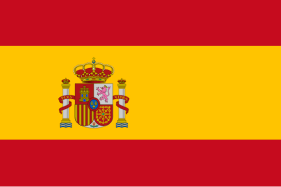
As regional President Puigdemont called for new negotiations with his federal counterpart early this week, Spain signals a hardening line over the Catalonian independence issue. Although Puigdemont failed to respond to Madrid’s ultimatum to clarify whether he had declared unilateral independence in a speech last week, he instead made a “sincere and honest” offer of dialogue over the next two months. In reply, Rajoy said Puigdemont’s stance had brought Madrid closer to triggering article 155 of the constitution, under which it can impose direct rule on any of the country’s 17 autonomous communities if they break the law.
In the meantime, the Spanish high court ordered the heads of the Catalan National Assembly and independence group Omnium to be held without bail, pending an investigation for alleged sedition, in the first imprisonment of senior secessionist figures since Catalonia’s 1 October independence referendum. Both Jordi Sànchez and Jordi Cuixart allegedly played central roles in orchestrating pro-independence protests that last month trapped national police inside a Barcelona building and destroyed their vehicles. Puigdemont regretted the arrests, stating that “sadly, [Spain] has political prisoners again.”
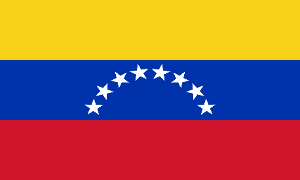
Early on Monday, a socialist win in regional elections caused allegations of irregularities and a new risk of rekindling unrest. Despite devastating food shortages and salary-destroying inflation in Venezuela, President Nicolas Maduro’s candidates took 17 out of 23 governorships, versus six for the opposition, in Sunday’s poll with turnout of more than 61 percent. “The results are difficult to believe, obviously, given pre-electoral polling that gave the opposition in the range of 15 to 18 governorships, with normal turnout (around 55 percent or above),” political scientist John Polga-Hecimovich told Al Jazeera. As a reaction, opposition leaders decried irregularities and called for street protests on Monday. They also demanded a full audit, but did not immediately offer any evidence of fraud.
On Tuesday, reactions on the election-results could not be any more diverse. Although most opposition leaders claimed the elections to be rigged by the Maduro-state apparatus, some opposition figures acknowledged failures in their counter-campaign. The abstention by their supporters, disillusioned by the failure of street protests to dislodge Maduro earlier this year, was a big factor, opposition figures told Reuters. The United States accounted for the strongest foreign reaction, as Washington slammed Maduro’s “authoritarian dictatorship,” while other major nations from France to Colombia also expressed concern about the adherence to democratic process in Venezuela. “With the opposition coalition’s dozens of parties arguing over whether there was fraud, what went wrong, and where to go next, it will need to regroup and map strategy quickly heading into the 2018 presidential campaign,” according to Reuters.
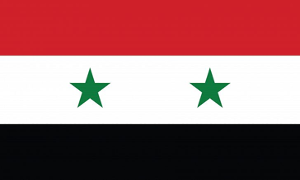
This week, after four months of Western backed fighting, Syrian forces re-established themselves in Raqqa, ISIS’ self-proclaimed capital. The battle has damaged almost every building in the Syrian city. Although the ISIS-forces have fled Raqqa, the battle continuous to take lives, as hundreds of mines and explosives litter the streets. Now that the extremists are being rolled back, other disputes are coming to the fore. According to Australian ABC-news, “in Raqqa, it is not clear how long local Arabs will continue to cooperate with the Syrian Kurds who dominate the Syrian Democratic Forces, or whether the Syrian Government will continue to tolerate the SDF, negotiate or fight to regain control of the large swathe of Syria now under its control.”
On Tuesday, in-depth Syria platform Syria Deeply writes about the changing role women are playing in the country, focussing on Syrian politics. “The conflict in Syria has shifted traditional roles within communities. More women are starting to play roles in politics at all levels,” according to Federica Marsi, “but their overall influence remains minimal, leaving Syria’s destiny in the hands of men.” Although the feminist movement in Rojava, the Kurdish-controlled Democratic Federation of Northern Syria, might not be comparable to the situation in other Syrian territories, groups of non-Kurdish women also reportedly created similar female popular assemblies and battalions in villages liberated from the so-called Islamic State (ISIS), including in Manbij and Raqqa. Also, beyond the country’s borders, Syrian women in the opposition are taking new steps to increase their representation. Mariam Jalabi, a member of the Women’s Advisory Committee at the U.N. and director of the National Coalition of Syrian Revolution and Opposition Forces’ Representative Office, told Syria Deeply about a forthcoming “women’s political movement for Syria” that is set to launch its mission for effective female political representation in mid-October and present at the U.N. later this year.
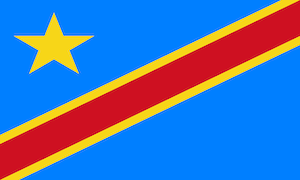
On Monday, the Democratic Republic of Congo was elected to the UN Human Rights Council, serving on the 47-member council from January 2018 until the end of 2020. Despite opposition from the United States, “Kinshasa now finds itself in the rare position of sitting on the Geneva-based council while the body investigates allegations of killings, torture, rape and the use of child soldiers in the Kasai region of the DR Congo,” according to New Vision. Human Rights Watch called the election of the DR Congo “a slap in the face to the many victims of the Congolese government’s grave abuses across the country.
Early on Tuesday, Human Rights Watch published a series of newly released satellite images, which are said to reveal that at least 288 villages were partially or totally destroyed by fire in northern Rakhine State in Burma since August 25 of this year. “The destruction encompassed tens of thousands of structures, primarily homes inhabited by ethnic Rohingya Muslims,” according to HRW. The publication claims that at least 66 villages were burned after September 5, when security force operations supposedly ended, according to a September 18 speech by State Counselor Aung San Suu Kyi.
Late on Sunday, the New York Times reports on the newest developments in the NFL-protests. Instigator and main protagonist of the recent protest movement against racial injustice Colin Kaepernick, has filed a grievance against the N.F.L., accusing all 32 teams of colluding to keep him from playing in the league. When the protests led to condemnation by US President Trump and other high-ranking figures, team-owners were quick to restrict the protests, which fueled a national conversation on the propriety of protesting during the national anthem. According to the NY-Times, “Kaepernick’s inability to find a team, and the broader debate over the anthem protests, will now become a legal tug of war that could potentially amplify the dispute for months.” In the meantime, other sports teams, also outside of the US, join NFL-players in solidarity.
Since that same New York Times published an investigative report detailing decades of sexual harassment allegations against the Hollywood producer Harvey Weinstein (early October), social media has provided a galvanizing platform for women to discuss their experiences. Building on this case, and the impact it had on American society and societies all around the world, women worldwide were posting messages on social media under the hashtag #MeToo, early this week, to show how commonplace sexual assault and harassment actually are. The hashtag refers to the fact that they, too, have been victims of such misconduct.
Finally, this week the third travel-ban which was proclaimed by the Trump-administration late September came across new restrictions from a federal court. The new travel restrictions, which were supposed to come into force on Wednesday, were overruled by Derrick Watson, a judge in Hawai. Where earlier counterarguments focused on the question if the travel ban targeted Muslims in an inordinate way, this time the argument challenged if Trumps new restrictions would actually be a solution to the supposed problem (national security). The policy “lacks sufficient findings that the entry of more than 150 million nationals from six specified countries would be ‘detrimental to the interests of the United States,’” Watson wrote.
Hong Kong – After China countered the Hong Kong national anthem protests with fierce new regulations, the Hong Kong government now considers adopting similar legislation – https://www.scmp.com/news/hong-kong/politics/article/2115503/after-china-makes-insulting-national-anthem-illegal-hong?utm_content=bufferdcaa7&utm_medium=social&utm_source=twitter.com&utm_campaign=buffer
Iraq – While bickering continues in the Iraqi Kurdish region early this week, Reuters on Wednesday writes about the risky Kurdhish trade-gamble for a region that is heavily dependent on food imports and oil exports, via a pipeline that passes through Turkey – https://www.reuters.com/article/us-mideast-crisis-iraq-kurds-economy/defiant-kurds-shrug-off-risk-of-trade-war-after-independence-vote-idUSKBN1CN0QS?feedType=RSS&feedName=worldNews&utm_source=Twitter&utm_medium=Social&utm_campaign=Feed%3A+Reuters%2FworldNews+%28Reuters+World+News%29
Kenia – As Kenia heads towards the scheduled October 26 rerun of the 2017 presidential election, Human Rights Watch releases a report on violations by security forces in the electoral period of August 2017. Meanwhile, Kenyatta’s competitor Raila Odinga pulled back from the rerun, and here is why – https://www.hrw.org/news/2017/10/15/kenya-police-killed-beat-post-election-protesters
Malta – In Malta, investigative journalist Daphne Caruana Galizia was killed using a car-bomb on Monday, as a sudden plot twist in the islands’ unfolding governmental corruption saga – https://www.scmp.com/news/world/europe/article/2115644/malta-car-bomb-kills-star-investigative-journalist-who-reported?utm_content=buffer9af12&utm_medium=social&utm_source=twitter.com&utm_campaign=buffer
Argentina – Ahead of congressional elections on Sunday, Major political parties in Argentina have suspended their election campaigning after the discovery of a body thought to be that of a missing activist. According to BBC, “Mr Maldonado’s disappearance caused a national outcry and has since become highly politicised.” – https://www.bbc.com/news/world-latin-america-41674565
Ukraine – Thousands of protesters clashed with the police on Tuesday, before setting up more than 50 tents in central Kiev, demanding the creation of an anti-corruption court, the lifting of lawmakers’ immunity from prosecution and a fairer electoral law – https://www.kyivpost.com/ukraine-politics/protesters-set-first-large-tent-camp-since-euromaidan-revolution.html
Aktivista i jedan od osnivaca Otpora Srda Popovic izabran je za rektora skotskog univerziteta Sent Endruz, preneo je BBC.
Studenti univerziteta u gradu Sent Endruz izabrali su Popovica za rektora, koji je na skotskim univerzitetima predsednik univerzitetskog suda i predsedava sastancima na kojima se donese odluke od raspodele budzeta do akademskih politika.
Popovic, koji je osnovao i nevladinu organizaciju Kanvas (Centar za primenjenu nenasilnu akciju i strategiju), bio je kandidat za rektora na predlog studenta Dzejmija Rodnija koji je procitao njegovu knjigu “Mustra za revoluciju”.
Na glasanju studenata, Popovic je dobio vise glasova od bivseg lidera skotske liberaldemokratske partije Vilijama Renija.
BBC navodi da je Popovica ubedilo da bude kandidat to sto je na toj funkciji bio i komicar Dzon Kliz iz Monti Pajtona.
“Citav zivot volim Monti Pajton i njihov apsurdan humor je nesto sto je inspirisalo moju kreativnu taktiku protesta”, rekao je Popovic.
Univerzitet Sent Endruz u istoimenom gradu osnovan je 1413. godine i najstariji je u Skotskoj, a treci najstariji u zemljama engleskog govornog podruja u svetu.
Vise o Srdji Popovicu i njegovom izboru za rektora univerziteta u Skotskoj procitajte ovde
After being approached by a St. Andrews student, CANVAS founding member Srdja Popovic ran for the position of Rector at St. Andrews University – and won the election last week. Running against MSP and Scottish Liberal Democrat leader Willie Rennie, Popovic was able to secure double the student’s votes. The position of Rector, existing at Scotland’s oldest universities, is elected by the student body every three years to become President of the University Court, presiding over meetings taking essential decisions for the University.
In the new position of Rector at the prestigious university, Srdja Popovic “aims to empower students in St Andrews to mobilise themselves”, he told Rachel Miller from BBC News. The Serbian activist further stated that one of the goals should be to build a student movement as a platform for broader social change. Srdja Popovic already came closer to achieving this goal by helping 50 students active in the campaign to build their own ‘students for students’ movement. He also revealed to BBC that what ultimately convinced him to run for the position, was the discovery that one of the former Rectors was John Cleese who inspired him in his own creative protest through Monty Python’s absurd humor.
To read more about Srdja Popovic and his new position as the Rector of the University of St. Andrews, read this BBC article.
Chicago Tribune reported on American artist Aram Han Sifuentes who started sewing protest banner and arranging a “Protest Banner Lending Library”.
The fiber arts’ teacher started sewing protest banners with different slogans last year. It was her way to support protests without having to go to the streets herself, as she was still in the process of applying for citizenship. The artist had moved to the US with her family from South Korea when she was a child and grew up in California.
Establishing the “Protest Banner Lending Library”, she enabled others to go through a large list of already existing banners and to lend them for their own protests. Some of the banners Sifuente made herself, others were made by collaborators or one of the visitors of one of many workshops in Chicago or New York. Until mid-November, the Lending Library can be visited at the Alphawood Gallery in Lincoln Park, Chicago.
This project is an example of how one can support protest and a cause without going to the streets or taking risks he or she is not prepared to take. Others who are, can still benefit from this support! And besides this “practical” aspect, a lot of Sifuente’s projects are creative and humorous, another quality which can be useful in attracting people to a cause when trying to win over more supporters, for example.
To read more about the “Protest Banner Lending Library” and other creative projects by the artist, like a disco-themed polling booth for all those who cannot vote legally, follow this link.
With lots of attention focused on kneeling protests during the national anthem in the United States, some media has reported on a similar movement in Hong Kong. But while in the US it’s the athletes who protest, in Hong Kong it’s the fans.
Hong Kong sports fans have been turning their backs, booing, chanting and even raising their middle fingers during China’s national anthem being played. “[A] protest of Beijing’s growing influence in this semiautonomous city”, states New York Times. Most recently on last Tuesday, Hong Kong soccer fans booed before an Asian Cup qualifier against Malaysia started, while two weeks ago, they protested at another game against Laos.
After the street protests of the Umbrella Movement in Hong Kong had ended three years ago “without the government ceding any ground on expanding residents’ say in local elections”, the New York Times reports “that [the] spirit of protest has been revived in the stadium jeers, which appear to have started two years ago.”
This month, a new law passed by the Chinese government went into effect, among other things prohibiting the disrespect of the anthem. Hong Kong has yet to enact its own version of the law. The city which returned to Chinese control in 1997 after being a British colony, enjoys significant autonomy and many citizens “desire to maintain a separate identity as Hongkongers”, writes Washington Post. In international sports competitions, Hong Kong also has its own teams competing.
To read more about the protests, some local and international reactions or watch the latest videos from Hong Kong, take a look at the following articles by the New York Times and Washington Post.
Photo: Hong Kong fans’ protest during Chinese national anthem last week (Photo Credit: AP / washingtonpost.com)
In past weeks, professional athletes kneeling during the national anthem to protest and raise awareness on the issue of racial injustice in the United States have caught the media’s attention. CANVAS’ Weekly Report and Daily News reported on the protests and Donald Trump’s and Vice President Mike Pence’s reaction at a San Francisco 49ers game earlier this month. While protests had caused solidarity in the NFL for a while, the league’s commissioner Roger Goodell called on the players last week to stand up for the national anthem possibly fearing financial consequences, wrote Les Carpenter on the Sportsblog for the Guardian. But even after this statement, some players again kneeled during the anthem at a game on Sunday.
In an opinion article for Bloomberg last Thursday, Stephen L. Carter, columnist and professor of law at Yale University, pointed out that even though he is a supporter of the athletes’ cause, the players are currently not causing any disruption and are thus not advancing their struggle. He refers to lessons learned by Martin Luther King during the Albany Movement in 1961-1962, when activists failed to incite the expected harsh responses by the police, not being able to make their point.
Carter writes: “Protest at its best should have a clear, articulable purpose. It should also be designed to create a disruptive tension that can be resolved only by bringing the movement nearer to its goal.” The CANVAS Core Curriculum as well points out that “[t]he world rarely changes because of symbolic actions” (p. 69), that protests should communicate a clear message and that one of the main desired outcomes of nonviolent action, besides mobilization and defection, is the interruption of the ‘business as usual’ (pp. 92-93).
According to Carter, there have certainly been reactions by fans and statements as that by Roger Goodell. But it remains to be seen whether the protests will have any serious consequences, and whether the US American athletes and their supporters can further promote the cause, triggering a genuine national debate on the issue.
Read more about what Stephen L. Carter writes on the NFL protesters here.
Photo Left: Bettmann Archive / dailymail.co.uk
Photo Right: Patrick Smith / sportsday.dallasnews.com
Late on Friday, Al Jazeera aired an interview with prominent Palestian human rights activist Issa Amro. As a part of the weekly UpFront- show, presenter Medhi Hasan asked Amro, who’s been recognised by both the European Union and the United Nations for his tireless work, about his persistent advocacy for specifically non-violent action.
Amro was asked if he could understand that many of his fellow countrymen, repressed for so many years, would rather fight back instead of using a peaceful sit-in or other civil-disobedience tactics. “If a Palestinian under occupation wants to fight back against an Israeli soldier illegally occupying their land, what is wrong with that in your view?” asked Hasan.
“It is not about what is wrong. It is not about armed resistance versus nonviolent resistance. On the contrary. The armed resistance is allowed under international law, to resist the occupiers. But it is about tactics, and what is possible. About what you win and how you will win. Palestinians practiced people’s resistance in the first Intifada and it went very well, we were achieving a lot. In the second Intifada, we lost a lot from [more violent tactics], and the price was very very high. So it is about tactics and strategies, and about what kind of resistance will make you stronger. […] Non-violence as a tactics now is just the best tool to end occupation.”
Where Amro has been dubbed ‘the Palestinina Ghandi’ by many, his views are not at all those of so called ‘principled non-violent resistance‘ grounded in religious and ethically based injunctions against violence. Rather, his adoption of non-violence is a strategic choice, simply waging the impact of both forms of strategy. “I simply think that civil disobedience will make the cost of the occupation higher.”
Rather than being embraced by political leaders on both sides, Palestinian security forces arrested Amro in September for a Facebook-post criticizing the Palestinian Authority arresting a journalist. Amro is also awaiting trial in an Israeli military court for a series of charges, dismissed by international rights groups as baseless.
“It is part of my struggle. To teach the international community, who is asking us day and night to do nonviolent resistance, to tell them who the occupier is, how they attack human rights defenders, […] how they will take me to jail for a few years for only using nonviolence resistance. […] There is no change without a price.”
Watch the full interview with this courageous acticist via this link on Al Jazeera (starting from 12.15).
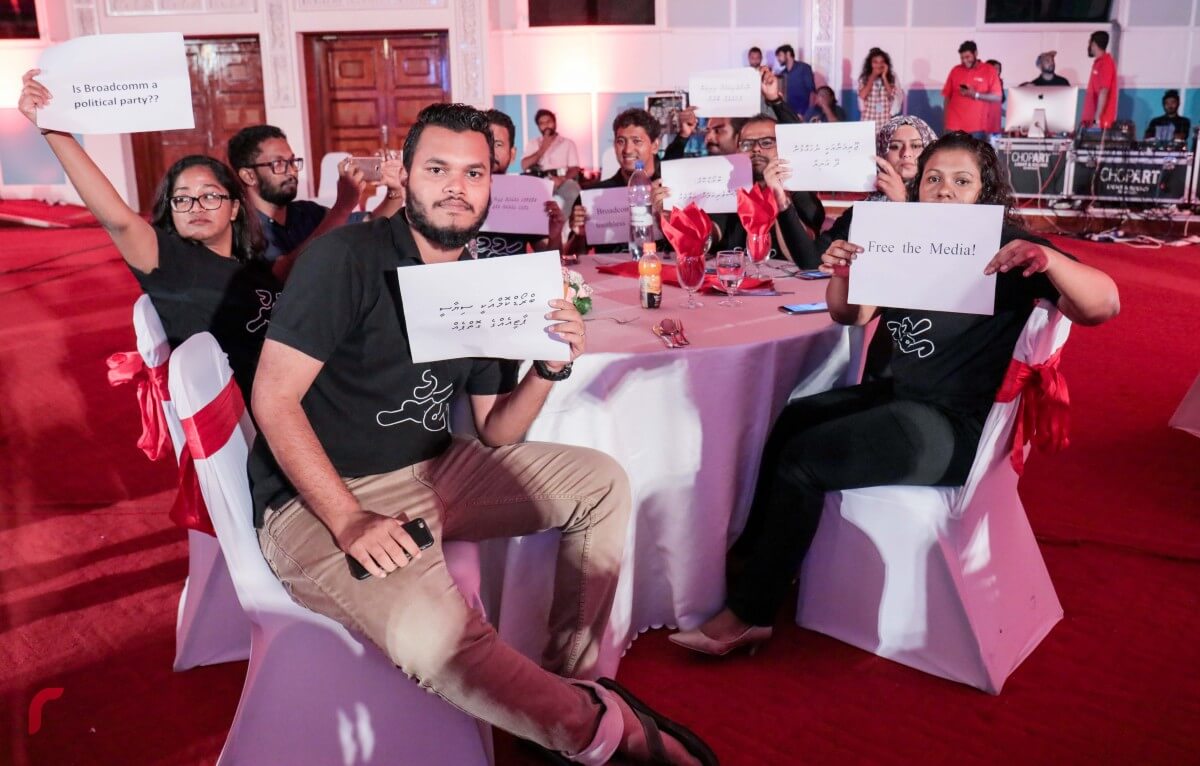
Photo: On a Media Award Ceremony, RaajjeTV staff staged a silent protest against the Maldives Media Council Photograph: RaajjeTV
The Maldives
In a statement, UN Special Rapporteur Diego García-Sayán, part of the Special Procedures of the Human Rights Council, has condemned the indefinite suspension of 54 lawyers in the Maldives after The International Commission of Jurists had already done so two weeks ago (see Weekly Report: 29 September). Among other things, the Special Rapporteur expressed his concerns about the independence of the legal profession and access to justice in the Maldives, and called on the authorities to establish an independent bar association overseeing lawyers’ affairs in the country.
As the second hearing of the suspects charged with the murder of popular blogger and human rights defender Yameen Rasheed was held behind closed doors, some have called for public hearings of the case in the future. The Asian Tribune and other organizations such as the Asian Forum for Human Rights and Democracy (FORUM-ASIA) or the Maldivian Democracy Network (MDN) called on the Criminal Court of the Maldives to do so in order “to respect the Constitution […] [and] the interest of Yammen, his family and justice in the Maldives. Yameen had received several death threats which were ignored by the police and was stabbed to death in April this year. Besides criticizing prevailing issues in the Maldives such as pervasive injustice and human rights abuses, the blogger was a leading advocate of justice for his friend and journalist Ahmad Rilwan Adulla who had disappeared in 2014.
On Wednesday, Moosa Rasheed of Avas Online dedicated his award of “Most Promising Journalist Of The Year”, awarded by the Maldives Media Council (MCC), to the missing journalist. At the awards ceremony, RaajjeTV also staged a silent protest, criticizing the unfairness and bias of the Commission in panalizing the TV station. RaajjeTV was fined by the Commission, penalizing a statement made in July during a live program, which allegedly encouraged to overthrow the government and negatively impacted national security, among other things.
After the ruling Cambodian government has started dissolving the main opposition party, UN Special Rapporteur on the human rights situation in Cambodia now warns about Cambodia’s rapidly deteriorating civil and political rights. According to a statement, current developments have “deeply worrying implications for forthcoming elections and the future of democracy in the country.”
The South China Morning Post referred to Cambodia as “Asia’s newest one-party state” and reported Mu Sochua, one of Cambodia’s top opposition leaders, had fled to Morocco. She is one of three vice-presidents of the opposition party and was one of the remaining senior leaders still left free in Cambodia. She had been involved in opposition politics since the mid 1990s, but did not feel safe in the country anymore.
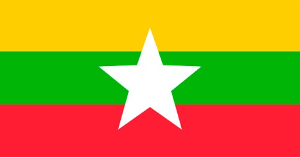
After thousands of Rohingya were leaving Myanmar on Wednesday and Thursday last week, army chief, Senior General Min Aung Hlaing stated that the Rohingya ‘were not native’ to Myanmar. According to him, they were rather left in only by the colonialists and they were originally Bengali. In his accounts, the general – most powerful person in Bugghist-majority Myanmar – claims that Rohingya insurgents’ attacks had triggered the situation. According to the UN human rights office, the military has been violently forcing out Rohingya to Bangladesh in recent weeks, and the “U.N. High Commissioner for Human Rights Zeid Ra‘ad al-Hussein has described the government operations as ‘a textbook example of ethnic cleansing’”. U.N. political affairs chief Jeffrey Feltman is scheduled to visit the country today. In the meantime, the EU is reportedly considering sanctions and cutting ties with the country if the situation does not improve. EU ambassadors have approved an agreement calling for the violence to end.
Bloomberg reported on Wednesday that the electoral commission of the DRC has announced that presidential elections are not to be held before April 2019, after they were already due to be held last year. President Joseph Kabila therein undermines the pact of him to step down in 2017, made with the political opposition. According to a senior opposition member “[t]he holding of elections has become a political tool of Mr. Kabila to distract the people,” and The Rassemblement opposition coalition “will ‘no longer recognize him as head of state’ after Dec. 31”.
On Tuesday, a Statement by the UN Security Council condemned the attacks by the Allied Democratic Forces (ADF) on 09 October in the North Kivu Province on a base of the United Nations Organization Stabilization Mission in the DRC (MONUSCO). The attack had led to the death of two Tanzanian peacekeepers and 18 further peacekeepers injured. Besides the attacks on MONUSCO, presumed ADF forces have ambushed a group of motorbiker, reportedly killing 20 civilians earlier on Sunday. On Thursday, News24 further reported on Rwandan rebels from the Democratic Forces for the Liberation of Rwanda (FDLR) killing 7 people including civilians and a police officer in the same province. At the same time, the International Committee of the Red Cross highlighted the urgent need for humanitarian assistance in the Kasai region. Seven international and Congolese human rights organizations urged the United States and the European Union to increase targeted sanctions on President Joseph Kabila’s family and financial associates who benefit from unlawful activity, reported Human Rights Watch on Tuesday.
Upcoming Sunday, Venezuelans will participate in state elections to vote for governors. The opposition already claims that the government is using tactics of manipulation, confusion and fear. According to recent polls, Maduro is deeply unpopular, but support for the opposition has also gone down. Whatever Sunday’s elections’ outcome will be, governors are expected to be subordinated to the government-controlled assembly, leaving little risk when allowing clean votes, “while gaining much from the optics” – possibly hoping to defuse international pressure and appease domestic opposition. While demand for travel documents is at a record high, many Venezuelans have been waiting for their passports to be renewed since new ones cannot be issued due to a lack of material, and have not been able to travel in the meantime. President Maduro has now signed an emergency decree to extent those passports’ validity. At the same time, Colombian authorities have already stated that the number of foreigners coming in to Cucuta has more than doubled this summer, though it does not reflect dual nationals returning or those crossing without passing official checkpoints. More Venezuelans than ever have decided to leave the country, many using the Simon Bolivar International Bridge towards Colombia.
While calls for Catalan independence continue, others have made statements against independence the independence of Catalonia as happened on Sunday during a march organized by the Catalan Civil Society, when people were waving Spanish, Catalan and EU flags together. On Thursday, many Spaniards also crowded the streets and displayed flags in Madrid and Barcelona to demonstrate Spanish unity on a National Holiday. However, Sunday as well as Thursday were marked by extremism and violent escalation. Tension remains high between the central government and Catalonia after Catalan government chief Puigdemont signed a symbolic declaration of independence on Tuesday, citing the results of the referendum from 01 October which had been declared illegal by Madrid. Prime Minister Rajoy has now given Puigdemont eight days to drop his push for independence. If the latter does not do so, Rajoy could use Article 155 of the constitution and impose rule from Madrid. As the Article has never been used before, uncertainty remains about what that could mean in practice.
The Islamic State (IS) has seen its territories decline throughout the last year, now falling back on territories in the Euphrates valley southeast of Deir al-Zor, writes Reuters. While the US-backed Syrian Defense Forces (SDF) have been preparing for “a final showdown with Islamic State”, the UN estimates up to 8,000 civilians to still be trapped in Raqqa. The Raqqa Civic Council has attempted to negotiate to release of civilians facing fear that the latter may be used as human shields. Raqqa is one of the IS’ last strongholds and has served as their de-facto Syrian capital since 2014. Reportedly, there has been a number of IS fighters surrendering in recent weeks. However, the SDF had already been predicted ahead of a major push in June, which has proven overly optimistic with militants holding out months until now.
On Thursday, IS suicide attackers staged a triple car bomb attack in Abu Fas, northeast Syria, killing at least 50 people among which were refugees fleeing the fighting in Deir-al Zor. On Wednesday, suicide bombers had detonated near the Damascus police headquarters, killing two people and leaving six wounded. Reuter reports of aid agencies warnings’ “the the fighting in eastern Syria is the worst in the country this year and that air strikes have caused hundreds of civilian casualties.”
The US announced its withdrawal from the United Nations Scientific and Cultural Organization (UNESCO), accusing the body of an ‘anti-Israel bias’. Heather Nauert, US state department spokesperson, announced on Thursday that the US would replace its representation there with an ‘observer mission’. Israel has also declared to prepare a withdrawal from UNESCO alongside the US. Among other reactions, Irina Bokova, the Director-General of the organization, lamented the US decision and stated that at times when “conflicts continue to tear apart societies across the world, it is deeply regrettable for the United States to withdraw from the United Nations agency promoting education for peace and protecting culture under attack,” she said.
Early this week, President Mugabe announced a Cabinet reshuffle where he dropped three ministers and reassigned ten others. The reconfiguration of Cabinet posts should be viewed in the light of ZANU-PF’s internal battle over Mugabe’s succession. President Mugabe “clipped under-fire Vice-President Mnangagwa’s wings” by taking away the Justice Ministry from him as well as demoting several of his affiliates. The post was re-administered to Happyton Bonyongwe, director-general of the Central Intelligence Organisation, which is still under strong hold of the President.
The Cabinet reshuffle included the creation of a new ‘Cyber-Ministry’, which pro-democracy groups and social media users fear will be used to suppress free speech following comments by Mugabe’s spokesperson. The new Ministry will “will help us in nailing those who do mischief using cyber space,” George Charamba told reporters at State House on Tuesday. The Presidential spokesperson also mentioned the fact that Mugabe learned a lot from Zimbabwe’s Eastern allies in this matter, such as China, Russia and Korea, as these countries “have done exceedingly well in terms of ensuring some kind of order and lawfulness in that area.”
Also this week, Zimbabwean activist and National Vendors Union leader Sten Zvorwadza was arrested for describing the ancient President of the country, Robert Mugabe as a dead man walking. Zvorwadza made the remark about the 93-year-old leader while he was commenting on the recent disturbance between authorities and vendors. Armed Zimbabwean police have arrested several vendors resisting moves by the government to remove them from the streets following an order by President Robert Mugabe to get rid of people selling various wares in public.
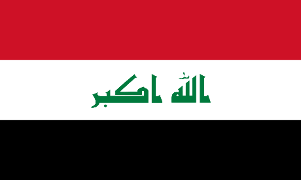
On Thursday, The Iraqi government stated that it would not hold talks with the Kurdish autonomous region on reopening its airports and providing dollars for its banks, unless the Kurds commit to “Iraq’s unity”. The flight-ban was imposed immediately after the September 25th referendum, in which a landslide majority voted in favor of independence. Among other measures to isolate the Kurdish region, Baghdad stopped selling dollars to four Kurdish-owned banks and called for a halt to its independent crude oil sales. Although the Kurdish representatives have called for negotiations many times since the independence-vote, Baghdad sticks to their position that the Kurds must disavow the referendum result as a pre-condition for any talks. In coordination with the Bagdad-regime, Turkey this week committed to gradually closing border gates with northern Iraq in response to the independence referendum in Iraq’s Kurdish region.
Reacting to the rising tension in the region, the two main roads connecting Erbil and Dohuk to Mosul were cut off on Thursday with sand embankments as a precautionary measure after Kurdish forces detected an increase in deployments and movements of Iraqi forces near the front line with the Peshmerga. According to Al Jazeera, the move came after Kurdish authorities on Wednesday claimed they feared Iraqi government forces and allied paramilitary units were preparing to launch an assault on the autonomous northern region.
Bolivia: Thousands of protestors marched in several cities throughout Bolivia to make a statement against President Evo Morales newest attempt to clear the way to run for a fourth term in 2019. – https://www.reuters.com/article/us-bolivia-politics-protests/bolivians-protest-morales-new-bid-to-extend-term-limits-idUSKBN1CG0BR?utm_source=34553&utm_medium=partner Morocco: Last Sunday, hundreds of people from all over Morocco protested in Casablanca and continued the wave of demonstrations which have been happening throughout the year. Protestors came out in support of jailed activists and in general solidarity with the Rif region, where protests had started last year. – https://www.alaraby.co.uk/english/news/2017/10/9/casablanca-protests-in-solidarity-with-jailed-rif-activists
Developing your goals and ‘Vision of Tomorrow‘ is one thing, focussing public attention to the underexposed issue you are fighting for might be as important. How does one bring attention to a public risk that affects millions of people?
In Greenpeace’s battle against nuclear energy, the organisation published a new report on the danger of fuel storage pools at nuclear facillities in France and Belgium. The report by independent experts, submitted to French and Belgium authorities earlier this week, questions the security of several nuclear facilities and points at their vulnerability to outside attacks. “While these pools can contain the highest volume of radioactive matter in a nuclear plant, they are very poorly protected,” according to Greenpeace. “Rather than wait for the worst to happen, let’s address this issue and take action.”
The report, however, was not the only action this week! Early on Thursday, Greenpeace activists broke through two security barriers at EDF’s Cattenom nuclear plant in northeast France, reaching the reactor’s nuclear zone to within a few tens of meters of the nuclear installations. Several activists launched fireworks inside the grounds of the French nuclear plant, to highlight the vulnerability of the plant to attacks. Using drones and on the ground activists to register their actions, the fireworks made it all over the news.
Greenpeace reports might only reach a secluded group of people, but the issues they report on concern a much wider audience. Getting their attention, even for a brief moment, is part of building a bigger movement, and mobilizing people for your Vision of Tomorrow.
For footage of the Greenpeace action, read the full Reuters-article here.
Photograph: Greenpeace Luxembourgh/Twitter
This website uses cookies to improve your experience. By closing this message, you consent to their use in accordance with our cookie policy, unless you have disabled them. ACCEPTRead More
Manage consent
Privacy Overview
This website uses cookies to improve your experience while you navigate through the website. Out of these, the cookies that are categorized as necessary are stored on your browser as they are essential for the working of basic functionalities of the website. We also use third-party cookies that help us analyze and understand how you use this website. These cookies will be stored in your browser only with your consent. You also have the option to opt-out of these cookies. But opting out of some of these cookies may affect your browsing experience.
Necessary cookies are absolutely essential for the website to function properly. This category only includes cookies that ensures basic functionalities and security features of the website. These cookies do not store any personal information.
Any cookies that may not be particularly necessary for the website to function and is used specifically to collect user personal data via analytics, ads, other embedded contents are termed as non-necessary cookies. It is mandatory to procure user consent prior to running these cookies on your website.